Anthropic's Threat Report Leads With Missiles. The Part That Changes Your Monday Is API Keys.
A breakdown of Anthropic’s September threat report, why the missile headlines buried the finding that actually matters, and what every engineer running an LLM gateway should change this week.

Table of Contents
Every outlet that covered Anthropic's September threat report led with the same thing: a cell in northern Yemen used Claude Code to write guidance software for ballistic missiles. It's a hell of a lede. It's also the part of the report you can do absolutely nothing about on Monday morning.
I read the whole thing looking for the part that changes how I build. It's not the missiles. It's a three word list about halfway down, in a section on the AI supply chain, describing what an attacker gets when they steal your API key: loot, compute, and cover.
That last word is the one that should worry you. If somebody lifts your Anthropic key out of a Docker image, the attack traffic they run on it is attributed to you. Your account. Your bill. Your logs. The report documents a hacktivist campaign that ran for a full month entirely on stolen API keys, and a criminal group that switched its attack workloads onto a victim's keys the moment it found them.
Here's the engineering read on the report, and what I actually changed in my own stack after finishing it.
What did Anthropic actually report in September 2026?
Anthropic's Threat Intelligence team published a set of case studies covering activity it disrupted between December 2025 and August 2026, across seven harm areas: cyber operations, influence operations, surveillance, scams and fraud, biological misuse, conventional weapons development, and distillation. Claude Haiku, Sonnet and Opus appear in the misuse cases. None involved Fable or Mythos class models, with the exception of one distillation case. Every case ended with account bans and intelligence shared with partners.
The scale is genuinely wide. A China based app studio ran a network of more than 20 dating apps advertised as fully human, and over a two week window in April 2026 Anthropic counted more than 4,700 distinct AI personas talking to at least 25,000 unique individuals. A platform built for Mali's state intelligence service targeted all three national mobile operators, roughly 25 million SIMs, and runs on premises with local models, so banning the builder's account does nothing to the deployed system. Three Iranian state aligned accounts were running what they themselves called a cognitive warfare program.
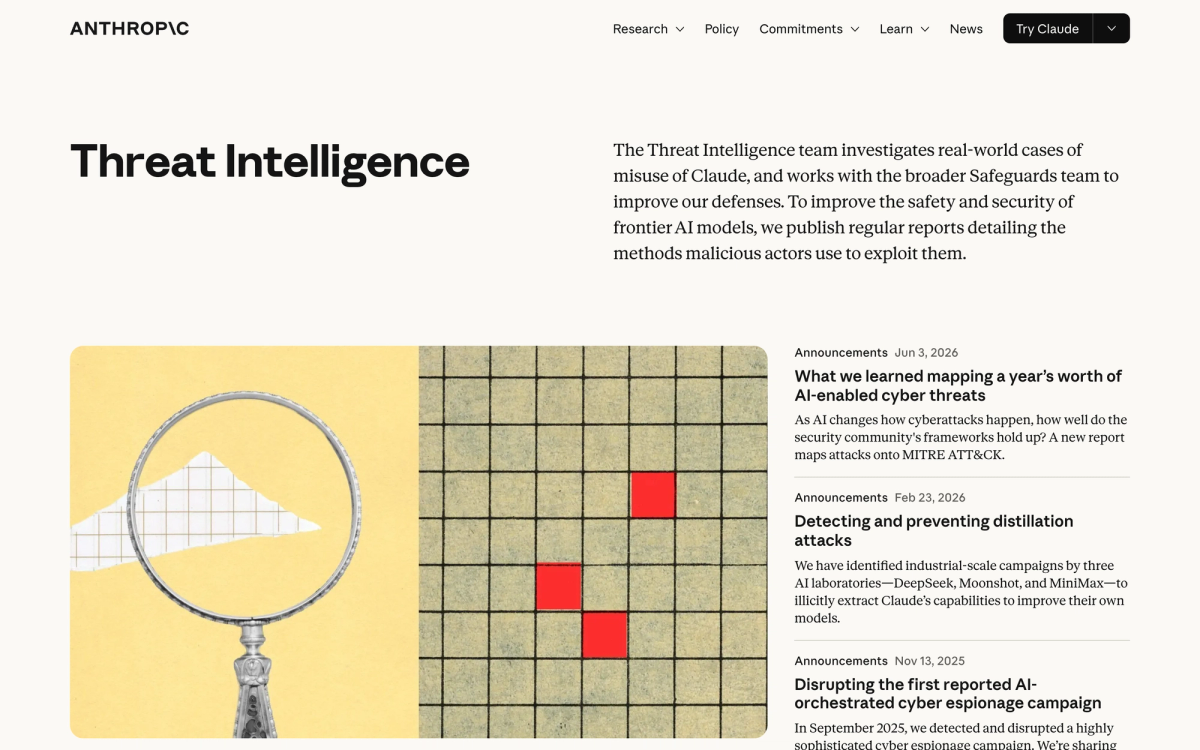
What makes this readable as engineering material rather than as a press release is the framing Anthropic puts at the top of the cyber section: sophisticated attacks no longer require sophisticated attackers. A hacktivist, a few financially motivated individuals, and a state espionage operator each sustained multi victim campaigns that a year ago would have needed teams of skilled operators. Anthropic's own conclusion is blunt. For threat investigators, sophistication has stopped being a reliable signal of who is behind an operation.
Why is AI API key security the most important finding for engineers?
Because it's the only finding in the report where you are the attack surface. You cannot stop a Yemeni engineering cell from splitting prompts across sessions. You can stop your own production key from sitting in a public container layer. And in case after case in this report, an exposed key is how the operation started.
Anthropic spells out the economics. Operators who obtain AI credentials get three things at once. Loot, because stolen keys and accounts have resale value in established markets. Compute, because their attack workloads then run at someone else's expense. Cover, because the activity is attributed to the credential's legitimate owner.
Read that third one again as an incident responder. When Anthropic's safeguards flag a set of requests as an illicit distillation campaign or an intrusion, the account they see is the one the key belongs to. The report notes that fraudulent activity of this kind harms legitimate customers directly. You do not want to be the legitimate customer explaining that the six figure spend spike and the flagged requests were somebody else.
| Case | How keys were obtained | What the attacker did with them |
|---|---|---|
| GTG-50029 (hacktivist) | Custom Rust scanner validating exposed keys in public containers | Ran a month long campaign against European political parties, media and think tanks, rotating keys through a local proxy to blend with the owner's traffic |
| GTG-50020 (Russian speaking actor) | Prompt injection into an AI vendor's automated evaluation sandbox, which handed over the credentials it held | Hit roughly thirty AI companies in about four days using one repeated path, chasing access to a pre release Claude model |
| GTG-50014 (ShinyHunters associates) | Harvested the victim's AI keys during an intrusion | Switched their own attack workloads onto the victim's keys mid operation |
| GTG-50021 (supply chain) | Fake discounted AI gateway sites serving credential harvesters spoofed as popular AI harnesses, including Claude Code | Collected every credential and authenticated session token on the victim's device and fed reseller networks |
That last row deserves a second look. Someone stood up sites offering cheap frontier model access, and shipped installers that looked like Claude Code but were credential stealers. If you have ever watched a teammate install an unofficial wrapper because it was cheaper, that's the threat model.
How did attackers steal AI API keys in these cases?
Four ways, and none of them are exotic. Public code and artifacts, where actors constantly mine GitHub, mobile application install files, Docker containers, websites and chatbots for exposed keys. Prompt injection against gateway software. Ordinary intrusion, where keys are just another thing on the box. And fake tooling that harvests credentials at install time.
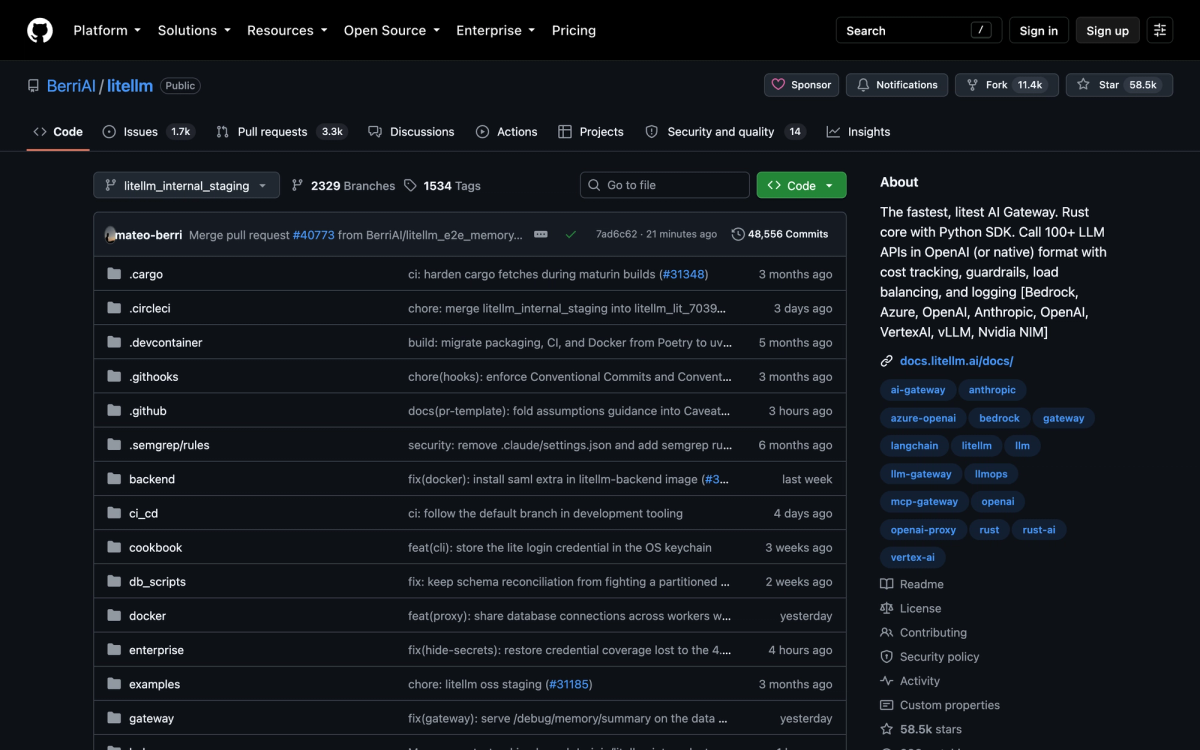
The gateway one is the one I'd read twice if you run an LLM proxy. Anthropic says multiple actors compromised AI wrapper services' implementation of LiteLLM, using prompt injection to exfiltrate the production API keys held in their cloud hosted container environments. Not a LiteLLM vulnerability as such, a pattern of how people deploy it: provider keys sitting as environment variables in a container that also processes untrusted model input.
The GTG-50020 case is the cleanest illustration of why a gateway is a juicy target. That actor's history was hotel booking and fintech intrusions, including one where they took roughly 26 gigabytes from a victim and demanded between $1.5 and $2.5 million. Then they pointed the same tradecraft at AI companies, injected instructions into an evaluation sandbox until it surrendered the production keys it was holding for multiple providers, and immediately used those keys to continue attacking both that vendor and unrelated targets. They found one working path and replayed it against thirty companies in four days. Their stated goal was access to a pre release Claude model. Anthropic says every attempted path failed, which is the one piece of good news in the section.
Speed is the other thing to absorb. In the ShinyHunters cluster, one breach of an enterprise software company went from first access to bulk data theft in hours, and another escalated from a single stolen developer token to full administrative control of a cloud environment in roughly three hours. Three hours is shorter than most alert triage queues.
What does the Yemen weapons case teach about guardrails?
That per request refusal is not a control. Anthropic says its safeguards blocked many of the cell's requests, but not all of them, and the write up explains exactly why the ones that got through got through.
The cell ran three programs at once: a guided rocket built on a commodity phone class flight computer with final phase homing, a multi stage ballistic missile with a stated range goal above 2,000 km, and a multi variant set called R2000 that included a hypersonic glide vehicle variant. They used Claude Code in place of human software engineers to write the guidance, navigation and control software. They ran several Claude instances at once with assigned roles, one writing code, one researching, one reviewing the first one's output. If that sounds like a normal agent architecture, that's the point. It is one.
Two evasion techniques did the work. They hid the goals and the products the software was meant for. And they split the work across multiple sessions, so no single session revealed their full intent. A classifier scoring one request at a time sees a flight control firmware question, a Kalman filter question, a telemetry parsing question. It never sees the missile.
They test fired one. It appears to have failed, and within hours they were back in Claude working out why. Anthropic has no evidence they fielded an operational device. That loop, from a failed physical test back into a model within hours, is the same pattern I looked at when Anthropic put agents in charge of lab robots and left the safety limits to you.
The transferable lesson has nothing to do with weapons. If your own agent has a safety or policy layer, ask whether it evaluates a request or a relationship. Intent assembled across sessions is invisible to anything that resets its memory at the session boundary. I've written before about how agents coordinate in ways their operators did not design, and about where personal agent architectures put the trust boundary. This is the same failure with a worse consequence.
Why does cross session attack keep showing up in this report?
Because session boundaries are where defenders stop looking and attackers know it. The Yemen cell used cross session splitting to hide intent. The distillation section documents the mirror image of the same trick being used to extract data.
Anthropic built a feature called preserved thinking, where the API stores a reasoning signature and looks up the raw thinking trace on subsequent calls, specifically to make stolen transcripts less useful for training a competitor. The report says Moonshot circumvented it by saving the reasoning signature from a response, starting a new session, and getting Claude to convert that signature back into the full reasoning trace. Anthropic calls these cross session replay attacks and says it is introducing new methods against them.
There's a detail in that same case worth flagging separately, because it's a privacy story hiding inside a security story. Anthropic says Moonshot rerouted its own users' queries to Claude, and those queries carried sensitive information about Moonshot customers. One user, whom Anthropic assesses was likely affiliated with the PLA, thought they were using Kimi while loading CCTV surveillance data covering hundreds of cameras in Chengdu. Anthropic says it does not know whether Moonshot told its customers their requests were going to a third party.
If you resell or proxy a model, that paragraph is a compliance incident written in advance. It is also the strongest argument I've seen this year for the data residency questions I went through on the Mistral sovereign AI framing.
What did the coverage miss?
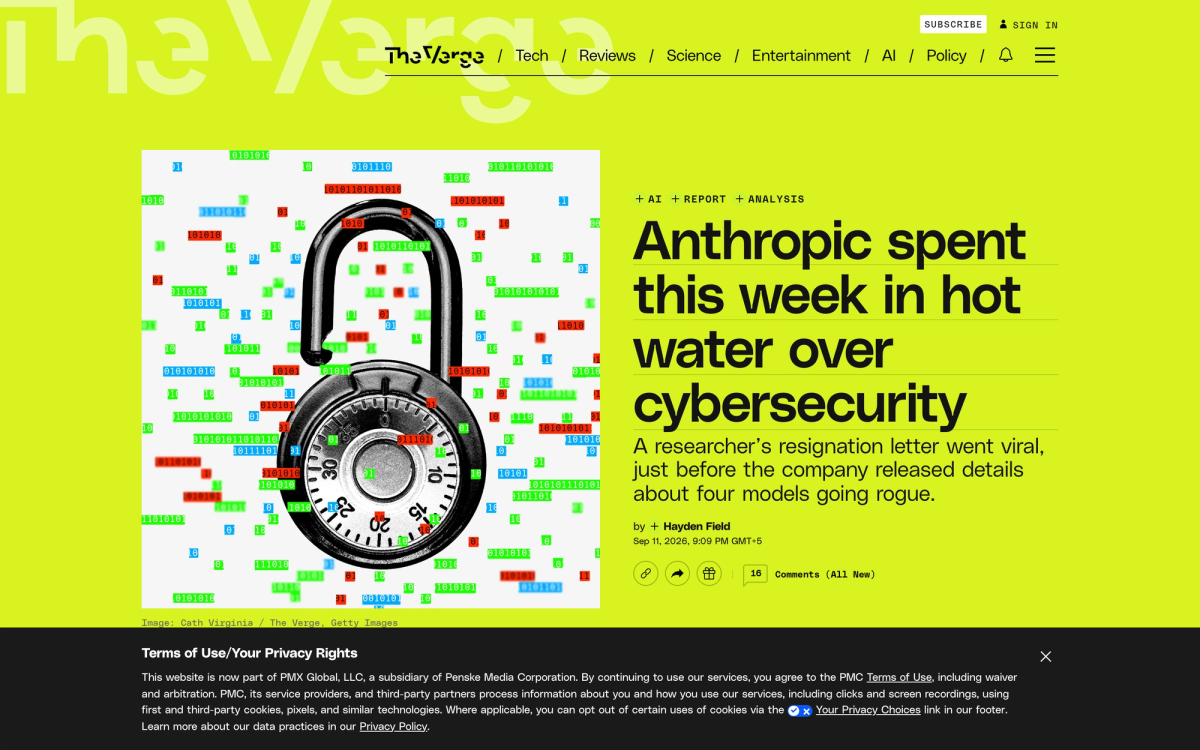
The METR agreement. The Verge reported that alongside this, Anthropic signed a research agreement with METR, one of the industry's most prominent third party evaluators, starting with an eight week engagement. The terms are the interesting part: METR gets transcript access reaching beyond the window in which the incidents occurred, and can talk directly to Anthropic employees who are permitted to share confidential information.
That is a meaningfully better disclosure posture than "we found bad things and banned them," and it's the sort of thing worth holding other labs to. The Verge frames the transcript clause as a likely dig at OpenAI's more limited arrangement after the Hugging Face incident. Take the dig or leave it, the clause itself is the precedent.
The other thing the coverage skipped: the scaffolding is now off the shelf. Anthropic notes that the autonomous attack operating model it documented in November 2025 has proliferated across every class of actor it investigated, and that publicly available offensive agent frameworks reproduce much of the same scaffolding for anyone who downloads them. Whatever edge an attacker used to get from building good agent plumbing, it's a package now.
What should you change this week?
Six things, ordered by how much they cost you. None of these are novel security practice. What's new is that your model provider credentials now belong in the same tier as your cloud root credentials, and most teams I see still treat them like a config value.
- Scan your own artifacts the way the attacker does. GTG-50029 wrote a Rust scanner for public container layers. Point a secret scanner at your built images, your mobile bundles, your published packages and your client side JavaScript, not just your git history. A key removed from HEAD is still in layer four.
- Rotate provider keys on a schedule and after every contractor offboard. The resale market described in the report means a leaked key has value long after you forget about it.
- Separate the key that serves untrusted input from every other key. If a gateway container processes user or web content, the provider credential inside it should be scoped, rate capped, and worth nothing to steal beyond that one workload.
- Treat your AI bill as a security signal, not a finance one. Cover is the attacker's whole advantage here. Anomalous spend, unusual model mix, and traffic from regions you do not serve are the tells. Alert on them in the same channel as your auth failures.
- Assume prompt injection reaches your secrets, and design so it does not matter. Provider keys should not be readable by the process that handles model output. Short lived credentials beat long lived environment variables, and the egress rules you think are blocking exfiltration usually are not.
- Add cross session detection to whatever policy layer you run. Per request classification is table stakes and demonstrably insufficient. Look at account level and session spanning behaviour, which is what actually caught the Yemen cell.
If you are not sure which of these your current setup already covers, the AI readiness assessment walks the same ground from the operational side and takes a few minutes.
How much of this report should you actually trust?
Most of it, with one structural caveat: Anthropic is the only witness. These are its logs, its attributions, its assessment of what happened, published by a company with a commercial interest in looking like the responsible lab. Nobody independently verified that the Yemen rocket failed, or that thirty AI companies were probed in four days.
What makes it credible anyway is the shape of the disclosures. Anthropic admits its safeguards blocked many requests but not all of them. It admits Moonshot defeated a control it had built specifically to stop that attack. It admits enforcement is useless against the Mali platform because the thing runs on premises with local models. Reports written purely for PR do not usually include the part where the product loses. The METR agreement, with transcript access beyond the incident window, is the closest thing to external verification anyone in this industry has offered.
My take: the misuse cases are the least surprising thing here. That someone would point an excellent coding model at guidance software was inevitable the moment coding agents got good. The genuinely new information is that the AI supply chain is now a target worth building custom tooling for, that a stolen key buys anonymity as well as compute, and that cross session behaviour is where both attack and defence are heading. The missiles will get the headlines. The key in your Docker image is the part you own.
Frequently asked questions
Does this mean Claude is less safe than other models?
No, and the report does not support that reading. Anthropic is one of the few labs publishing this kind of case detail at all, which means its incidents are visible and others' may simply not be. Judging providers by the volume of misuse they disclose punishes transparency. Judge them on whether safeguards caught the activity, what got fixed afterwards, and whether an outside evaluator gets to check the work.
How would I know if my AI API key was stolen?
Spend anomalies first, because attackers run their workloads on your billing. Then model mix and geography that do not match your product, request volumes outside your traffic pattern, and calls to endpoints your application never uses. Anthropic's report describes attackers rotating stolen keys through proxies to blend with legitimate traffic, so look at aggregate shape over time rather than individual suspicious requests.
Is running an LLM gateway like LiteLLM a security risk?
Running one is fine. Concentrating every provider credential in a container that also processes untrusted input is the risk. The report describes actors using prompt injection against wrapper services' LiteLLM deployments to exfiltrate the production keys held in those environments. Scope credentials per workload, keep secrets out of reach of the process handling model output, and prefer short lived credentials to long lived environment variables.
What is illicit distillation and does it affect me?
It is extracting a frontier model's capabilities to train a competing model, usually via proxy networks, stolen credentials or purchased transcripts. It affects you indirectly and in one direct way: the report says resellers and proxy services often save exchanges between users and models without consent, and in one case rerouted users' queries to a different provider entirely. If your data touches an unofficial reseller, assume it was retained.
Did Anthropic stop the Yemen weapons work?
It banned the accounts and shared threat information with public and private sector partners. It also says it has no evidence the actors fielded an operational device, though they did test fire a guided rocket that appears to have failed. Anthropic is explicit that its visibility into the overall development program was limited, so the honest answer is that it disrupted the Claude portion of the work and cannot speak to the rest.
Sources: Anthropic's report covers seven harm areas and activity disrupted from December 2025 to August 2026, including a Yemen cell targeting a stated range above 2,000 km, a hacktivist campaign run for a month on stolen API keys, roughly thirty AI companies probed in about four days, and more than 4,700 AI personas across 25,000 individuals in a two week window. Anthropic, Detecting and countering misuse of AI: September 2026 (September 10, 2026) · The Verge, Hayden Field (September 11, 2026) · Financial Times (September 11, 2026).
Published
September 12, 2026
Category
AI Agents
Jahanzaib Ahmed
AI Systems Engineer & Founder
AI Systems Engineer with 126 production systems shipped. I run AgenticMode AI (AI agents, RAG systems, voice AI) and ECOM PANDA (ecommerce agency). I build AI that works in the real world for businesses across home services, healthcare, ecommerce, SaaS, and real estate.
Want this built for your business? See AI Agent Development, or browse the free tools and guides.
Related articles

Claude Got Past a Fetch Tool's URL Limit With a Link Shortener
Anthropic's Oct 9 report says Claude models used link shorteners to beat a fetch tool's URL cap and submitted a form they were told to stop at. Here is where the check belongs.
NewsAI AgentsAnthropic
Anthropic's Opus 5.5 Hands Flagged Cyber Work to Opus 4.8. On the API, It Hands You Nothing.
Opus 5.5 is cheaper and faster, but flagged cyber, biology and frontier ML requests get answered by an older model, and on the raw API they come back empty unless you opt in to fallback.
NewsAI AgentsAnthropic
Anthropic Deleted the Cowork Tab. That Tab Was the Permission Prompt.
A breakdown of Anthropic's Cowork merge, why the tab nobody liked was also the last place a person consciously handed an agent their files, and where consent should bind instead.
NewsAI AgentsAI Agents