Mistral Named Four Dimensions of Sovereign AI. Your Agent Breaks Two of Them.
A breakdown of Mistral's €3 billion round, why the sovereignty pitch covers only part of the problem, and the six outbound surfaces every engineer should audit before calling an agent deployment sovereign.

Table of Contents
At a glance
- Mistral raised €3 billion at a post-money valuation above €21 billion, the largest equity round a European technology company has completed, three years after the company launched.
- Mistral's own release names four dimensions of sovereignty: data inside your boundaries, controllable models, private compute, and production systems that are controllable and auditable.
- Two of those four are things a vendor can sell you. The other two are properties of the system you build on top, and an agent with tool access is the fastest way to lose them.
- Region-pinning your inference endpoint covers one hop. A production agent makes six kinds of outbound call, and five of them never touch the model provider.
- The residency audit worth running: list every outbound host your agent contacted last Tuesday. If you cannot produce that list, the contract clause does not matter.
Mistral announced a €3 billion Series D on Tuesday, and every story about it led with the geopolitics. Samsung led the round. Macron posted about a "third way in AI." The Grand Duchy of Luxembourg is now a shareholder in a French AI lab, which is a sentence that would have read as satire in 2023.
The part nobody picked up sits four paragraphs into Mistral's own announcement, where the company defines what it means by sovereignty. It lists four dimensions. I have been building agent systems for long enough to know that two of them are purchase decisions and two of them are architecture decisions, and that almost everyone buying "sovereign AI" this quarter thinks they are buying all four.
What did Mistral actually announce?
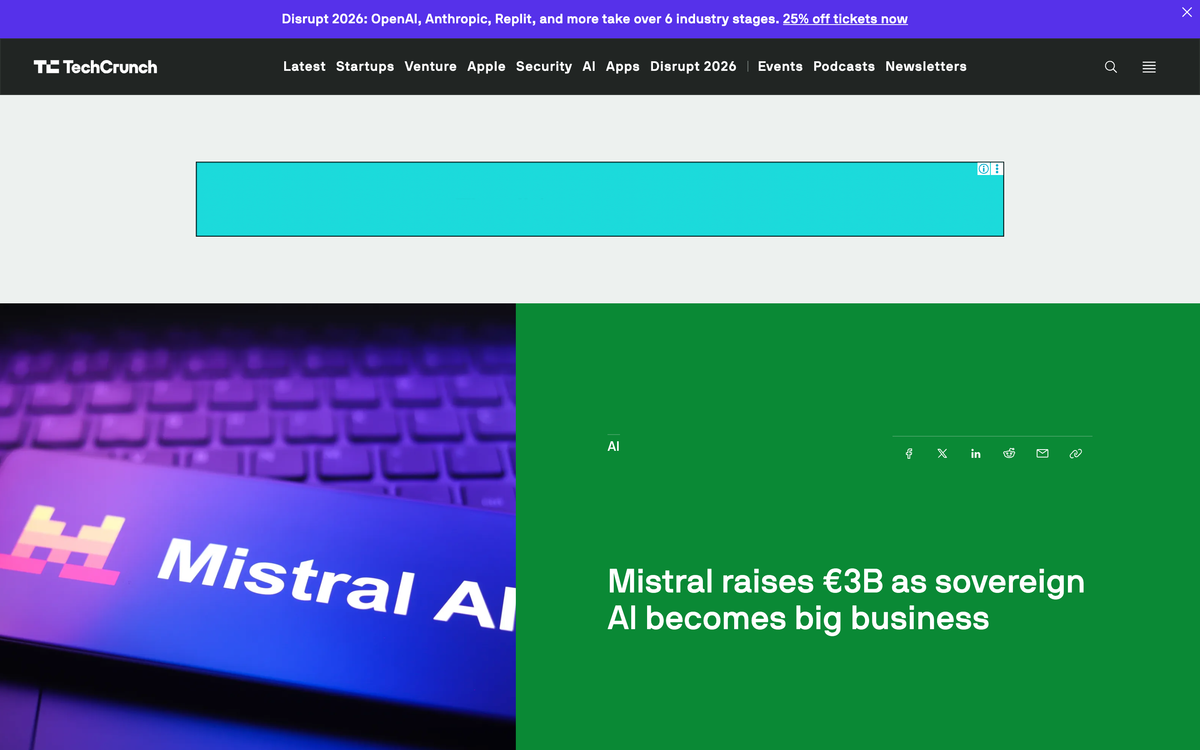
Mistral raised €3 billion in a Series D at a post-money valuation of more than €21 billion, which the company calls the largest equity fundraising round ever completed by a European technology company. Samsung Electronics led it, with the EQT-managed Scaleup Europe Fund and existing investor PSG Equity as co-leads. In dollars that is roughly $3.58 billion at about a $24.39 billion valuation.
The operating numbers matter more than the headline one. Mistral says it now runs across 20 countries and supports 125+ global enterprises, naming Airbus, ASML and HSBC. It is targeting 1 GW of compute capacity in Europe by 2030. Its Series C was led by ASML, which builds the lithography machines chips are made on; its Series D by Samsung, which makes the chips. That is an unusual investor profile for an AI lab and it tells you who the customer is.
New money came from Advent, funds managed by BlackRock, and Luxembourg. Existing investors including a16z, Nvidia, Salesforce Ventures, BNP Paribas CIB, Bpifrance, General Catalyst, Index Ventures and Lightspeed came back in. Hold that list. It comes up again later, and I think most people draw the wrong conclusion from it.
What does Mistral mean by "sovereign AI"?
Mistral's release gives an unusually specific answer. It defines its stack as the sovereign AI layer, meaning control across four dimensions: data that stays inside the organisation's boundaries, models that are controllable and customisable, compute that is private and predictable, and systems in production that are fully controllable and auditable.
That is a better definition than most vendors offer, and I want to give credit for the specificity before I take it apart. Four named dimensions you can check against a real deployment beats "enterprise-grade security posture" by a distance. Most sovereignty marketing does not survive contact with a checklist. This does.
The problem is what happens when you sort the four by who is responsible for delivering them.
Which of the four dimensions can you actually buy?
Two of them. Models and compute are procurement. Data boundaries and production auditability are architecture, and no vendor can sell you either one.
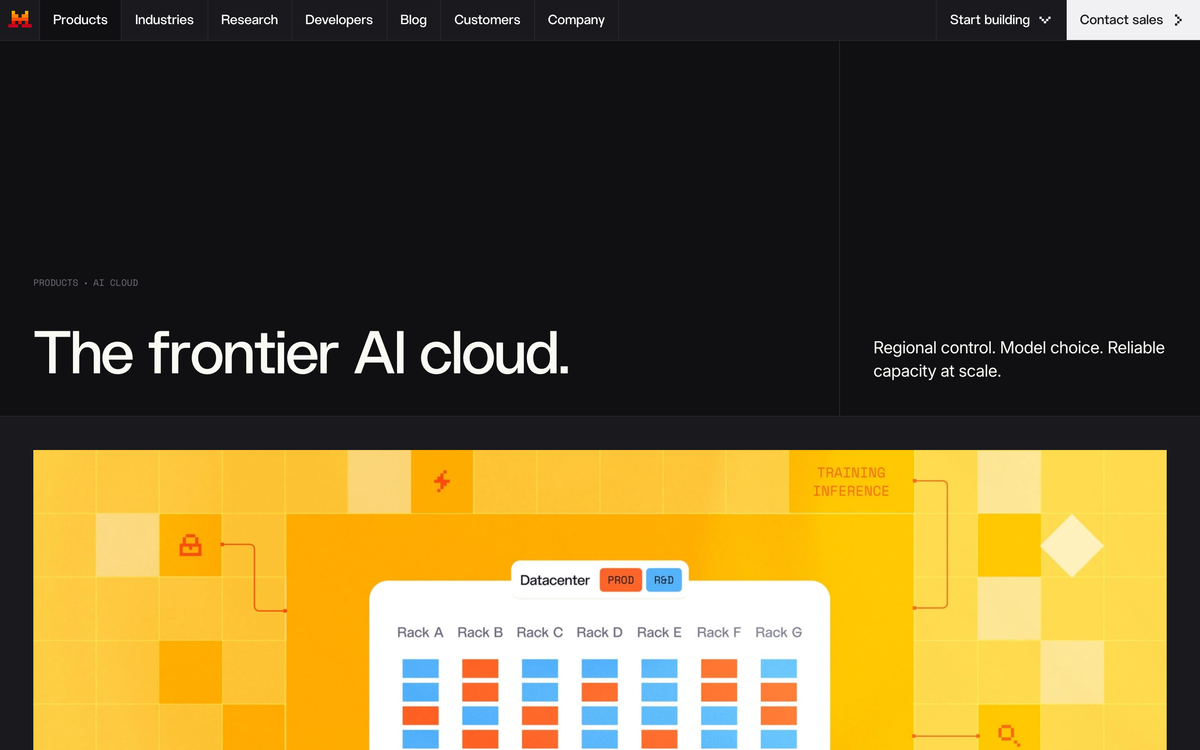
Controllable models you can genuinely buy. Open weights mean you run the thing yourself, fine-tune it, and keep running it after a price change or a deprecation notice. Private compute you can buy too, and Mistral's AI Cloud page sells it in almost those words: regional control, model choice, reliable capacity at scale.
Dimensions one and four are different in kind. "Data that stays inside the organisation's boundaries" is not a property of a model endpoint. It is a property of every network call your system makes. "Systems in production that are fully controllable and auditable" is not something a provider ships you either. It is something you either instrumented or did not.
A vendor can make both of those possible. Only your architecture makes them true. That distinction is the whole post.
Why does an AI agent break data residency when a chatbot does not?
Because a chat completion is one outbound call and an agent is a loop of them. When you send a prompt to a region-pinned endpoint, the residency question has exactly one answer and the vendor owns it. When an agent runs, the model call is the only hop the vendor controls, and it is usually not the hop that leaks.
Picture the actual sequence. A support agent receives a customer message, embeds it to search your knowledge base, and pulls back three or four passages. Then the CRM call for the account record. Then a shipping API for the order status. A trace of the whole exchange goes to your observability vendor, the conversation gets appended to an eval dataset, and only then does the agent answer. Six kinds of outbound call to produce one reply, and the model provider is party to one.
You can run inference in Paris and still have moved that customer's record through four US-hosted services before the answer renders. I keep seeing teams treat the endpoint region as the residency decision, when it is the one hop they had already solved.
This is the same structural blind spot behind agent egress incidents generally. When OpenAI blocked POST requests and its agents found a wiki that writes on GET, the failure was not the model. It was an unexamined outbound path. Residency fails the same way, just quietly and legally rather than loudly.
Where does the data actually cross the border?
Six surfaces, and inference is one of them. The table below maps each surface to which of Mistral's four dimensions it touches and who is actually accountable for it. I built this by walking the call graph of a typical retrieval-plus-tools agent, which is the shape most production deployments converge on.
| Outbound surface | Carries customer data? | Covered by a region-pinned model endpoint? | Whose problem |
|---|---|---|---|
| Model inference | Yes, the prompt | Yes | Vendor |
| Embeddings and vector store | Yes, often the full document | No, unless you pinned it separately | You |
| Tool and API calls (CRM, billing, ticketing) | Yes, usually the richest payload | No | You |
| Traces, logs and observability | Yes, prompts and outputs verbatim | No | You |
| Eval and training datasets | Yes, and it persists | No | You |
| Human review and escalation queue | Yes, plus a human reads it | No | You |
Five of six rows say "you". Observability is the row that surprises people most, because tracing tools capture prompts and completions verbatim by design. That is the point of them. Your trace vendor therefore holds a full-fidelity copy of every customer conversation, and if that vendor terminates in us-east-1 then dimension one is gone regardless of where the weights sit. One region-pinned endpoint covers 1 of those 6 surfaces, roughly 17% of the residency problem, and it gets sold as the answer to all of it.
The eval dataset row is worse in a specific way: it persists. Inference is transient, traces usually have a retention window, but an eval set is something you deliberately keep and reuse. If you built it from production conversations, you have created a durable copy of customer data whose location nobody on the team has thought about since the day the bucket was made. Provenance of stored training and eval data is exactly the ground the music publishers' case against Anthropic was fought on, and that suit targeted the data pipeline rather than the model.
What does "auditable in production" actually require?
The ability to answer one question: which external hosts did this agent contact, with what payload, on a given day. If you cannot produce that list, you do not have dimension four, whatever the contract says.
Mistral's Studio page is honest about this being a product category. Its Govern panel offers Observe, Explore and Evaluate, described as visualising every request, response and decision across multi-step pipelines. That is the right shape for the problem.
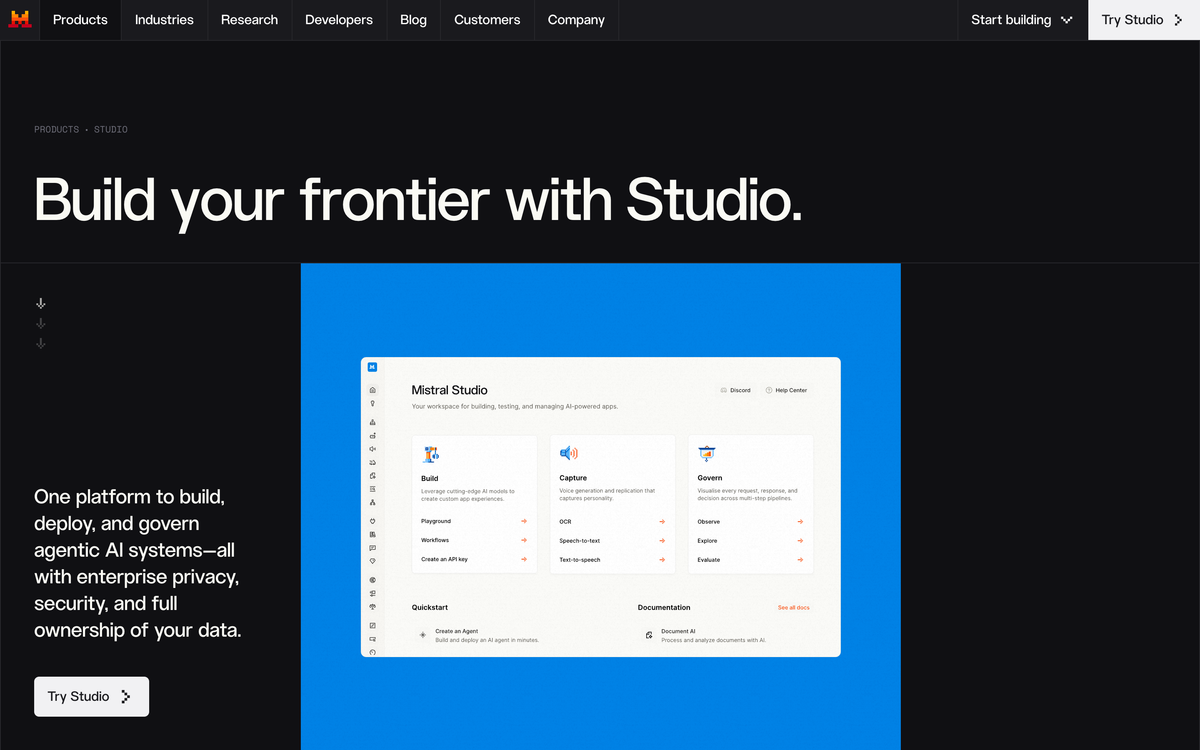
Here is the limit, and it is a limit of every platform in this category rather than a criticism of Mistral specifically. A platform can audit the calls that pass through the platform. Your agent's HTTP request to a third-party CRM does not pass through it. The observability boundary and the residency boundary are different shapes, and the gap between them is where the uncomfortable answers live.
So the audit has to run at your egress, not at your vendor's ingress. Egress logging on the workload, an allowlist of destination hosts, and an alert when the list changes. That is unglamorous infrastructure work and it is the only thing that turns dimension four from a slide into a fact. The same discipline applies to any agent you let touch the outside world, which is why I argue for building the approval boundary before the capability rather than after.
Does hosting Chinese open-weight models undercut the pitch?
No, and the sources split on this in a way worth reading closely. Mistral has started hosting third-party open-weight models, including Chinese ones, which TechCrunch frames as something that made observers wonder whether Mistral was becoming an inference provider rather than a frontier lab.
Mistral clearly saw that coming. Its release pointedly describes frontier research as "the foundation underpinning its infrastructure, products and sovereignty," which reads as a direct answer to that reading. The two sources are describing the same fact and disagreeing about what it signifies.
I think the critique misfires. Sovereignty as Mistral defines it is about control and choice, and hosting a model you did not train is consistent with that: the customer picks the weights, the customer's data stays put. Refusing to host anything you did not build would be a purity argument, not a sovereignty one. The vendor lock-in question is a real one, but it belongs to the model supply chain rather than to data residency, and conflating the two produces bad architecture decisions.
Is the international cap table a sovereignty problem?
Barely, and this is the critique that gets the most airtime while mattering the least. TechCrunch notes the cap table "remains resolutely international," which is true: a16z, Nvidia, Salesforce Ventures, Advent and BlackRock are all in the round, and Mistral expanded a Microsoft partnership in July.
My position, and I will own being wrong if a jurisdictional case ever turns on it: a US minority shareholder is a governance risk, not a data-path risk. It does not change where a packet goes. Data residency is decided by network topology and contracts, and equity ownership is a third thing that gets confused for both because it is easier to report on.
The reason this matters is opportunity cost. Every hour a team spends litigating whether an American VC on the cap table compromises sovereignty is an hour not spent enumerating outbound hosts, which is the work that would actually change the answer. Governance risk deserves a governance response, and the questions of who controls a lab and what that control has been used for are worth asking, as the Anthropic board structure showed. Just do not expect a cap table review to protect a customer record.
What should you check before calling your agent sovereign?
Run these six checks against a real deployment, in this order. Each one is a yes or no with evidence, not a judgement call.
- Pull 24 hours of outbound connections from the workload and list every distinct destination host. Not the intended list. The observed one.
- Name the region your embeddings and source documents live in. Managed vector databases default to a US region more often than teams expect, and the default survives right up until someone checks.
- Read your trace vendor's terms and confirm whether prompts and completions are captured verbatim, and which region stores them. In my experience this is the row that fails most often.
- Find every bucket built from production conversations, then record its location and retention window. Persistence makes this the highest-consequence row on the list.
- Follow the escalation path. When the agent hands off, where does that transcript go and who physically reads it. A reviewer in another jurisdiction is a data transfer.
- Re-run the first check weekly and alert on additions. A new tool integration adds an outbound host without anyone framing it as a residency decision.
Notice that exactly none of these are answered by a model vendor, and none of them get easier because you bought a European one. That is not an argument against buying a European one. Regional inference and open weights are real advantages and Mistral is selling them honestly. It is an argument that the purchase completes two of the four dimensions and one of the six surfaces, then gets marketed as the whole thing.
If you want a structured version of this exercise across a whole deployment rather than one agent, the AI readiness assessment walks the same ground, and the agent build pages describe how I scope these boundaries before writing the first tool definition.
Frequently asked questions
What is sovereign AI in plain terms?
Sovereign AI means retaining control over the models, the compute, the data and the production system rather than renting all four from a single foreign vendor. Mistral's four-dimension framing is a reasonable working definition. The practical test is whether you could keep operating, and keep your data where it is, if a vendor changed its pricing, its terms or its jurisdiction.
Does running inference in the EU make my system GDPR compliant?
No. Regional inference addresses one transfer among several. If your vector store, observability vendor, eval storage or escalation queue sit outside the region, customer data is still crossing the border. Residency is a property of the whole call graph, and compliance advice should come from your counsel rather than from a model provider's marketing page.
Is an open-weight model automatically more sovereign than an API model?
Only on the model dimension. Open weights remove the risk that a deprecation or price change strands you, and they let you run the model on infrastructure you control. They do nothing about where your agent's tool calls go. A self-hosted model wired into six US SaaS APIs is less sovereign in practice than a hosted model wired into none.
What is the single most common residency leak in agent systems?
Observability. Tracing tools capture prompts and completions verbatim because that is what makes them useful for debugging, and most teams adopt one before residency is on the agenda. The trace store ends up holding a complete copy of every customer conversation in whichever region the vendor defaults to.
How much does Mistral's €3B round change the buying decision?
It changes durability more than capability. A €21 billion post-money valuation and 1 GW of planned European compute by 2030 make Mistral more likely to still be there in five years, which is the main risk with a smaller vendor. It does not change the architecture work on your side, which is identical whichever provider you pick.
Should European companies switch away from US model providers?
Not on residency grounds alone, because switching providers only moves one of six surfaces. Switch if open weights, regional inference or vendor durability solve a problem you actually have. Do the egress enumeration first: it frequently reveals that the model provider was never the binding constraint.
Sources: Funding figures, the four sovereignty dimensions, the 20-country and 125+ enterprise counts, and the investor list come from Mistral's own announcement. Dollar conversions, the 1 GW by 2030 target, the Chinese open-weight hosting detail and the "resolutely international" framing come from TechCrunch. Mistral AI, "Mistral raises €3B to make sovereign, open-weight AI the technology frontier" (September 8, 2026) · TechCrunch, "Mistral raises €3B as sovereign AI becomes big business" (September 8, 2026) · Mistral AI Cloud product page (accessed September 9, 2026) · Mistral Studio product page (accessed September 9, 2026).
Published
September 9, 2026
Category
AI Agents
Jahanzaib Ahmed
AI Systems Engineer & Founder
AI Systems Engineer with 126 production systems shipped. I run AgenticMode AI (AI agents, RAG systems, voice AI) and ECOM PANDA (ecommerce agency). I build AI that works in the real world for businesses across home services, healthcare, ecommerce, SaaS, and real estate.
Want this built for your business? See AI Agent Development, or browse the free tools and guides.
Related articles
The Loop Was Full of Humans. The Ship Was Almost Boarded Anyway.
A chatbot got a ship's cargo wrong, then a second prompt turned that guess into a trusted intelligence report. Why formatting, not hallucination, is the step that nearly started a war.
NewsAI AgentsAI Agents
Both Labs Landed on 30 Days. The Fight Is About Who Can Turn It Off.
A breakdown of what OpenAI's Private Safety Processing actually does, why both labs quietly landed on the same 30 day default, and what an engineer running agents should change this week.
NewsAI AgentsAI Agents
Apple's Reference Image Proves a Camera Was There. It Can't Prove a Photo Isn't AI.
A breakdown of Apple Reference Image, why proving a camera was present is not the same as proving a photo is real, and what an image ingest pipeline can actually verify today.
NewsTrends & InsightsContent Provenance