Best Virtual Receptionist for Law Firms (Australia, 2026): What I'd Pick After Building 126 AI Systems
An engineer's comparison of every virtual receptionist option for Australian law firms in 2026, including human services, AI platforms, hybrids, and custom builds. Plus the decision framework most guides skip.

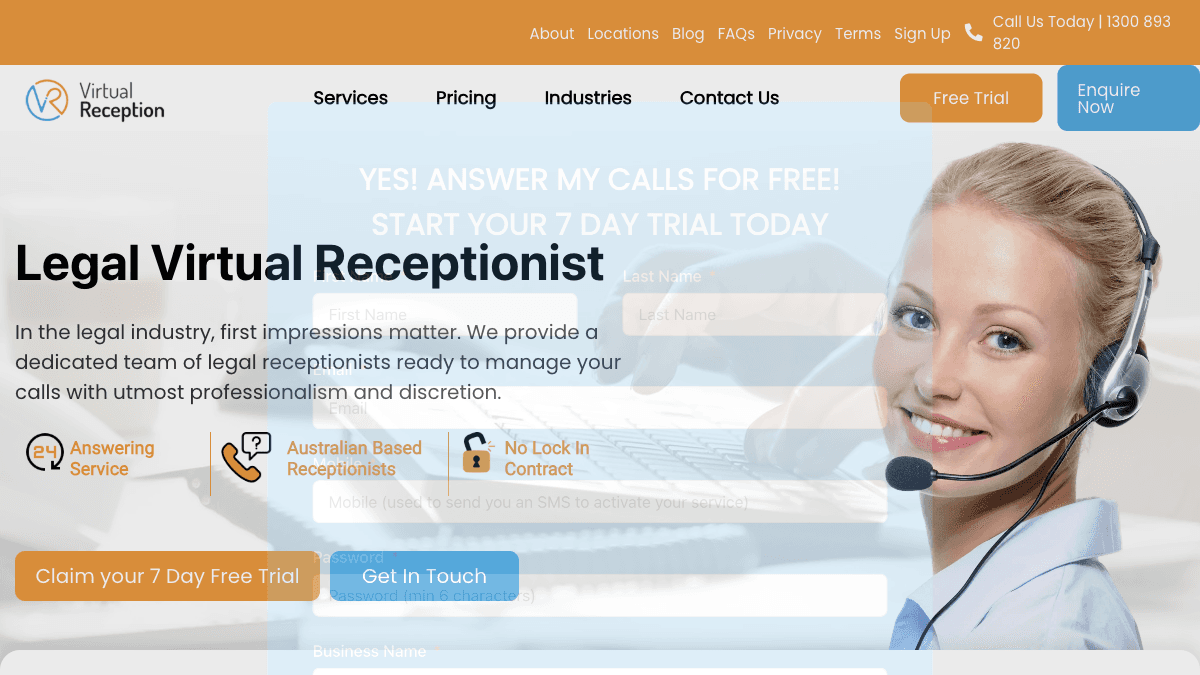
Table of Contents
This is a decision problem, not a research problem, so here is the decision. Solo or small firm under five fee earners, fewer than 200 calls a month, intake that still feels relationship driven: pick a human Australian service such as Virtual Reception, Lex Reception or Ruby Australia, and budget $250 to $700 a month. Predictable inbound flow, a clear practice area shortlist, and willingness to supervise an automated agent: pick an Australian AI receptionist like Valory, Johnni AI, TransferToAI or BotBloke, at $99 to $1,300.
Want AI asking the qualifying questions with a human stepping in on sensitive calls: Smith.ai or a hybrid, $300 to $1,500 a month. Commission a custom AI receptionist only when the volume justifies it, meaning more than 500 intake calls a month, multiple jurisdictions, deep Clio or LEAP integration, or a firm where call to retainer conversion is the metric that moves everything. That tier runs $8,000 to $30,000 to build. The mistake is buying the custom tier at 80 calls a month because it sounds thorough.
If you run a law firm in Australia and you're staring at a spreadsheet of receptionist services, you have a decision problem, not a research problem. You already know clients call, you already know voicemail loses cases, and you already know hiring a full-time receptionist starts at $65,000 a year before super. The real question is whether the best virtual receptionist for your law firm is a human service in Sydney, an AI receptionist built in Melbourne, a US hybrid like Smith.ai, or a custom build wired into your matter system.
I've shipped 126 production AI systems, including voice agents for legal and financial services firms across Australia and Canada. So this guide is the same conversation I have with managing partners every other week, written down. Quick verdict first, then the work.
Why most law firm receptionist comparisons miss the point
Every comparison guide I've read for Australian law firms ranks providers on price, hours of coverage, and whether they integrate with Clio. That's the easy part. The thing the guides skip is the only thing that matters: does the service convert anxious callers into signed retainers?
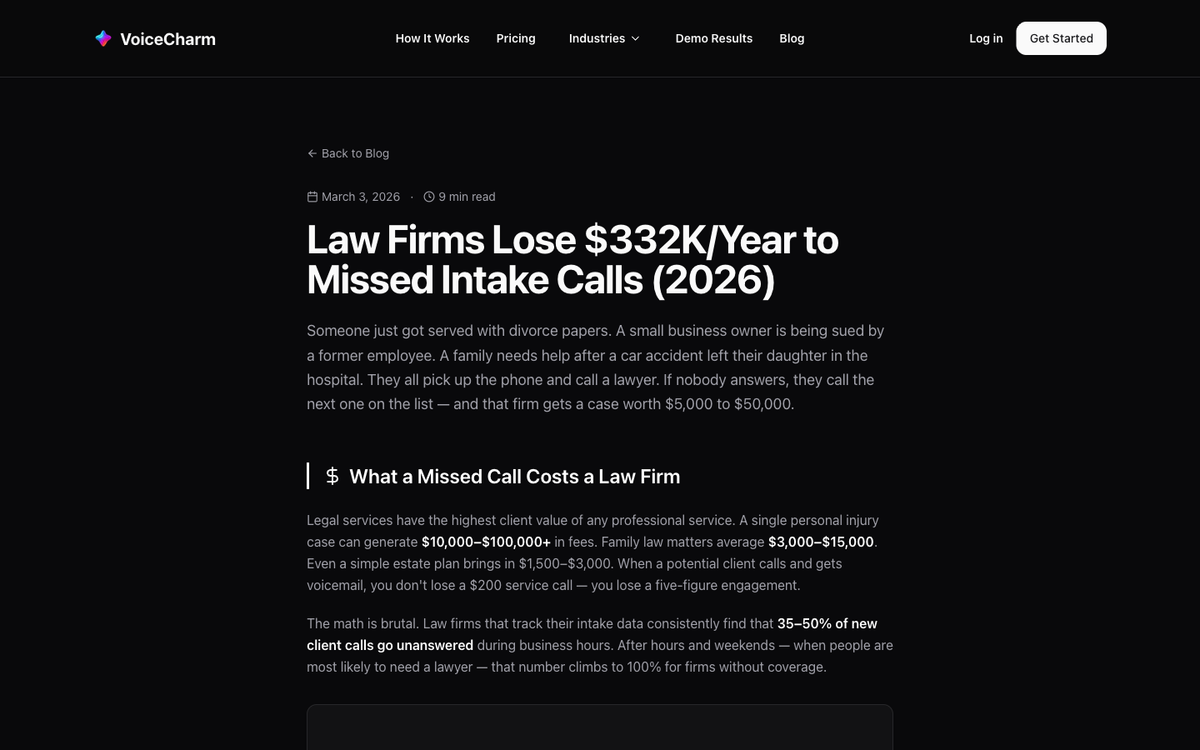
Here's the math that should drive your decision. Research compiled by VoiceCharm in March 2026 found that 35 to 50 percent of new client calls go unanswered at typical Australian and US small firms during business hours. After hours, that number climbs to 100 percent for firms without coverage. Only 15 to 20 percent of prospective legal clients leave a voicemail. The rest call the next firm on the Google results page. And the hardest number to swallow: the first attorney to have a live conversation with a prospective client wins the case 70 percent of the time. Not the best attorney. Not the cheapest. The first one who picks up.
If you're a five-person Sydney family law practice missing eight calls a week at an average matter value of $5,000, you're losing roughly $1.66 million a year in opportunity cost before factoring in any conversion rate. Even at a conservative 20 percent close rate, that's $332,000 of revenue walking to the firm down the road. VoiceCharm 2026.
That's the lens this comparison runs through. Cheapest plan is irrelevant if it loses you a single PI matter.
What we're actually comparing
There are four real categories serving Australian law firms in 2026. They're not all "virtual receptionists" in the same sense, but lawyers shop them all in the same Google session, so let's name the field properly.
- Australian human virtual receptionist services. A team of trained operators in Australia answers your calls, takes intake details, schedules consultations, and forwards urgent matters. Examples: Virtual Reception (virtualreception.com.au), Lex Reception (legal-specialist), Ruby Australia, OracleCMS.
- Australian AI receptionist platforms. A voice AI answers, qualifies, books, and writes back to your CRM. No human in the loop unless you escalate. Examples: Valory AI ($149 to $1,299 a month managed), Johnni AI (~$300 to $600 a month, trades-leaning), TransferToAI (~$99 a month self-serve), BotBloke, Nexwin.
- Hybrid services. AI handles initial qualifying, a human takes over for sensitive matters. Smith.ai is the dominant US option Australian firms still use because of legal-vertical maturity.
- Custom AI receptionist builds. A bespoke voice agent on Vapi, Retell, or LiveKit, integrated directly into your matter management (Clio, LEAP, Smokeball, Actionstep) with practice-specific scripts, conflict-check logic, and calendar handoff. This is what I build for firms.
Pricing data in the next four sections is from publicly available vendor pages and pricing guides as of early 2026. Numbers move; sources are linked.
Option 1: Australian human virtual receptionist services
This is the default choice. A friendly Australian voice answers the phone, takes a structured intake, and sends you the message. There are dozens of operators. Three matter most for law firms.
Virtual Reception (virtualreception.com.au)
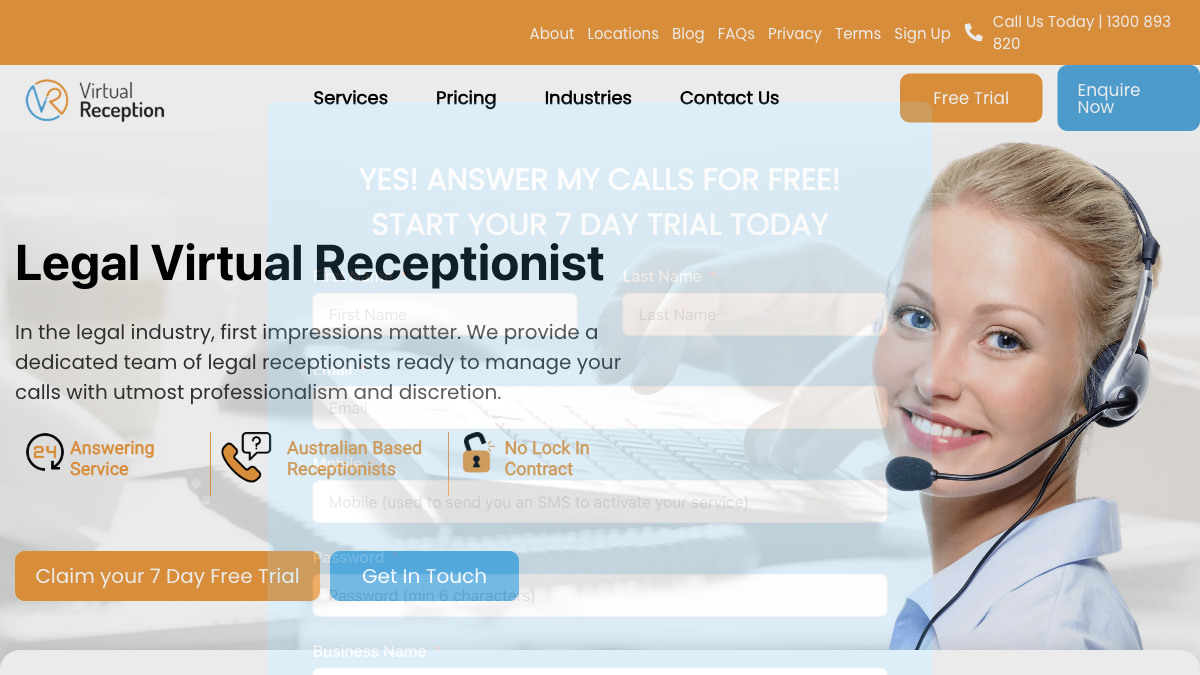
Australian-based agents, 24/7 answering, no lock-in contract, and a 7-day free trial. They have a dedicated legal product covering intake, conflict screening notes, and after-hours coverage. Plans typically run $149 to $499 a month for SME volumes. Best fit for a small firm that wants Australian voices and quick onboarding.
Lex Reception
The legal-vertical specialist. Operators are trained on legal intake terminology, conflict checks, and matter-specific qualifying questions. Pricing is bespoke (US parent), but Australian firms commonly land between $400 and $900 a month for moderate call volumes. Worth the premium if your intake is technical and varies by practice area.
Ruby Australia
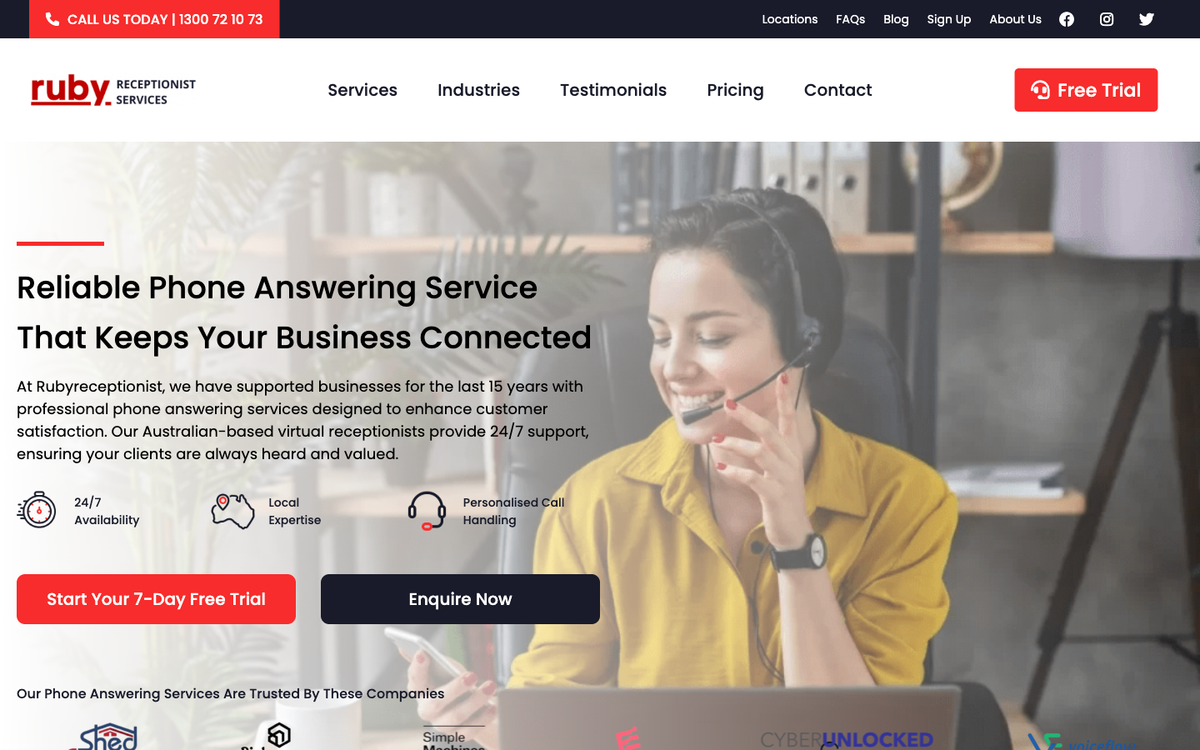
Ruby's appeal is warmth. Their operators sound like they actually care, which matters when a divorce caller is in tears. Australian pricing tracks the global plans: around AU$250 to $1,500 a month depending on minutes used. Recent global pricing has been climbing (Essential plan at $449 USD a month for 50 minutes is one widely reported tier). Strong choice for firms that win on client experience.
What human services do well
- Empathy. A person in distress wants a person.
- Australian voices. Critical for older clients in WA and regional Victoria.
- Flexible intake. Operators handle ambiguity better than scripts.
- Legal language familiarity if you pick a vertical specialist.
Where they break
- Per-minute economics get ugly as call volume grows. At $3.79 per call or $2.99 per minute (typical AU averages), a busy month can blow your budget.
- Operators rotate. The voice your client gets in May is not the voice they got in February.
- After-hours coverage often sits with offshore teams on the cheaper plans.
- Limited matter-system integration beyond email or basic webhooks.
Option 2: Australian AI receptionist platforms
This category exploded in 2025 and 2026. Five players are now serious in Australia.
Valory AI ($149 to $1,299 a month)
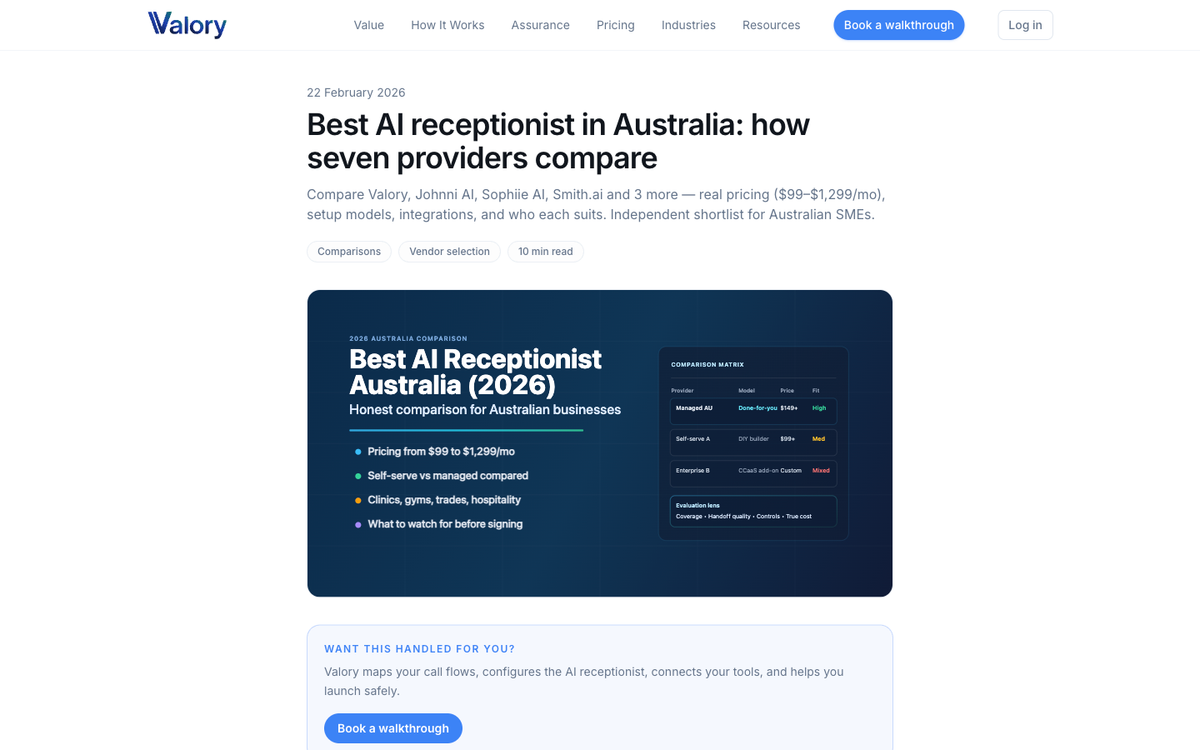
Fully managed AI receptionist. Valory configures the call flow, tunes the prompts, and runs ongoing supervision. Setup fee is $990 (waived on a 3-month plan). Best fit for firms that want AI without doing the engineering themselves. They lean toward clinics and trades but the plumbing works for legal intake.
Johnni AI (~$300 to $600 a month)
Trades-focused. Built around ServiceM8 and Simpro integrations. Wrong tool for law firms unless you're handling a single high-volume practice area like personal injury with a tight intake script.
TransferToAI (~$99 a month)
Self-serve, budget tier. 14-day free trial. Perfect for solo practitioners who want a sandbox. Don't trust it with your intake without weeks of testing first.
BotBloke and Nexwin
Australian-built, voice plus chat. Pricing is by enquiry. Both are solid mid-market platforms but neither is legal-specialised. You'll do the configuration work yourself.
What AI platforms do well
- Sub-2-second answer time, every time, including 2am Saturday.
- Consistent intake. Same questions, same order, every call.
- Cheap at volume. Doubling your calls doesn't double your bill.
- Direct CRM writes if the platform supports your matter system.
Where they break
- Edge cases sound robotic. A grandfather calling about a probate matter who doesn't speak English at home will struggle.
- Hallucination risk. An AI saying "yes, we handle workers' compensation" when you don't can create regulatory exposure under the Australian Solicitors' Conduct Rules.
- Per-minute overages at $0.50 to $1.00 a minute add up if a caller rambles.
- Generic platforms can't do conflict checks against your existing matter list without integration work.
Option 3: Hybrid (Smith.ai)
Smith.ai sits in its own category. AI does the first 30 seconds (greeting, basic qualifying), and a US-based human takes over for substantive intake. Australian firms still use it because Smith.ai's legal vertical playbook is the most mature in the market and they integrate cleanly with Clio.
Pricing is premium. Plans start around US$292.50 a month for limited usage and climb fast. Realistic spend for an Australian firm with moderate intake is US$500 to US$1,500 a month, plus the AUD/USD conversion friction.
The trade-off: callers get an American voice. For some practice areas (commercial law, IP, anything where your clients are also doing US business), this is fine. For family law in Adelaide, it's a problem.
Option 4: Custom AI receptionist build
This is what I do for clients. A custom build sits on top of Vapi, Retell, or LiveKit, runs on Claude or GPT, and is wired directly into your matter system. The voice is whatever you want (Australian neural voice from ElevenLabs or PlayHT). The intake script is yours. The conflict check runs against your real matter database. The calendar handoff books on your real Outlook or Cal.com.
Realistic numbers from my 126 builds:
- Build cost: $8,000 to $30,000, scoped to practice areas.
- Run cost: $300 to $900 a month at typical SME volumes (telephony, LLM tokens, STT, TTS, hosting).
- Timeline: 3 to 6 weeks from kickoff to live, depending on integration depth.
- Payback: 4 to 9 months if you're currently missing 20 percent or more of inbound calls.
What you get that no platform gives you:
- Practice-specific qualifying. "I was rear-ended" gets routed to your PI lead. "My spouse filed" goes to family. The classifier is yours.
- Conflict screening at intake. If a caller's name or matter description hits an existing matter, the AI flags it before booking.
- Real Clio or LEAP writes. Not a webhook payload that someone has to retype later.
- Compliance language. The AI will not promise representation, will not give legal advice, and will read the disclaimer your principal solicitor signed off on.
- Custom escalation. Criminal matters at 11pm Saturday wake your duty solicitor. Probate inquiries go in the Monday triage queue.
- Your data stays in your stack. Critical for firms in regulated practice areas.
This is overkill for a solo practitioner taking 50 calls a month. It pays for itself fast at 300+ calls a month or in any firm where matter values north of $20,000 are common.
Head-to-head comparison
| Option | Monthly cost (AUD) | Setup | Best for | Real weakness |
|---|---|---|---|---|
| Virtual Reception (AU) | $149 to $499 | 7-day trial, no lock-in | Solo + small firms wanting AU human voice | Per-call economics at high volume |
| Lex Reception | $400 to $900 | Bespoke onboarding | Firms with technical, varied intake | Premium pricing, US ownership |
| Ruby Australia | $250 to $1,500 | Fast onboarding | Client-experience-led firms | Climbing global pricing |
| Valory AI | $149 to $1,299 | $990 setup (waived 3-mo) | Firms wanting managed AI | Not legal-specialised |
| Johnni AI | $300 to $600 | Self-serve | High-volume single practice area | Trades-built, weak for legal |
| TransferToAI | $99+ | 14-day trial | Solo practitioners testing AI | You build it, you maintain it |
| Smith.ai (hybrid) | US$292+ | Bespoke | Mature Clio shops, premium feel | US voices, USD billing |
| Custom AI build | $300 to $900 run + $8K to $30K build | 3 to 6 weeks | Firms with 300+ calls/month or high matter values | Build cost upfront |
The decision framework: six yes/no questions
Print this list. Walk through it with the partner who handles intake. Whichever column you tick the most is your answer.
- Are you missing 20 percent or more of inbound calls right now? Yes means you need coverage now. Default to a human Australian service or Smith.ai for fastest deployment.
- Is your monthly call volume above 300? Yes pushes you toward AI (per-minute economics) or custom build. No keeps human services on the table.
- Do you take more than 5 calls a week outside business hours? Yes means after-hours coverage is non-negotiable. AI is cheapest. Human services charge premium for after-hours.
- Do you have a single dominant practice area? Yes makes AI easier (the qualifying script is narrower). Multi-practice firms benefit more from human flexibility or custom builds.
- Is your average matter value above $15,000? Yes means a single missed call eclipses six months of receptionist fees. Pay for the better service. Cheap is expensive.
- Do you use Clio, LEAP, Smokeball, or Actionstep with active conflict-check workflows? Yes pushes toward Smith.ai (Clio integration depth), Lex Reception (legal-aware), or a custom build (real integration). No keeps the field open.
What most comparison guides get wrong
I read every "best virtual receptionist for law firms" article that ranked on the first page of Google in April 2026 before drafting this. Three things they get wrong, every time.
1. They rank on coverage hours, not on conversion rate
Hours of coverage is a vanity metric. What matters is what percentage of inbound calls become signed retainers. The right service for a $5M revenue PI firm in Brisbane is whichever option produces the highest call-to-retainer rate, full stop. That's almost never the cheapest option, and rarely the most popular one. Run the numbers on your last 100 inbound calls.
2. They treat AI and human as substitutes
They aren't. AI receptionists are fastest at qualifying and routing. Humans are better at empathy and ambiguity. The mature firms I work with run a hybrid: AI handles the first 30 seconds and the after-hours load, a human handles substantive intake and high-emotion calls. The question isn't "AI or human?" It's "what's the right split for my call mix?"
3. They never quote real pricing
Most lists say "contact for pricing" against half the options. That's intentional. Vendors with weak unit economics hide their numbers because the per-minute math at scale doesn't favour them. The pricing in this guide is from Valory's published 2026 comparison and individual vendor pages as of February to April 2026. If a vendor won't quote, that's a signal.
A real Sydney deployment, end to end
One of my recent builds was for a 7-person Sydney family law practice. Names redacted under our standard NDA. Here's what the engagement looked like.
The problem. The firm was missing 41 percent of inbound calls during business hours and 100 percent after hours. Their existing reception was a paralegal splitting time between drafting and the phone. Their average matter value was $11,500. Their close rate on first-call intake was 64 percent. Their close rate on voicemail follow-up was 9 percent.
What we shipped. A custom AI receptionist on Vapi, integrated with their LEAP matter system. The AI answered every call in 1.7 seconds, ran a family-law-specific qualifying script (jurisdiction, matter type, urgency), checked the caller's name against existing matters for conflicts, booked consultations on the senior partner's actual Cal.com calendar, and escalated criminal-adjacent calls to a duty mobile. The Australian neural voice from ElevenLabs sounded like a Sydney professional in her thirties. We tuned the script for six weeks before going live, then ran a two-week supervised rollout with the paralegal listening to every call.
Costs. Build was $14,500. Monthly run cost is around $470 (telephony, LLM, STT, TTS, hosting). The paralegal is now drafting full-time.
Result after 90 days. Call answer rate went to 99.4 percent. After-hours pickup rate went from 0 to 96 percent. Conflict-check flag rate is 7 percent (matters they would have booked and then had to rescind). Close rate on AI-qualified intakes is 71 percent, slightly higher than human-handled because the qualifying is more consistent. New matter throughput is up 38 percent. Payback hit at month 4.
That's the upside when the right tier matches the firm. Same firm with TransferToAI would have hallucinated practice areas. Same firm with Smith.ai would have paid 4x and got American voices. Same firm with Virtual Reception would still be losing the after-hours load.
Frequently asked questions
Is it ethical for an AI to answer law firm calls in Australia?
Yes, with guardrails. The Australian Solicitors' Conduct Rules don't prohibit AI receptionists. What they prohibit is the AI giving legal advice, promising representation, or holding itself out as a solicitor. Every AI receptionist I build for legal includes a hard-coded disclaimer at the start ("I'm an automated assistant for [Firm Name], I can take your details but I cannot give legal advice"), and the script blocks the AI from answering substantive legal questions. Done right, it's strictly safer than a tired paralegal at 4:50pm.
Can a virtual receptionist do conflict checks for me?
Human services capture caller details and forward them to you for manual conflict screening. Custom AI builds can run an actual conflict check against your matter database in real time and flag the issue before booking. Off-the-shelf platforms generally cannot. If conflict screening is critical, that's a strong signal toward a custom build or a legal-specialised service like Lex Reception.
What's the cheapest virtual receptionist for a solo Australian lawyer?
If you want a human, Virtual Reception's entry plan starts around $149 a month with a 7-day free trial. If you want AI, TransferToAI starts at $99 a month self-serve. The catch with the AI option is that you configure the script yourself, which means you need to think hard about your intake flow before you ship. For most solo practitioners, the human service is faster to value.
How many calls does a typical 5-person Australian law firm get a month?
Across the firms I've worked with, the range is 180 to 450 inbound calls a month. Personal injury and family law sit at the high end. Estate planning and commercial work sit lower but with higher matter values. Track yours for two weeks before picking a plan. Most firms underestimate by 30 percent.
Will an AI receptionist integrate with my Clio or LEAP setup?
Smith.ai has the most mature Clio integration of the off-the-shelf options. LEAP integration is sparse across most platforms (LEAP's API is more closed than Clio's). Custom builds can integrate with both at the data-write level. If your matter system is anything other than Clio or Actionstep, expect to do integration work or commission a custom build.
What happens if the AI receptionist hallucinates a practice area?
It depends on what was said and to whom. If the AI told a caller "yes, we handle wills" when you don't, and the caller relied on that, you may have a complaint to deal with. The fix is two-layer: a tightly scoped system prompt that allowlists only your real practice areas, and a content-moderation layer that blocks the AI from making representations outside that list. Every legal-grade build I ship has this. Off-the-shelf platforms vary widely.
How long does a custom AI receptionist take to build?
For a single-practice-area firm with one matter system, 3 to 4 weeks. For a multi-practice firm with custom conflict logic, 4 to 6 weeks. Add a week for supervised rollout where a human listens to every call before the AI books anything autonomously. Total project time is typically 5 to 8 weeks from kickoff to fully autonomous.
Do I still need a human receptionist if I use AI?
Most firms over 5 fee-earners keep one human in the loop, but the role shifts from answering calls to handling escalations, complex bookings, and walk-ins. The AI takes the volume; the human takes the judgment calls. The economic argument for going fully autonomous only makes sense for firms with very high call volume and a narrow practice area (mass tort, high-volume PI).
If you've decided you need a custom build, here's how I work
If the decision framework above lands you in the custom-build column, the path forward is straightforward.
- Discovery (week 1). I sit with your intake person, listen to 50 historical calls, map your real qualifying flow, and write the spec. Fixed fee.
- Build (weeks 2 to 4). Voice agent on Vapi or Retell, hooked into your matter system, with the script your principal solicitor signed off on.
- Supervised rollout (weeks 5 to 6). Every call is reviewed by a human before the AI takes the next. We tune until the misroute rate is under 2 percent.
- Live (week 7+). Monthly tuning, escalation review, and quarterly script updates as your practice areas shift.
The firms I work with all converge on the same number: you cannot afford to miss a call, and you cannot afford to staff against the worst-case load. The right virtual receptionist for your law firm is the one that closes that gap at the lowest blended cost per signed retainer, not the one with the cheapest sticker. Pick the tier that matches your call mix, run it for 90 days, measure conversion, then iterate.
If you want help picking the tier or scoping a custom build, the law firm AI page has the typical engagement model and the contact page books you straight on my calendar. Twenty minutes is enough to tell you whether you should be on a $300 a month plan or a $14K build.
Missed-call statistics for law firms (35 to 50 percent unanswered, 70 percent first-attorney-wins, $332K annual loss): VoiceCharm March 2026. Australian AI receptionist pricing bands ($99 to $1,299 a month, $0.50 to $1.00 per minute overages): Valory AI April 2026. Australian AI receptionist provider shortlist (Valory, Johnni, TransferToAI, BotBloke, Nexwin, Smith.ai, RingCentral): Valory AI February 2026. Australian legal virtual receptionist services with intake and conflict notes: Virtual Reception 2026. Ruby Australia legal positioning and pricing: Ruby Australia February 2026.
Related Posts
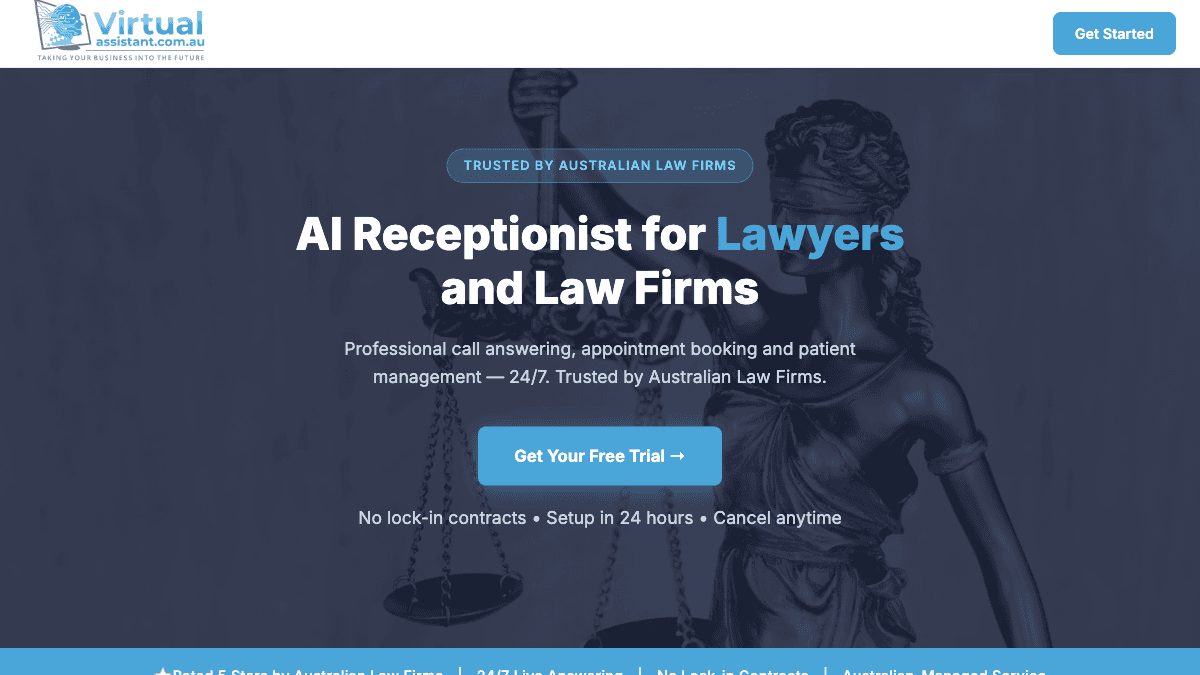
What Is a Legal Virtual Receptionist? An Honest Guide for Australian Law Firms
Industry GuidesVirtual ReceptionistLegal
Virtual Receptionist Australia: Real AUD Pricing, Your Options, and the AI Version Most Businesses Haven't Tried
Industry GuidesVirtual ReceptionistAustralia
Virtual Receptionist for Lawyers: What Your Intake Call Legally Creates
Industry GuidesVirtual ReceptionistLegal

Jahanzaib Ahmed
AI Systems Engineer & Founder
AI Systems Engineer with 126 production systems shipped. I run AgenticMode AI (AI agents, RAG systems, voice AI) and ECOM PANDA (ecommerce agency). I build AI that works in the real world for businesses across home services, healthcare, ecommerce, SaaS, and real estate.