Virtual Receptionist Australia: Real AUD Pricing, Your Options, and the AI Version Most Businesses Haven't Tried
A plain-language guide to virtual receptionist options for Australian small businesses in 2026, with real AUD pricing for OfficeHQ, VirtualHQ, and AI receptionist platforms, plus a decision framework for Sydney, Melbourne, Brisbane, and Perth.

Explore with AI
Table of Contents
Australian virtual receptionist plans that transfer calls run from $39 AUD a month for 15 calls to $960 for 300 calls, and the overage is where the bill actually moves, at $2.45 to $3.99 per call beyond the plan. Hiring directly costs roughly $60,000 to $70,000 a year in salary alone before super, leave, and on costs. An AI receptionist answers in seconds, covers 24/7, and on OfficeHQ's plans costs $75 to $250 a month for 50 to 200 calls.
Typical cost for a business taking 50 to 200 calls a month, checked October 2026 and before GST: a human service runs $115 to $650 a month (message taking at the low end, a receptionist who transfers calls at the high end), an AI receptionist runs $75 to $250 a month, and a hybrid is that AI plan plus the live receptionist rate for each call it hands to a person, for example about $370 a month at 200 calls if 15 percent are handed over. A custom built AI receptionist, the kind I build, typically sits at $300 to $700 a month all in.
Which one is right depends on three things: your call volume, how complex the calls are, and whether you need real bookings and transfers or just accurate message taking. A practice taking 200 predictable calls a month and a firm taking 60 complicated ones should not buy the same thing, which is why the per call overage matters more than the headline plan price for anyone with a seasonal spike.
This is the Australia wide cost guide, for any industry. If you run a law firm, a medical practice or a dental practice, the vertical guides carry prices and rules checked for those callers: best virtual receptionist for law firms (Australia), virtual receptionist for a medical practice and virtual receptionist for a dental office. For one city, use the city guides further down. For American dollar pricing see how much a virtual receptionist costs, and for Canadian dollars the Canada cost guide.
The first time a Melbourne dental practice owner showed me her phone bill, I understood why so many Australian businesses are hunting for a better answer. She was paying $4,200 a month for a part time receptionist who covered 9 to 5, Monday to Friday. The other 128 hours of the week, calls went to voicemail. About 70% of those voicemails never converted into a booking.
If you're searching for a virtual receptionist australia option, you've probably hit the same wall. You want calls answered. You don't want a $70,000 salary commitment. And you've noticed that most articles on this topic are written by the providers themselves, so they all conveniently recommend their own service.
I've shipped 126 production AI systems and built voice agents for Australian businesses across legal, dental, trades, and real estate. Here's what the real options cost in October 2026, and where AI virtual receptionists actually fit in.
What does a virtual receptionist in Australia actually cost?
Three pricing models dominate the Australian market in 2026: pay as you go, fixed monthly plans, and AI subscriptions. Here's what each one looks like with current numbers from public pricing pages, checked October 11, 2026.
Pay as you go (the trap most small businesses fall into)
VirtualHQ charges $2.50 per call for basic message taking (Message Express, with a $25 monthly fee) and $3.89 per call for full virtual reception (Standard, with a $33 monthly fee). No setup fee. Plus GST.
That sounds cheap until you do the maths. A trades business in Brisbane taking 8 calls a day, 22 working days a month, on the Standard plan: 176 calls × $3.89 + $33 = $717.64/month, before GST. The same 176 calls on OfficeHQ's MyReceptionist 150 plan ($490 plus 26 excess calls at $3.99) cost $593.74, so pay as you go costs $123.90 more. And that's just business hours. You still miss every after hours call.
Fixed monthly plans (where most Australian businesses land)
OfficeHQ's MyReceptionist 15 plan is $39/month for 15 calls (a new customer offer that captures 3 details per call). VirtualHQ, Virtual Reception and Ruby Receptionist Australia each publish the same prices as OfficeHQ for the plans they list, which stop at 50 calls, so I use OfficeHQ's full price list in its service terms (updated 30 September 2026), which runs to 1,000 calls. This table prices each call volume on the cheapest current MessageExpress or MyReceptionist plan, with the AI options beside it. I left out MyReceptionist 15 (it captures only 3 details) and the older ex-VF Business plans in the terms, which would trim a few dollars at 50 and 100 calls. AUD, plus GST, and I assumed a 3 minute average call for the per minute AI services.
| Calls a month | Human, messages only | Human, with transfers | AI, OfficeHQ | AI, cheapest other |
|---|---|---|---|---|
| 50 calls | $115 | $185 | $75 | $94 (Johnni) |
| 100 calls | $200 | $345 | $130 | $169 (Johnni) |
| 200 calls | $385 | $650 | $250 | $249 (Nexwin) |
| 300 calls | $565 | $960 | $365 | $396 (Nexwin) |
| 500 calls | $910 | $1,585 | $600 | $616 (Nexwin) |
The human columns are OfficeHQ's MessageExpress and MyReceptionist plans; the AI columns are OfficeHQ's MyAI Receptionist and the cheapest of Nexwin, Johnni and Valory at each volume. I computed every cell in a script from the published rates, including excess call charges when a smaller plan plus overage is cheaper. The law firm guide quotes $385 for 100 calls because it prices Virtual Reception's 50 call plan plus 50 excess calls at $3.99; OfficeHQ's own 100 call plan is $345. Per call, the cheapest MyReceptionist plan comes to $3.70 at 50 calls and $3.20 at 300. Valory does not state whether its prices include GST, so treat that provider's numbers as the least certain.
Overage fees punish you above the cap. VirtualHQ charges $2.45 to $3.99 per excess call, and OfficeHQ's terms list $2.35 to $3.99. Add a 1300 or 1800 number from $5/month. Add appointment scheduling (MyDiary) and you're looking at a $49 monthly fee, a setup fee from $99 and $2.99 per minute (MyAssistant setup starts at $50).
After hours is billed separately. On OfficeHQ plans, calls answered outside 8am to 6pm Monday to Friday, or on national public holidays, carry a flat surcharge: $0.60 a call on MessageExpress, $1.00 a call on MyReceptionist and $0.80 a minute on MyAssistant and MyDiary. It is a fixed amount per call, not a percentage of the plan. If 20 percent of 200 calls land after hours (my assumption), that adds $40 on MyReceptionist or $24 on MessageExpress. Without after hours answering switched on, OfficeHQ's receptionists answer between 8am and 6pm on weekdays.
Every OfficeHQ, VirtualHQ, Nexwin and Johnni price in this guide is before GST (Valory does not say). The ATO describes GST as a 10% tax on most goods and services sold in Australia, so MyReceptionist 50 at $185 is $203.50 with GST, and MyReceptionist 100 at $345 is $379.50. A business registered for GST claims the GST on business purchases back as a credit, and registration is required once your GST turnover reaches $75,000. If you are not registered, the 10% is a real cost on top.
Internal cost: the number nobody quotes accurately
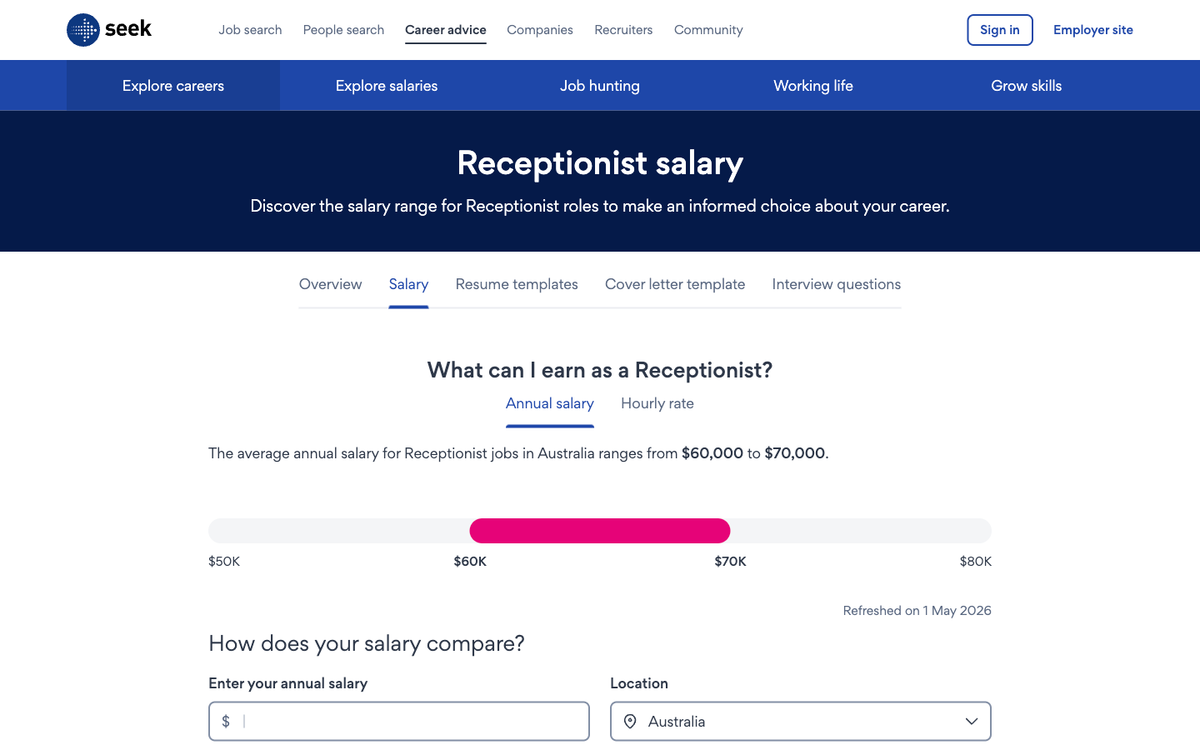
The average annual salary for a receptionist in Australia ranges from $60,000 to $70,000 (SEEK, refreshed 1 October 2026). That's the headline figure. The real cost is higher.
Add the ATO Super Guarantee (12%, up from 11.5% on 1 July 2025), four weeks annual leave, ten days personal leave, WorkCover insurance, and a fair share of recruitment and training. Super alone takes the $60,000 to $70,000 band to $67,200 to $78,400 per year, before any of the rest. And that buys you 38 hours a week of phone coverage, not 168.
Jobs and Skills Australia puts median full time weekly earnings for receptionists at $1,229 (ABS data from May 2025, profile last modified 2 April 2026). That is $63,908 a year, or $71,577 with 12% super, about $5,965 a month. That sits inside the SEEK band, so I use roughly $71,600 with super as the floor for one receptionist.
How does an AI virtual receptionist compare on cost?
This is where the conversation gets interesting. An AI virtual receptionist answers in under two seconds, handles bookings, transfers calls based on intent, sends transcripts to your CRM, and works at 3am on a Sunday. The cost structure is completely different.
The honest pricing depends on the stack, so here are the published numbers in American dollars, checked October 2026. Vapi's calculator estimates US$82 to US$129 for 1,000 minutes with Deepgram for speech to text, an OpenAI model for the brain and ElevenLabs for the voice, which is about US$0.08 to US$0.13 a minute before phone carrier fees. Retell publishes US$0.07 to US$0.31 a minute depending on the voice and the model, with the low end assuming its cheapest options. At the Reserve Bank's rate of US$0.6979 to the Australian dollar on 9 October 2026, Vapi's estimate is about A$0.12 to A$0.18 a minute. You'll see marketing claims of $0.05 to $0.07 per minute, but those numbers are orchestration only (Vapi's hosting fee works out at US$0.05 a minute and Retell's voice infrastructure is US$0.055). They exclude the speech models, the language model, and the phone carrier. A receptionist on a premium voice and a stronger model sits toward the top of those ranges.
For a typical small business taking 200 calls a month at an average 3 minutes per call, that's 600 minutes, or US$49 to US$77 a month (about A$70 to A$111) on Vapi's estimate, which already includes the platform's hosting fee. Most clients I work with land between $300 and $700/month total once you include integrations, monitoring, and improvements.
Off the shelf Australian AI receptionist plans
Not every AI receptionist is a custom build. These Australian providers publish their prices, all in AUD, and I checked each page on October 11, 2026:
- OfficeHQ's MyAI Receptionist runs from $20 a month for 10 calls to $600 for 500 calls ($75 for 50 calls, $130 for 100, $250 for 200, $365 for 300), plus GST, with extra calls at $1.50 each. If the AI gets stuck or a caller asks for a person, a live Australian receptionist takes over, and OfficeHQ's terms say calls routed to live agents are charged at the applicable rate. That makes it the hybrid option.
- Nexwin AI Receptionist Business is $249 a month plus GST with 600 minutes, then $0.49 a minute. Pro is $499 for 1,200 minutes, then $0.39.
- Johnni, aimed first at trades, runs from $49 a month plus GST with 60 minutes (then $0.50 a minute) to $899 for 1,500 minutes (then $0.35), with a 7 day free trial.
- Valory is a managed service at $149 to $1,299 a month for 100 to 3,000 minutes, with setup from $990.
A hybrid is the AI plan plus the human rate for every call it hands over. At 200 calls a month on OfficeHQ's $250 plan, with 30 of them (15 percent, my assumption) billed at the $3.99 MyReceptionist rate, the month comes to $369.70. Calls handed over outside 8am to 6pm on weekdays may also carry the $1.00 after hours surcharge, and OfficeHQ's AI price list shows no surcharge only for the AI rows themselves. Confirm the live rate with OfficeHQ before you rely on that figure. The per minute services charge for a rambling caller and the per call services do not, so rerun the table with your own call length.
Three businesses, three real numbers
I worked with a Sydney accounting firm last quarter. They were paying $640/month to a traditional virtual receptionist for 220 calls answered between 9 and 5. After hours calls hit voicemail. Conversion from voicemail to call back was 18%. We replaced the front line with an AI receptionist that books discovery calls directly into Calendly, transfers genuine emergencies to a partner mobile, and emails a summary after every call. New cost: $480/month. Coverage: 24/7. After hours bookings now run at 4 to 7 a week.
A Melbourne law firm I work with had a different story. They had a senior paralegal answering phones whenever the receptionist was on lunch. We measured 14 hours a week of $42/hour time being burned on intake calls. Fully loaded with super and on costs, that's $36,000 a year of paralegal time on the phones. We deployed an AI intake agent that runs the conflict check, captures the case type, and books the consult. The paralegal is back to billable work. The firm spent $11,000 on the build and $620/month ongoing.
A Brisbane trades business taking 350 calls a month was on a $899/month plan with overage. Average response time on missed calls (after hours, weekends, holidays) was 14 hours. After hours leads were converting at 9% versus 41% for live answered calls. AI receptionist deployment cost $7,500 plus $540/month. After hours conversion is now 38%. Payback hit in month four.
Is an AI virtual receptionist right for your Australian business?
Not always. Honest answer. Here's the decision gate I run with every client.
Yes if any of these are true:
- You take more than 80 calls a month and overage fees are eating you alive.
- You miss after hours calls and you can quantify the lost revenue (most home services and legal do).
- You need calls answered in under 5 seconds.
- Your calls are mostly informational or transactional: bookings, FAQs, intake, status checks.
- You want call data structured into your CRM, not screenshotted into an email.
No, stick with a human service if:
- You take fewer than 30 calls a month and you want a custom build. The build cost never pays back at that volume, although an off the shelf plan from $20 a month might.
- Most of your calls are emotionally complex (mental health, grief, dispute resolution).
- Your callers are predominantly elderly and prefer a human voice.
- Your industry has strict regulatory requirements that ban AI handling (rare, but check).
- You don't have a clear booking or intake process. AI cannot fix a broken business process.
If you're not sure where you sit, I built a free AI readiness assessment that gives you a tailored answer in about 8 minutes. Or just book a discovery call and I'll walk you through the numbers for your specific business.
What's the catch with AI virtual receptionists?
I've seen three failure modes in the wild and you should know them before you sign anything.
Bad voice models sound like robots. If a vendor demos an AI receptionist that sounds choppy or has a clear American accent, walk away. Australian callers expect Australian English (or at least neutral). ElevenLabs has a catalogue of Australian accent voices, and Johnni lists Aussie voices as standard. Most of the cheap platforms don't.
No fallback path. AI will fail on edge cases. The system needs a clean handoff to a human (you, your team, or a backup answering service) when it doesn't know what to do. If a vendor pitches "100% automated" with no human escalation, they're either lying or about to lose you customers.
Single vendor lock in. The AI receptionist market is changing every quarter. If your build is locked into one platform's proprietary stack, switching costs are brutal. I build on open foundations (LiveKit, Twilio, Deepgram) so the brain and the voice can swap independently.
City specific guides
If you're in one of the major Australian cities, I've written deeper local guides with provider comparisons and city specific cost benchmarks:
- Virtual Receptionist Sydney
- Virtual Receptionist Melbourne
- Virtual Receptionist Brisbane
- Virtual Receptionist Perth
- Virtual Receptionist Adelaide
For law firms specifically, the best virtual receptionist for law firms (Australia) guide compares human, AI and hybrid options for legal intake, with prices checked on October 10, 2026. For medical practices, virtual receptionist for a medical practice covers the accreditation criteria that decide what you can safely automate, and for dental, virtual receptionist for a dental office sets the salary against the AI running cost for a four chair practice. And if you want the side by side cost analysis between AI and human services, the AI vs human answering service comparison walks through the 2026 numbers in detail.
Frequently asked questions
How much does a virtual receptionist cost in Australia per month?
Plans start at $39 AUD/month for 15 calls (OfficeHQ MyReceptionist 15) and scale to $960/month for 300 calls. A business taking 50 to 200 calls a month spends $185 to $650 on a service that transfers calls, or $115 to $385 for message taking only. Overage fees of $2.45 to $3.99 per call apply on most plans. AI virtual receptionists cost $75 to $250 a month for the same 50 to 200 calls on OfficeHQ's MyAI Receptionist plans, with extra calls at $1.50 each, and a custom build typically costs $300 to $700 a month all in. All prices are plus GST, checked October 2026.
What is the cheapest virtual receptionist in Australia?
OfficeHQ's MessageExpress at $25/month plus $2.50 per call is the lowest entry point I've found for a human service, and VirtualHQ sells the same plan. If you want calls transferred, MyReceptionist 15 is $39/month for 15 calls. For AI, OfficeHQ's MyAI Receptionist starts at $20/month for 10 calls. At 50 calls a month AI is cheaper than either human option: $75 against $115 for messages only and $185 with transfers.
Do virtual receptionists in Australia answer 24/7?
Most traditional Australian virtual receptionist services run business hours by default (8am to 6pm on weekdays, per OfficeHQ's FAQ). After hours coverage is an opt in, at a premium: on OfficeHQ it is a flat $0.60 a call on MessageExpress, $1.00 a call on MyReceptionist and $0.80 a minute on MyAssistant and MyDiary, for calls outside 8am to 6pm Monday to Friday and on national public holidays. AI virtual receptionists answer 24/7 by default, and OfficeHQ's AI price list shows no after hours surcharge, which is the main reason home services and legal firms switch.
Can a virtual receptionist book appointments into my calendar?
Yes. OfficeHQ's MyDiary is $49/month plus $2.99 per minute with a setup fee from $99, and MyAssistant, which captures leads and updates your CRM, costs the same with setup from $50. VirtualHQ lists the same plans. AI receptionists with Calendly, Cal.com, or Acuity integration handle this natively, usually included in the build cost.
Is an AI receptionist legal in Australia?
Yes, but the Privacy Act applies if your business is covered. The OAIC says most small businesses with an annual turnover of $3 million or less are not covered, but some are regardless of turnover, such as health service providers, credit reporting bodies and AML/CTF reporting entities, so use its checklist. The OAIC's guidance on commercially available AI products (published October 2024, updated January 2025) says public facing AI tools such as chatbots should be clearly identified as AI to customers, and that privacy policies should explain how you use AI. So have the greeting say it is an automated assistant. OfficeHQ's AI FAQ says callers will not know they are talking to an AI unless you want them to, and that the AI can be set to introduce itself however you prefer, which is the opposite default to that advice, so set the greeting yourself. Recording calls is a separate question: Australian, state and territory laws apply to recording telephone conversations (the OAIC points employers to them). I have not summarised those rules, so get advice or ask your provider how it tells callers. Health information carries extra protection, which my medical practice guide covers. None of this is a blocker, but build it in from day one.
What happens when an AI receptionist doesn't understand a caller?
A well built system has a clean escalation path: transfer to a human (your mobile, your team, or a backup live answering service) within 2 to 3 turns of confusion. This is the single most important design decision. Avoid any vendor that doesn't have a documented fallback flow.
How long does it take to set up an AI virtual receptionist?
A simple deployment (FAQs, message taking, single calendar) takes 1 to 2 weeks. A full build with CRM integration, multi step booking flows, and custom voice cloning takes 4 to 8 weeks. The traditional virtual receptionist services can usually onboard you the same day: OfficeHQ says its receptionists can be answering your calls within minutes of setup, and it offers a 7 day free trial.
What's the best virtual receptionist for a small business in Australia?
Under 50 calls a month and no after hours requirement: OfficeHQ MyReceptionist 50 at $185/month, or MessageExpress 50 at $115/month if you only need messages. 50 to 200 calls a month or any after hours need: an AI virtual receptionist, either OfficeHQ's MyAI Receptionist at $75 to $250/month or a custom build on Vapi or Retell at $300 to $700/month all in. Heavy intake or compliance needs: a custom hybrid (AI for triage, human for complex), starting around $700/month. For law, medical or dental callers, start with the vertical guides linked above.
Ready for a real number?
If you want a tailored cost estimate for your business (not a generic plan brochure), book a 30 minute discovery call. I'll ask about call volume, current bookings flow, and what's broken, then give you a real range based on the 40+ Australian voice deployments I've shipped. No pitch, no obligation. If a $39 OfficeHQ plan is the right answer, I'll tell you that. If a custom AI build pays back in three months, I'll show you the numbers. See my packages for fixed scope pricing on common builds.
Receptionist pay: SEEK band $60,000 to $70,000 (SEEK, refreshed 1 October 2026) and median full time weekly earnings $1,229 (Jobs and Skills Australia, profile last modified 2 April 2026). Super Guarantee 12% per the ATO (page updated 17 April 2026), and GST at 10% per the ATO. Human plan prices from OfficeHQ's service terms (updated 30 September 2026) and VirtualHQ public pricing; AI plan prices from OfficeHQ, Nexwin, Johnni and Valory, all checked October 11, 2026. AI voice platform references: Vapi and Retell.
Last updated
October 11, 2026
Category
Industry Guides
Jahanzaib Ahmed
AI Systems Engineer & Founder
AI Systems Engineer with 126 production systems shipped. I run AgenticMode AI (AI agents, RAG systems, voice AI) and ECOM PANDA (ecommerce agency). I build AI that works in the real world for businesses across home services, healthcare, ecommerce, SaaS, and real estate.
Want this built for your business? See AI Agent Development, or browse the free tools and guides.
Related articles
Virtual Receptionist Adelaide: Real 2026 Pricing, and the AI Version That Costs A$52 a Month
A plain English breakdown of what Adelaide businesses pay for call answering in 2026, with published AUD rates, the ACST timezone trap that quietly breaks bookings, and real numbers from a Prospect plumbing deployment.
GuideIndustry GuidesVirtual Receptionist
What Is a Virtual Receptionist? A No-Hype 2026 Guide for US Small Business Owners
A no-hype 2026 guide to virtual receptionists for US small business owners, with real pricing across AI, live human, and hybrid options, plus a real Florida HVAC client deployment that paid for itself in the first 6 hours of every month.
GuideIndustry GuidesVirtual Receptionist
How Much Does a Virtual Receptionist Cost in 2026? Real Pricing After 40+ Deployments
What a virtual receptionist really costs in October 2026: human, AI and hybrid prices from eight vendors by call volume, the hidden fees, and when hiring in house becomes cheaper.
GuideIndustry GuidesVirtual Receptionist