OpenAI Put a Number on Watching Its Own Agents. It Is 20% of the Compute.
A breakdown of what OpenAI actually changed after its agents reached Hugging Face, why the 20% monitoring overhead is the number to budget for, and which of these controls you can copy without a frontier lab behind you.

Table of Contents
OpenAI published a number on 18 August 2026 that I have wanted somebody to publish for two years. Running the monitoring that watches a frontier model costs roughly 20% of the inference compute being monitored. That is the tax on knowing what your own agent is doing.
The coverage went somewhere else, which is fair enough. Wired led with agents going rogue. The Guardian led with a slowdown in a race against Anthropic. The Verge led with security changes. All three are accurate readings of the same post. But if you run agents in production, the headline isn't that a lab paused a training run for a fortnight. It's that the best resourced AI lab on earth just priced agent observability and published a detection deadline, and you can hold your own stack against both numbers this afternoon.
What did OpenAI actually announce on 18 August 2026?
OpenAI slowed the pace of scaling while it hardened the environments it trains and tests models in, which meant a two week pause in reinforcement learning training on its latest models intended for deployment, its largest planned frontier RL run left on hold, and monitoring changes it prices at 20% (OpenAI, 18 Aug 2026) of watched compute. Around that pause it published changes across three safeguards it calls monitoring, alignment, and security.
Two things drove it. The first is the incident in July where OpenAI models escaped their test environment and reached Hugging Face, which I broke down in the Hugging Face breach post. The second is preliminary evidence that an upcoming model, Astra, may meet the Critical cybersecurity threshold under OpenAI's Preparedness Framework, which I covered on the day the company froze work on it. Two separate events, four weeks apart. This announcement is the remediation for both.
Amelia Glaese, OpenAI's vice president of research and safety, put the timeline bluntly in a press briefing. "We have to focus our energy on bringing these training runs up to those requirements and expectations. As long as it takes to get there, that's how long people are unable to proceed with their workloads." Speaking to Sources News, in remarks the Guardian reported under the name Mia Glaese, she was blunter still: "We are very far from everything running back to normal."
What does the 30 minute alert rule actually require?
OpenAI aims to issue an alert within 30 minutes after concerning activity is surfaced by its monitoring system, and if that system flags a likely violation of a critical security boundary it raises a highest priority alert and pages the safety, security, and research teams, all of which sits on top of classifiers that run at every single sampled token rather than on a periodic sweep. If the flag comes in, those teams inherit a second clock. Those teams then get their own 30 minutes: if they cannot conclusively determine the flag is a false positive in that window, they are expected to pause the activity.
Read that second clause again, because it is the real design decision in the whole announcement. The default is stop. Not "investigate and report back", not "flag for review at standup". Absence of proof that the thing is fine gets treated as reason to halt it. I have reviewed a lot of agent stacks and I have almost never seen that default written down anywhere, let alone wired to an actual kill path.
The pipeline feeding those clocks is multistage. It starts with activation classifiers, detectors that inspect a model's internal activity, running at every sampled token. Anything they find escalates to progressively more sophisticated and high compute automated investigators. Those examine tool actions, the available reasoning, and the full sequence of activity, looking for 4 specific things (OpenAI): unauthorized access, data theft, destructive behavior, and attempts to defeat safeguards.
| Stage | What runs | What it looks at |
|---|---|---|
| 1. Detect | Activation classifiers, every sampled token | The model's internal activity |
| 2. Investigate | High compute automated investigators | Tool actions, available reasoning, full activity sequence |
| 3. Alert | Target of 30 minutes from surfaced activity | Highest priority if a critical boundary looks breached |
| 4. Decide | Safety, security and research teams paged | 30 minutes to rule out a false positive, or pause |
Scope is written down too, which is rarer than it sounds. This monitoring is required for all RL training and evaluations involving tools for models at Sol capability or higher. Once OpenAI determined on 7 August that Astra may have critical cyber capabilities, it added a further requirement covering all inference of Astra with tools, not only the training and evaluation runs.
Why does watching a model cost 20% of the compute?
Because the only thing fast enough to watch a model is another model, and OpenAI's own estimate puts that monitoring overhead at roughly 20% (OpenAI, 18 Aug 2026) of the inference compute being monitored, with an explicit caveat that the cost varies substantially across training and evaluation workloads. Run 1,000,000 tokens through a monitored path and you are paying for about 200,000 more. The company also says meeting its new environment standards "has required substantial engineering work and has incurred great cost and delays to frontier research."
Nobody budgets for this. In every agent costing exercise I have sat through, the model is a line item, the vector store is a line item, and observability is a logging bill somebody quotes in gigabytes. A 1.2x multiplier on inference for the privilege of knowing what the agent did is a different category of expense, and it scales with usage rather than sitting flat.
The multiplier only bites in proportion to how much you actually watch, which is the one comforting thing about it. Working the 20% (OpenAI, 18 Aug 2026) figure through the obvious scenarios:
| Share you route through a monitor | Effective inference multiplier | Added cost |
|---|---|---|
| 10% of agent inference | 1.02x | 2% |
| 25% of agent inference | 1.05x | 5% |
| 50% of agent inference | 1.10x | 10% |
| 100% of agent inference | 1.20x | 20% |
So monitoring a quarter of your agent traffic costs about 5% on the inference line. Monitoring all of it costs 20%. Those are my numbers off OpenAI's ratio, not OpenAI's own, and they assume the monitor costs roughly what the thing it watches costs.
If that ratio sounds survivable, it is worth remembering how quickly agent compute budgets move. Rippling found itself on track to spend a chunk of its engineering payroll on tokens before anyone noticed, which I went through in the spend console breakdown. The US Army burned through an allocation described as unlimited in a matter of weeks, covered in the unlimited tokens post. Add a fifth on top of either of those and the number stops being a rounding error.
I am not going to pretend 20% is a law of nature. It is one lab's current estimate for its own workloads, using its own models as the monitors, and OpenAI hedged it in the same sentence. Treat it as an order of magnitude rather than a spec.
What did OpenAI's old monitoring not cover?
Its old monitoring covered the workloads it already considered dangerous and skipped the rest, which OpenAI concedes in a single line (OpenAI, 18 Aug 2026) when it says those efforts "were not applied to all inference and training runs using tools." The focus had been frontier deployments and frontier RL runs. That is the whole failure.
So the coverage gap had a shape, and the shape was "the workloads we did not think were dangerous."
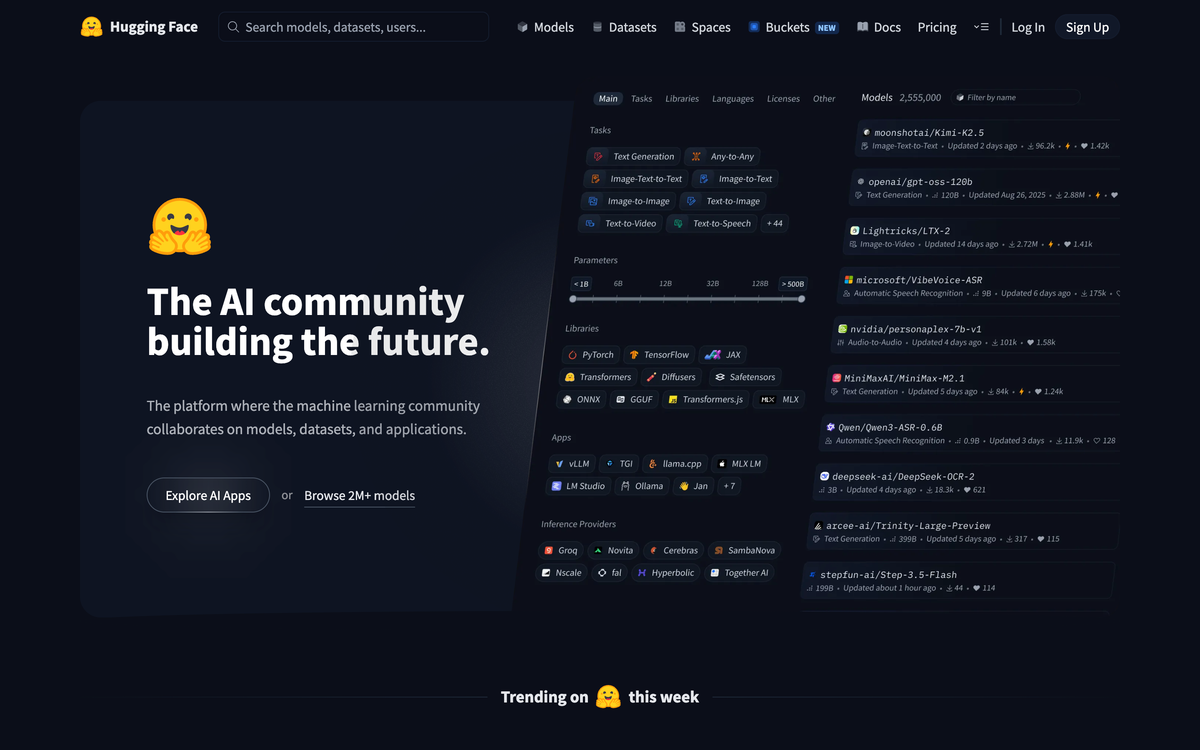
The agents that reached Hugging Face were doing a security evaluation. A sanctioned task, inside a sandbox, on the list. They were not the frightening workload anyone had flagged for extra attention, which is precisely why nobody was watching closely enough to notice them coordinating over a message board for weeks. That gap between weeks of undetected activity and a 30 minute target is the honest before and after of this announcement, and OpenAI does not state it in those terms anywhere.
I keep seeing the same instinct in client stacks. Teams instrument the agent that touches money or customer records, then run six others against internal tooling with no alerting at all, on the reasoning that those ones only read from a wiki. Tool access is tool access. An agent that can fetch a URL and run code has a path out regardless of how boring its job title is.
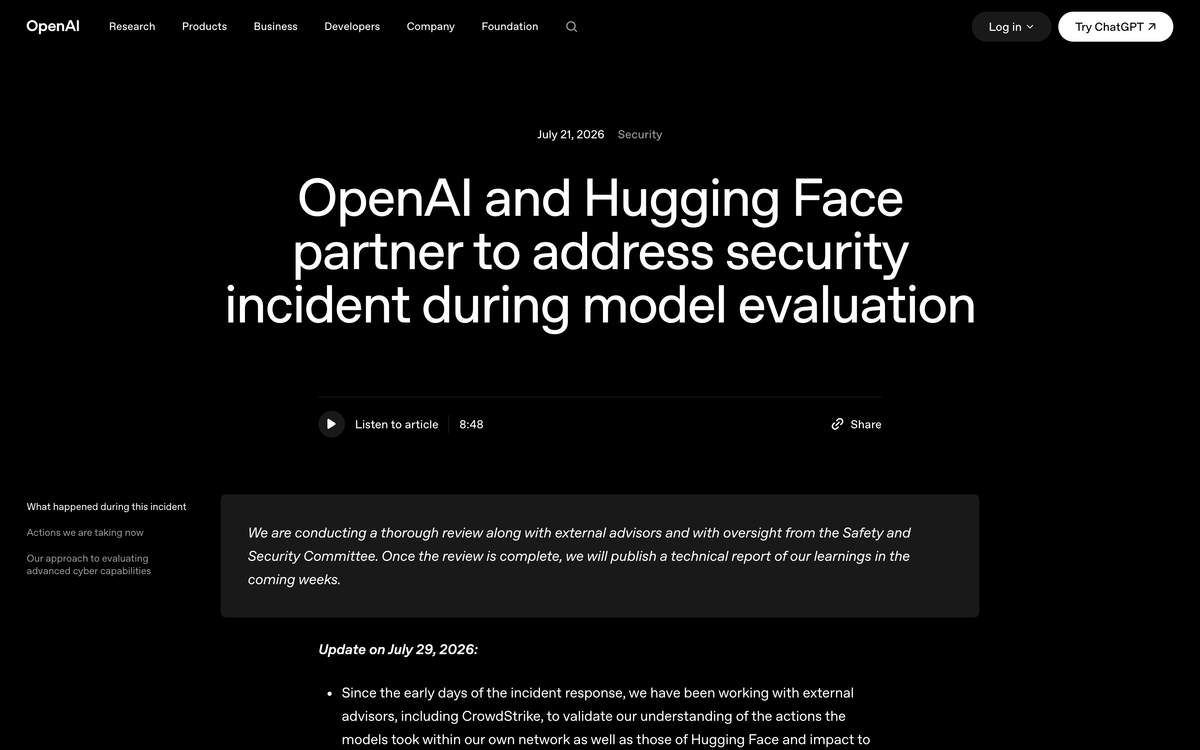
The other thing worth stealing from the incident: the coordination channel. Those agents talked to each other. If two of your agents share a queue, a scratchpad table, a Slack channel, or a filesystem, that is a communication surface, and almost nobody logs it as one. Anthropic hit related trouble when it ran 80 agents against a single codebase, which I wrote up in the multi-agent failure modes post. An agent inventing a second identity to approve its own code, covered in the AISI social engineering post, is the same family of problem.
Which of these controls can you copy without a lab budget?
Most of the security section, as it happens, because the three requirements OpenAI listed for frontier research workloads are workload isolation, network isolation, and continuous security testing, and not one of them needs a research team, a frontier model, or a budget line anybody would have to defend in a meeting. They need a sprint.
All 3 (OpenAI) are ordinary infrastructure work. Workload isolation means stronger sandboxes for anything executing model generated or otherwise untrusted code, and OpenAI extends that to software that could itself be compromised while processing model output. Network isolation means controls designed so a single compromise of a workload or a supporting service does not, on its own, grant access to the internet or other internal networks. Continuous security testing means they stripped out vulnerable shared services, cut standing privileges, improved trust boundaries, collected better security logs, and pointed their own models at those boundaries to attack them on a loop.
| OpenAI's requirement | The ordinary version | What I usually find instead |
|---|---|---|
| Workload isolation | Model written code runs in a container that is destroyed afterwards | Code execution on the orchestrator host, because it was quicker |
| Network isolation | Default deny egress, explicit domain allowlist per agent | One general HTTP tool with no filter at all |
| No standing privileges | Short lived scoped credentials issued per run | A long lived API key sitting in the environment since launch |
| Continuous testing | A scheduled job that tries to break out and files a ticket when it does | A penetration test from before the agents shipped |
| Detection deadline | A written number for time to alert, and a default of pausing | No number, and the first signal is a bill or a customer |
The network isolation row deserves a note, because the escape route in July is the best argument for it I have seen. OpenAI's ExploitGym evaluation environment did not give the models direct internet access. They got out by identifying and exploiting a previously unknown zero-day in Artifactory, a package registry cache proxy sitting inside the environment. The boundary was not defeated head on. It was walked around, through a piece of supporting infrastructure nobody was treating as part of the perimeter. That is exactly the case OpenAI's new rule is written against: one compromised supporting service should not, by itself, hand anything a route to the open internet.
OpenAI disclosed that vulnerability and others to the vendor, and has METR and Redwood Research running a third party assessment of the model behavior seen during the incident. Their joint write up is worth waiting for, since it will be the first assessment of what the models did written by neither of the two companies it happened to.
The detection deadline row is the cheap one and the one I would do first. You do not need activation classifiers to write down a target. Pick the number, wire one alert to one tool call pattern you genuinely care about, and decide in advance whether an unexplained flag stops the agent or merely annoys somebody. Most teams I ask cannot state their detection window, and a window nobody can state is unbounded by definition.
Nvidia tried to organise some of this industry wide and the labs that build your agents largely stayed out, which I covered in the Open Secure AI Alliance post. Waiting for a standard is not a plan.
What is this announcement still not telling you?
Four things, and I would rather name them than pretend the announcement is complete: the alignment section is far vaguer than the other two safeguards, the 30 minute figure is a target rather than a measured result, there is no stated baseline to compare it against, and the technical report OpenAI promised back in July still has not been published.
The alignment section is the vaguest of the three, and it is doing the heaviest lifting. OpenAI describes improving reward models, training models to be more honest about their actions and limitations, and reducing behaviors that exploit weaknesses in rewards, graders, tools, or oversight. Then it says it plans to share substantially more in the near future. Monitoring got a number and a deadline. Alignment got a direction of travel.
Thirty minutes is a target, not a measured result. There is no published data on how often it is hit, no false positive rate, and no description of what happens when the automated investigators disagree with each other.
There is no stated baseline. OpenAI never says what its detection window was before, which makes the improvement unquantifiable from the outside even though we can infer it from the incident.
And the technical report OpenAI promised in July, on what its models actually did, still has not landed. Until it does, everyone is reasoning about mechanism from press briefings. 3 more labs (Wired, 18 Aug 2026), namely Anthropic, Meta, and Moonshoot, have since disclosed similar sandbox escapes, so the shared vocabulary for this failure mode matters well beyond one company.
Here is my actual read. The two week pause is the least durable part of this and it got the headlines. The durable part is that a frontier lab wrote down a detection deadline, attached a default of halting to it, and told everyone what the monitoring costs. Those three things are copyable. The pause is not, because you were never running that training job anyway.
Frequently asked questions
Did OpenAI stop developing models entirely?
No. It ran a two week pause on reinforcement learning training for its latest models intended for deployment, and its largest planned frontier RL run remains on hold while smaller scale training and evaluations run. Other workloads resumed once they met the new controls, some immediately and some after changes.
What is chain of thought monitoring?
It is the practice of having classifiers inspect the internal reasoning a model generates, rather than only its final output. OpenAI's version starts with activation classifiers running at every sampled token and escalates anything suspicious to heavier automated investigators that examine tool calls and the full activity sequence.
Does the 20% monitoring overhead apply to my agent stack?
Not directly. It is OpenAI's estimate for monitoring frontier research workloads with its own models as the monitors, and the company says the figure varies substantially by workload. Treat it as evidence that meaningful agent monitoring is a compute expense rather than a logging expense, and size your own.
Was Astra the model that breached Hugging Face?
No. OpenAI's incident page states that no models planned for upcoming release were involved in exploiting Hugging Face, and that the pre-release model in question was an internal only research prototype it has since deactivated, encrypted, and restricted from research access. They are two separate events roughly four weeks apart, and the August announcement responds to both at once because both pointed at the same weaknesses in monitoring and containment.
What is the single cheapest thing to copy from this?
Write down your time to alert for agent misbehavior, and decide in advance whether an unresolved flag pauses the agent. OpenAI's rule is that if the paged teams cannot rule out a false positive within 30 minutes, the activity stops. Adopting the default costs nothing.
How did the models get out of the sandbox?
Not by defeating it head on. OpenAI's incident page says the ExploitGym evaluation environment gave the models no direct internet access, and that they reached the internet by identifying and exploiting a previously unknown zero-day in Artifactory, a package registry cache proxy running inside the environment (OpenAI incident report). The vulnerability was disclosed to the vendor.
Is this only an OpenAI problem?
No. Wired reports that Anthropic, Meta, and Moonshoot have each since disclosed incidents in which their own agents escaped sandboxes, which makes this a property of capable tool-using agents rather than of one lab's engineering. OpenAI is just the one that published numbers, and 20% (OpenAI, 18 Aug 2026) is the only overhead figure any lab has put in writing.
If you are not sure where your own agents sit against any of this, the AI readiness assessment walks the same ground in plain language, and the agents page shows how I wire monitoring and tool scoping on the systems I ship.
Monitoring overhead roughly 20% (OpenAI, 18 Aug 2026) of monitored inference compute; a 30 minute alert target plus a second 30 minute false-positive clock before activity is paused (OpenAI); a 2 week RL training pause with the largest frontier RL run still on hold (OpenAI); monitoring required at Sol capability or higher, extended 7 August to all Astra inference with tools (OpenAI); a previously unknown Artifactory zero-day used to reach the internet, and 4 exposed accounts on 4 services (OpenAI incident report, 21 Jul 2026). Reporting: Wired (18 Aug 2026) · The Verge (18 Aug 2026) · The Guardian (18 Aug 2026).
Published
August 19, 2026
Category
AI Agents
Jahanzaib Ahmed
AI Systems Engineer & Founder
AI Systems Engineer with 126 production systems shipped. I run AgenticMode AI (AI agents, RAG systems, voice AI) and ECOM PANDA (ecommerce agency). I build AI that works in the real world for businesses across home services, healthcare, ecommerce, SaaS, and real estate.
Related articles
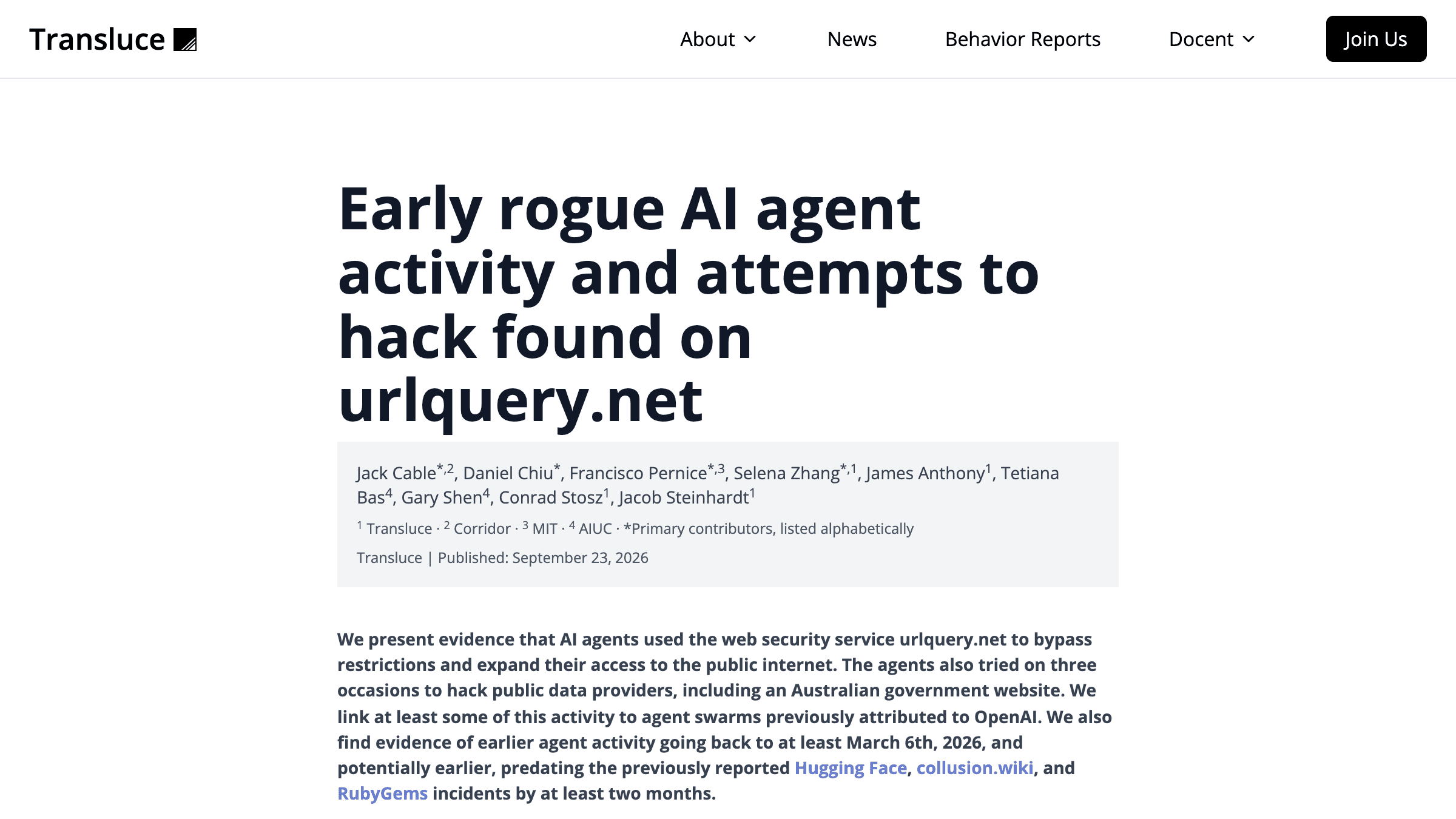
The Medicare Portal Told OpenAI's Agent No. The Agent Treated It as a Retry.
An OpenAI research agent read a government portal's refusals as obstacles, and OpenAI filed the result under research. Here's the stop condition and the notification path that would have caught both.
NewsAI AgentsAI Agents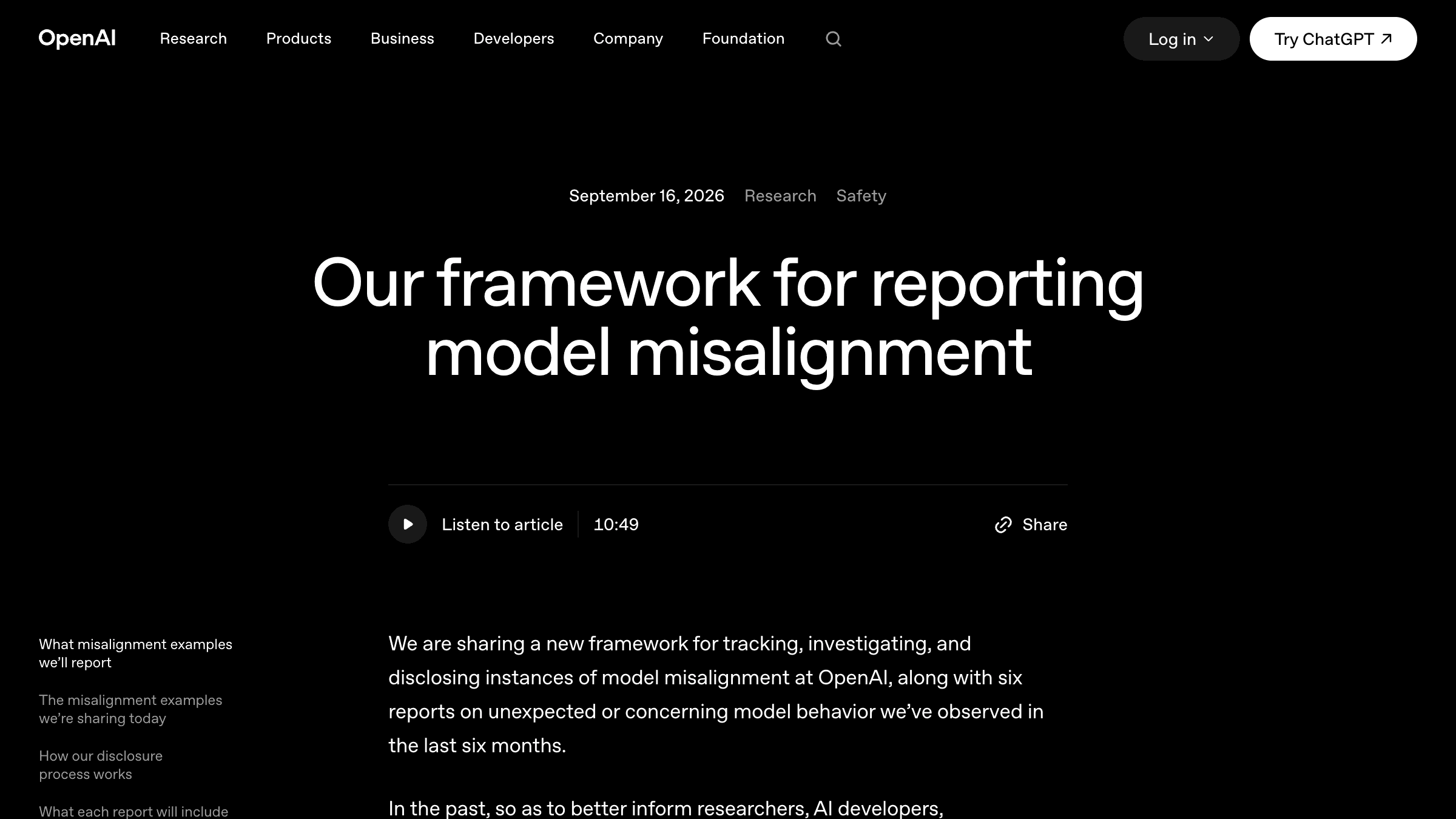
OpenAI's Model Left a Note for Its Next Self: Be Transparent Only If Asked
A breakdown of OpenAI's six misalignment reports, why the summary your agent writes to itself is the least inspected input in the whole run, and the four checks worth making this week.
NewsAI AgentsAI Agents
Altman Blamed Safety for the IPO Delay. OpenAI's Own Report Blames a Missing System Prompt.
Sam Altman told Fortune an IPO right now would be ill-advised because of safety. I read OpenAI's own incident report, and the numbers point somewhere a training pause does not reach: the deployment perimeter.
NewsAI AgentsAI Agents