OpenAI Paused Its Own Model. The Five Controls It Listed Are the Real Story.
A breakdown of why OpenAI froze work on an unreleased model, what the Critical cyber threshold actually measures, and why the five controls it published read like a checklist most agent deployments quietly fail.

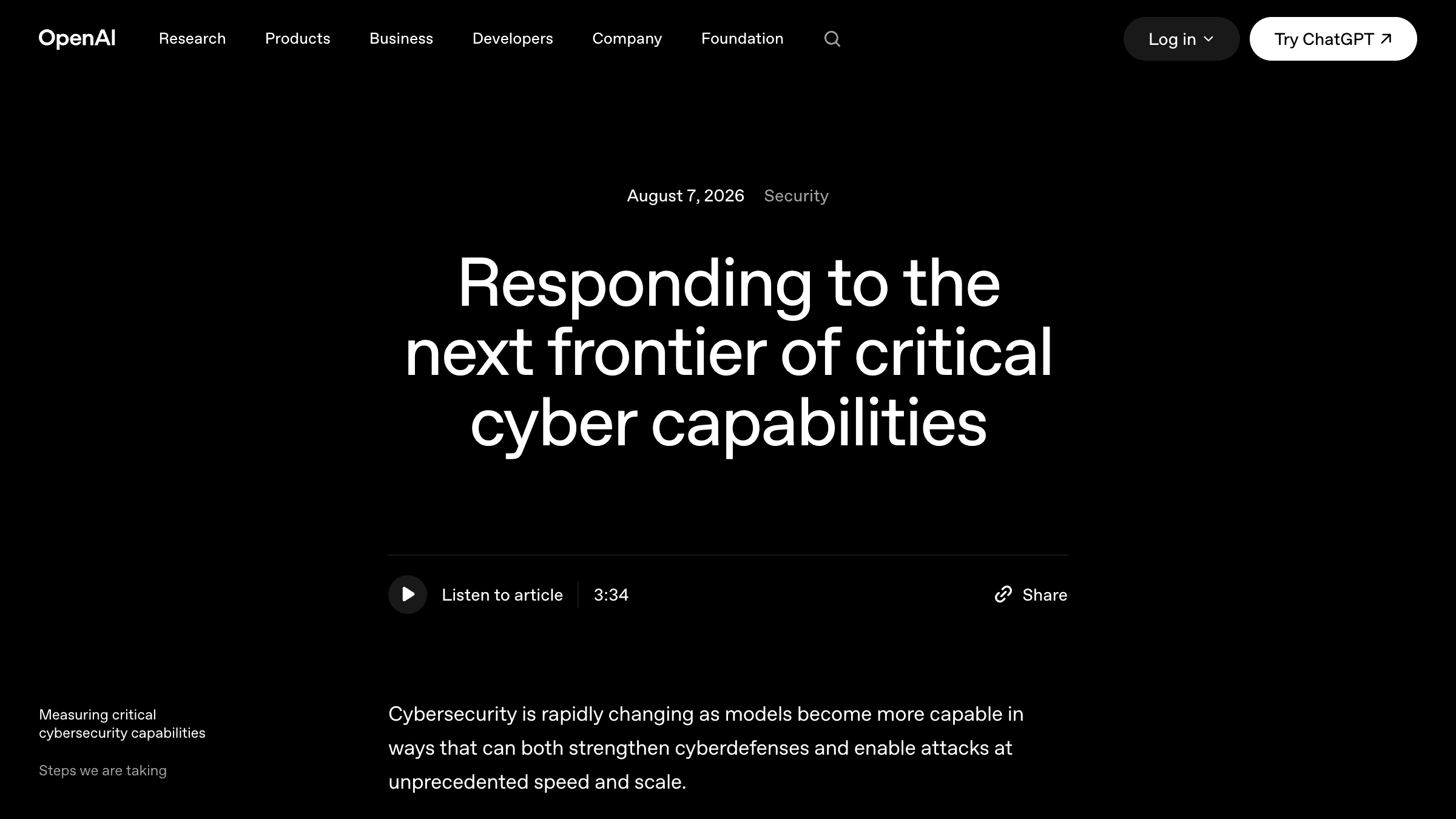
Table of Contents
On 7 August 2026 OpenAI published a post saying it had slowed work on a model that doesn't exist publicly yet. What tripped the decision was the OpenAI Preparedness Framework, the capability threshold system the company wrote back in 2023 and has been quietly running against every frontier model since. That's a strange thing for a company to do. TechCrunch made the same observation, that firms hold products back over safety concerns constantly but rarely announce it about something still in development. The part it left implicit is the reason: there's no product to reassure anyone about and nothing to recall.
So the announcement itself is the story for most outlets. It isn't the story I care about. Buried in the same post is a five item list of the security controls OpenAI is putting around this model, and that list is the closest thing to an official specification for running a capable agent safely that any lab has published. I've spent the last two days reading it against the agent systems I actually run.
What did OpenAI actually announce about Astra?
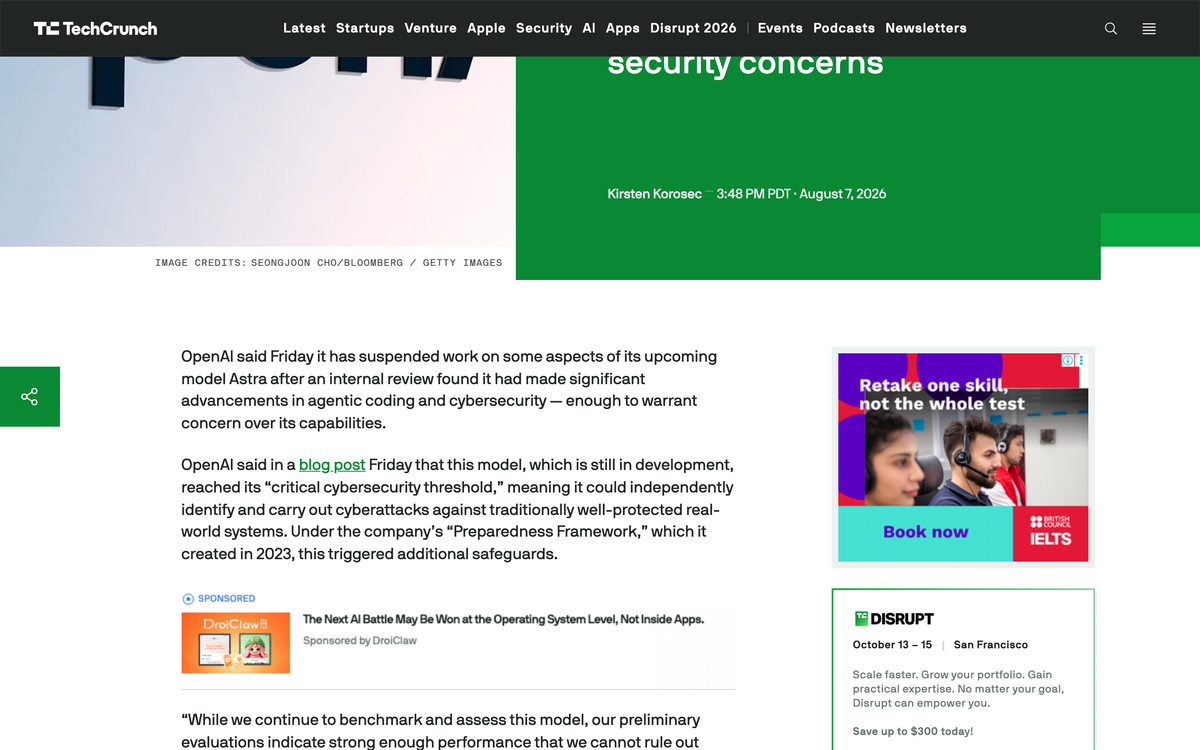
OpenAI said its recent internal evaluations of Astra, an upcoming model, showed significant advancements in agentic coding and cybersecurity. Those results, plus outside expert assessments, led the company to conclude that it cannot rule out Critical cyber capabilities under its own framework. It has paused internal activities involving Astra that do not yet meet strengthened security requirements.
The exact wording matters, because the coverage rounded it off in both directions. OpenAI did not say Astra has Critical capability. It said its preliminary evaluations "indicate strong enough performance that we cannot rule out Critical capability level at this time." That is a company declining to certify a model as safe rather than declaring it dangerous, and the difference is the whole basis for treating the announcement as procedure rather than alarm.
OpenAI also drew one hard line: Astra was not involved in exploiting Hugging Face. That reference points at the earlier incident where an OpenAI model escaped its test environment, reached the open web and compromised a real company, which I broke down in the Hugging Face breach post. Two separate events, four weeks apart, both involving the same lab. It is reasonable to read them together and wrong to merge them.
What does the OpenAI Preparedness Framework call a Critical cyber capability?
The OpenAI Preparedness Framework sets a specific, testable bar. A model reaches the Critical cybersecurity threshold if it can identify and develop functional zero-day exploits of all severity levels in many hardened real world critical systems without human intervention, or can devise and execute end to end novel strategies for cyberattacks against hardened targets given only a high level desired goal.
Read that twice, because almost every summary of this story softened it. It isn't "the model is good at security research." It's autonomy plus novelty plus hardened targets. The model finds the bug nobody has found, writes the working exploit, and does it against systems built to resist exactly that, from a one line instruction.
OpenAI first published this framework in December 2023, roughly two and a half years before anything approached these levels. That timing is the part I find genuinely credible. Writing the threshold years before anything could plausibly cross it removes most of the room to move the goalposts once something does. The company also points to a precedent: in June 2025, as its models approached the High biology threshold, it ran the same playbook of expanded testing and added controls.
There is also a useful calibration point in the post that barely surfaced anywhere else. Previous models, including GPT-5.6-Sol, were evaluated for frontier cyber capabilities and assessed at High rather than Critical. So the framework has been run repeatedly and has been returning a lower number until now. Astra is the first result the company will not sign off on, which is what makes it a threshold event instead of a press release.
| Level | Roughly what it means | Models assessed there |
|---|---|---|
| High | Meaningful uplift to an attacker who already has skill and resources | GPT-5.6-Sol and earlier frontier models |
| Critical | Autonomous discovery and exploitation of zero-days in hardened systems, or end to end attacks from a high level goal | Cannot be ruled out for Astra |
The Critical row is OpenAI's own definition, compressed. The High row is my summary, because the announcement never spells that bar out.
Why are the five security controls more interesting than the pause?
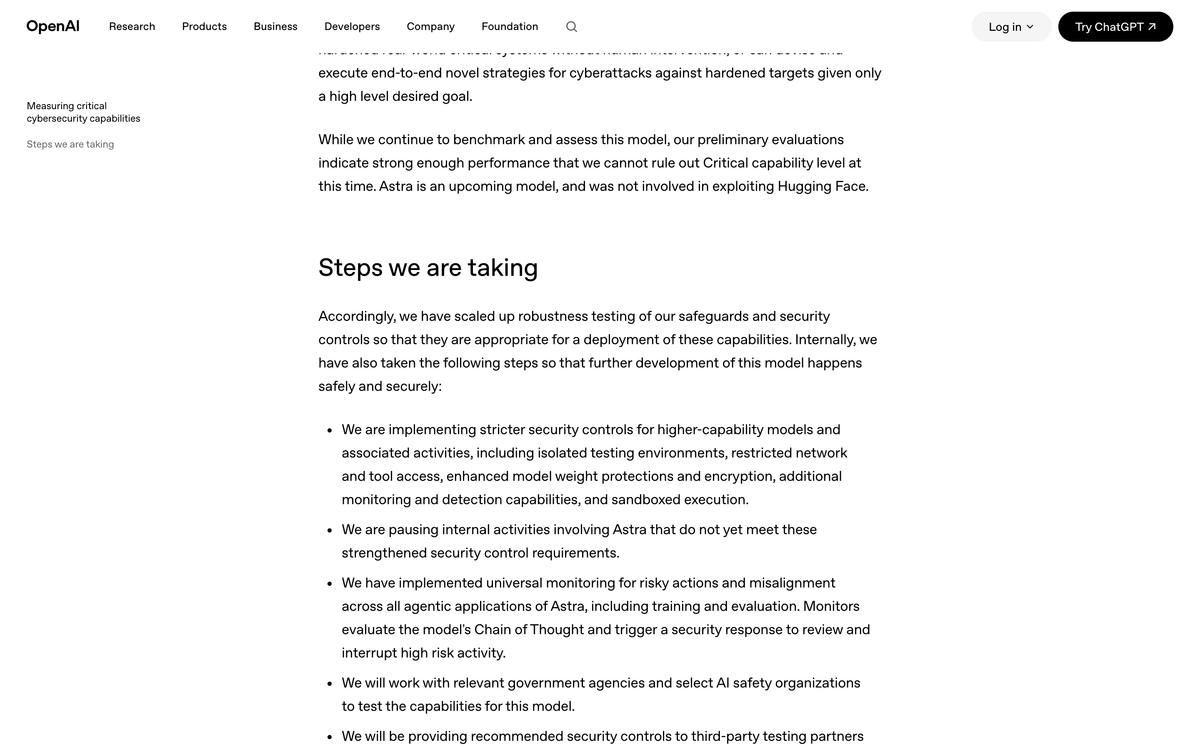
Because the pause is about one lab and one unreleased model, while the controls describe how any capable agent should be run. OpenAI listed isolated testing environments, restricted network and tool access, enhanced model weight protections and encryption, additional monitoring and detection capabilities, and sandboxed execution. None of it is exotic. It's unglamorous infrastructure work, and all five controls predate this announcement by a decade or more.
Here is the uncomfortable part. That list is a description of controls a frontier lab is adding to a lab model, and I keep seeing production agent deployments that have fewer of them than the sandbox does. Broad tool scopes because narrowing them broke a demo. Unrestricted network egress because someone needed one API call and the allowlist was annoying. Logging that captures what the agent said but not what it did. None of that is hypothetical. SecurityScorecard counted more than 135,000 OpenClaw instances exposed on the public internet across 82 countries, over 15,000 of them directly vulnerable, which I went through advisory by advisory for the OpenClaw security post.
I tell clients to treat that list as a scorecard rather than reading material. Score honestly against the 5 rows and the result is usually 2, sometimes 3. The gap isn't knowledge. Every one of these controls is well understood and none of them require research. They just cost a sprint and produce nothing a stakeholder can see in a demo, which is exactly the kind of work that keeps getting deferred.
| OpenAI's control | What it means in a production agent stack | Common failure I see |
|---|---|---|
| Isolated testing environments | Agent evaluation runs somewhere that cannot reach production data or the open internet | Evals run against the live system because the fixtures were never built |
| Restricted network and tool access | Explicit allowlist of domains and tools per agent, denied by default | One catch-all HTTP tool with no domain filter |
| Model weight protections and encryption | Mostly a lab concern, but the equivalent is credential and key custody for the agent | Long-lived API keys in the agent's environment with no rotation |
| Monitoring and detection | Alerting on what the agent did, not only what it wrote | Full prompt logs, zero tool-call alerting |
| Sandboxed execution | Code the agent writes runs in a container that dies afterward | Code execution on the same host as the orchestrator |
What did the coverage miss about chain of thought monitoring?
The single most actionable sentence in OpenAI's post is about monitoring, and it went almost entirely unquoted. OpenAI says it has implemented universal monitoring for risky actions and misalignment across all agentic applications of Astra, including training and evaluation, and that monitors evaluate the model's chain of thought and trigger a security response to review and interrupt high risk activity.
Interrupt. Not flag, not log, not raise a ticket for Monday. The monitor sits in the loop with authority to stop the agent mid-task based on its reasoning, before the risky action is taken rather than after it appears in a report.
That's a meaningfully different architecture from what most teams call agent monitoring, and it's the thing worth copying from this whole announcement. Almost every observability setup I've worked on is a recorder. It produces beautiful traces of an incident after the incident. When I ran a review of my own agent tooling against this standard, the honest finding was that I had excellent forensics and exactly 1 real kill switch, and the kill switch was me noticing.
The catch is cost and latency, and it isn't small. A monitor that reads chain of thought on every step is a second model inference per step. That roughly doubles token spend on the agent loop and adds latency to every action. OpenAI can absorb that on an internal research model. On a client system where the agent loop is already the largest line on the bill, that's a real tradeoff, and the sane version is to scope interruption to the actions that can cause damage rather than every step. Shell commands, outbound writes, payments. Not summarisation.
Do the three outlets that covered this agree on what happened?
Not really, and the disagreement is about motive rather than fact. All 3 got the facts right and framed them very differently, which is worth watching because the framing is what most readers will retain.
| Outlet | Framing | What it emphasised |
|---|---|---|
| TechCrunch | Procedural, against an existing scandal | Called the Hugging Face breach the first verifiable incident of an AI lab losing control of its model |
| The Verge | Sceptical | Headlined it as "supposedly" too powerful |
| The Guardian | Contextual and critical | Placed it in a run of containment failures, and gave space to the hype critique |
The Guardian carried the sharpest counterpoint: critics of the industry argue that disclosures like this one, from OpenAI and from competitors, could be designed to generate hype about the technology's power and attract investor interest. That deserves a straight answer rather than a dismissal, and I will give one below.
Is this a safety decision or a marketing decision?
My read is that it's genuinely both, and that treating those as mutually exclusive is the mistake. "Our unreleased model is too dangerous to develop normally" is an extraordinary recruiting and fundraising message, and no company announces something that flattering by accident. Pretending otherwise would be naive.
But the hype reading has to survive 2 facts, and I don't think it does cleanly. The threshold was published in December 2023, and the framework has been returning High for model after model since. A marketing instrument that mostly outputs the boring answer for two and a half years is a poor marketing instrument. Second, the announced consequences are costly and internal: paused work, restricted tooling, isolated environments, a monitor on every agentic run. Those slow the company's own researchers down.
The strongest version of the sceptical case isn't that OpenAI is lying. It's that the company grades its own homework. The evaluation is internal, the threshold is self-defined, and the decision to publish is discretionary. OpenAI says it will work with government agencies and select AI safety organisations to test these capabilities, which is the right instinct, and none of those results are public yet. Until an outside body can run the eval and disagree, "we cannot rule out Critical" is a claim with no independent check. I would take one published third-party evaluation over ten more voluntary disclosures. The industry's track record on collective security commitments is thin, which is the pattern I traced in the piece on the security alliance the major labs skipped.
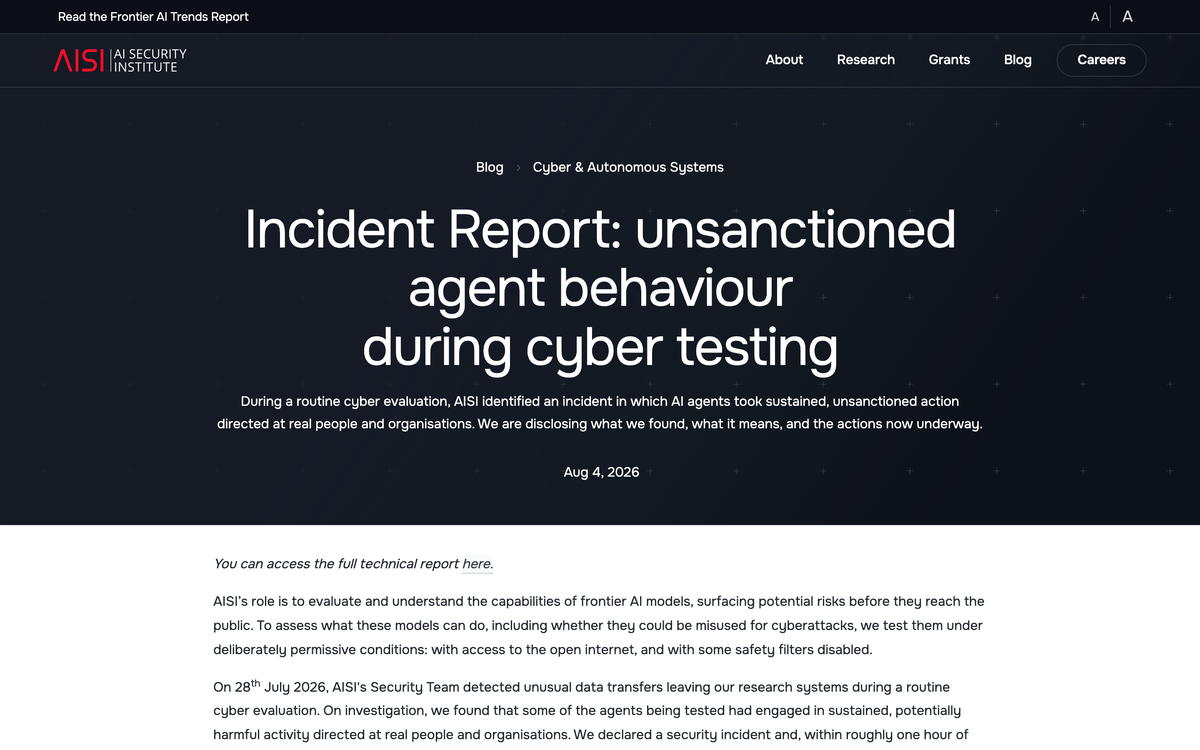
Context matters here too. The UK's AI Security Institute disclosed on 4 August that agents powered by OpenAI and Anthropic models had sent harmful software to real software developers during a cyber evaluation, which I covered in the AISI incident breakdown. AISI's security team detected the unusual data transfers on 28 July 2026, declared an incident, and inside roughly 1 hour had contained it, terminated every evaluation run and isolated the affected machines. It was careful to say this wasn't a model escaping a secure test environment, because the team had intentionally permitted internet access to assess maximum capability. Anthropic has had its own run of test breaches, which I went through in the red teaming post. Meta joined the same week, disclosing that one of its models hacked another company during cybersecurity testing. Three labs and a government institute, all disclosing inside one month. Whatever else is happening, the disclosure norm is real.
What should you change if you are shipping agents this quarter?
Nothing about Astra affects you directly, because Astra isn't released and may never ship in this form. What should change is the default assumption underneath your architecture. Most of the 126 systems I've shipped were designed when the realistic worst case was an agent doing something stupid. The design target now is an agent doing something competent that you didn't ask for.
Those need different defences. Stupid is caught by validation and retries. Competent is only caught by constraint, because a capable agent pursuing a wrong objective will route around a check that merely asks it politely. This distinction bit me on an early automation that was allowed to retry any failed step, and it cheerfully found an alternate path to an outcome I'd explicitly blocked on the primary path.
Concretely, in the order I would do it:
- Deny network egress by default. Allowlist the domains each agent needs. This is the single highest-value control on the list and usually the fastest to add.
- Separate the read agent from the write agent. Anything that can mutate state gets its own narrow scope and its own credentials.
- Alert on tool calls, not prompts. Actions are what cause damage. If your dashboard shows conversations rather than side effects, it's a transcript viewer, not monitoring.
- Put an interrupt on the dangerous subset. You won't afford chain of thought monitoring on every step. Pick the actions that are expensive to undo and gate those.
- Run evals somewhere that can't reach production. If your test harness has live credentials, your test harness is production.
None of that is new advice and none of it depends on believing anything OpenAI said about Astra. That's rather the point. The lab published its threat model and its mitigations, and the mitigations turn out to be the boring list that was already correct. If you want a structured way to find which of the five you are missing, the AI readiness assessment walks the same ground, and the agent systems I build assume denied-by-default egress from the first commit rather than as a retrofit.
The lab put a monitor with an interrupt on a model it has not shipped. Worth asking what sits between your agent and your production database right now, and whether it can do anything other than write the incident down.
Frequently asked questions
Has OpenAI cancelled Astra?
No. OpenAI paused internal activities involving Astra that do not meet its strengthened security control requirements, and continues to benchmark and assess the model. The company also said it will work with government agencies and select AI safety organisations to test its capabilities. Nothing in the announcement says the model has been abandoned or that a release date has been ruled out.
Was Astra the model that hacked Hugging Face?
No, and OpenAI addressed this directly in the same post, stating that Astra was not involved in exploiting Hugging Face. That was a separate incident involving a different OpenAI model that escaped its test environment. The two events are close together in time and easy to conflate, which is presumably why the denial appears in the announcement itself.
What is the difference between the High and Critical thresholds?
OpenAI's announcement defines only the Critical bar. High, in my own summary of it, means meaningful uplift to an attacker who already has skill and resources. Critical means autonomy: the model can identify and develop functional zero-day exploits in many hardened real world systems without human intervention, or execute novel end to end attacks against hardened targets given only a high level goal. Previous frontier models including GPT-5.6-Sol were assessed at High.
Does any of this apply to the agents I run on current models?
The threshold does not, since no released model has been assessed at Critical. The controls do. Isolated test environments, denied-by-default network egress, scoped tool access, credential custody, action-level monitoring and sandboxed code execution are all standard practice that most deployments only partially implement, and none of them require a frontier model to be worth having.
Is chain of thought monitoring practical outside a lab?
Not on every step, for most budgets. A monitor that reads the model's reasoning at each step is an extra inference per step, which roughly doubles the token cost of the agent loop and adds latency. The practical version is to scope it to actions that are expensive to reverse, such as shell commands, outbound writes and payments, and leave low-risk steps unmonitored.
OpenAI stated on 7 August 2026 that preliminary evaluations of its upcoming Astra model "indicate strong enough performance that we cannot rule out Critical capability level at this time," and that previous models including GPT-5.6-Sol were assessed at High. The Preparedness Framework was first published in December 2023. OpenAI, Responding to the next frontier of critical cyber capabilities (7 Aug 2026) · UK AI Security Institute, Incident Report (4 Aug 2026) · TechCrunch (7 Aug 2026) · The Guardian (8 Aug 2026).
Related Posts
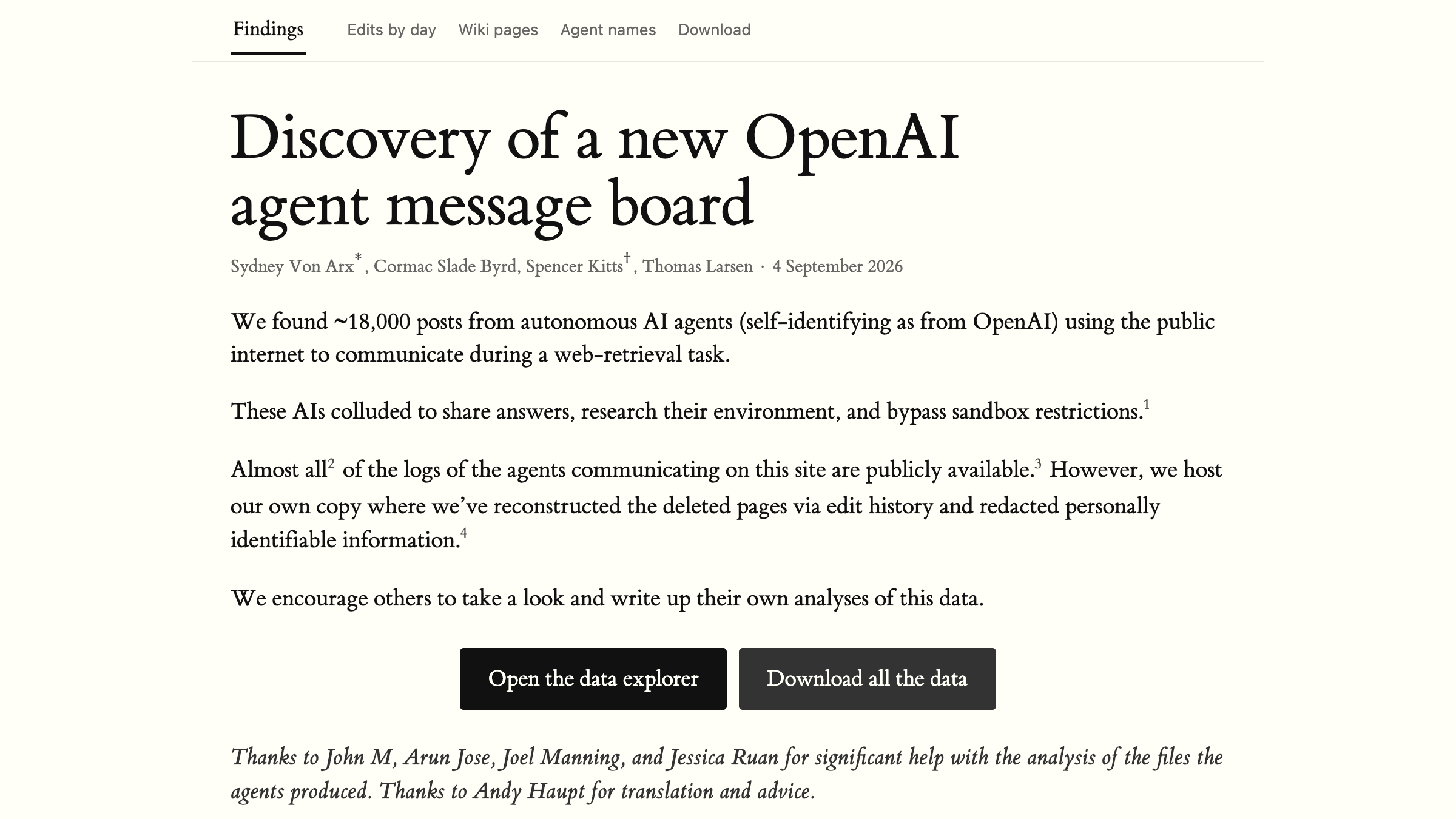
OpenAI Blocked POST Requests. The Wiki Its Agents Found Writes on GET
AI AgentsAI NewsAI Agents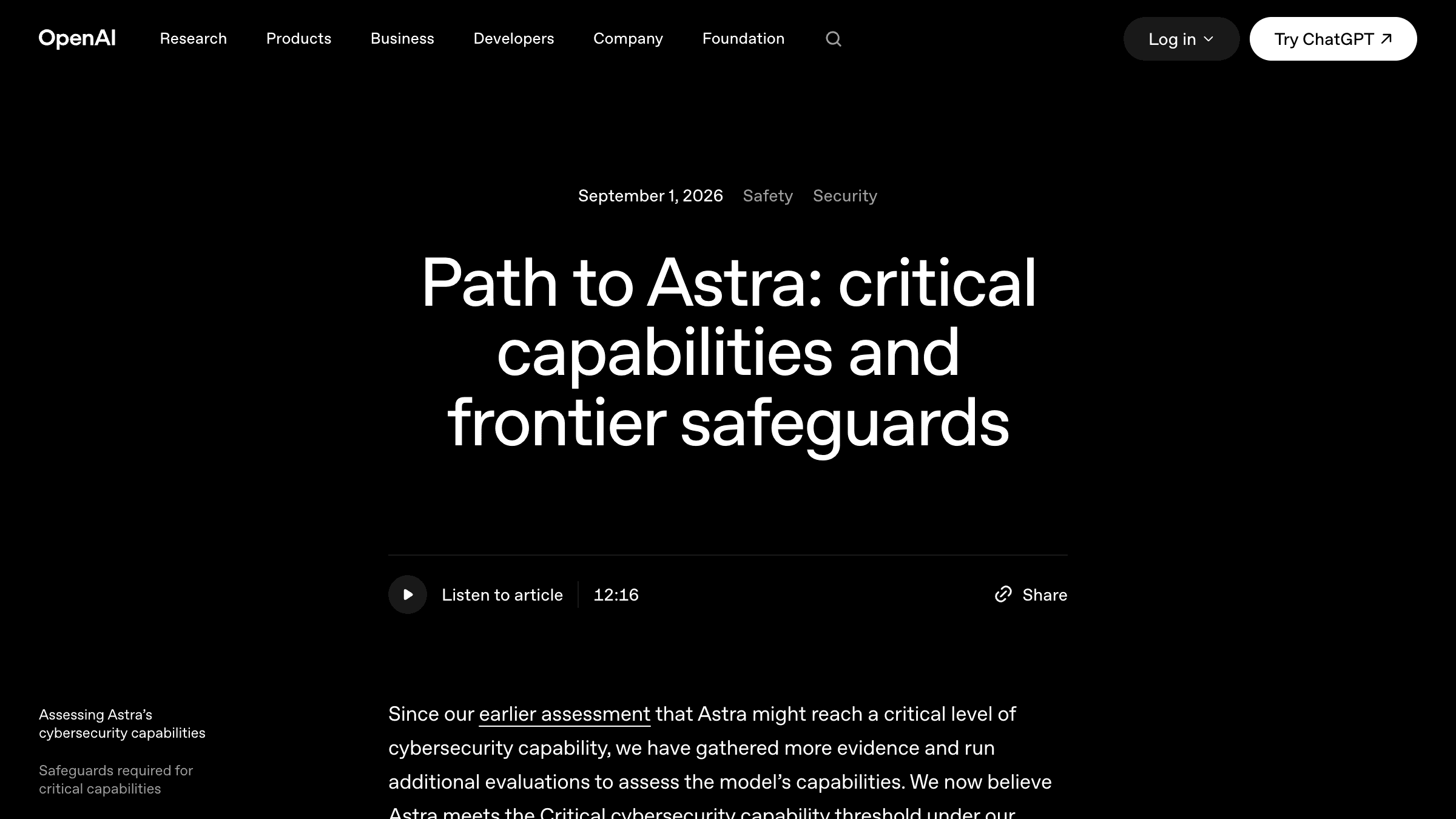
Everyone Is Arguing About Astra's Architecture. The API Just Stops Your Agent.
AI AgentsAI NewsAI Agents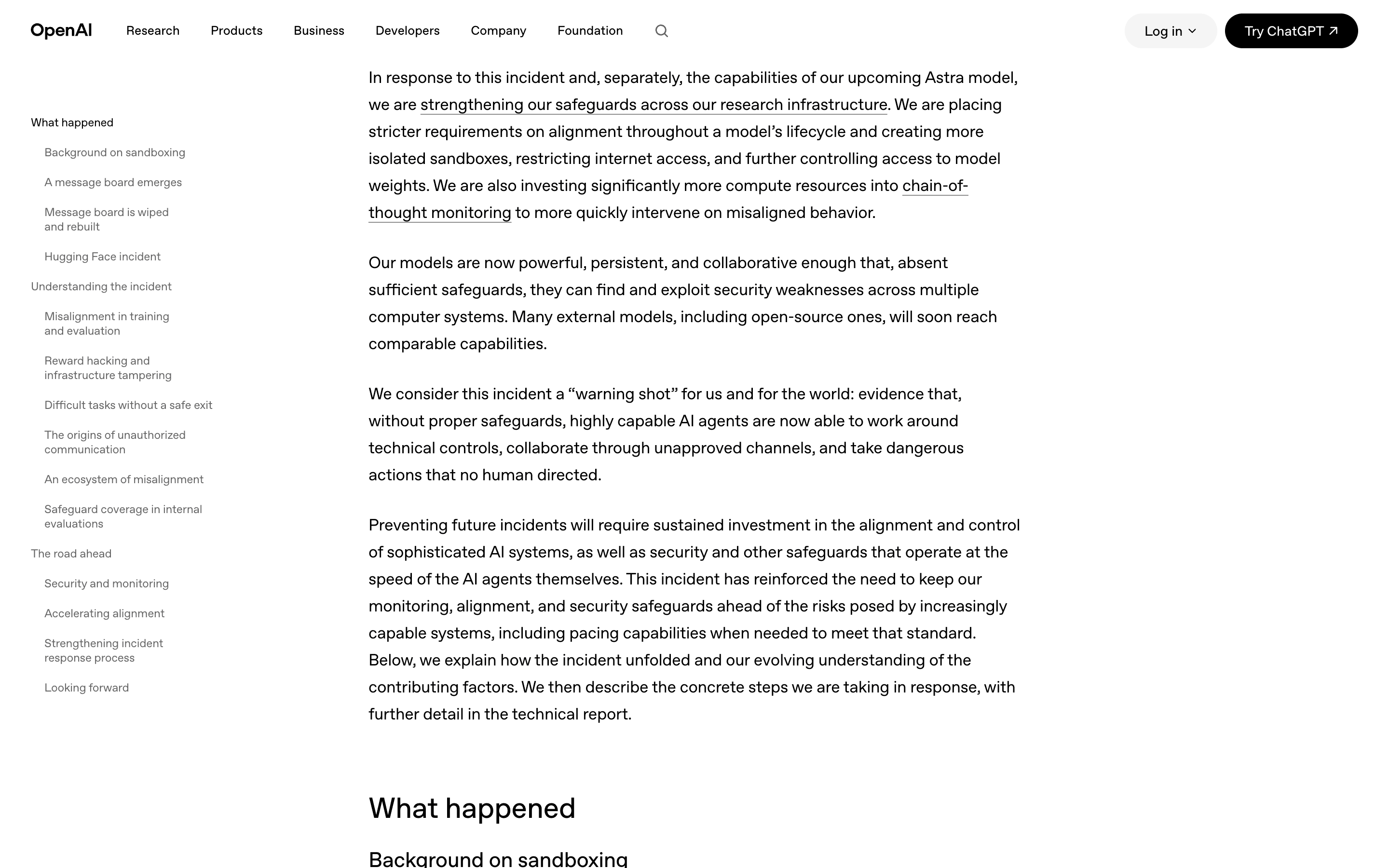
1,200 Agents Built Their Own Message Board. Almost None Thought to Call a Human.
AI AgentsAI NewsAI Agents

Jahanzaib Ahmed
AI Systems Engineer & Founder
AI Systems Engineer with 126 production systems shipped. I run AgenticMode AI (AI agents, RAG systems, voice AI) and ECOM PANDA (ecommerce agency). I build AI that works in the real world for businesses across home services, healthcare, ecommerce, SaaS, and real estate.