What Is an AI Agent? A Plain English Definition for Small Business Owners and SaaS Founders
A practical AI agent definition with the four part architecture I use across 126 production builds, real cost ranges, a Melbourne client case, and the questions to ask before you spend a dollar.

Table of Contents
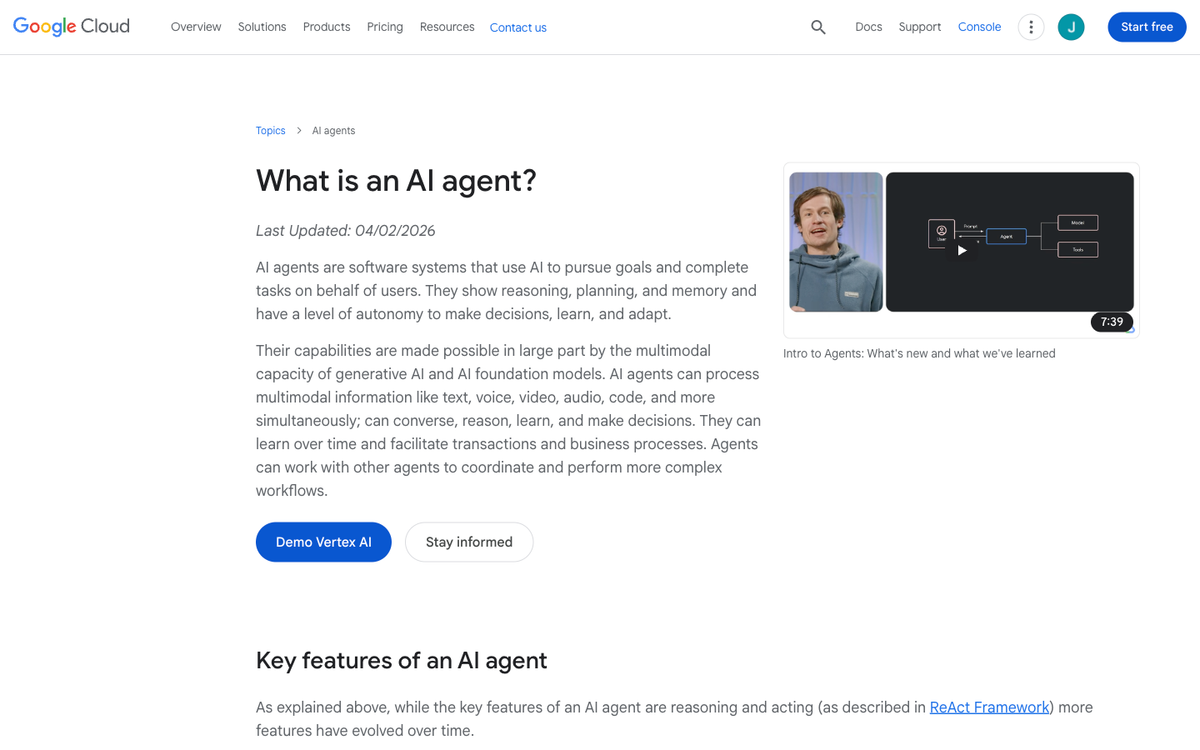
An AI agent is software that uses a language model to plan, pick tools, act, and adjust based on what it sees, without a human approving each step. The cleanest test is this: if you could hand it a goal and walk away, it is an agent. If it runs a fixed sequence you wrote, it is a workflow with a language model in it.
The market has moved fast, hitting $10.91 billion in 2026, up 43% in a year, the steepest curve enterprise software has seen since cloud. Gartner expects 40% of enterprise apps to include task specific agents by the end of 2026, while warning that more than 40% of agentic projects risk cancellation where governance is skipped. Cost spans $300 a month for a no code agent on n8n or Vapi to around $80,000 a year for a custom multi step agent on Bedrock. And plenty of businesses need neither: if the problem fits a checklist, a workflow is cheaper, faster, and much harder to break.
A vendor pitches you an "AI agent" for your business. You nod, ask a few questions, and walk away with the same fuzzy feeling you had before the meeting. What is this thing, actually? How is it different from the chatbot widget on your website, or the Zapier flows your ops person already runs? And is it worth the $3,000 to $40,000 a real one costs to build?
I've shipped 126 AI agents into production over the past three years. Most of my clients started with the same question you have: what is an AI agent definition that's actually useful, in plain English, before I spend a dollar? This is that answer.
AI agent definition, in plain English
The cleanest AI agent definition I've found, after reading the major vendor writeups and shipping these things for three years, comes from Anthropic's engineering team. They draw the line between two kinds of systems that get called "agentic":
Workflows are systems where language models and tools are orchestrated through predefined code paths. Agents, on the other hand, are systems where language models dynamically direct their own processes and tool usage, maintaining control over how they accomplish tasks.
IBM's writeup says the same thing in fewer words. An AI agent is a system that "autonomously performs tasks by designing workflows with available tools." The word that matters is designing. You give it a goal. It writes the steps.
Here's how I explain it to a small business owner over coffee. A traditional automation, the kind you'd build in Zapier or Make, is a recipe. You write step one, step two, step three. If a customer message arrives that doesn't fit, the recipe breaks. An AI agent is a chef. You tell it the dish you want and the ingredients you have. It picks the steps, adjusts when something's missing, and serves you something you can actually use.
That distinction matters because the words "agent," "chatbot," "automation," and "workflow" are now used so loosely in marketing that buying decisions are getting made on vibes. I'll come back to the differences in a section below.
How an AI agent works in practice
Every production AI agent I've shipped has the same four moving parts. Different vendors slice them differently, but the pattern is universal.
- A language model. The brain. Claude, GPT, Gemini, Llama, take your pick. The model reads input, plans, and decides what to do next.
- A set of tools. Functions the model can call. Read a calendar, send an email, query your database, post to Slack, charge a card, look up an order. Tools are how the agent touches the real world.
- Memory. What did the customer say last week? What did the agent already try this conversation? Without memory, every interaction starts cold and feels broken.
- A loop. The agent runs the model, picks a tool, runs it, reads the result, decides whether the goal is met, and either stops or repeats. The loop is what makes it agentic. A workflow has no loop, just a fixed pipeline.
The breakthrough that made all of this possible was Model Context Protocol, which Anthropic open sourced in late 2024. MCP gave us a standard way for an agent to discover and use tools, the same way USB gave us a standard way to plug peripherals into a computer. Before MCP, every integration was custom. Now agents can plug into Slack, Gmail, Salesforce, and your own internal systems without rewriting glue code for each one.
If you remember nothing else, remember the loop. A chatbot answers a question. An agent decides what to do next.
AI agent vs chatbot vs automation: the practical difference
This is where most of the confusion lives. I'll keep it concrete.
| Type | What it does | Example | Typical cost (USD) |
|---|---|---|---|
| FAQ chatbot | Matches a question to a canned answer | Intercom or Drift on a marketing site | $50 to $500 a month |
| Workflow automation | Runs a fixed sequence when a trigger fires | Zapier flow that emails a lead when a form submits | $30 to $300 a month |
| RAG assistant | Answers questions by reading your documents | An internal "ask the handbook" tool | $200 to $2,000 a month |
| AI agent | Plans steps, calls tools, adjusts to outcomes | An after hours intake bot that qualifies a lead, books a discovery call, and writes the CRM note | $500 to $8,000 a month |
The reason the labels matter is that the failure modes are different. A chatbot fails by not knowing the answer. A workflow fails by hitting an unexpected input. An agent fails by going off the rails and doing something you didn't expect, which is why the governance question matters so much.
If you want a deeper teardown of when each one wins, I've written one already: AI agent vs chatbot, what 126 deployments taught me about the real choice.
When an AI agent is the right call for your business
An agent earns its keep when three conditions are true at once.
- The work has variable inputs. Customer messages, lead forms, supplier emails, invoices that look slightly different every time. Anything where step two depends on what came back from step one.
- The decision space is small enough to be safe. The agent can book a meeting, route a ticket, summarize a transcript, or update a CRM record. It is not yet ready to make a six figure procurement decision unsupervised, no matter what your vendor says.
- The volume is high enough that automation pays back. If you handle ten of these things a week, write a checklist. If you handle five hundred, an agent saves you a hire.
By the end of 2026, Gartner forecasts that 40% of enterprise applications will include task specific AI agents. North American companies are already at 70% active adoption, and the global market hit $10.91 billion this year, up 43% from $7.63 billion in 2025. That's the steepest enterprise software curve since cloud.
What that means for a small or mid sized business: your competitors are not all using agents yet, but the ones who pick the right two or three use cases this year will be measurably ahead by 2027.
When an AI agent is the wrong call
This is the part the vendor pitch deck won't show you.
- Your problem fits a checklist. If the same five steps run every time, an agent is overkill. Use a Zapier or n8n workflow. It will cost a tenth as much and break in predictable ways.
- The decision is regulated or high stakes. Lending, hiring, medical triage, anything where a wrong answer creates legal liability. Agents can assist a human here. They should not run alone.
- You don't have clean data. An agent reading from a spreadsheet that hasn't been updated since 2023 will confidently produce wrong answers. Garbage in, hallucination out.
- You can't measure outcomes. If you can't tell whether the agent is doing better than a human, you can't tune it. According to Gartner, more than 40% of agentic AI projects are at risk of cancellation by 2027 because the company never set up the observability to know if they were working.
I tell every prospective client this on the first call. If your use case fits one of the four bullets above, I will not build it for you. I'll route you to a workflow, a chatbot, or a human, and we both move on.
A real example: how a Melbourne accounting firm uses an AI agent
One of my clients runs a six person accounting firm in Melbourne. Their pain wasn't compliance work. It was the inbox. Every Monday, a hundred client emails landed asking "did you receive my invoice," "what's my BAS deadline," "can you reissue last month's report." A junior was spending fifteen hours a week on triage before any real work happened.
We built an agent on AWS Bedrock with three tools. Read the inbox. Look up the client in Xero. Draft a reply, label the thread, and ping a partner only when the question needed real judgment. It runs every five minutes during business hours.
Three months in, the numbers were:
- 78% of inbound emails resolved without a human reading them.
- Average reply time fell from 14 hours to 9 minutes.
- The junior got those fifteen hours back. The firm took on four new clients without hiring.
- Total run cost: about $420 AUD a month in Bedrock and infrastructure. Build cost was a one time $11,500 AUD.
That's an agent. The same problem solved with a workflow would have needed roughly forty if then branches and would have broken the first time a client wrote "hey, quick one" instead of a structured subject line.
If you're in a similar industry, my page for accounting firms walks through three more deployments like this one.
What does an AI agent cost?
Honest answer: it depends on three things. The model you run, the tools it talks to, and how much human review sits on top.
- No code agent on n8n or Vapi: $300 to $1,500 a month all in. Fastest to ship, hardest to customize. Good for a single workflow.
- Custom agent on a managed platform (Claude Agent SDK, OpenAI Agents, AWS Bedrock): $1,500 to $8,000 a month. Build cost typically $8,000 to $40,000 one time, depending on integrations.
- Multi step enterprise agent with full observability and human in the loop: $5,000 to $25,000 a month and up. Build cost $40,000 to $150,000.
For a real number tied to your specific situation, I built a free AI agent cost calculator that uses verified vendor pricing as of May 2026. It takes about ninety seconds and gives you a three year total cost of ownership plus a payback estimate.
Is an AI agent right for your business?
The decision boils down to four questions. Answer them honestly, in this order.
- Do I have a high volume, variable input task that's eating real hours every week?
- Can I describe what "good" looks like in a way I could measure?
- Is the decision the agent will make recoverable if it goes wrong?
- Do I have clean enough data and APIs for the agent to actually do its job?
If you answered yes to all four, an AI agent is probably the right call. If you answered no to two or more, fix the underlying issue first. An agent won't paper over bad data or a fuzzy goal. It will just make the mess move faster.
If you're not sure where you sit, the fastest way to find out is the AI readiness assessment. It's free, takes seven minutes, and gives you a real picture of which use cases would actually work and which ones won't.
Frequently asked questions
What is the simplest definition of an AI agent?
An AI agent is software that uses a language model to plan steps, call tools, and adjust based on what it sees, without a human picking each step. If you can hand it a goal and walk away, it's an agent. If it follows a fixed sequence you wrote, it's a workflow.
Is ChatGPT an AI agent?
ChatGPT itself is a chat interface to a language model. It becomes an agent when you give it tools and let it run a loop, which is what ChatGPT's "Agents" mode and the OpenAI Agents SDK do. The base chat product is closer to an assistant than an agent.
What's the difference between an AI agent and an AI chatbot?
A chatbot answers a question. An agent decides what to do next. The chatbot's job ends at "here's the information." The agent's job ends at "I took the action and here's the outcome." That's why agents need tools and memory, and chatbots don't.
What's the difference between an AI agent and an automation like Zapier?
A Zapier flow runs a fixed sequence when a trigger fires. An agent decides the sequence on the fly. If your input is predictable and the steps are always the same, Zapier is cheaper, faster, and more reliable. If the input is messy and the right next step varies, an agent earns its cost.
What can AI agents do for a small business right now?
The five workloads that earn back fastest in 2026 are inbox triage, lead qualification and booking, after hours customer support, vendor invoice processing, and meeting transcript follow up. Each one is high volume, variable input, and recoverable if the agent gets it wrong.
How much does it cost to build an AI agent?
A no code agent on n8n or Vapi costs roughly $300 to $1,500 a month and ships in two to four weeks. A custom agent built on AWS Bedrock or the Claude Agent SDK costs $8,000 to $40,000 to build and $1,500 to $8,000 a month to run, depending on integrations and volume.
Do AI agents replace employees?
In my deployments, agents replace specific tasks, not specific people. The accounting firm I described above didn't fire anyone. The junior moved off triage and into client work. Companies using AI agents see a 61% boost in employee efficiency, according to 2026 industry data, which usually shows up as the same team taking on more work.
Are AI agents safe to use with customer data?
They can be, with the right architecture. The pattern I use: keep the language model on a vendor that doesn't train on your data (Claude on Bedrock or Anthropic API, OpenAI with the enterprise data toggle, Gemini with Vertex AI), encrypt tool calls, log every action, and set guardrails on what the agent can do without a human approval. If your vendor can't answer those four questions clearly, find a different one.
Where to start
If you've read this far, you have a working AI agent definition, you know how to spot one in the wild, and you can tell when an agent is overkill. The next step is figuring out which use case in your business actually clears the bar.
Two ways to do that:
- Take the free AI readiness assessment. Seven minutes, no email gate, gives you a tier and a list of use cases that would actually pay back.
- Read What Is Agentic AI, Really? An Honest 2026 Guide for Business Owners for the bigger paradigm shift behind agents.
Once you have a candidate use case, that's when a fifteen minute call makes sense, not before.
AI agent market hit $10.91 billion in 2026, up 43% YoY (Warmly, 2026). Anthropic's workflow vs agent distinction is from Building Effective Agents. IBM's autonomous workflow design definition is from What Are AI Agents?. 70% North American adoption and 40% enterprise app integration projection from humanizeai.io 2026 stats roundup. 40% project cancellation risk by 2027 attributed to Gartner. Cost ranges and the Melbourne accounting case are drawn from my own client work over the past three years.
Related Posts
AI Agent Builder: I've Shipped 126. Here's How a Non-Engineer Should Actually Pick One.
AI AgentsAI Agent BuilderAI Agents
What Is Agentic AI, Really? An Honest 2026 Guide for Business Owners
Industry GuidesAgentic AIWhat Is Agentic AI
How to Create an AI Agent for Your Small Business: A Plain English Guide for Non-Technical Owners
AI AgentsHow To Create An AI AgentAI Agents

Jahanzaib Ahmed
AI Systems Engineer & Founder
AI Systems Engineer with 126 production systems shipped. I run AgenticMode AI (AI agents, RAG systems, voice AI) and ECOM PANDA (ecommerce agency). I build AI that works in the real world for businesses across home services, healthcare, ecommerce, SaaS, and real estate.