OpenAI's Voice AI Engineering Post Has Zero Latency Numbers. Here's What That Tells You About Picking an AI Agent Platform in 2026
A breakdown of OpenAI's May 4 voice AI engineering post, why a 4,000-word low-latency writeup contains zero millisecond figures, and what every builder picking an AI agent platform should take from the story behind it.

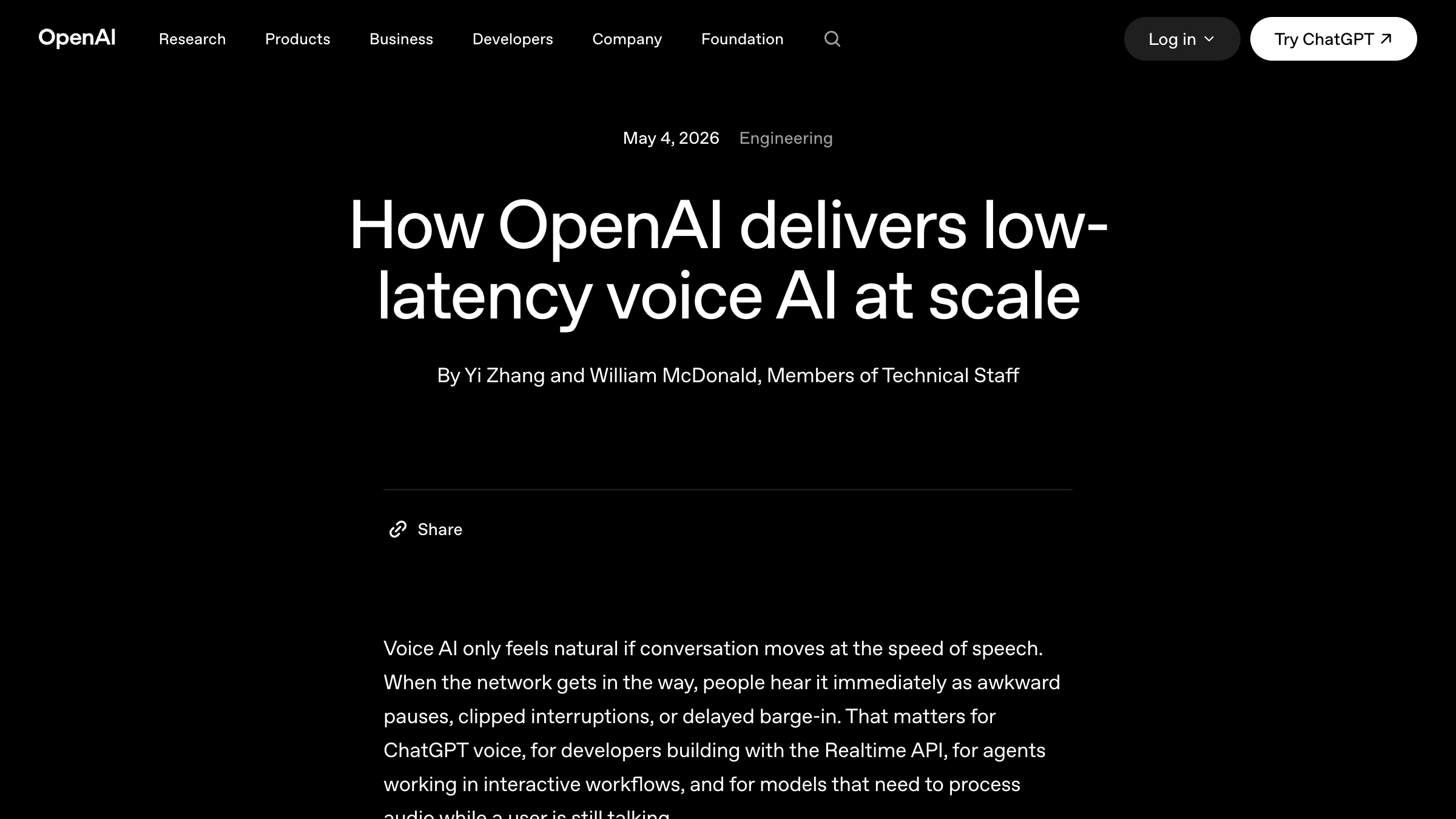
Table of Contents
OpenAI published a 4,000 word engineering post about low latency voice on May 4, 2026 and did not include a single millisecond figure. For a realtime voice system that absence is the finding. The exportable idea in it is the thin relay pattern: route at the edge keyed on ICE ufrag per RFC 8445, and keep the inference backend dumb. Nearly every serious platform either does this already or is moving toward it.
So the practical takeaway for anyone choosing a voice platform is to demand the numbers the post omitted: p50 and p99 end to end latency, time to first token, and a barge in budget under 200ms. An architecture diagram without numbers is a sales asset, not a spec sheet. OpenAI's Realtime API, LiveKit Agents, Twilio's voice stack and Daily's Pipecat are converging on the same wire shape anyway, so the differences that will actually affect your build are model choice, voice activity detection, and how the platform handles interruption.
What OpenAI Actually Published
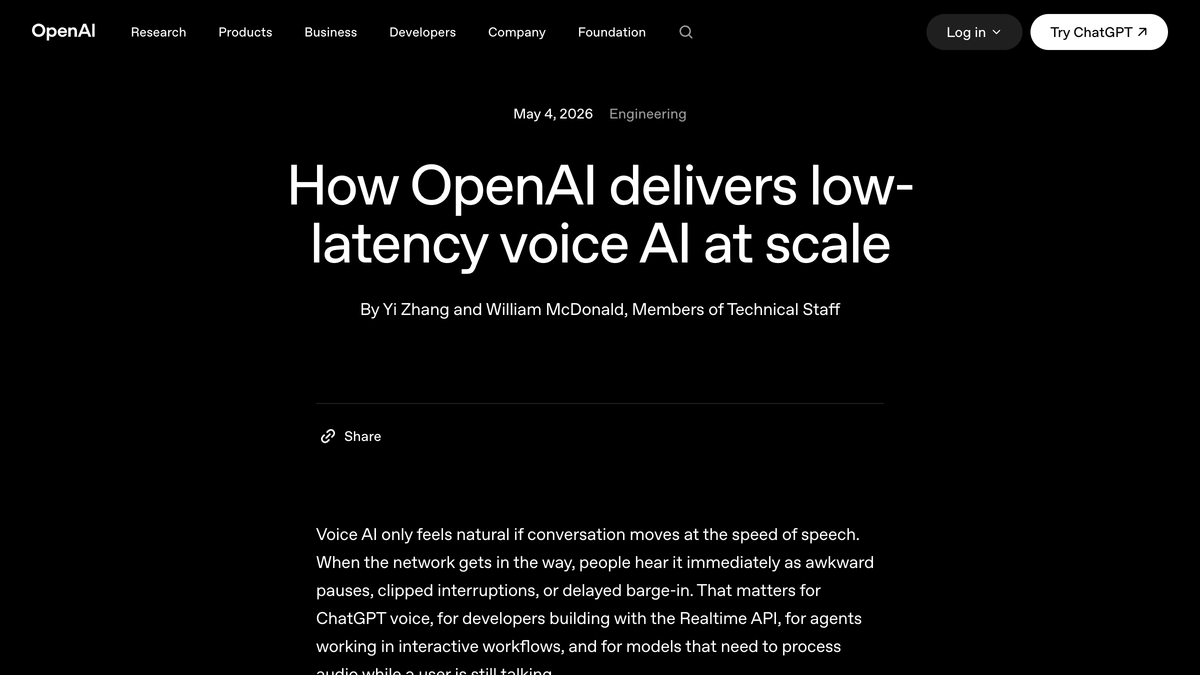
Short answer: a 4,000-word engineering writeup on May 4, 2026 about the routing layer that sits in front of every ChatGPT voice session and the Realtime API endpoint, written by 2 OpenAI staff engineers, built on open-source Pion (16,400 GitHub stars at the time of writing), running on Kubernetes, and using a stateless UDP forwarder that steers the first STUN binding via ICE ufrag per IETF RFC 8445.
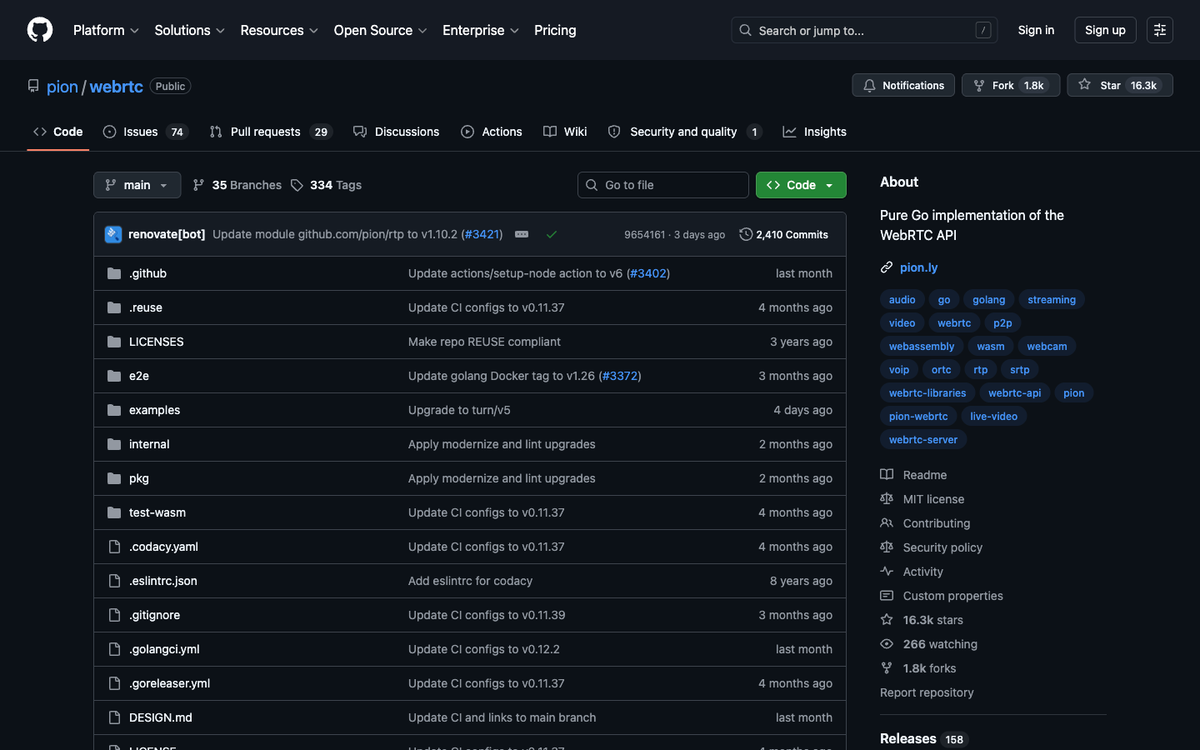
On May 4, 2026, two engineers on OpenAI's technical staff, Yi Zhang and William McDonald, posted "How OpenAI delivers low-latency voice AI at scale." It described the routing layer in front of every ChatGPT voice session, the Realtime API's WebRTC endpoint, and OpenAI's internal voice research. The stack: Pion, an open-source Go WebRTC library, running on Kubernetes, with a thin "relay plus transceiver" split that uses ICE ufrag (a username fragment in the very first STUN binding request defined by RFC 8489 STUN) to encode which cluster and transceiver should own the session.
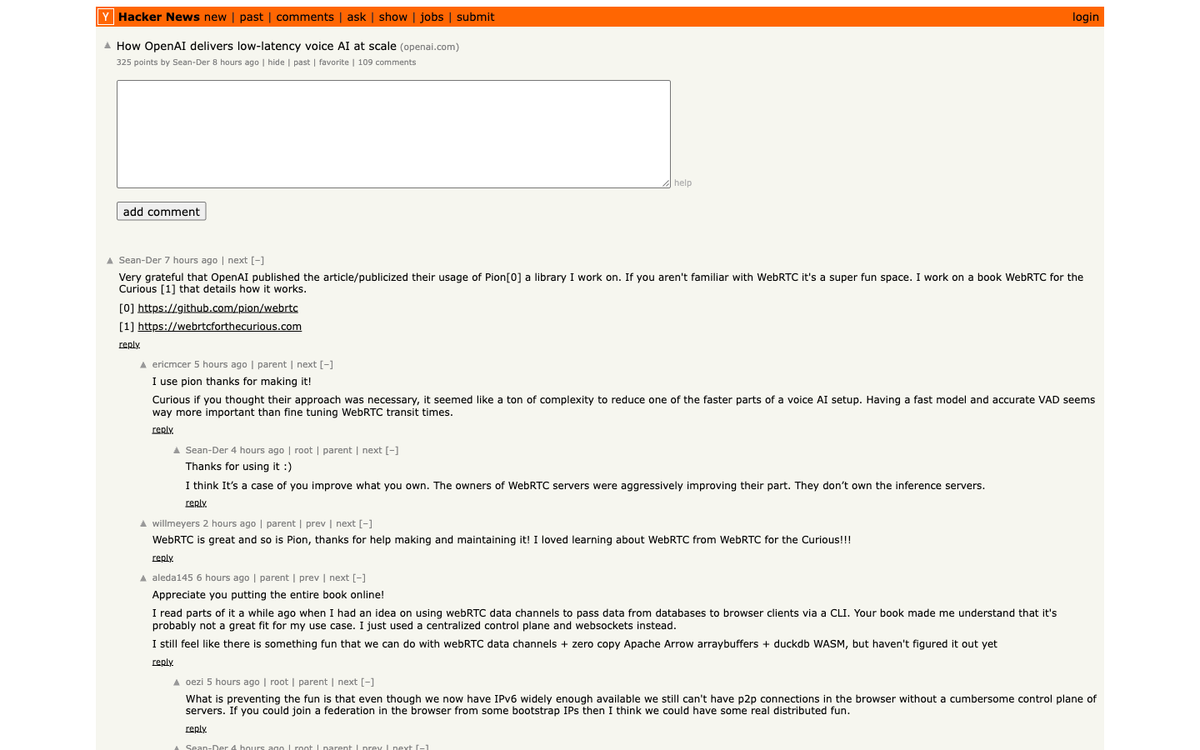
The post went up on Hacker News within 4 hours, hit 324 points, drew 109 comments, and the submitter was Sean DuBois, the creator of Pion himself. If you're keeping score, that means the open-source maintainer of the library OpenAI built on submitted OpenAI's writeup that publicly thanks him. It's not bad. It's textbook ecosystem PR. But it is, importantly, the launch shape.
I read the post end-to-end, then read every one of the 109 comments. Here's what I think it means for you if you're picking an AI agent platform in 2026, especially one with a voice use case.
Why an Engineering Post About Latency Has Zero Latency Numbers
Short answer: the post mentions the word "latency" 17 times across 4,000 words and contains 0 millisecond figures, with no p50, no p99, no jitter, no setup-time, and no ICE-restart frequency, which is unusual enough to be the actual signal of the writeup. If their network rework moved end-to-end voice latency from 800ms down to 400ms (a 50% improvement worth bragging about), that number would be in the headline; the absence strongly suggests the routing slice was already small.
Read the OpenAI writeup carefully. It's 4,000 words. It uses the word "latency" 17 times. It does not contain a single millisecond figure. No p50. No p99. No before-and-after. No jitter. No setup-time. No ICE-restart frequency. Nothing.
That's not an oversight. The work is solid, the trick with ICE ufrag is genuinely clever, and the SFU rejection is well-reasoned. But the post is calibrated to make a routing-layer optimization sound like the bottleneck. It never actually confirms it was.
The most-upvoted skeptical comment in the 109-comment thread put it bluntly: network transit is "one of the faster parts of a voice AI setup." Voice activity detection, accurate barge-in, and model time-to-first-token dominate the perceived-conversation-feel budget. Optimizing the wire is honest work. It's also the easier domain to control if you happen to be a network engineer.
The "You Improve What You Own" Confession
Short answer: Pion creator Sean DuBois (the same person who submitted the post to Hacker News where it earned 324 points and 109 comments in roughly 8 hours) replied to a skeptical commenter with a sentence that quietly admits the post optimizes the easier slice, since the network team controls the wire and improves the wire while the inference team, whose work likely dominates time-to-first-token at the 600ms p50 range, did not ship a writeup of equal depth.
Sean DuBois replied to the skeptic, and the response is more revealing than he probably intended:
It's a case of you improve what you own. The owners of WebRTC servers were aggressively improving their part. They don't own the inference servers.
That's an admission, even if it's a friendly one. The network team wrote a great post about the slice they could control. The inference team, the team whose work likely dominates time-to-first-token and the perceived feel of the conversation, didn't. We don't know what their numbers look like. If you're picking an AI agent platform off the back of this writeup, you should notice that the post tells you about the routing tier and almost nothing about the part of the system that actually decides whether a voice agent feels human.
This isn't an attack on the engineering. It's a media-literacy point. Big-tech engineering posts are not random journalism. They're written by the team whose work gets shipped, polished by the comms team, and timed for ecosystem benefit. The maintainer of the underlying library posts it himself. You read the post and walk away thinking "WebRTC plus a thin Go relay is the shape." That conclusion happens to be true, but it would have happened to be true even if the post had no numbers, which it doesn't.
Lesson 1 for Picking an AI Agent Platform: Demand Numbers, Not Diagrams
Short answer: after shipping 126 production AI systems for clients spending between $5,000 and $250,000 per build, the single most useful filter when evaluating an AI agent platform is a 5-number request covering end-to-end p50 and p99 voice loop latency in milliseconds, time-to-first-token p50 and p99, barge-in window in milliseconds, packet-loss tolerance threshold around 2%, and voice activity detection error rates broken down by false-trigger and miss percentages.
I've shipped 126 production AI systems. The single most useful filter when evaluating an AI agent platform, especially for voice, is to ask vendors for these specific numbers, and to refuse to move forward if they won't share them:
- End-to-end voice loop p50 and p99 latency from end-of-user-speech to start-of-agent-speech, measured from a residential US network on a 50 Mbps connection.
- Time-to-first-token (TTFT) p50 and p99 for whichever model the platform uses by default. Target sub-600ms p50.
- Barge-in window in milliseconds: how fast can the user interrupt and have the agent stop talking. Target sub-200ms.
- Packet-loss tolerance: at what loss rate does the conversation noticeably degrade. Healthy targets sit around 5% before quality breaks down.
- Voice activity detection error rates: false-trigger rate (interrupts on background noise) and miss rate (fails to detect user speech). Aim for under 5% false-trigger.
If a platform leans on architecture diagrams, names of well-known open-source libraries they've integrated, and qualitative phrases like "low latency" or "natural conversation," without numbers behind them, you're talking to marketing, not engineering. The OpenAI post is a polished version of that pattern. So is most of the rest of the category.
Lesson 2: The Thin-Relay Pattern Is the Most Exportable Idea
Short answer: the architecture rejects the SFU model and rejects having inference servers join WebRTC sessions as peers, and instead places a stateless UDP forwarder in front of a stateful WebRTC endpoint that uses a server-generated ICE ufrag (per the W3C WebRTC 1.0 specification) to route the first STUN binding to the right transceiver, after which the data plane is straight UDP, a pattern that scales to OpenAI's 900 million weekly ChatGPT users.
Here's what's genuinely useful in the writeup, and why I'd ask any platform you evaluate whether they do it.
OpenAI rejected the SFU model (selective forwarding unit, common in video conferencing) and rejected having the inference servers join WebRTC sessions as peers. Instead they sit a stateless UDP forwarder in front of a stateful WebRTC endpoint. The forwarder's only job is to route the first STUN binding to the right transceiver, using a server-generated ICE ufrag that encodes the destination cluster and the owning transceiver. After that, the data plane is straight UDP between client and the transceiver, and the transceiver translates WebRTC into an internal protocol upstream to the inference services.
Why it matters for AI agent platforms: this is the architecture that scales. Cloud load balancers and Kubernetes Services are not built for tens of thousands of public UDP ports per service. Without a thin routing layer, every agent platform hits the same cliff at the same scale. Discord uses a variant of this. Cloudflare Calls uses a variant. LiveKit, mediasoup, and l7mp/stunner are in this design space. If you ask a platform "how does your routing layer handle ICE ufrag–based steering" and they look at you blankly, that's a tell about how far they've actually scaled.
Lesson 3: WebRTC Beats Roll-Your-Own, But Only If You're Forced To Care
Short answer: OpenAI did not need DPDK, XDP, or any kernel-bypass framework to scale this layer, getting far enough on standard Linux networking with SO_REUSEPORT, Go OS-thread pinning via runtime.LockOSThread, and pre-allocated buffers to avoid garbage-collector pauses, which means roughly 99% of AI agent builders should not be writing UDP forwarders themselves and should pick a managed platform instead unless they hit OpenAI-class scale of 100,000,000 weekly active users.
OpenAI explicitly said they "did not need any kernel-bypass framework." No DPDK, no XDP, no custom userspace networking. They got far enough on standard Linux networking with SO_REUSEPORT, OS-thread pinning via runtime.LockOSThread, and pre-allocated buffers to avoid Go GC pauses. That's a strong vote against rolling your own transport.
For most AI agent builders, the practical lesson is even simpler: if your platform handles the WebRTC ingress for you and exposes a sane SDK on top, you should not be writing UDP forwarders. You should be writing the agent. The class of problems OpenAI solved with this routing layer is the class you only encounter at very large scale or when you've made a specific architectural choice that forces you into it. If you're shipping a voice agent for a law firm with 50 attorneys, your bottleneck is not your relay tier. It's your prompt, your model, your VAD, and your fallback handling.
The corollary: when picking an AI agent platform, don't pick on infrastructure prestige. Pick on whether the platform abstracts the right things. Most platforms are converging on a similar shape. The differences that matter are the model and prompt layer above WebRTC, not WebRTC itself.
Where the OpenAI Approach Doesn't Fit Most Builders
Short answer: OpenAI's design is tuned for one shape, point-to-point ChatGPT-style voice, and there are 3 common production workloads where the architecture is the wrong reference, namely multi-agent voice rooms (where SFUs win, see RFC 7667 RTP Topologies), on-prem or air-gapped deployments under HIPAA / FedRAMP / financial-services constraints affecting roughly 30% of regulated enterprise buyers, and long-running agent sessions that need hour-plus persistent state across reconnects.
OpenAI's setup is optimized for one workload: ChatGPT voice and the Realtime API, where most sessions are point-to-point, latency-sensitive, and the user is talking to a single AI peer. The SFU rejection makes sense in that world. It does not make sense if you're building a multi-agent voice room (three AI agents and two humans on a call together) because that's exactly the workload SFUs were designed for.
Three patterns where OpenAI's architecture is the wrong reference:
- Multi-party voice rooms with multiple AI agents. You want an SFU. LiveKit handles this; OpenAI's stack is not designed for it.
- On-prem or air-gapped deployments. The OpenAI Realtime API only runs in OpenAI's cloud. If you have a HIPAA, defense, or financial-services client who needs the inference to stay on their infrastructure, you need a platform with a self-hosted option.
- Long-running agent sessions with persistent state. WebRTC sessions are designed for ephemeral conversations. If your agent needs to maintain hour-plus state across reconnects, you'll want a platform with first-class session persistence layered above the wire protocol.
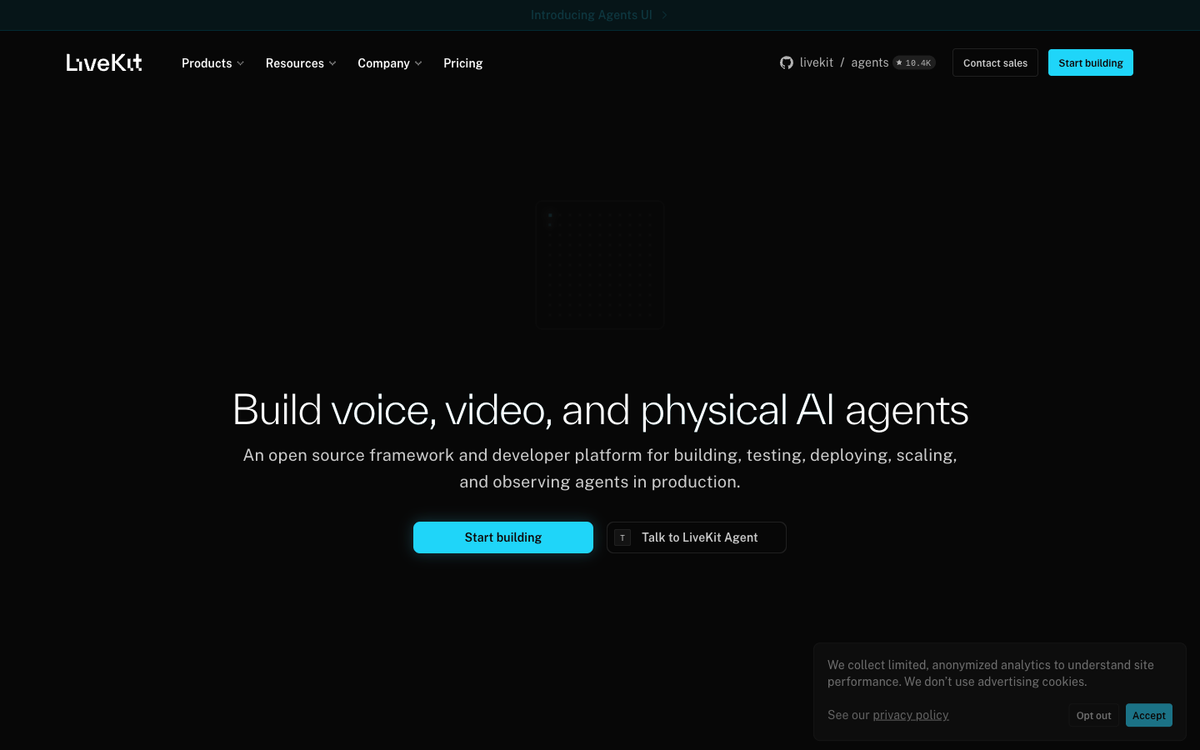
Comparison: OpenAI Realtime API vs LiveKit Agents vs Build-Your-Own
Short answer: there are 3 real options at 3 different cost and control points, with OpenAI Realtime API getting you to a working prototype in roughly 4 hours but locking model and hosting, model-flexible stacks like LiveKit Agents (10,400 GitHub stars, hundreds of voice apps in production) giving you self-host, multi-agent rooms, and any model, and Build-Your-Own on Pion making sense only at OpenAI-class scale or under specific regulated-jurisdiction constraints.
If you're picking an AI agent platform in 2026 and voice is on your shortlist, these are the three real options. The names of the categories matter less than what they actually deliver under load.
| Capability | OpenAI Realtime API | LiveKit Agents | Build-Your-Own (Pion + custom relay) |
|---|---|---|---|
| Wire protocol | WebRTC (or WebSocket fallback) | WebRTC (LiveKit SFU) | WebRTC (Pion or pion-fork) |
| Hosting model | OpenAI cloud only | Self-host or LiveKit Cloud | Your infra, your problem |
| Model lock-in | OpenAI models only | Any provider (OpenAI, Anthropic, Gemini, open-weights) | Whatever you wire up |
| Multi-agent rooms | No (point-to-point only) | Yes (SFU is the whole point) | Yes if you build it |
| Time to first prototype | 4 hours | 1 to 2 days | 4 to 12 weeks |
| Sensible scale ceiling | Whatever OpenAI ships | 10,000+ concurrent rooms | Where you stop investing |
| HIPAA / regulated workloads | BAA available, narrow scope | Yes (self-host) | Yes (you own everything) |
| Where the latency budget goes | Mostly model TTFT, OpenAI tunes the wire | You tune the model, LiveKit tunes the wire | You tune both, you own both |
The honest take after building a lot of voice agents: most teams should start on a platform (OpenAI Realtime API or LiveKit Agents), get the agent working, and only consider rolling their own when they hit a specific constraint a platform can't satisfy. That constraint is almost never wire latency. It's usually model choice, hosting jurisdiction, or a multi-party topology.
What This Means If You're Picking an AI Agent Platform Today
Short answer: 5 concrete moves drawn from what OpenAI did, what they didn't say, and what the 109-comment HN thread surfaced, namely running a numbers test before signing any contract, testing on degraded networks at 200ms RTT and 2% packet loss, measuring voice activity detection error rates rather than wire latency alone, picking on platform plumbing (function calling, fallback handling) and not model name, and planning for the model layer to be swapped at least once inside any 12-month vendor contract.
Five concrete moves I'd make based on what OpenAI did, what they didn't say, and what the HN thread surfaced:
- Run the latency-numbers test before signing anything. Send the platform's pre-sales the bullet list above. Watch what they do. The good ones answer with numbers in 24 hours. The bad ones send a whitepaper.
- Test on a degraded network, not just your office WiFi. Use a network conditioner to simulate 200ms RTT, 2% packet loss. Most voice agents that look great in a demo fall apart at this level. The platforms that hold up are the ones that have actually been used in the wild.
- Measure VAD, not just latency. Have someone with a kid in the background or a dog barking try the agent. False-trigger rate is the real production killer for voice. None of the "low latency" posts you'll read will tell you about it.
- Don't pick on the model alone. The platform's model choice is one slider; the platform's surrounding software (turn detection, interruption handling, function calling, fallback when the model times out) is the other. Most platforms underinvest in the second.
- Plan for the model layer to change. Whatever model you pick today will be replaced inside the contract. Pick a platform that lets you swap it without re-architecting. That's a much shorter list than the marketing pages suggest.
If you want a starting point on the broader category, our best AI chatbot 2026 guide covers the platforms by use case, our how to build an AI agent in 2026 guide walks the build-vs-buy decision, and our AI agent builder guide for business owners covers the non-engineer path. For workflow automation context that often sits next to a voice agent, the n8n vs Zapier 2026 comparison is the place to start.
Stuck on which AI agent platform fits your use case? The shortest path is usually a 5-minute self-check on what you actually need: voice or chat, on-prem or cloud, single-agent or multi-party, and where your latency budget really lives. Take the AI Readiness quiz to map it out, then we'll point you at the platform that matches the answer (without the architecture diagrams that pretend to be specs).
FAQ
What is an AI agent platform?
An AI agent platform is the surrounding software that turns a model API call into a deployable agent. It handles the wire protocol (often WebRTC for voice), session state, voice activity detection, model routing, function calling, fallback when a model times out, and observability. The model is one component. The platform is everything else.
Is OpenAI's Realtime API the best AI agent platform for voice?
It's the fastest path to a working prototype if you're already in the OpenAI stack and don't need to host inference yourself. It's not the right pick if you need a different model provider, self-hosted deployment, or multi-agent rooms. Most teams should test it against LiveKit Agents on a real degraded-network workload before committing.
How much latency is acceptable for a voice AI agent?
The widely-cited target is sub-500ms end-to-end from end-of-user-speech to start-of-agent-speech for a conversation to feel natural. The dominant cost in that budget is usually time-to-first-token from the language model, not network transit. Optimizing the wire below 100ms while leaving TTFT at 600ms doesn't change the felt experience. Optimize the bottleneck slice first.
Why is voice activity detection more important than network latency?
Network latency is the time the wire takes. VAD decides when the agent thinks the user has stopped talking, and when the user has interrupted the agent. A 200ms VAD lag feels worse than a 200ms wire lag because it manifests as the agent talking over you. False-trigger rates (the agent reacting to a dog bark or a clatter in the background) are a production-killer that almost no marketing page discusses. Measure it before signing.
Should I build my own AI agent platform on top of Pion or use a managed service?
Build your own only if you have a specific constraint that managed services cannot satisfy: an unusual model deployment, a regulated jurisdiction, multi-agent topology, or scale where the platform's pricing breaks your model. For most teams shipping their first ten voice agents, the answer is "use a managed service, ship the agent, learn what actually breaks at scale, then revisit." The OpenAI writeup's clearest unstated message is that the routing layer only mattered to them at OpenAI's scale.
What's the difference between an SFU and the relay pattern OpenAI uses?
An SFU (selective forwarding unit) is designed for many-to-many video conferencing. It terminates each peer's WebRTC session and re-forwards media to other peers. OpenAI's relay is a thin stateless UDP forwarder in front of a stateful WebRTC endpoint, optimized for one-to-one sessions where the other "peer" is an inference service that doesn't need to behave like a real WebRTC participant. SFU is right for multi-agent rooms; the relay is right for ChatGPT-shaped one-on-one voice. Pick the topology that matches your use case before picking the wire.
Primary engineering details from OpenAI's "How OpenAI delivers low-latency voice AI at scale" (May 4, 2026, by Yi Zhang and William McDonald). HN discussion at 324 points and 109 comments, submitted by Pion creator Sean DuBois, at news.ycombinator.com/item?id=48013919. WebRTC standards: W3C WebRTC 1.0, IETF RFC 8445 ICE, RFC 8489 STUN, RFC 7667 RTP Topologies. Underlying open-source library: pion/webrtc. Comparable platforms referenced: LiveKit Agents, mediasoup, l7mp/stunner, Cloudflare Calls, Discord, Anthropic agent capabilities API. WebRTC architectural credit: Justin Uberti (original WebRTC) and Sean DuBois (Pion).
Related Posts
How to Create an AI Chatbot in 2026: What OpenAI's New Voice API Means for Builders
AI AgentsAI NewsAI Agents
How to Make an AI Agent in 2026: GPT-5.5 Just Changed the Rules (And the Lawsuits Are Telling You Why It Matters)
AI AgentsAI NewsAI Agents
Pentagon Just Cut Anthropic From Classified AI: An 8-Vendor Bet Every AI Builder Should Read
Trends & InsightsAI NewsAI Agents

Jahanzaib Ahmed
AI Systems Engineer & Founder
AI Systems Engineer with 126 production systems shipped. I run AgenticMode AI (AI agents, RAG systems, voice AI) and ECOM PANDA (ecommerce agency). I build AI that works in the real world for businesses across home services, healthcare, ecommerce, SaaS, and real estate.