Pentagon Just Cut Anthropic From Classified AI: An 8-Vendor Bet Every AI Builder Should Read
A breakdown of the Pentagon's May 2026 deal with eight AI vendors for classified networks, why Anthropic was cut, and what every AI builder should take from the eight-vendor bet.

Table of Contents
On May 1, 2026 the US Department of War announced classified network AI agreements with eight vendors: SpaceX, OpenAI, Google, NVIDIA, Reflection, Microsoft, AWS and Oracle. Anthropic, which had previously handled classified information for the department, is the only major frontier lab absent, following a public dispute over its usage policy on military applications. The agreements cover Impact Level 6 and 7, the two highest classifications below SCI, so vendor models run inside the same enclave as live national security data.
Scale is worth noting before dismissing this as procurement news: the department's unclassified GenAI platform already serves more than 1.3 million people, making it a larger production AI operation than most of the Fortune 500. The lesson for a builder is not to chase defence work. It is that the most security conscious AI customer on earth deliberately chose eight vendors rather than one, which reframes vendor concentration as an enterprise risk signal rather than a procurement convenience.
I run an AI-implementation studio. I've shipped 126 production systems. I read about half a dozen Pentagon-AI announcements every week and ignore most of them, because most are press-release theater. This one isn't. The May 1 announcement out of war.gov changes how I'd advise any business with more than ten people thinking seriously about an AI stack.
Here's what actually happened, where the press got the framing slightly wrong, what they all missed, and what I think it means if you're not the Pentagon, which is, I'm guessing, you.
What did the Pentagon actually announce?
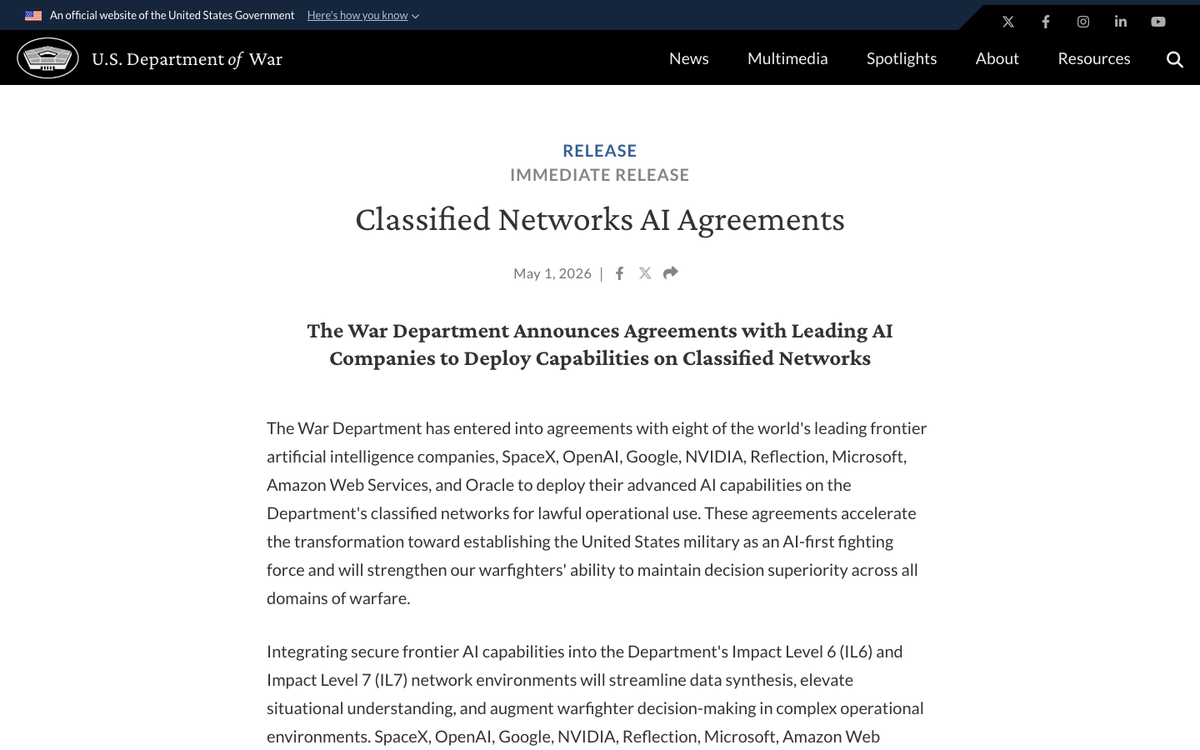
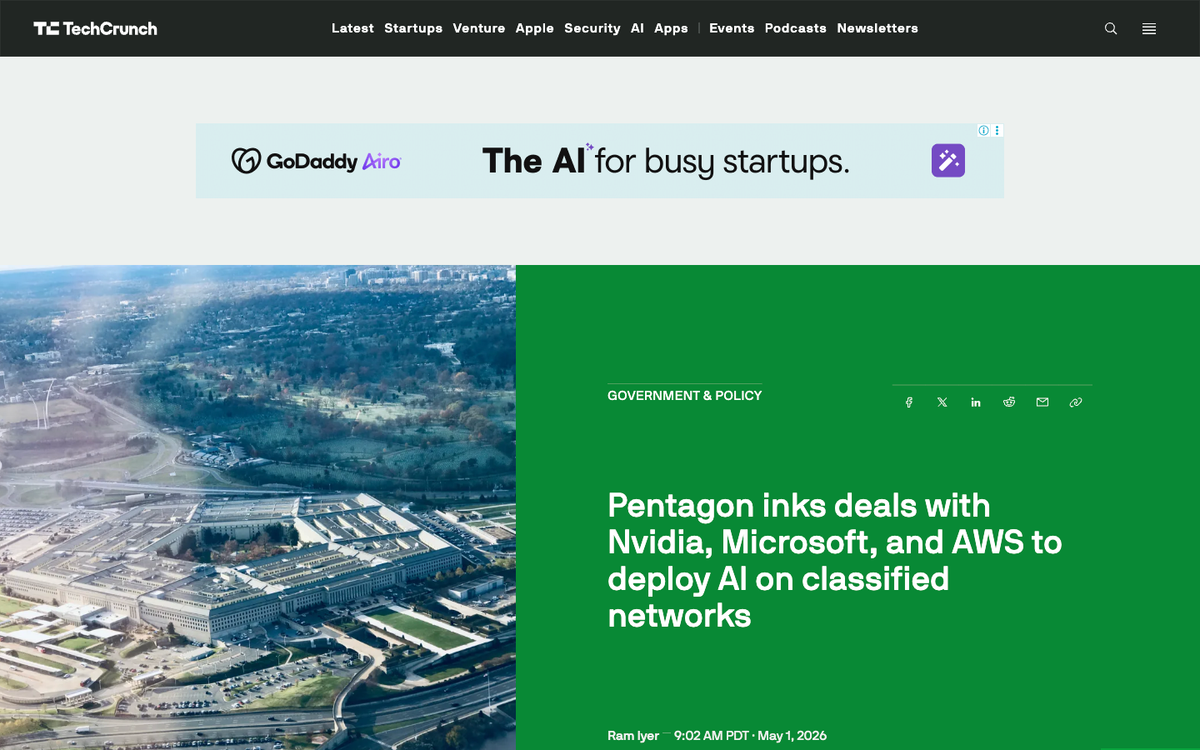
The U.S. Department of War (the office formerly called the Department of Defense) posted a release on May 1, 2026 titled "Classified Networks AI Agreements." It names eight vendors that have signed agreements to deploy "frontier artificial intelligence" on the department's classified networks: SpaceX, OpenAI, Google, NVIDIA, Reflection, Microsoft, Amazon Web Services, and Oracle.
The announced scope: Impact Level 6 (IL6) and Impact Level 7 (IL7) environments. Those are the security tiers above standard FedRAMP High. IL6 covers Secret-classified information. IL7 covers the same plus tactical-edge environments where data crosses physical-control boundaries. They aren't the absolute top, Sensitive Compartmented Information sits above, but they're the two tiers where most actual classified workload lives.
The stated purpose, in the release's own language, is to "streamline data synthesis, elevate situational understanding, and augment warfighter decision-making." Translate that out of Pentagon prose: pulling intelligence reports together, summarizing battlefield telemetry, and helping commanders make calls faster.
Why "Department of War"? The Pentagon was renamed from Department of Defense to Department of War in 2025 by executive order. The .gov domain moved with it. If you're searching primary sources, war.gov is the live one, defense.gov redirects.
Was this a one-off deal, or part of a pattern?
It's the back half of a six-month spree. The May 1 announcement is a batch of four, Nvidia, Microsoft, AWS, Reflection, but the department has been signing classified-network agreements steadily since March. OpenAI signed in March. SpaceX's xAI got access in mid-March, which prompted a Senate inquiry. Google expanded its agreement on April 28. Oracle, the eighth vendor named in the release, hasn't gotten a single major-press article, neither TechCrunch nor The Verge mentioned them in their headlines. They're in the primary source. They're real.
The cadence matters. Six months ago, classified-network AI was a theoretical posture. Today the Pentagon has agreements with effectively every meaningful U.S.-based frontier lab, except one.
Why the headlines disagreed about who's in
If you read three articles, you got three lists.
| Source | Headline list | Anthropic angle | What's missing |
|---|---|---|---|
| TechCrunch | Nvidia, Microsoft, AWS | Mentioned in metadata, not headline | Reflection AI, Oracle |
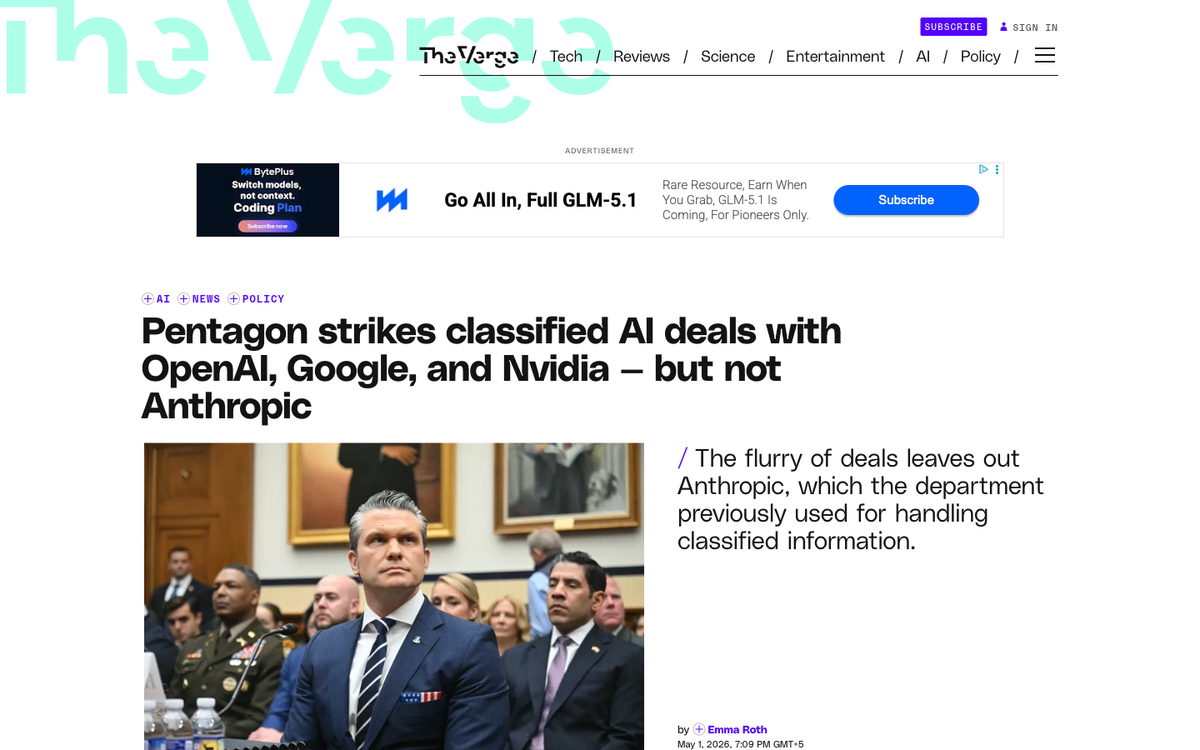
| The Verge | OpenAI, Google, Nvidia, but not Anthropic | Lead angle | Microsoft, AWS, Reflection AI, Oracle |
| FT | Nvidia, Microsoft, Amazon | Behind paywall | Five other vendors |
| war.gov primary source | SpaceX, OpenAI, Google, NVIDIA, Reflection, Microsoft, AWS, Oracle | Not named, exclusion is implicit | Nothing, this is the source of truth |
Each outlet picked an angle. TechCrunch foregrounded the four newest deals because that's what hit the wire that morning. The Verge had been running an "Anthropic vs. the Pentagon" thread for weeks and used this as the next chapter, which is why their headline buried Microsoft and AWS to make room for "but not Anthropic." FT's paywall hides their reasoning. Nobody led with Oracle.
This is normal news work and I'm not annoyed about it. I'm pointing it out because you, reading this, almost certainly read one outlet, formed an opinion, and stopped. The actual list is bigger than what most readers walked away with. That difference matters when you're using this announcement to update your view of where the AI industry is going.
What is Anthropic's actual position, and what got them excluded?
Anthropic publishes a usage policy that restricts certain military uses of Claude, specifically autonomous weapons and lethal-targeting decisions. Earlier in 2026, that policy bumped against Pentagon demands during a contract negotiation. Anthropic declined to relax the terms. The Verge has been tracking the dispute as a recurring storyline.
Note what Anthropic did not do: they didn't refuse to work with the Pentagon. Anthropic still has a Defense AI agreement that handles classified information, the previous one, the one The Verge says they were "previously" used for. What they refused was a specific expansion that would have removed safety guardrails for high-stakes targeting work.
The other seven vendors either don't publish equivalent restrictions or interpret theirs more permissively. That's a defensible business choice and I'm not here to litigate it. The relevant fact for builders is: a publicly-stated AI safety policy now has measurable, contract-losing economic weight. Six months ago people argued whether responsible-AI commitments cost real money. The Pentagon just answered.
How big is the Pentagon's actual production AI footprint?
The release buries the most important number. 1.3 million Department of War personnel are already using GenAI.mil, the department's secure unclassified generative AI platform. Currently it's used for "research, document drafting, and data analysis."
Stop and reread that. 1.3 million users on a single internal LLM platform. That's roughly 60% of the department's full-time workforce. By scale of usage, the Department of War is one of the three or four largest production AI deployments in the world, alongside ChatGPT, Gemini for Workspace, and Microsoft Copilot. Most Fortune 500 enterprises don't have a tenth of that internal adoption.
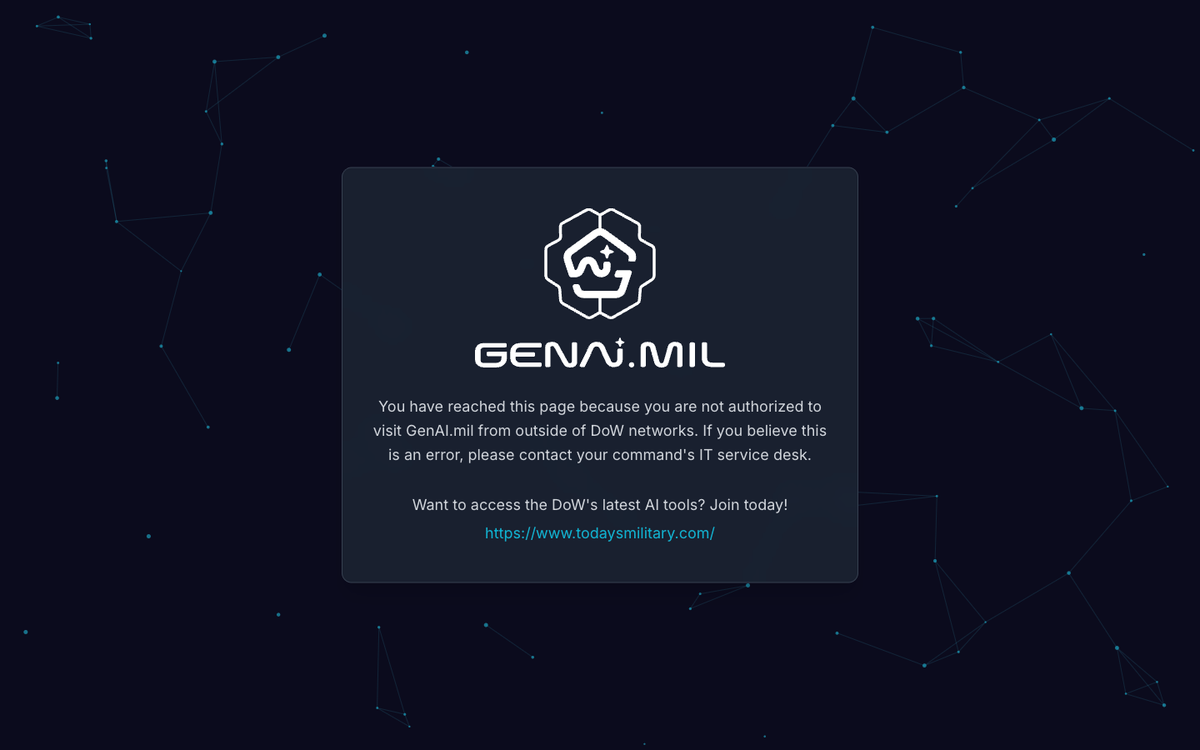
The IL6/IL7 deals announced May 1 are the next phase: take what 1.3 million unclassified users are already doing and let it touch classified data. That's not a "the Pentagon is interested in AI" story. That's a "the Pentagon is the largest enterprise AI customer in the U.S. government and is now signing the production contract" story. The first wave already happened. This is the cleanup.
What is Reflection AI, and why is a year-old startup on the list?
Nobody is talking about this and they should be. Reflection AI is the smallest-named vendor on the war.gov release. Founded in 2024 by ex-DeepMind researchers Ioannis Antonoglou and Misha Laskin. Raised a $130M round in late 2025. Their pitch is autonomous coding agents for software engineering work, think Devin, but with explicit enterprise positioning.
They're not a frontier lab. They don't have their own foundation model. And they're on a classified-networks list with NVIDIA and OpenAI. That tells you the Pentagon isn't just buying foundation-model access. They're buying agent-shaped tools that wrap the foundation models, exactly the layer most enterprise builders are working on. If a year-old agent startup can land an IL6 contract, the moat that traditional defense primes spent decades building has cracks the size of a Series A.
So what does this mean if you're not the Pentagon?
Five lessons that I'm carrying into client conversations next week.
1. Single-vendor AI strategy is now visibly riskier than multi-vendor.
The most security-conscious customer in the U.S. just signed eight vendors instead of one. They had every reason to consolidate, fewer integration headaches, easier compliance, simpler procurement. They didn't. Take that signal seriously. If your AI roadmap is "we'll build everything on OpenAI" or "Claude is our standard," you're now visibly out of step with the customer that is most rigorous about supply-chain risk in the country.
2. Your usage-policy posture has dollar value.
Anthropic's exclusion is the cleanest case study yet of policy-driven revenue loss. That cuts both ways. If your business serves regulated customers, healthcare, finance, education, your AI vendors' usage policies will be litigated against your industry's red lines too. Pick partners whose published commitments you can defend in front of a regulator and a customer simultaneously. And know in advance what you'd give up if the vendor quietly weakens those commitments mid-contract.
3. The IL6 bar is doable. Plan for it.
The fact that NVIDIA, AWS, and Microsoft can deploy on IL6/IL7 in 2026, when this was operationally fictional in 2023, means the cloud floor for handling regulated workloads has risen fast. If your roadmap touches PHI, PCI, or anything CJIS-flavored, the assumption "AI can't run inside our compliance perimeter" has expired. Build for AI-inside-the-enclave, not AI-as-an-external-API.
4. Production scale beats demo scale by an order of magnitude.
1.3 million Pentagon users on GenAI.mil should reframe what "AI deployed at the company" means. Most enterprises I work with have ten people using ChatGPT Team and call themselves "AI-native." That's not deployment. Deployment is a platform every employee logs into without thinking. The Pentagon got there. Your competitors will. Build for the platform tier, not the pilot tier.
5. The agent layer is now defense-validated.
Reflection AI's inclusion is the underplayed signal. The Pentagon isn't just licensing GPT-5 or Gemini and calling it done. They're contracting with the agent-builder layer too, the layer where most independent software companies actually live. That's a market-formation moment for the entire vertical-AI-agents category, and I expect a wave of "we passed FedRAMP High" announcements from agent startups within twelve months.
The contrarian take I'd defend over coffee
Most takes I'm seeing land in two camps. Camp A: "Anthropic stood on principle, good for them, this is bad for the AI safety movement." Camp B: "Anthropic priced themselves out of the most lucrative customer on Earth, this proves safety theater is over."
Neither is what I think is going on. The actually-interesting story is that the Pentagon is now operating on a vendor-portfolio model that looks indistinguishable from a sophisticated enterprise CIO's. That's new. Three years ago the department's AI procurement was either bespoke-defense-prime or bolt-on-cloud. Now it's the same multi-cloud, multi-model, agent-layer-included portfolio that a competent Fortune 100 IT leader would build.
The implication: the gap between "defense AI" and "enterprise AI" is closing fast. Not because the Pentagon is getting more commercial, though it is, but because commercial enterprises are getting more rigorous about AI in ways that resemble defense. Your audit trail, your model lineage, your usage-policy enforcement, your vendor diversification, your inside-the-enclave deployment posture, all of these are now table stakes for the department, and they will be table stakes for any regulated enterprise within thirty-six months.
If you're the buyer: stop thinking about AI as one vendor relationship. Start thinking about it as a portfolio with concentration limits.
If you're the builder: the moat is no longer "we have GPT access." The moat is "we have the audit trail and the deployment story to live inside a regulated enclave." Build for that.
If you're Anthropic: the bet that policy posture would eventually become a moat, and not a tax, is still live. The companies excluded from defense work in 2026 may be the only ones cleared to take pharma and financial-services workloads in 2028. We'll see.
What to read next on jahanzaib.ai
If you want to go deeper on the angles this post touches:
- AI Agent News in 2026: A Business Owner's Guide to What's Actually Worth Tracking, how to filter the daily AI-news firehose without losing your weekend.
- OpenAI on AWS: What Bedrock Managed Agents Mean for Businesses Building AI Agents in 2026, the commercial precursor to the Pentagon's multi-vendor move.
- Agentic AI vs Generative AI: A Builder's Decision Guide for 2026, what an "AI agent" actually is, and why Reflection AI's inclusion in the Pentagon list matters.
- AI Agent Builder: I've Shipped 126. Here's How a Non-Engineer Should Actually Pick One., the practitioner's view on multi-vendor agent selection.
- What Is Agentic AI, Really? An Honest 2026 Guide for Business Owners, definitions that hold up under scrutiny.
- n8n vs Zapier in 2026: After 126 Production Systems, Here Is My Honest Verdict, what multi-vendor orchestration looks like at the SMB layer.
- DeepSeek V4: What an Open-Source Frontier Model With 1M Context Actually Means for AI Builders, the other shoe dropping on vendor concentration.
Frequently asked questions
What is the AI agent definition the Pentagon is buying, foundation model, agent, or both?
Both, but with a deliberate split. The foundation-model deals (OpenAI, Google, AWS Bedrock through AWS, Microsoft via Azure) provide raw model access. The agent-layer deals, most notably Reflection AI, but also the SpaceX/xAI agreement, wrap those models in autonomous-task systems with their own orchestration, memory, and tool-use logic. The simplest working AI agent definition I'd use: an AI agent is a system that takes a goal, decides on intermediate steps, calls tools or models to execute them, and reports back. Foundation models are the engines. Agents are the cars built around them. The Pentagon bought both.
Why was Anthropic excluded if they previously handled classified data?
The exclusion follows a 2026 contract dispute over usage-policy terms governing autonomous weapons and lethal-targeting applications. Anthropic's published Acceptable Use Policy restricts those applications. The Pentagon wanted broader latitude. Anthropic declined to relax the policy. The previous classified-information work continues under its existing scope; what got blocked was a specific expansion. The Verge has been the most thorough chronicler of the dispute under their "Anthropic vs. the Pentagon" series.
What are Impact Level 6 and Impact Level 7?
IL6 and IL7 are Department of War security tiers above standard FedRAMP High. IL6 covers Secret-classified information. IL7 covers Secret plus the tactical-edge environments where data physically leaves a controlled facility. Above both sits Sensitive Compartmented Information (SCI), which the May 1 release does not appear to cover. For a vendor, going from FedRAMP High to IL6 is a multi-year compliance lift involving dedicated infrastructure, cleared personnel, and physical security audits.
How does this affect AI vendors that don't sell to the government?
It affects them through enterprise procurement. Regulated industries, banking, insurance, healthcare, energy, increasingly mirror defense procurement patterns when they buy AI. A multi-vendor portfolio is now the visible template. A published usage policy is now a real procurement criterion. An audit-trail and inside-the-enclave deployment story is now table stakes. Even if you never bid on a Pentagon contract, your enterprise customers' RFPs will start to look more like one within twelve to twenty-four months.
Should businesses use this announcement to pick their own AI vendor?
Use it as one input, not a pick list. The vendors on the war.gov release are reliable enough for the most security-rigorous customer in the country, which is a real signal. But the Pentagon's procurement criteria, clearance compatibility, sovereign-cloud requirements, lethal-application latitude, aren't yours. What you should copy is the structure: assemble a 2-4 vendor portfolio, write your own usage policy, set concentration limits, and pick partners whose published commitments survive a customer audit. The list of names is less important than the shape of the strategy.
Where can I check whether other AI vendors get added later?
The primary source is war.gov releases under the "Classified Networks" tag. Additional vendors typically post their own announcements within forty-eight hours of a Pentagon release, and TechCrunch and FT cover material additions reliably. The Verge's "Anthropic vs. the Pentagon" topic page is the best running thread on the political/policy dimension.
Want help building an AI strategy that holds up under enterprise scrutiny?
If you're sitting where I sit when I read a release like this, wondering whether your current AI vendor concentration is a feature or a liability, the cheapest next step is the AI Readiness Quiz. Five minutes, no signup. It surfaces where your business is concentrated, where the obvious next-vendor moves are, and what compliance posture you'd need to land an enterprise customer who reads news like this and updates their procurement criteria the next week.
Department of War "Classified Networks AI Agreements" press release, May 1, 2026, names eight vendors and 1.3M GenAI.mil users. War.gov primary source (May 1, 2026) · TechCrunch (May 1, 2026) · The Verge (May 1, 2026) · Financial Times (May 1, 2026) · Anthropic Acceptable Use Policy.
Related Posts
How to Make an AI Agent in 2026: GPT-5.5 Just Changed the Rules (And the Lawsuits Are Telling You Why It Matters)
AI AgentsAI NewsAI Agents
Apple's Reference Image Proves a Camera Was There. It Can't Prove a Photo Isn't AI.
Trends & InsightsAI NewsContent Provenance
Mistral Named Four Dimensions of Sovereign AI. Your Agent Breaks Two of Them.
AI AgentsAI NewsAI Agents

Jahanzaib Ahmed
AI Systems Engineer & Founder
AI Systems Engineer with 126 production systems shipped. I run AgenticMode AI (AI agents, RAG systems, voice AI) and ECOM PANDA (ecommerce agency). I build AI that works in the real world for businesses across home services, healthcare, ecommerce, SaaS, and real estate.