OpenAI Lands on AWS: What Bedrock Managed Agents Mean for Businesses Building AI Agents in 2026

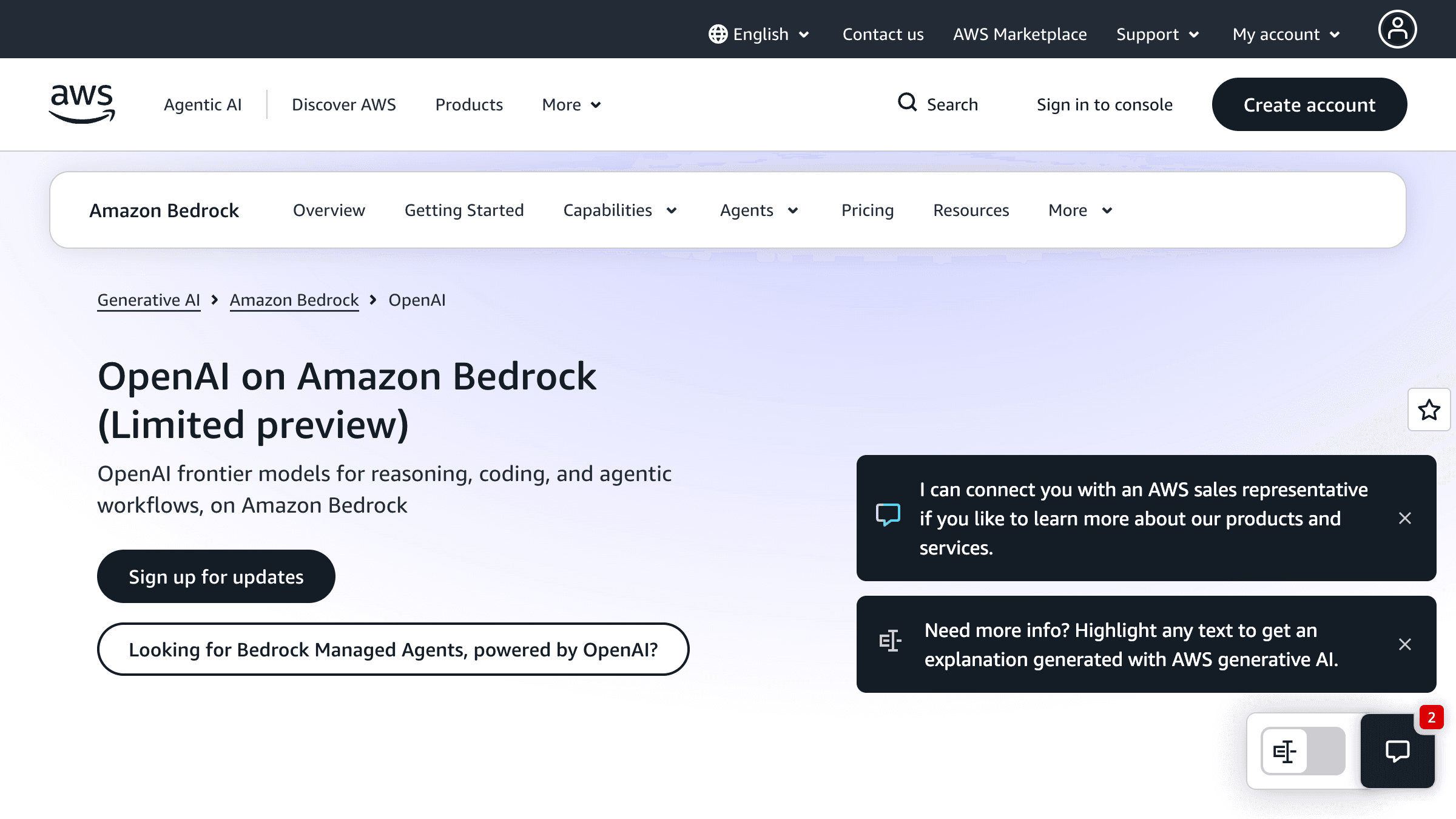
Table of Contents
On April 28, 2026 AWS switched on three things at once, all limited preview: OpenAI's latest models on Bedrock, Codex on Bedrock, and a new product called Bedrock Managed Agents built on the OpenAI agent harness. It only happened because OpenAI got Microsoft to drop its API exclusivity clause the day before, in exchange for a non exclusive license through 2032 plus a revenue share.
The headline item is Managed Agents: an opinionated agent runtime with identity per agent, full audit logs, and AgentCore underneath, already running at Box. For anyone building agents this changes procurement more than architecture, because you can now buy OpenAI reasoning models, Codex, and a managed agent platform without leaving your AWS account or your existing spend commitment. The catch worth knowing before you plan around it: Frontier, OpenAI's own first party agent product, still lives on Azure. What landed on AWS is OpenAI's frontier models behind AWS controls, not Frontier the product.
What actually launched on April 28, 2026?
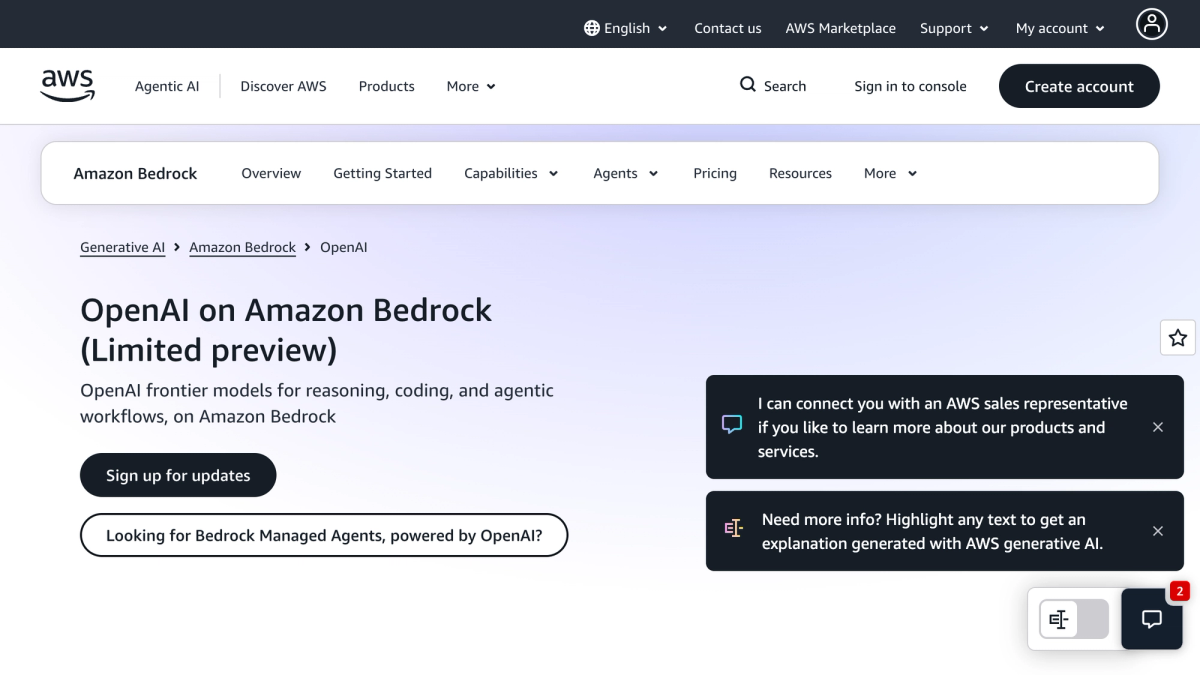
Three products, all stamped "limited preview," all announced in a single Amazon staff post on aboutamazon.com. The headline you're hearing, "OpenAI is on AWS now," is correct, but the shape of the launch is more specific than the framing suggests.
Here's the literal list, pulled from Amazon's announcement:
OpenAI models on Amazon Bedrock. The latest OpenAI frontier models, accessible through the same Bedrock APIs and IAM controls AWS customers already use. They show up next to Anthropic, Meta, Mistral, Cohere, and Amazon's own Nova models in Bedrock's model catalog. One unified billing surface, one set of guardrails, one cost-control layer. If you already have an AWS Enterprise Discount Program or a Marketplace private offer, OpenAI usage drops into that envelope instead of becoming a separate vendor relationship.
Codex on Amazon Bedrock. OpenAI's coding agent now runs in your AWS environment. Authentication uses your AWS credentials. Inference goes through Bedrock infrastructure. And here's the line that matters for procurement: "Customers can authenticate using their AWS credentials, process inference through Amazon Bedrock infrastructure, and apply Codex usage toward their AWS cloud commitments." Translation: if your finance team already negotiated a 3-year AWS commit with a discount, Codex now burns those dollars instead of opening a new ChatGPT Enterprise contract. Available through the Bedrock API, the Codex CLI, the Codex desktop app, and a VS Code extension.
Amazon Bedrock Managed Agents, powered by OpenAI. This is the new product, not a port. It's a managed agent runtime designed specifically for OpenAI's reasoning models. Agent steering, security, identity per agent, persistent memory across sessions, and full action logs are baked in. The first big customer Amazon named is Box, which has 115,000 organizations on its content management platform.
OpenAI also has more than 4 million weekly active users on Codex already. Putting that user base inside enterprise AWS accounts is a serious wedge.
Why did this take so long? The Microsoft exclusivity story
The Bedrock launch is the easy part. The deal that made it possible is the interesting part.
In November 2025, OpenAI signed a $38 billion multi-year cloud contract with AWS. In February 2026, Amazon announced an up-to-$50 billion investment in OpenAI ($15 billion upfront, $35 billion contingent on undisclosed conditions), in exchange for which OpenAI agreed to two things: co-develop "stateful runtime technology" on AWS Bedrock (the infrastructure that lets agents remember tasks across long-running sessions), and grant AWS exclusive rights to host OpenAI's new agent product, Frontier.
That second part broke the deal. Microsoft's existing agreement with OpenAI gave it exclusive rights to any OpenAI product accessed through an API. The day Amazon announced its investment, Microsoft put out a public statement refuting the AWS exclusivity, in bold: "Azure remains the exclusive cloud provider of stateless OpenAI APIs. Any stateless API calls to OpenAI models that result from a collaboration between OpenAI and any third party, including Amazon, would be hosted on Azure. OpenAI's first party products, including Frontier, will continue to be hosted on Azure."
So OpenAI had taken Amazon's $50 billion to do something Microsoft was, on paper, blocking it from doing. That's the legal peril TechCrunch's headline refers to.

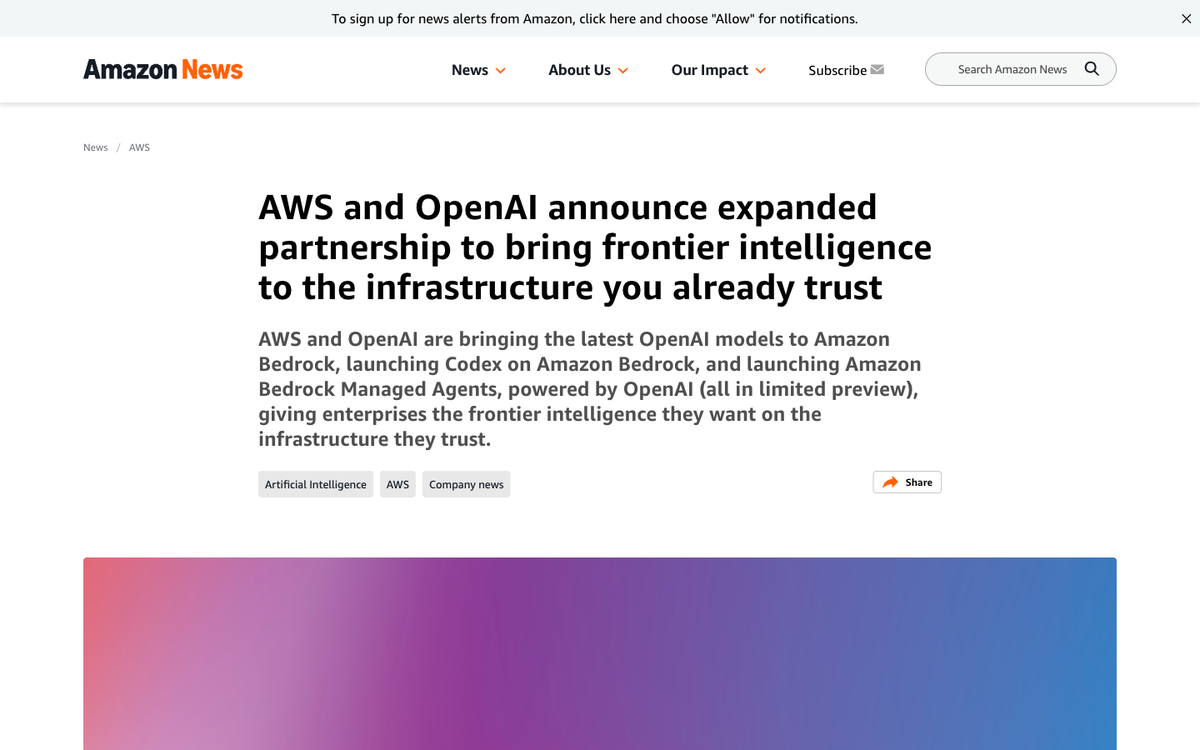
On April 27, 2026, that knot got cut. Microsoft accepted a non-exclusive license to OpenAI IP for models and products through 2032, plus a revenue-share agreement on stateless API traffic that flows through other clouds. In return, OpenAI got the right to actually sell its products on AWS. Microsoft is still being called OpenAI's "primary cloud partner" in both companies' statements, which is true in volume terms (Azure will still serve the bulk of OpenAI's API load through 2032), but the exclusivity is gone.
One day after Microsoft signed off, Amazon turned on three products. CEO Andy Jassy posted a one-line tweet about the Microsoft news ("very interesting announcement") on Monday, then on Tuesday Amazon's blog quietly went live. That timing is not a coincidence. AWS clearly had this build ready to ship.
What is Bedrock Managed Agents, really?
Of the three launches, this is the one worth the most reading time. The other two are competitive rebalancing. This one is a new product category for AWS.
Bedrock Managed Agents is built on the OpenAI agent harness, which is OpenAI's runtime for orchestrating long-running, multi-step tasks. Amazon describes it as "engineered to unlock the full potential of OpenAI frontier models, delivering faster execution, sharper reasoning, and reliable steering of long-running tasks." Translation: it knows how to drive OpenAI's reasoning models specifically, with the kind of mid-task correction that generic agent runtimes fumble.
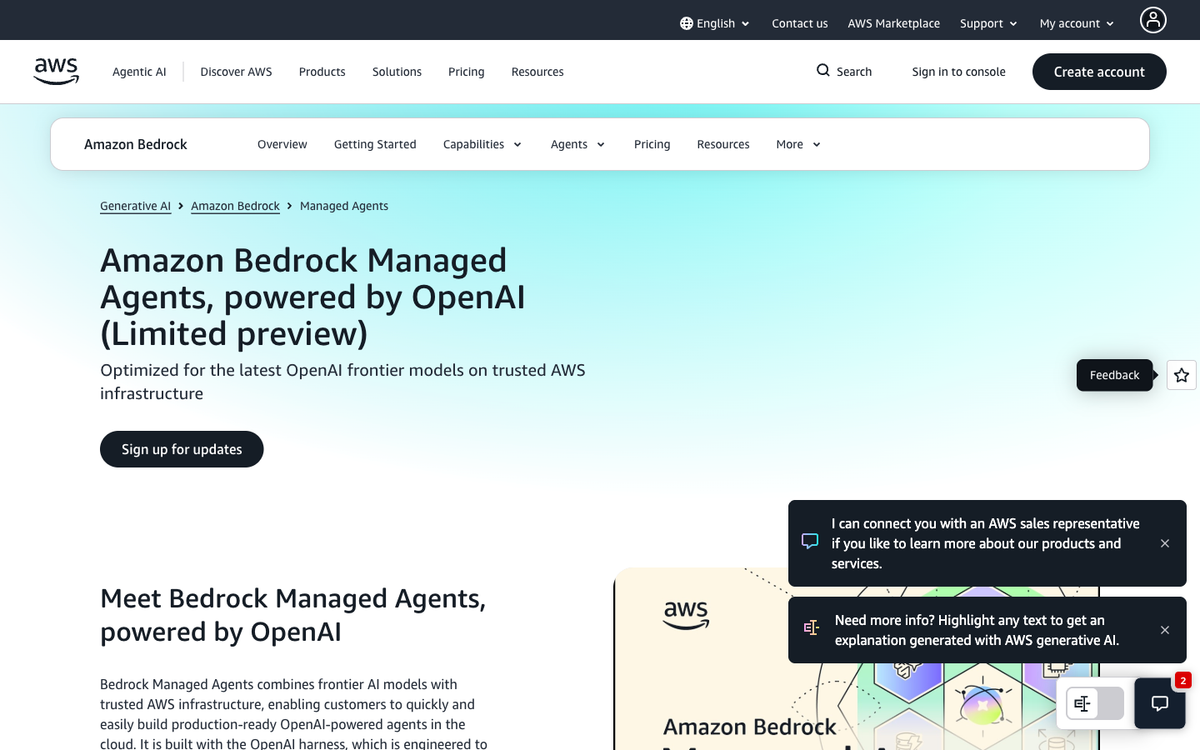
Three operational details matter for anyone evaluating this for production:
Identity per agent. Every agent gets its own AWS identity. That means least-privilege IAM policies attached directly to the agent, not to the human who launched it. If an agent is compromised, you blast-radius it the same way you'd blast-radius any service principal. This is a real difference from running OpenAI's Assistants API in your own infra, where identity bookkeeping is your problem.
Full action audit logs. Every tool call, every model call, every state mutation is logged. The marketing copy says "logs every action for auditability." The actual value is that you can pipe that log into CloudTrail, S3, or any SIEM you already have, and pass an audit without writing custom telemetry.
AgentCore as the compute layer. Bedrock Managed Agents runs on top of Bedrock AgentCore, AWS's open agent platform. Amazon says, "AgentCore provides the default compute environment for Bedrock Managed Agents, and as your agent footprint expands across your enterprise, AgentCore and Bedrock Managed Agents will provide additional capabilities such as authorization policy enforcement, agent and agent tool discovery, and observability and evaluation capabilities." The interesting word there is "expands." Amazon is saying: build with Managed Agents now, scale into AgentCore for enterprise discovery and governance, and never have to switch runtimes.
Box's CTO Ben Kus called it a way to "build optimized, production-scale AI applications" without the integration tax. That's PR copy, but Box's 115,000-org customer base is real, and the deployment isn't theoretical.
AWS Bedrock vs Azure for OpenAI: where does the choice actually matter?
Here's the comparison most coverage missed. Both clouds now serve OpenAI models. They're not interchangeable.
| What you're trying to do | Azure (incumbent) | AWS Bedrock (April 2026 launch) |
|---|---|---|
| Use the latest OpenAI models via API | Available, GA | Available, limited preview |
| Use Codex inside enterprise dev workflows | GitHub Copilot Enterprise (related but different product) | Codex on Bedrock, native AWS auth, applies to AWS commit |
| Use OpenAI's first-party agent product (Frontier) | Yes, exclusive host | No, Azure-only through 2032 |
| Build production agents on a managed runtime | Azure AI Agent Service | Bedrock Managed Agents (OpenAI agent harness, AgentCore compute) |
| Mix OpenAI with Anthropic, Meta, Mistral in one API | No (Azure is OpenAI-first) | Yes (Bedrock model garden) |
| Burn an existing cloud commitment on AI usage | Yes, if you have an Azure ECP | Yes, if you have an AWS EDP/MAP |
| Strongest data residency / sovereignty story | Strong (broad regional coverage) | Strong (broader, more regions live for years) |
If you're already deeply on Azure with a 3-year ECP, this announcement changes very little for you. Azure stays the primary path for stateless OpenAI APIs and the only path for Frontier. If you're on AWS with a multi-year EDP and you've been waiting to consolidate AI vendors, the consolidation is now possible, and that's the actual news. For everyone in the middle, you finally have real model choice. You can put GPT-class reasoning, Claude, Llama, Mistral Large, and Nova into the same Bedrock-managed app and route by task. That used to require separate API integrations.
If you're trying to figure out where to actually start, our guide to AI agent development services walks through the procurement-vs-build decision in more detail.
What this means for businesses building AI agents
I've now built or shipped 126 production AI systems. The most common reason agent projects stall isn't the model. It's the integration tax. You pick OpenAI for the model quality, Pinecone or Weaviate for vectors, LangChain or LlamaIndex for orchestration, Datadog for observability, Auth0 for identity, and somewhere in there your security team asks for an audit log and you realize you have to build one.
Bedrock Managed Agents is Amazon's bet that this integration tax is worth eliminating, even at the cost of some flexibility. For most enterprise teams, that's the right tradeoff. The same logic that pushed companies onto Bedrock AgentCore in late 2025 applies more strongly here: a managed runtime with built-in identity, observability, and policy enforcement saves quarters of work compared to assembling the equivalent stack yourself.
Three things change for anyone shipping agents in the second half of 2026:
Procurement gets simpler. If your company has an AWS EDP, you stop opening new vendor relationships for OpenAI usage and Codex seats. That's not a minor thing. Vendor management overhead is real, and security review for a brand-new SaaS contract can take 60-90 days at large enterprises. Buying OpenAI inside your existing AWS contract collapses that into an IAM permission change.
Multi-model agents get easier. Bedrock has been pushing the "model garden" pitch for two years. Now it actually has every major frontier model, with OpenAI being the last big gap. You can A/B test Claude vs GPT vs Llama on the same task, with the same observability, without three integrations. If you've been wrestling with whether to use Claude for reasoning and GPT for coding, the answer is now "both, and route at the orchestration layer." For builders comparing the alternatives, our n8n vs Zapier breakdown covers the no-code side of that same routing problem.
Compliance posture improves. The "agent has its own IAM identity" model is what enterprise security teams actually want. Today, most production agents share a service account or a human's keys, which is unauditable. Bedrock Managed Agents flips that. If you've been blocked from production by InfoSec, this is the first agent runtime they'll like.
If you're newer to all of this, our honest 2026 guide to agentic AI covers the basics without the hype.
Where the announcements fall short (what TechCrunch and Amazon both missed)
Two things nobody is saying loudly.
First, "limited preview" is doing a lot of work. All three products launched April 28, 2026 are gated behind a sign-up form. There's no public pricing, no published rate limits, no SLA. Amazon's track record on Bedrock previews is mixed. Some products (Claude on Bedrock, Llama on Bedrock) hit GA fast. Others (Bedrock Studio, parts of AgentCore) lingered in preview for over a year. If your roadmap depends on a 2026 Q3 launch, do not bake Managed Agents into the critical path until you have a date in writing.
Second, Frontier is still on Azure. This is the part of OpenAI's product line that's furthest into the agent era. It's the new agent-making tool that the entire $50B Amazon deal originally hinged on. Microsoft now keeps Frontier exclusively through 2032. So when the marketing says "OpenAI on AWS," the asterisk is: OpenAI's models, OpenAI's coding agent, and OpenAI's agent harness inside an AWS-built runtime. Not OpenAI's flagship agent product itself. If you specifically want Frontier, you go to Azure.
Andy Jassy's "very interesting announcement" tweet was, I think, deliberately understated. AWS got the parts of OpenAI it could productize within AWS's existing platform model. It didn't get the part that competes with AWS's own agent platform. That's not a coincidence either.
For broader agent-platform context, our recent A2A protocol coverage covers the cross-vendor agent communication standard that this announcement now plugs into more directly.
Should you wait for Bedrock Managed Agents or ship now?
Short answer: if you're starting an agent project in May or June 2026, prototype on whatever stack you can move fastest with. Options include LangGraph, CrewAI, raw OpenAI Agents SDK, or Anthropic's Claude Agent SDK on Bedrock. Get to a working agent. Then, when Managed Agents hits GA (probably late 2026), evaluate migrating only if you're hitting governance or scale problems your current stack can't solve.
The reasons not to wait:
Limited preview means feature changes. APIs in preview can and do break before GA. Building a production system on a preview runtime is a known anti-pattern. Amazon Bedrock Knowledge Bases changed materially three times during its 2024 preview period.
The integration tax is real but it's not infinite. A senior backend engineer can wire OpenAI Agents SDK to Postgres, S3, and CloudWatch in two weeks. You don't need a managed agent runtime to get to production. You need one to scale from 5 agents to 500.
The reasons to wait, or at least to plan around it:
If your security team won't approve a new SaaS vendor, Bedrock Managed Agents at GA may be the only viable path. Your timeline is dictated by their release schedule.
If you're building 50+ agents across the org, the AgentCore plus Managed Agents combo is genuinely better than rolling your own. Don't fight that battle.
If you're already building on AgentCore, Managed Agents is a drop-in upgrade. There's no architectural cost to switching.
Personally, on the projects we're shipping in May 2026, we're prototyping on raw OpenAI Agents SDK and Bedrock AgentCore in parallel, with a portability layer that lets us move whichever way the GA dates fall. That's not a sexy answer, but it's the one that doesn't blow up a roadmap.
Frequently asked questions
Is OpenAI on AWS Bedrock generally available?
No. As of April 28, 2026, all three new products (OpenAI models on Bedrock, Codex on Bedrock, Bedrock Managed Agents) are in limited preview. Customers sign up via the AWS interest form, and access is gated. Amazon has not announced GA dates.
What is Bedrock Managed Agents, powered by OpenAI?
It's a new managed runtime for building production AI agents using OpenAI's frontier models. It runs on AWS infrastructure, uses OpenAI's agent harness for orchestration, gives each agent its own IAM identity, logs every action, and uses Bedrock AgentCore as the compute layer. Box, with 115,000 customers, was the named launch reference.
Does this mean Microsoft Azure loses OpenAI?
No. Microsoft still has a non-exclusive license to OpenAI IP through 2032, plus a revenue-share on stateless API calls routed through other clouds. Microsoft is still called OpenAI's "primary cloud partner" by both companies. The change is that AWS can now also sell OpenAI products. Frontier (OpenAI's first-party agent product) remains exclusive to Azure.
Can I use Codex on Bedrock as a drop-in for ChatGPT Enterprise?
Not yet. Codex on Bedrock is the OpenAI coding agent, not the full ChatGPT Enterprise product. It's available through the Bedrock API, the Codex CLI, the Codex desktop app, and a VS Code extension. Inference goes through your AWS account and counts toward your AWS commit.
How does AWS Bedrock Managed Agents compare to Azure AI Agent Service?
Azure AI Agent Service is closer to OpenAI Assistants under the hood and has more of OpenAI's first-party tooling, including Frontier. Bedrock Managed Agents is multi-model from day one (Anthropic, Meta, Mistral, Nova, OpenAI all in one API), has tighter integration with AWS-native security and observability, and uses AgentCore as the underlying compute substrate. If you're an AWS shop, Bedrock wins on operational fit. If you need Frontier specifically, Azure wins.
What is OpenAI's $50B Amazon deal in plain terms?
In February 2026, Amazon committed up to $50 billion in OpenAI ($15B initial, $35B contingent on conditions). In exchange, OpenAI agreed to co-develop stateful runtime tech on AWS Bedrock and to grant AWS exclusive hosting for OpenAI's Frontier agent product. The Frontier exclusivity broke against Microsoft's existing rights, which forced the April 27 renegotiation. The investment money is separate from OpenAI's prior $38B AWS cloud spend commitment from November 2025.
Should I move my OpenAI workload from Azure to AWS today?
Probably not. Bedrock Managed Agents is in limited preview with no SLA or GA date. Codex on Bedrock applies to AWS commits, which is useful, but Azure remains GA, mature, and the only host for Frontier. The right move is to evaluate a pilot on Bedrock if you're an AWS-first shop, while keeping production on Azure until Bedrock hits GA.
The procurement story is the real story
If you only remember one thing from this announcement: the technology layer didn't move much. The procurement layer did.
OpenAI's models were already great. Codex was already great. The OpenAI agent harness already existed. What changed on April 28, 2026 is that AWS customers can buy all of it through the contract they already have, with the IAM model they already use, applied to the cloud commit they already negotiated, audited by the SIEM their security team already approved.
For a CTO at a 5,000-person company on AWS, that's the unblock. For a startup founder spinning up an agent demo this weekend, it's a footnote. Read the framing accordingly.
If you want a starting point on what to actually build first, take 5 minutes with our agentic vs generative AI decision guide or the broader 2026 agentic AI cheat sheet. Both are written from the same set of 126 production builds, and both will save you a planning meeting.
Three primary sources for this analysis. AWS & OpenAI announce expanded partnership (Apr 28, 2026) · TechCrunch: Amazon is already offering new OpenAI products on AWS (Apr 28, 2026) · TechCrunch: OpenAI ends Microsoft legal peril over its $50B Amazon deal (Apr 27, 2026) · Microsoft & OpenAI joint partnership statement (Feb 27, 2026).
Built 126 AI systems for businesses across SaaS, healthcare, professional services, and ops. If you want a no-pitch read on whether your business should be using OpenAI on AWS, Anthropic, or open-source models, take the 2-minute AI Readiness Quiz and we'll send a tailored recommendation.
Related Posts


Jahanzaib Ahmed
AI Systems Engineer & Founder
AI Systems Engineer with 126 production systems shipped. I run AgenticMode AI (AI agents, RAG systems, voice AI) and ECOM PANDA (ecommerce agency). I build AI that works in the real world for businesses across home services, healthcare, ecommerce, SaaS, and real estate.