AI Agent for Customer Service vs Live Chat Software: Which One Actually Resolves Tickets?
A data-backed comparison of AI agents vs live chat software for customer service. Covers costs, use cases, a 6-question decision framework, and a real deployment example.

Table of Contents
An AI agent and live chat software solve different halves of the same queue. Agents run unlimited concurrent conversations at roughly $0.50 to $2 per resolution at published list prices (checked October 11, 2026) against about $5 to $18 per chat for human staffed live chat on routine queries, by my own arithmetic below (the $1 to $3 against $15 to $25 I used before sat above both ranges); live chat wins wherever judgment, emotion, or stakes are involved, and no pricing table changes that.
Volume decides where you start. Under about 500 support conversations a month, start with live chat and add AI when the repetition becomes visible. Above roughly 1,000 a month, an AI agent handling routine queries pays for itself within 60 to 90 days in my deployments. The mistake worth avoiding is treating it as a choice at all: Gartner forecasts that agentic AI will autonomously resolve 80% of common customer service issues by 2029 (Gartner, March 2025), Zendesk's CEO has made a similar call of 80% of consumer and company interactions solved by AI within five years (CX Today, May 2025), and the architecture that actually works today is both, with a clean handoff between them. Both are forecasts, not 2026 results.
If you are shopping for an ai agent for customer service, you have already noticed the problem: every vendor claims to do both AI and live chat, the pricing pages are deliberately confusing, and a Google search returns comparison articles written by people who have never actually deployed either at scale.
I have built AI-powered customer service systems for over 40 businesses in the last three years. Some got AI agents. Some got live chat software. Several got both. And a few came to me after buying the wrong one and spending six months frustrated by it.
This is the comparison I wish existed when I started.
Quick Verdict
Pick an AI agent if: You have more than 1,000 monthly support conversations, most are repetitive (order status, password resets, FAQs, billing questions), and you cannot staff 24/7 without adding headcount.
Stick with live chat if: Your product is complex, your customers are high-value (think enterprise B2B or luxury retail), or your support conversations regularly involve negotiation, complaints, or emotional distress.
Still unsure? The answer is almost always a hybrid. Book a 15-minute call and I will tell you exactly what your specific ticket mix requires.
What We Are Actually Comparing
Before the breakdown, let me define the terms precisely because the market has blurred them deliberately.
Live chat software is a platform that lets your human agents chat with customers in real time through a widget on your website or app. Think Intercom, Zendesk, Crisp, or Tidio in human agent mode. The quality of the interaction is entirely dependent on your people. The software just routes, queues, and logs.
An AI agent for customer service is software that uses large language models and business logic to autonomously handle customer conversations from start to finish, without a human in the loop. It understands intent, accesses your systems (CRM, order management, billing), takes action, and closes the ticket. It is not a chatbot that deflects. It is not a bot that says "let me connect you to an agent." It resolves.
The distinction matters. When a vendor says their live chat platform "has AI," they usually mean AI-assisted features for human agents: suggested replies, ticket summarization, intent detection. That is fundamentally different from a fully autonomous AI agent that handles conversations end-to-end.
Both have a place. The question is which place is right for your business right now.
AI Agent for Customer Service: What It Actually Does Well
I want to be specific here because the generic pitch ("AI handles tickets so your team can focus on what matters") does not tell you anything useful.
An AI agent performs exceptionally well on what I call tier-1 deflectable queries. These are conversations where the answer exists somewhere in your systems, the customer just needs it retrieved and communicated. In my deployments, these typically account for 60 to 75% of total ticket volume. Examples:
- Where is my order? (pulls tracking from your OMS and responds)
- Can I get a refund? (checks your refund policy, order age, and processes if eligible)
- How do I reset my password? (walks through the process step by step)
- What does your [plan/product/service] include? (answers from your knowledge base)
- I need to update my billing address (accesses your CRM, makes the change, confirms)
What makes an AI agent different from a 2021-era chatbot is that it does not just answer. It acts. It can process the refund. It can update the record. It can cancel the order. When I say "resolves tickets," I mean the customer's problem is actually solved, not transferred to a queue.
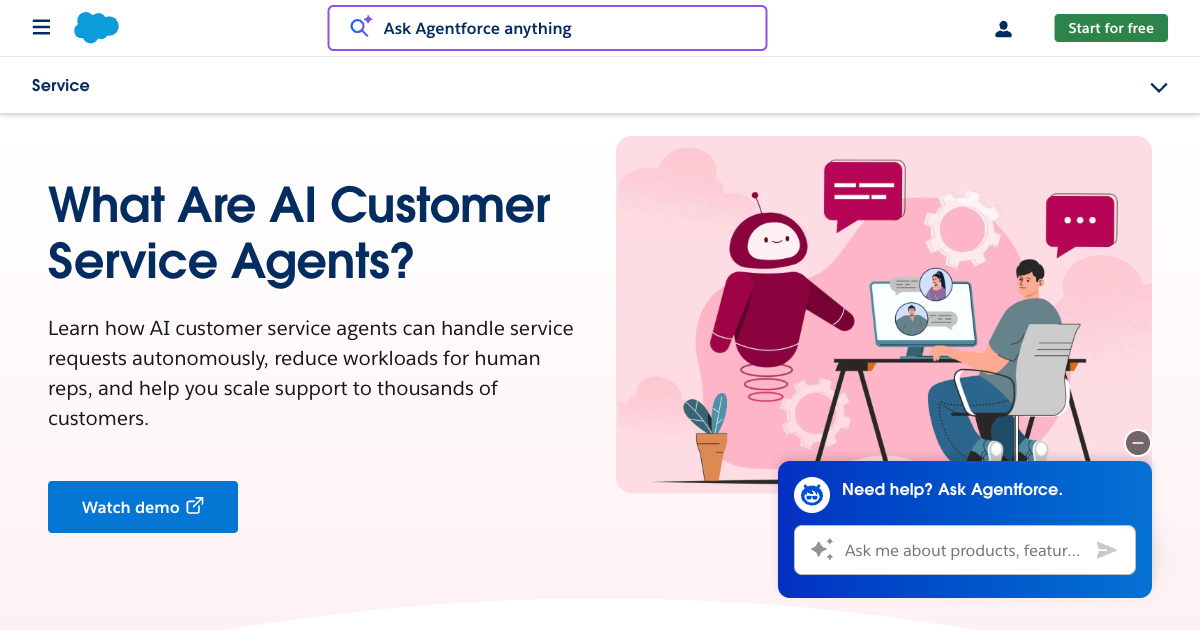
The volume economics are compelling for AI agents. A Zendesk CX Trends survey, repeated without a survey year in its January 2026 statistics roundup, found that 51% of consumers prefer bots over humans when they want immediate service. Businesses keep adopting AI agents because of what I have seen directly: the cost per interaction drops from about $5 to $18 with human agents to $0.50 to $2 with AI agents on routine queries (published list prices, checked October 11, 2026, before seats and monthly minimums). I show the arithmetic under the comparison table, and my AI vs human employee cost calculator runs the same comparison on your own numbers.
One client of mine, an ecommerce brand doing $4M ARR, was paying three full-time support agents to handle 4,500 conversations a month. After deploying an AI agent to handle their tier-1 queries, 68% of conversations were resolved without human involvement within the first 90 days. Their support cost dropped by 61%. The human agents still handle everything, but now "everything" means complex issues, escalations, and VIP customers instead of "where is my package" for the hundredth time that day.
Live Chat Software: Where It Still Wins
I am not going to pretend AI agents are the answer to everything. There is a class of conversation where a human being is irreplaceable, and building a system that routes those conversations wrong creates real business damage.
Live chat wins decisively in three scenarios.
Complex multi-step issues. A customer who was double-charged for three months, then received the wrong product, and is now threatening to dispute the charge on their credit card needs someone who can look at the full account history, understand what went wrong across multiple systems, and make a judgment call about what resolution to offer. That is not a retrieval problem. That is a judgment problem. Current AI agents are not reliable here.
High-value sales conversations. If a prospect is evaluating a $50,000 annual contract and has a technical question about your API integration, you want a human. The AI might give a technically accurate answer that misses the sales context entirely. A good presales engineer or senior account executive reading between the lines on that conversation is worth real revenue.
Emotionally charged interactions. When a customer is genuinely upset, what they want first is to feel heard. A human agent who acknowledges frustration, takes accountability, and communicates with genuine empathy changes the customer's emotional state in a way that AI responses cannot reliably replicate yet. Churn prevention often depends on this.
The mistake I see most often is businesses using live chat as their primary support channel for all queries because they are afraid of AI, and then burning out their support team on repetitive questions that should never reach a human in the first place.
Head-to-Head: AI Agent vs Live Chat Software
| Factor | AI Agent | Live Chat (Human) |
|---|---|---|
| Availability | 24/7, zero overhead | Business hours (24/7 requires shift staffing) |
| Response time | Seconds, at any hour | Depends on staffing; queues grow during peaks |
| Concurrent capacity | Unlimited | 2 to 6 conversations per agent (a common industry range, Cobbai) |
| Cost per interaction | $0.50 to $2 per resolution at list prices, Oct 2026 (routine queries) | About $5 to $18 per chat, fully loaded (my model, below) |
| Scaling cost | Pay per resolution; no hiring lag | Linear with volume (more agents) |
| Complex issues | Weak (should escalate) | Strong (human judgment) |
| Emotional situations | Limited (pattern-based empathy) | Strong (genuine connection) |
| Training required | Initial setup; self-improving over time | Ongoing agent training, onboarding cycles |
| Typical setup time | 2 to 6 weeks | 1 to 2 weeks (software); hiring adds months |
| Best fit | High volume, repetitive queries | Complex, high-value, emotional conversations |
Where the cost per interaction numbers come from
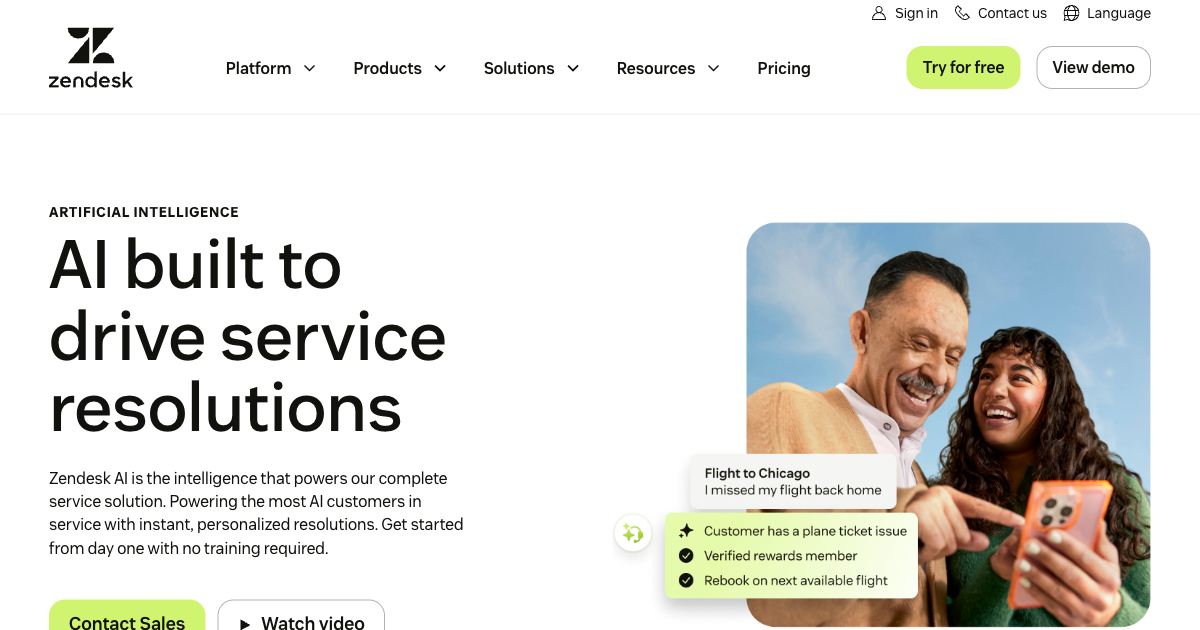
The AI side is list prices as of October 11, 2026: Intercom's Fin is $0.99 per outcome with a $49 monthly minimum that includes 50 outcomes, Zendesk charges $1.50 per automated resolution on a committed plan or $2.00 pay as you go, Salesforce Agentforce lists $2 per conversation, and Freshdesk's Freddy AI Agent is $49 per 100 sessions, about $0.49 each. That puts the range at roughly $0.50 to $2. Seat prices and monthly minimums sit on top, and each vendor defines a billable resolution differently, which my Fin versus Zendesk AI comparison works through at 2,000 and 10,000 resolutions a month.
The human side is harder to source. The one published benchmark I could check is a 2019 Gartner poll that put live channels at $8.01 per contact (DestinationCRM), so I built my own figure from public labor data. The median customer service representative earned $21.53 an hour in May 2025 (BLS), and wages are 70.0% of employer compensation costs in private industry (BLS, June 2026). I then assumed 25% more for management, training and tooling, and 70% of paid hours spent on live conversations. Those last two are my assumptions, not published figures. That gives $38.45 per paid hour, and this cost per chat:
| Minutes per chat | 1 chat at a time | 2 chats at once | 3 chats at once |
|---|---|---|---|
| 10 | $9.15 | $4.58 | $3.05 |
| 15 | $13.73 | $6.87 | $4.58 |
| 20 | $18.31 | $9.15 | $6.10 |
Rounded, the one and two chat cells run from about $5 to $18, which is the human range I use above. Three chats at once, which the 2 to 6 range in the table allows, would pull the low end to about $3 to $6, so $5 is not a floor. The $15 to $25 I quoted before only comes close when an agent works one long chat at a time. For 2,000 routine conversations a month, that is roughly $9,000 to $37,000 in loaded labor against $1,000 to $4,000 in AI resolution fees at $0.50 to $2 each. I computed both ranges in a script rather than by hand, using the October 11, 2026 prices above. Gartner's January 2026 forecast adds a warning: by 2030 the cost per resolution for generative AI will exceed $3, higher than many offshore human agents (Gartner).
The Decision Framework: 6 Questions That Tell You What You Need
Before choosing a platform, answer these six questions honestly.
1. What percentage of your monthly support conversations are tier-1 repetitive queries? If you do not know, pull your last three months of tickets and manually tag the first 100. If more than 50% are questions that have a single correct answer that exists in your systems, an AI agent will handle them. If less than 30% are like that, AI will deflect more than it resolves.
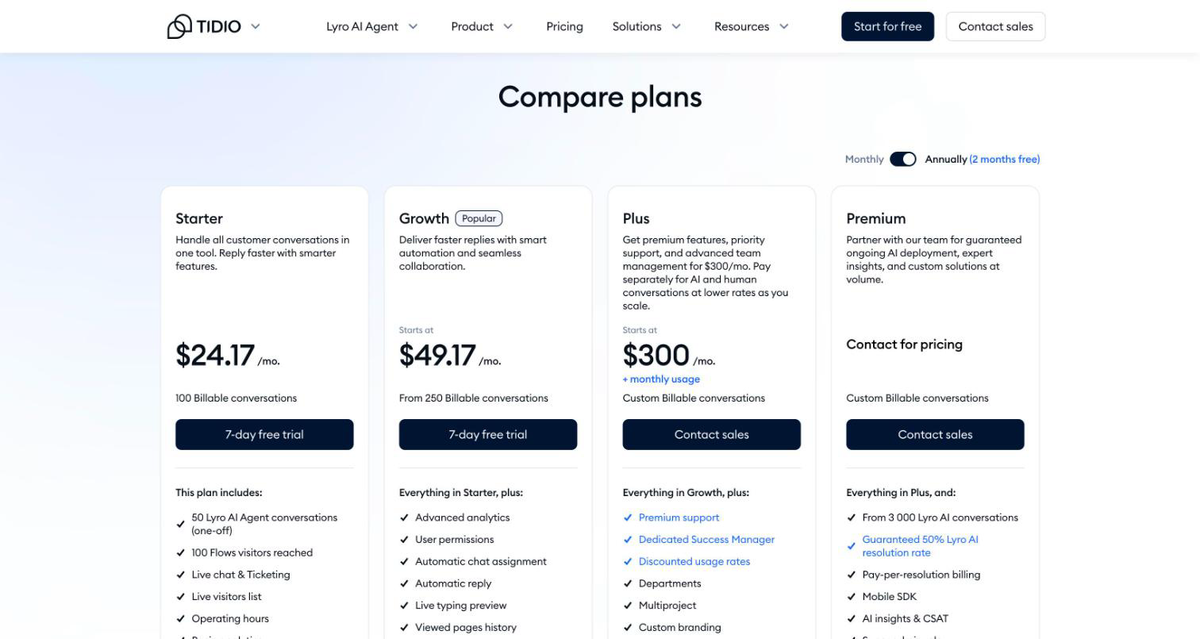
2. What is your current monthly ticket volume? Under 500 conversations per month, the economics of AI barely move the needle. Start with live chat software (Tidio from $24.17 a month, Crisp from $45 a month per workspace, or Hiver from $25 per user a month are fine for small teams, checked October 11, 2026), deploy a basic FAQ bot, and revisit when you hit 1,000 monthly conversations. Over 1,000 per month, the savings from AI compound quickly enough to justify real implementation investment.
3. Do you need 24/7 coverage? If your customers expect responses outside business hours, live chat requires night and weekend staffing that is expensive and hard to retain. An AI agent solves this at near-zero cost. This alone drives a lot of the adoption I see in B2C businesses with global customer bases.
4. How often do your support conversations require system actions vs just answers? If your support team mostly looks up information and reports it, a knowledge base bot may be sufficient. But if they routinely take actions (process refunds, modify orders, update account details, apply credits), you need a proper AI agent that integrates with your backend systems, not a glorified FAQ search.
5. What is the average customer lifetime value? If your customers are worth $50 to $100 lifetime, optimize hard for cost. AI agents are the right default. If your customers are worth $10,000 to $100,000 or more, the cost of a poor automated interaction outweighs the savings. Human agents for those accounts. AI for everything else.
Multi channel volume adds a separate question. When high value accounts reach you across chat, email and phone, a chat transcript that ends when the window closes loses the history, while a ticket with an owner and a service target keeps it.
6. What does your support team actually want to be doing? This question gets skipped almost every time. I have had deployments where the support team resisted AI because they genuinely preferred handling the repetitive queries. And deployments where they embraced it because they were burning out on the same 12 questions every day. Implementation success depends significantly on whether your team sees the AI as a tool that helps them or a replacement that threatens them. Handle this before you deploy anything.
What Most Comparisons Get Wrong
I have read dozens of articles comparing these two categories and most of them make the same mistake: they compare the best case for AI against the worst case for live chat, or vice versa.
The honest truth is that the AI agent market in 2026 is uneven. Gartner's August 2022 projection that conversational AI would reduce contact center agent labor costs by $80 billion globally in 2026 was a forecast, and it is a worldwide aggregate (Gartner). The 30 day chatbot you bolt onto your website with no CRM integration is not that.
The deployments that fail share a pattern: businesses buy AI expecting it to work on day one without setup, feed it minimal training data, and then conclude AI does not work when the bot gives wrong answers or routes customers to dead ends. The deployments that succeed treat the AI agent as a new hire. They spend two to four weeks on knowledge base setup, system integration, and testing edge cases before going live.
Live chat software is also frequently oversold as a relationship-building tool when the reality is that most live chat interactions are transactional. Customers do not want to chat. They want their problem solved. The medium matters less than the outcome.
The honest comparison is this: a well-implemented AI agent beats live chat on cost, availability, and volume every time. A poorly implemented AI agent is worse than no AI at all. And live chat software's value is entirely a function of the people using it.
A Real Deployment Scenario
Let me give you a concrete example of how I would think through this for a typical client.
A home services business doing $2M in annual revenue with four full-time employees, including one office manager who handles all support. They get roughly 800 customer conversations per month across phone, email, and chat. About 65% of those are: scheduling questions, pricing inquiries, service area questions, and status updates on existing jobs. 20% are complaints or issues that need judgment. 15% are new sales inquiries.
My recommendation: deploy an AI agent to handle the 65% tier-1 queries and the 15% sales inquiries (with immediate CTA to book a call, not try to close in chat). Keep the office manager handling the 20% that need human judgment. Net result: the office manager goes from 800 conversations a month to roughly 160. Instead of burning most of the day on repetitive questions, they focus on complaint resolution, customer relationships, and supporting the field team.
This is not a hypothetical. I have run this playbook for clients in home services, healthcare, and professional services. The pattern holds across industries as long as the ticket mix analysis is done first.
If you want to know whether your specific situation fits this model, the AI readiness assessment will tell you in about two minutes. It analyzes your current operations and gives you a tier-by-tier recommendation for what AI can and cannot do in your context.
FAQ
What is an AI agent for customer service?
An AI agent for customer service is software that uses large language models and business logic to autonomously handle customer conversations from start to finish without a human agent. Unlike traditional chatbots that answer FAQs, AI agents integrate with your CRM, order management, and billing systems to actually take action: processing refunds, updating records, and resolving tickets completely. Think of it as the difference between a bot that says "here is the return policy" and one that actually initiates the return.
How much does an AI customer service agent cost vs live chat staffing?
AI agents cost roughly $0.50 to $2 per resolved interaction at published list prices (checked October 11, 2026): Intercom's Fin is $0.99 per outcome with a $49 monthly minimum that includes 50 outcomes, Zendesk is $1.50 committed or $2.00 pay as you go per automated resolution, Salesforce Agentforce is $2 per conversation, and Freshdesk's Freddy AI Agent is $49 per 100 sessions, about $0.49 each. Seat prices come on top on most platforms. Fully loaded live chat staffing costs about $5 to $18 per chat on my model, which uses BLS wage data and two assumptions of mine (see the arithmetic under the comparison table). For a business handling 2,000 routine conversations per month, that is roughly $9,000 to $37,000 a month in labor versus $1,000 to $4,000 in AI resolution fees. For platform comparisons at your volume, see AI chatbot pricing and the chatbot builder comparison.
Will AI replace my customer service team?
No, not in the way the question implies. AI agents handle the tier-1 repetitive queries that currently eat most of your team's time. What it actually does is change what your team does, not eliminate them. In my deployments, human agents shift from answering the same 10 questions repeatedly to handling complaints, escalations, complex issues, and high-value customer relationships. Most teams prefer this shift. The businesses that use AI well do not shrink their support teams overnight. They grow revenue without growing the support headcount proportionally.
How long does it take to implement an AI agent for customer service?
A realistic implementation timeline is 2 to 6 weeks for a properly integrated AI agent. The first week is knowledge base setup and system integration mapping. The second week is testing against real historical tickets. Weeks three and four are live deployment with close monitoring and tuning. Simple deployments on platforms like Intercom Fin or Zendesk AI can go live faster if you already have a well-organized knowledge base, but expect at least two weeks for anything that connects to your backend systems.
What is the difference between an AI chatbot and an AI agent for customer service?
A chatbot follows predefined scripts or retrieves answers from a FAQ database. It deflects tickets. An AI agent reasons about the customer's intent, accesses your business systems, and takes action to resolve the issue. The output is different: a chatbot tells the customer what the refund policy is; an AI agent checks their order date, confirms eligibility under your policy, processes the refund, and sends the confirmation email. Both use AI in some sense, but the capabilities and business impact are completely different. See my full breakdown: AI agent vs chatbot: what actually matters.
Which live chat software is best in 2026?
For small teams under 10 agents: Tidio and Crisp offer the best value. Tidio Starter is $24.17 a month billed annually and its Lyro AI agent adds from $32.50 a month, while Crisp Mini is $45 a month per workspace and includes $5 of AI credits (about 90 automated conversations), with Plus at $295 (all checked October 11, 2026). For mid market businesses: Intercom (Advanced $85 and Expert $132 per seat a month billed annually, Fin at $0.99 per outcome) and Hiver (Growth $25 per user a month billed annually, AI agents included) provide strong agent workflows and better AI integration. For enterprise: Zendesk (Suite Team $55 and Suite Professional $115 per agent a month billed yearly) and Salesforce Service Cloud have the most mature AI agent capabilities but require significant setup investment. The "best" choice depends on your ticket volume, tech stack integrations, and whether you want AI assisted human agents or fully autonomous AI agents.
Can I use both an AI agent and live chat software together?
Yes, and this is the configuration I recommend for most businesses handling more than 500 conversations per month. The AI agent handles tier-1 queries automatically. When a conversation exceeds the AI's confidence threshold or the customer requests a human, it escalates seamlessly to a live chat agent with full conversation context. Every major live chat platform (Intercom, Zendesk, Tidio) has this handoff capability built in. The key is defining clear escalation triggers during setup so the handoff happens before the customer gets frustrated, not after.
How do I know if my business is ready for an AI agent?
Three signals: your support team handles more than 1,000 conversations per month, more than 50% of those conversations are repetitive tier-1 queries, and you have a documented knowledge base (even a basic one). If all three are true, you are ready. If you want a more detailed analysis specific to your industry and operations, the AI readiness assessment walks through 12 to 15 questions across eight dimensions and gives you a specific recommendation with implementation priorities.
Prices checked October 11, 2026 on the vendors' own pages: Fin, Intercom, Zendesk, Tidio, Crisp, Hiver, Freshdesk and Salesforce Agentforce. Acquisition details: Salesforce, September 10, 2026. The 51% preference figure comes from Zendesk's statistics roundup (January 2026).
If you have read this far and are trying to figure out whether AI agents, live chat optimization, or a hybrid architecture is the right next step for your business, the 15 minute call is the fastest way to get a concrete answer. I will ask about your ticket volume, current stack, and what your support team is actually spending time on. From there, the recommendation is usually clear. And if it is not the right time to invest in AI yet, I will tell you that too. Check out my AI implementation packages to see how I structure these implementations for businesses of different sizes, or read about my AI agent development service if you want one built around your own helpdesk and order systems.
Last updated
October 11, 2026
Category
Trends & Insights
Jahanzaib Ahmed
AI Systems Engineer & Founder
AI Systems Engineer with 126 production systems shipped. I run AgenticMode AI (AI agents, RAG systems, voice AI) and ECOM PANDA (ecommerce agency). I build AI that works in the real world for businesses across home services, healthcare, ecommerce, SaaS, and real estate.
Related articles
Best AI Chatbot for Customer Service Software 2026: Intercom Fin vs Zendesk AI vs Ada vs Sierra vs Decagon Compared
A direct comparison of Fin, Zendesk AI, Ada, Sierra and Decagon for customer service in 2026: published prices, total cost at 2,000 and 10,000 resolutions a month, and which deploys faster.
ComparisonTrends & InsightsAI Chatbot
AI Agents Are Coming for Your SaaS Stack and VCs Are Betting Billions on It
AI agents are replacing per seat SaaS. Gartner puts up to $234 billion of app spend at risk by 2030. Here is what it means for your business.
GuideTrends & InsightsAI Agents
AI Agent Builder: I've Shipped 126. Here's How a Non-Engineer Should Actually Pick One.
A practical guide to AI agent builders for business owners. Real platforms, real pricing, when each fits, and a four-question decision tree to pick yours.
GuideAI AgentsAI Agent Builder