AI Automation Consultant Hourly Rate in 2026: Published Rates by Source and When Hourly Is Wrong
What AI automation consultants charge per hour in 2026, from Upwork's $35 to $60 to a $195 federal median, with every source dated, plus when fixed price beats hourly.

Table of Contents
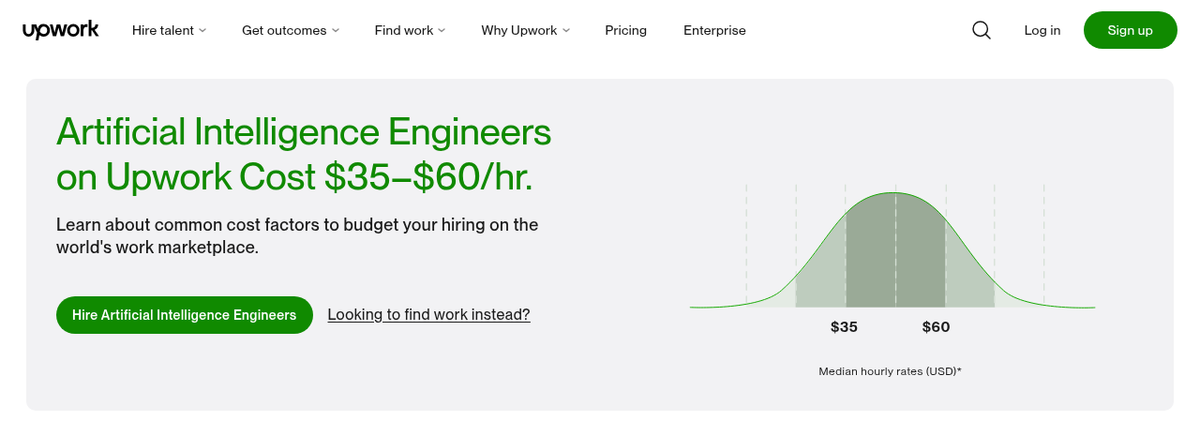
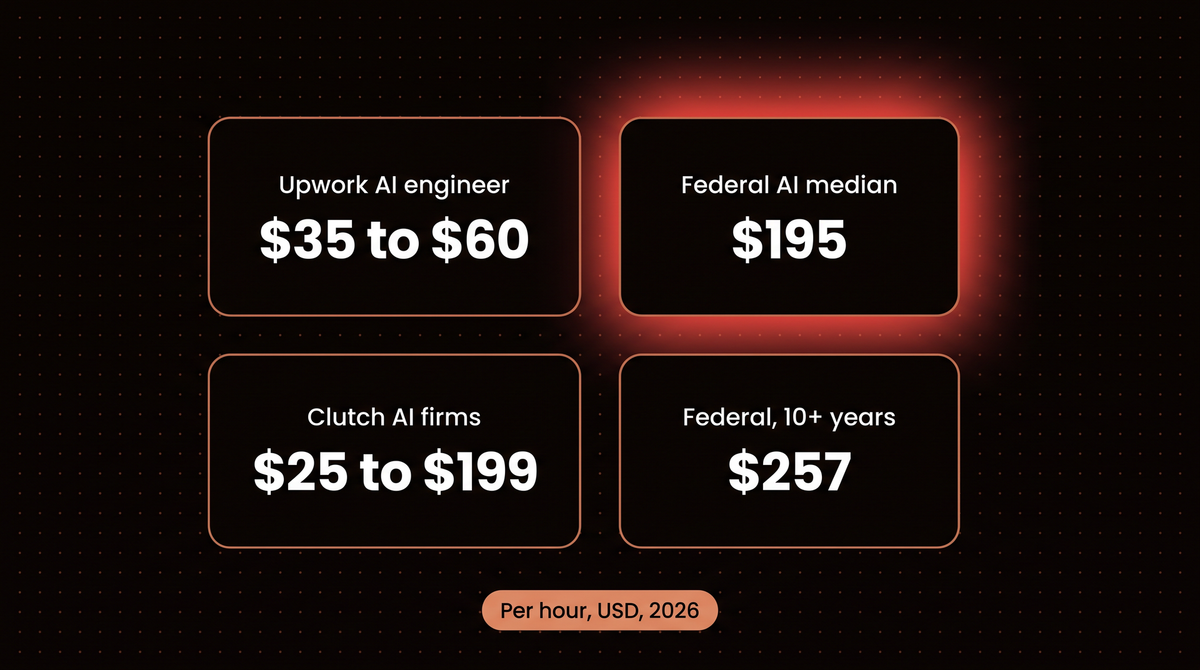
The AI automation consultant hourly rate runs from $35 to $60 on Upwork to a federal median of about $195, depending on who you hire. Upwork lists AI automation engineers at $35 to $60 an hour (October 2026) and says the most experienced AI consultants charge $100 or more. AI consulting firms in Clutch's directory list $25 to $199. Federal contract ceiling rates for AI roles have a median of about $195 (GSA CALC, 167 records, pulled October 9, 2026). I think the pricing model, hourly or fixed, matters as much as the rate.
This page answers the hourly question: freelance and Upwork rates, firm rates, and what the same skills pay as a salary. Machine learning engineers on Upwork list at $50 to $200 an hour, and ZipRecruiter estimates the average AI automation consultant salary in the United States at $104,000 a year, about $50 an hour (both checked October 11, 2026). If you want the total cost of a project, a package or a monthly retainer instead, my AI automation consulting pricing guide covers that.
I sell AI agent and automation work, so I am an interested party. Every figure below links to its source and date, and anything from my own work is marked as mine. I first wrote this post in April and rewrote it in October 2026, because several April figures had no source I could find.
Here is an illustration, not a client: a consultant at $50 an hour who needs 120 hours costs $6,000 (50 times 120), while one at $150 an hour who needs 30 hours costs $4,500 (150 times 30). The cheaper rate would be the more expensive project.
AI Automation Consultant Hourly Rate: What the Market Pays in 2026
There is no single market, so here is each published rate next to its source. I fetched every page on October 9, 2026, except where a different date is shown.
| Who you hire | Published hourly rate | Source and date |
|---|---|---|
| AI automation engineer on Upwork | $35 to $60 | Upwork hire page, October 2026 |
| AI consultant on Upwork | $35 to $60, with the most experienced at $100 or more | Upwork hire page, October 2026 |
| n8n expert on Upwork | $40 to $100. Upwork links this to its DevOps engineer figure, so it is not n8n specific data | Upwork hire page, October 2026 |
| Marketing automation consultant on Upwork | $40 to $90 | Upwork hourly rates page, published May 12, 2026 |
| Machine learning engineer on Upwork | $50 to $200 | Upwork hourly rates page, published May 12, 2026 |
| AI consulting firms on Clutch | $25 to $199 listed. 30 of the 48 firms with a listed rate charge $50 to $149 | Clutch directory, my tally of the 50 first page listings, page updated October 8, 2026 |
| AI development companies on Clutch overall | Most charge $24 to $49 | Clutch pricing guide, updated September 21, 2026 |
| Federal contract rates for AI labor categories | Median about $195. Middle half of rates $142 to $258 | GSA CALC, 167 records, my calculation on October 9, 2026 |
| Independent consultant, direct | One vendor guide says $150 to $350. I could not verify it against a primary source | Leanware guide, modified October 6, 2026 |
Three cautions on this table. First, the two Upwork hire pages for AI roles both link their $35 to $60 to the same AI engineer cost page, so they are one data point, not two. Second, Clutch disagrees with itself: the directory's own FAQ text says hourly rates typically fall between $125 and $300, the listings show $25 to $199, and the pricing guide says most AI development companies charge $24 to $49. The first page also includes sponsored listings. Third, the table is not a survey. Each row is a published range from a different kind of seller, and the ranges overlap.
Read the federal row with care. These are ceiling rates that companies list on General Services Administration schedule contracts. GSA says discounts at task order awards often occur, and these are not freelance rates and not specific to automation. I use them because they are the only large, dated, public set of firm billing rates I could find.
These come from the data behind GSA's CALC+ pricing tool. To reproduce them, I sent GET https://api.gsa.gov/acquisition/calc/v3/api/ceilingrates/?keyword=artificial%20intelligence&page_size=100&page=1 and page=2 with the public DEMO_KEY on October 9, 2026, against the index dated October 8, 2026. It returned 167 records, and every labor category title contains "Artificial Intelligence" or "AI". I took the current_price field and calculated percentiles by linear interpolation: 10th $112, 25th $142, median $195, 75th $258, 90th $306. The dataset is refreshed over time, so a rerun can differ.
The same federal data shows what seniority does to a rate. Median ceiling rate by the minimum years of experience the labor category requires:
| Minimum experience required | Median hourly ceiling rate | Records |
|---|---|---|
| Under 3 years | $131 | 23 |
| 3 to 5 years | $182 | 62 |
| 6 to 9 years | $219 | 47 |
| 10 or more years | $257 | 35 |
Upwork draws the same ladder for freelancers, at a much lower level. Its AI engineer cost page puts entry level at roughly $30 to $50 an hour, intermediate at $50 to $75 and the best at $75 to well over $100, with a median of $50.
Why Some Consultant Rates Sit Above a Salary Rate
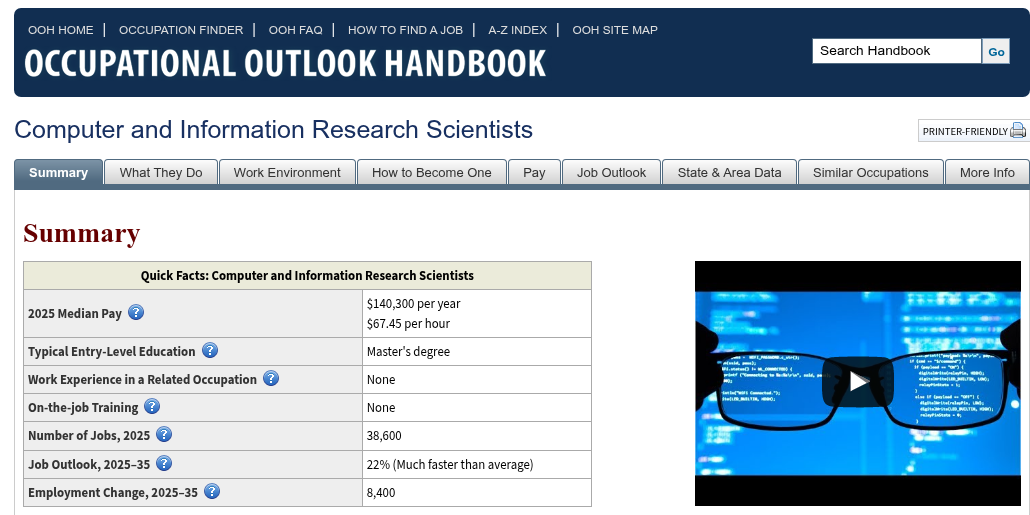
One reaction to a $150 an hour quote is to divide an annual salary by 2,080 hours and conclude the consultant is overcharging. The salary figures are real, and Upwork's $35 to $60 range sits below them. The Bureau of Labor Statistics lists 2025 median pay for computer and information research scientists at $140,300 a year, or $67.45 an hour. BLS has no AI consultant occupation, so treat this as an anchor, not a match. ZipRecruiter shows an average of $113,566 a year, or $54.60 an hour, for an AI consultant as of October 8, 2026, unchanged on October 11 (the page's meta description quotes a different hourly figure, so treat it as an estimate). Its narrower AI automation consultant salary page shows an average of $104,000 a year, or $50.00 an hour, with most salaries between $94,000 at the 25th percentile and $130,000 at the 75th, as of October 11, 2026. ZipRecruiter says its salary estimates come from employer job postings and third party data sources, so they are estimates, not a government survey. Upwork's cost page pairs a $130,000 to $170,000 AI engineer salary with $65 to $85 an hour, which implies about 2,000 hours a year.
The gap is hours. An employee is paid for roughly 2,080 hours. A consultant bills only the hours someone buys, and the rest goes to selling, scoping, admin and unpaid weeks. Here is a worked example with my own assumptions, not a market statistic: to earn the BLS median of $140,300, a consultant who bills 1,000 hours a year needs $140.30 an hour ($140,300 divided by 1,000). At 1,200 billable hours it is $116.92. So the arithmetic explains rates above $100, not marketplace rates, and a rate far above that needs a different justification, such as scarcity, speed or the cost of getting it wrong.
What Drives the Rate Up or Down
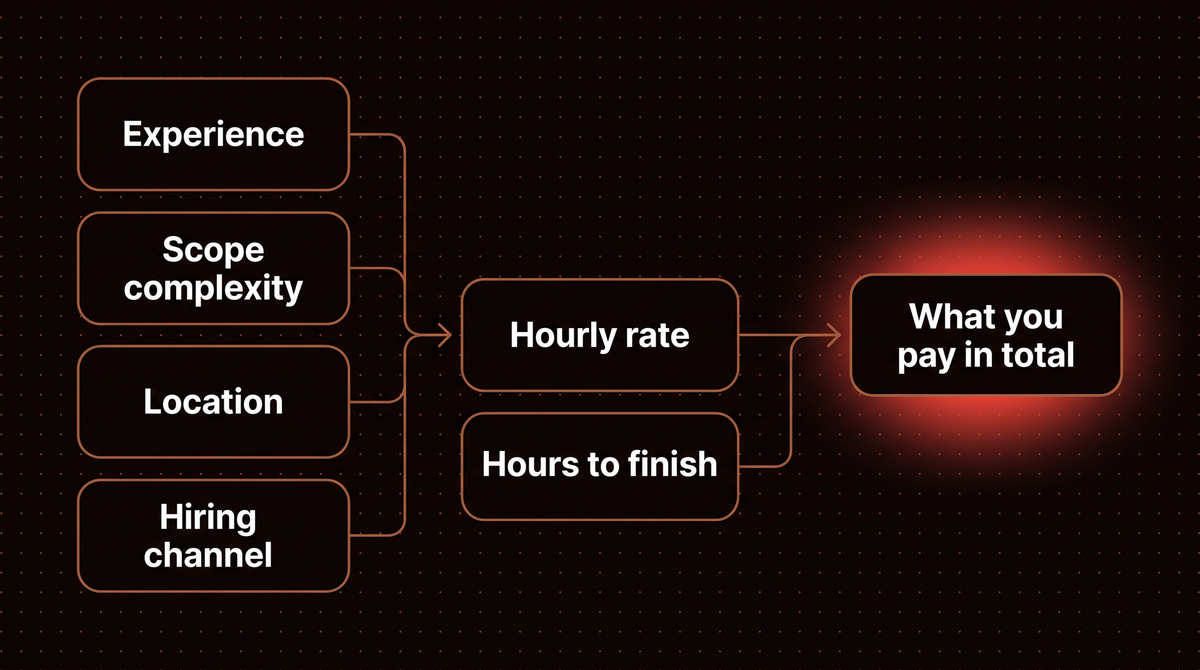
Upwork's cost page names the complexity of the project, the experience of the professional and geography as what drives the expense. The diagram below uses those three plus a fourth, hiring channel, which is my own addition. Rate is only half of the price: what you pay is the rate times the hours to finish.
1. Experience and specialization
Experience is the driver with the clearest data: the federal table above and Upwork's entry, intermediate and expert tiers both show it. Narrow skills price higher too. On Upwork, AI engineers list at $35 to $60 an hour and machine learning engineers at $50 to $200. Upwork's machine learning engineer cost page splits that into beginner at $50 to $80, intermediate at $80 to $120 and advanced at $120 to $200 or more (checked October 11, 2026). I could not find a published rate that prices production track record, so I treat it as a question to ask, covered below, rather than a number.
2. Scope complexity
There is a large difference between "automate this spreadsheet process in Zapier" and "build a multi agent AI system that handles inbound leads, qualifies them against your CRM, books calls and follows up for 30 days without human intervention." The second needs someone who knows LangGraph or n8n at the production level and can handle failures. Upwork's category ranges reflect the gap: chatbot developers at $30 to $61 an hour, marketing automation consultants at $40 to $90 and machine learning engineers at $50 to $200 (Upwork, published May 12, 2026).
3. Location
Upwork says independent professionals are most expensive in North America and western Europe, especially in large cities with a high cost of living such as New York or San Francisco. The spread shows in Clutch's directory. In my tally of the 50 first page listings, using the address in each listing's structured data, 15 of the 29 priced firms with a US address list $100 to $199 and the other 14 list $25 to $99. No firm with a non US address lists above $99 (19 firms by that data, 21 by the location printed on each card). I found no primary source for city by city rates.
4. How you find them
Upwork's freelancer service fee runs from 0% to 15% per contract and the freelancer pays it, so a platform hire carries a fee layer that a direct engagement does not. On a platform the marketplace does the matching. Direct, you do the vetting yourself.
Three Ways to Hire and What Each Actually Costs
Buyers can find AI automation help through a freelance platform, a firm, or a direct engagement with an independent.
- Freelance platform. Upwork lists AI automation engineers at $35 to $60 an hour (October 2026), and the freelancer pays the service fee. You carry the vetting time and any revision rounds.
- Firm. 30 of the 48 priced firms on Clutch's first page charge $50 to $149 an hour (my tally, October 2026). Ask who does the work and who manages it.
- Independent, direct. The only published figure I found is Leanware's $150 to $350, from a vendor guide I could not verify. The person who scopes the work can be the person who builds it.
Where the sources overlap: the top of Upwork's AI consultant range ($100 or more), the $100 to $199 firms on Clutch and the federal median ceiling rate (about $195) meet at roughly $100 to $200 an hour. My reading is that this is the band for senior specialists in the US, which is a judgment from these sources and not a survey. Some vendor guides quote higher bands, such as Leanware's $150 to $350 for independents, and I treat those as unverified.
Project prices are published too.
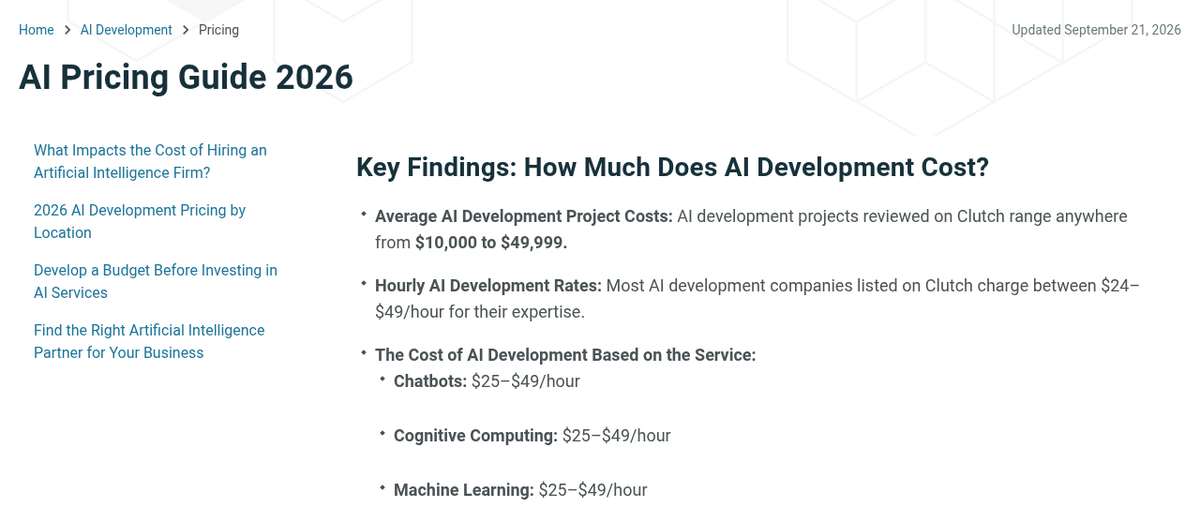
Clutch says AI development projects it reviewed range from $10,000 to $49,999. Upwork's cost page says a basic chatbot on third party software can cost $500 to $1,000, a custom business system for accounting automation or supply chain efficiency starts around $6,000, and custom development runs from $5,000 to hundreds of thousands of dollars depending on business size, data volume and complexity. In my judgment, a small business with one well defined workflow is asking "a few thousand or tens of thousands?", not "what is the rate?".
For one defined workflow, I think a single specialist who scopes and delivers is the safer choice, because a cheaper hire who needs three times the hours is not cheaper. That is a judgment, and the sources above do not prove it. If you want a rough budget before you talk to anyone, the AI agent cost calculator models build cost, running cost and return, and my guide to what AI automation services include and cost covers typical scopes.
When Hourly Billing Costs You More Than a Fixed Price
The risk with hourly billing is arithmetic. Here is an illustration, not a client: a consultant at $100 an hour estimates 40 hours, or $4,000. The loosely scoped work takes 70 hours. Billed hourly, you pay $7,000, which is $3,000 more than planned. At a fixed price of $4,000, you still pay $4,000 and the seller carries the overrun. Nobody has to act in bad faith for this to happen: on an hourly bill, the overrun is paid by you.
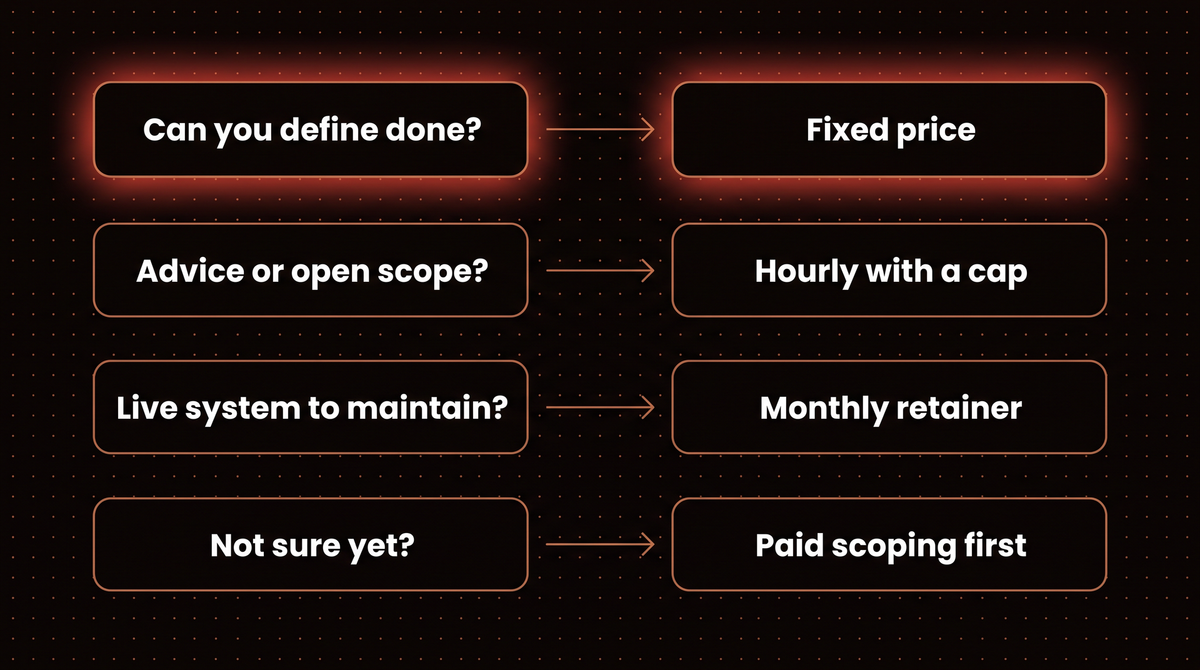
That does not mean hourly billing is wrong. Hourly makes sense when:
- You need advisory time without a defined deliverable, such as strategy calls or architecture reviews.
- The scope is genuinely unknown and you need to explore before committing to a build.
- You are making ongoing changes to a live system and need a consultant on call.
It does not make sense when you have a specific outcome in mind and a budget to protect. For those projects, ask for a fixed price scope upfront. A consultant who cannot give a scoped price may not have built something like it before, which is my judgment, not a measured fact. A monthly retainer, which buys an agreed block of time or a list of tasks for a set fee, fits the stage after launch, when the system is live and the work is small changes.
This is also how I sell. I do not publish an hourly rate. The AI Audit is $999 flat with no hourly billing, and builds are scoped and quoted on a call after the audit or a discovery conversation.
Where the Hours Go on an Automation Build
An hourly quote can price only the building. The hours that decide whether the system works sit on either side of it. On my own agent builds, week one goes to learning how the work is done today, including every exception and judgment call. Weeks two and three go to building and testing on real data, with the shadow run, the agent working beside the human doing the same job, in week three. Cutover is followed by 30 days of tuning. I do not publish an hour split for these phases, and your project will differ.
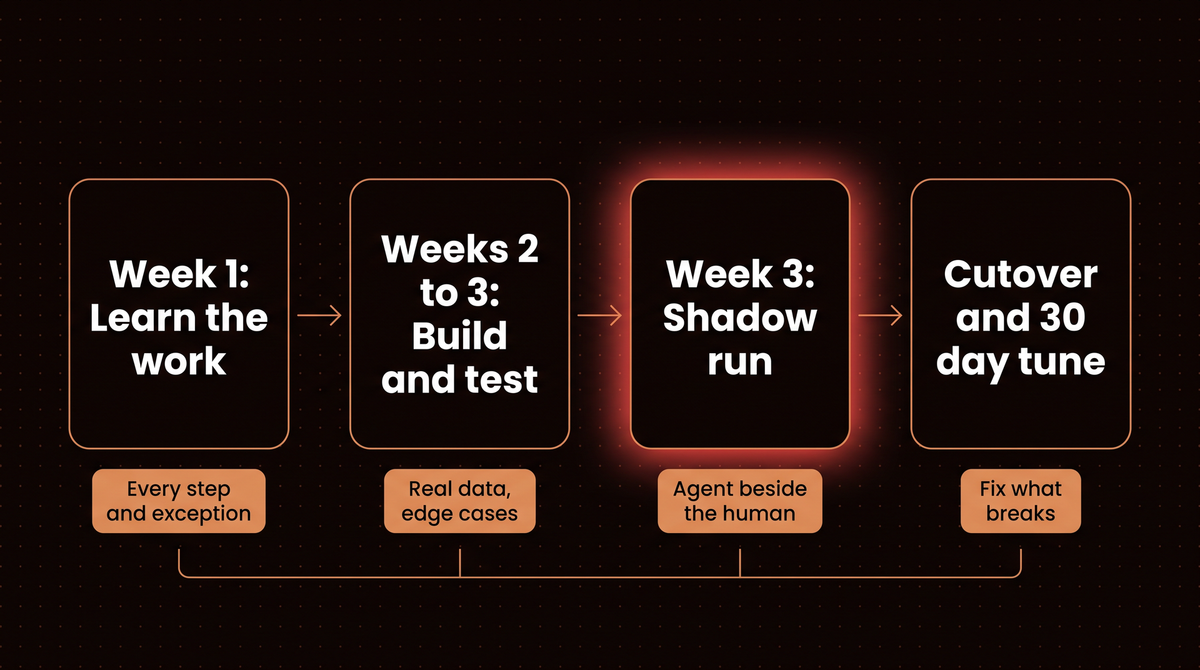
When you compare quotes, ask each consultant how many hours they have set aside for discovery, edge cases, the shadow run and the tune period. A quote that covers only the build leaves the other phases unpriced.
Is Hiring an AI Automation Consultant on Hourly Terms Right for You?
Run through these questions before you commit to an hourly engagement:
- Can you say what "done" looks like? If yes, push for a fixed price scope. Vague outcomes are where hourly scope creep starts. If you do not know what you want, paid advisory hours to define the scope first are reasonable.
- Is this ongoing work? In my judgment a retainer fits better than an open hourly meter for support after the initial build, because it puts a ceiling on the month.
- Have you checked their production track record? Anyone quoting above the marketplace ranges should be able to show systems running in production for real businesses.
If you are not sure whether you need AI agents or simple automation, my guide to AI agents versus automation explains the difference before any rate comparison. If you are past the research phase, the $999 AI Audit is the fixed price way to find out where AI fits your business and what it should cost. If you would rather talk first, book a discovery call.
Questions to Ask Before You Hire
Three questions that filter out consultants who will waste your hourly budget:
- "Can you show me a system you've built that has been running in production for more than six months?" Not a demo. A live system with real usage data.
- "What happens if the build takes longer than estimated?" The answer shows how they handle risk. "You pay more" is honest but not buyer friendly. "I scope in phases so you can control cost" is easier to budget.
- "What pricing model do you recommend for my project and why?" A consultant who only offers hourly billing leaves the overrun risk with you.
Frequently asked questions
What is a typical hourly rate for an AI automation consultant?
There is no single average. Upwork lists AI engineers at $35 to $60 an hour as of October 2026, worldwide. Clutch's directory lists AI consulting firms from $25 to $199, and only its US listings reach $100 or more. US federal contract rates for AI labor categories have a median of about $195. It depends on whether you hire a freelancer, a firm or a large contractor.
How much does a small business AI automation project cost?
Published figures vary with scope. Upwork's cost page says a basic chatbot on third party software can cost $500 to $1,000 and custom automation starts around $6,000. Clutch says the AI development projects it reviewed range from $10,000 to $49,999. In my judgment a tightly defined single workflow sits at the low end of those ranges, and open ended scope at the high end.
When does hourly billing make sense for AI automation consulting?
Hourly billing fits three situations: advisory calls with no defined deliverable, exploratory work before a build scope exists, and small ongoing changes to a live system. For a defined build with a clear outcome, a fixed or milestone price puts the estimation risk on the consultant. Whichever you choose, ask for a cap on hours.
What is the difference between an AI automation consultant and an AI developer?
In my description of the two roles, an automation consultant scopes the business process and builds it with tools such as n8n, Make or Zapier, and some write code too. An AI developer writes custom code in Python or frameworks like LangChain. Upwork's category rates show the spread: marketing automation consultants at $40 to $90 an hour, Python developers at $20 to $40 and machine learning engineers at $50 to $200.
Do AI automation consultants charge for the first call?
Policies vary and I found no survey on it. My own version is the AI Audit: $999 flat for one deep dive call, one or two workflows analyzed with monthly cost estimates, a ranked opportunity sheet and a 30 day plan, delivered in five business days.
What hourly rate should I expect to pay for AI agent development?
I found no primary source that prices AI agent development separately. The closest published benchmarks are Upwork's machine learning engineers at $50 to $200 an hour, its marketing automation consultants at $40 to $90, and the federal median of about $195 for AI labor categories. In my judgment, agents with memory, tool use and production reliability belong near the top of whichever range you use.
Last updated
October 11, 2026
Category
Implementation
Jahanzaib Ahmed
AI Systems Engineer & Founder
AI Systems Engineer with 126 production systems shipped. I run AgenticMode AI (AI agents, RAG systems, voice AI) and ECOM PANDA (ecommerce agency). I build AI that works in the real world for businesses across home services, healthcare, ecommerce, SaaS, and real estate.
Related articles
AI Automation Services: What They Actually Include, What They Cost, and Whether You Need Them
I've built 126 AI automation systems across industries. Here's what AI automation services actually include, what they cost in 2026, and how to tell whether you need a specialist.
GuideImplementationAI Automation
AI Automation Consultant Pricing: Every Model Explained, With Real 2026 Numbers and a Decision Framework
AI automation consultant pricing in 2026: hourly, project, retainer, productized audits and value based pricing, with sourced rates, agency versus independent minimums and a sample year one budget.
GuideAI AgentsAI Automation
How to Choose a Virtual Receptionist Service: A Small Business Buyer Guide to the Fine Print
A practical buyer guide to picking an answering service, with published 2026 rate cards, the call length that flips per minute against per call pricing, and the contract terms worth reading twice.
How toIndustry GuidesVirtual Receptionist