Most Clients Come to Me Wanting AI Agents. Most Leave With Zapier Instead.
I build AI agents professionally. Most of my clients come in wanting an agent and leave with a simpler, cheaper automation instead. Here is the framework I use to tell the difference.


Table of Contents
Most clients who ask me for an AI agent should buy Zapier instead, and I say that as someone whose business is building agents. The reason is that most business processes are far more deterministic than they look from the inside. If the steps are known in advance and the inputs are structured, an agent is a slower, costlier, less predictable way to run a workflow that a rules engine already handles perfectly.
Agents earn their cost in exactly three situations: unstructured data sits at the core of the task, the work needs multi step reasoning with feedback loops, or the tools have to be chosen at runtime rather than wired in advance. Everything else is automation with better marketing. MIT's NANDA study found 95% of generative AI pilots deliver no measurable P&L impact, and the pattern I see behind that number is teams reaching for agents where deterministic automation would have worked. Automate first, then add AI precisely where the automation breaks. Nearly every production system I run is that hybrid: automation takes the predictable 70% to 80%, the agent takes the rest.
I build AI agents for a living. Custom multistep orchestration systems, retrieval pipelines, tool calling architectures. The whole thing. I run AgenticMode and spend most of my working hours designing systems that automate complex business decisions using large language models.
And I spend a significant portion of those same hours talking clients out of building AI agents.
Not because agents are not powerful. They are. But the question "should I build an AI agent for this?" is almost never the right starting question. The right question is: does this task require reasoning, or does it just require rules? Those two things look the same from the outside. The cost difference between getting the answer wrong is enormous.
Gartner put a number on it in June 2025: over 40% of agentic AI projects will be canceled by end of 2027 due to escalating costs, unclear business value, or inadequate risk controls. That is not a fringe prediction. That is Gartner's base case. And in my experience building these systems, the number feels conservative.
The Expensive Mistake Everyone Is Making
Here is how the overengineering pattern plays out. A founder reads about AI agents. They see a demo. They feel behind. They commission someone to build an agent for their order processing, customer support, or lead qualification pipeline. The agent gets built. It works in demos. Then it hits production and starts doing things nobody expected: hallucinating context, failing silently, costing $8 in API calls for tasks that used to cost $0.003 in a Zapier workflow.
MIT's NANDA Initiative published a study in August 2025 based on 150 executive interviews, 350 employee surveys, and 300 AI deployments. Their headline finding: 95% of generative AI pilots fail to deliver measurable returns on the P&L. More than half of corporate AI budgets were directed at sales and marketing use cases, despite the strongest returns consistently coming from back office process automation.
I have seen this pattern in almost every industry. An e-commerce company spending $4,000 per month routing product questions through an LLM when a decision tree in n8n would have handled 80% of them at a fraction of the cost. A SaaS company building an agent to qualify leads when the qualification criteria were already well defined and a Make workflow would have worked fine. A healthcare practice building an "intelligent scheduling agent" for appointment types with exactly three decision variables, which is a job for a rules engine, not a language model.
The problem is not the technology. The problem is a fundamental mismatch between what businesses need and what they think they need.
What an AI Agent Actually Is (and Is Not)
Before you can make a good decision about whether you need one, you need a clear technical definition, not the marketing version.
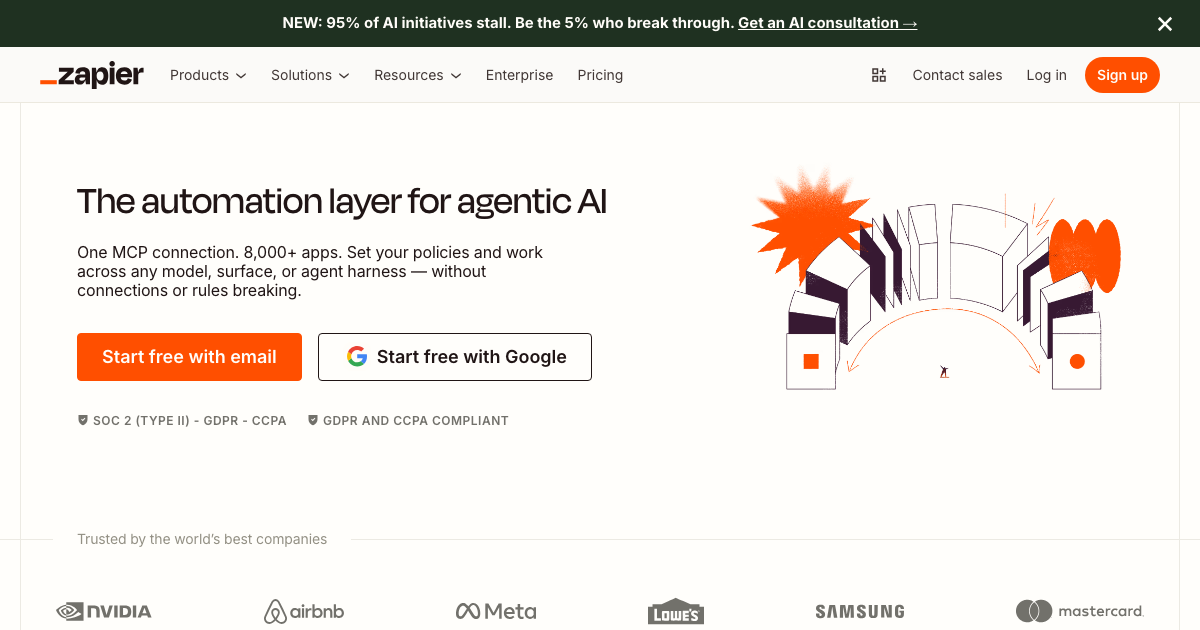
A workflow automation tool like Zapier, Make, or n8n executes a predefined sequence of steps. It moves data from A to B when a trigger fires. It does not decide what to do next based on context. It cannot handle inputs it wasn't programmed for. It fails predictably and loudly when something goes wrong. That is a feature, not a limitation.
An AI agent uses a language model to make decisions during execution. It can reason about ambiguous inputs, choose between tools dynamically, handle edge cases that weren't anticipated, and chain multiple steps in response to changing context. It is also unpredictable, meaning it can produce different outputs for the same input depending on factors you don't control.
That unpredictability is the part that gets people into trouble. In a Zapier flow, if step 3 fails, you know exactly what happened and why. In a multistep agent chain, a hallucinated intermediate result propagates forward and compounds with every subsequent step. By the time the error surfaces, tracing it back to the source is a serious debugging investment.
Gartner's June 2025 report noted that only around 130 of the thousands of companies calling themselves "agentic AI" vendors are genuinely building agentic systems. The rest are rebranding RPA, chatbots, and workflow tools as agents. That is not a coincidence. The label carries funding implications and price premiums that "workflow automation" does not.
| Dimension | Workflow Automation (Zapier / Make / n8n) | AI Agent |
|---|---|---|
| Task type | Deterministic, rules based | Ambiguous, judgment required |
| Failure mode | Loud, logged, traceable | Silent, propagating, hard to trace |
| Cost per 1,000 tasks | $0.01 to $0.50 | $5 to $100+ (model dependent) |
| Time to deploy | Hours to days | Weeks to months |
| Handles novel inputs | No (breaks or skips) | Yes (reasons about unexpected inputs) |
| Maintenance burden | Low | High (prompt drift, model updates, evals) |
| Debugging difficulty | Easy (step logs, clear error messages) | Hard (trace multi-step reasoning chains) |
| When it wins | Structured inputs, known decision paths | Unstructured data, dynamic tool selection |
The Decision Framework: Five Questions
I use a five question diagnostic before recommending an architecture to any client. Answer these in order. The first answer that points decisively in one direction is usually all you need.
1. Is the task deterministic?
Can you write down every possible input, every possible decision, and every possible output in advance? If yes, you don't need an AI agent. A rules based system will be cheaper, faster, more reliable, and easier to maintain. If no, if the range of inputs is genuinely open ended and the right response requires judgment, you might need an agent.
2. What happens when it goes wrong?
Every system fails eventually. Workflow tool failures are usually loud and logged: a webhook returns a 4xx, a step errors out, a Zap pauses. AI agent failures can be silent. A hallucinated fact gets written to your CRM. An incorrect summary gets sent to a client. A decision branch takes the wrong path and nobody notices for three days. If the cost of a silent failure is high, weight this heavily before choosing an agent architecture.
3. Does the task require dynamic tool selection at runtime?
An AI agent's real value is choosing, at runtime, which tools to use based on context. If your process always uses the same tools in the same order, you don't need dynamic selection. You need a workflow. Dynamic tool selection is justified when the same goal requires meaningfully different paths depending on inputs. A support agent that might need to check an order status, look up a contract, calculate a refund, and draft a personalized response based on what the customer actually said: that is a real agent job. A form that captures a lead and sends it to your CRM is not.
4. What is the token cost at your production volume?
This is the question almost nobody asks upfront. Take your expected monthly volume, multiply by your average task complexity, and calculate the estimated API cost at current model pricing. Then compare that to what the equivalent Zapier or Make plan would cost. I have seen teams build agentic pipelines that cost $2,000 to $8,000 per month in tokens for tasks that would cost $50 per month in workflow automation. If that number is not acceptable, build the automation first and add AI exactly where the workflow breaks down.
5. Is there genuine business value in handling edge cases programmatically?
Automation handles the 80% of cases that follow a predictable pattern. AI agents shine in the 20% that don't. But not every business needs to handle that 20% programmatically. Many businesses handle edge cases perfectly well with a human in the loop. Ask honestly: what is the dollar value of automating the edge cases versus the cost and complexity of building and maintaining an agent? If the math doesn't close, you are optimizing for technical elegance, not business outcomes.
The Automation Tool Landscape in 2026: Which Platform for What
If your process turns out to be more deterministic than you thought, and most do once you map them carefully, you have a genuinely strong set of tools to choose from. Here is how the main platforms stack up, and where each one earns its place.
Zapier is the most integration rich platform on the market, with connections to over 8,000 apps. If your stack includes less common or niche SaaS tools, Zapier probably connects them. The tradeoff is cost: at scale, Zapier's task based pricing adds up fast. The Team plan at $99 per month gives you 50,000 tasks, which sounds like a lot until a high volume process is running through it. Best suited for businesses that need maximum app coverage and can absorb the per task pricing model.
Make (formerly Integromat) balances power and price better than anything else in the market. Its scenario based pricing instead of task based pricing means complex multistep flows do not cost exponentially more than simple ones. The visual canvas is excellent for building workflows that non technical team members can own and maintain. This is where I send most clients who want to run their automations without a developer on call.
n8n is the right tool for technical teams that want serious automation power without vendor lock in. It is open source, self hostable, and has a JavaScript execution node that lets you run arbitrary code inside workflows. n8n has surpassed 230,000 active users and runs at over 3,000 enterprise companies, backed by Nvidia's investment arm and Accel. For teams comfortable with self hosting, it is also the cheapest option by a large margin.
And then there are the AI agent frameworks: LangGraph, AutoGen, CrewAI, and the growing ecosystem of managed agent platforms. These are powerful, genuinely necessary for real agentic use cases, and significantly more complex to build, deploy, monitor, and maintain than anything in the automation space. If you are evaluating one of these, read The Complete Guide to Building AI Agents That Actually Work in Production before you start scoping the build.
| Platform | Best For | 2026 Pricing | Technical Level | Integrations |
|---|---|---|---|---|
| Zapier | Maximum app coverage, non-technical teams | Free to $799/mo | Low | 8,000+ |
| Make | Complex flows at low cost, visual builders | Free to $29/mo (Core) | Low to Medium | 1,000+ |
| n8n | Technical teams, self-hosted, open source | Free (self-hosted) / $20/mo cloud | Medium to High | 400+ native, unlimited via HTTP |
| LangGraph / LangChain | Custom multi-step agent orchestration | Free (OSS) + LLM API costs | High | Custom built |
| CrewAI | Multi-agent role-based systems | Free (OSS) + LLM API costs | High | Custom built |
| Managed Agent Platforms | Non-technical teams needing agent capabilities | $500 to $5,000+/mo | Low (but constrained) | Platform-dependent |
The Real Cost Comparison
Let me put real numbers to this, because the handwaving in most "AI vs automation" posts is genuinely frustrating.
Zapier's most popular plan costs $69 per month for 2,000 tasks. Make's Core plan is $9 per month for 10,000 operations. n8n self hosted is free, and their cloud plan starts at $20 per month. These are serious, production grade tools used by millions of businesses.
An AI agent processing 2,000 tasks per month using Claude Haiku 4.5 at 1,000 input and 500 output tokens per task costs approximately $90 per month in API fees alone. Before infrastructure, engineering time, debugging, and ongoing maintenance. That is for the cheapest capable model. Step up to a reasoning model for complex tasks and the number multiplies by 20.
A client came to me last year wanting to build an AI agent to qualify inbound leads. The agent would read each submission, research the company, score the lead, write a personalized first touch email, and log everything to their CRM. They were processing about 400 leads per month.
I built them a tiered system instead. A Make workflow handled the 70% of leads that matched clean criteria: company size in range, industry on the list, budget field completed. Those got routed immediately with a templated sequence. The remaining 30% that needed judgment got a single lightweight LLM call with structured output. Total monthly cost: $34. A full agentic pipeline for all 400 leads would have cost $400 to $600 per month in API fees alone, with a significantly higher maintenance burden on top.
Here is a second example on the other side of the equation. A logistics company needed to process inbound freight quote requests. Each one was a PDF or email with carrier names, routes, weights, and special handling notes: variable structure, inconsistent formatting, genuinely ambiguous. That is a legitimate agent use case. Unstructured inputs, semantic understanding required, dynamic routing based on content. Their agent cost $180 per month in API fees to process 1,200 quotes. Without it, they had a full time data entry person at $3,200 per month doing the same work. The math was obvious and the agent paid for itself in week one.
The pattern holds across industries. Automation wins when inputs are structured. Agents win when they are not. Most inputs are more structured than they look once you sit down and actually map the process.
Gartner (June 2025) predicts that over 40% of agentic AI projects will be canceled by end of 2027 due to cost escalation and unclear business value. MIT's NANDA Initiative found that 95% of generative AI pilots fail to deliver measurable P&L impact, with the strongest ROI consistently coming from back office process automation. Sources: Gartner 2025, MIT NANDA via Fortune 2025.
The Hybrid Architecture: Where Most Businesses Should Actually Be
Here is what nobody explains clearly in the "automation vs agents" conversation: the best production systems are almost always hybrid. A workflow tool handles the predictable 70% to 80% of volume at near zero cost per task. An AI layer handles the remainder that genuinely needs judgment. The two parts operate independently, handing off based on clear criteria, and the overall system is cheaper and more reliable than a pure agent approach.
I see three patterns that work consistently in production.
Pattern one: Pre-filter, then reason. A workflow tool categorizes incoming data first using field values and basic conditions. Clean, structured cases get handled directly. Only ambiguous or complex cases pass through to an LLM. This alone reduces token costs by 60% to 80% in most real deployments.
Pattern two: Agent for extraction, automation for routing. When inputs are unstructured (emails, PDFs, call notes), an LLM extracts structured fields with high accuracy. Once the data is structured, a workflow tool handles all routing, integrations, and notifications. The LLM does only what it is actually good at: reading messy text. Everything else stays in the deterministic layer where it is cheaper and easier to debug.
Pattern three: Automation as backbone, agents as escalation handlers. A workflow runs your entire standard process. When it encounters a case that doesn't match any existing rule, instead of failing or routing to a human, it passes the case to an agent with full context. The agent handles the edge case and, if it needs human review, prepares a summary and routes accordingly. This is the pattern I used for the lead qualification client above, and the one I recommend to most businesses that want AI in their operations without replacing what is already working.
If you want to see what the automation side of this hybrid looks like in practice for a small business, 5 AI Automations Every Small Business Should Deploy covers five specific workflows with real ROI numbers and clear implementation steps.
When Agents Are Genuinely the Right Answer
I want to be specific here, because the "don't overbuild" message can tip into "never build agents" if you're not careful. There are real use cases where agents are not just appropriate but necessary.
Unstructured data at the center of the process. If your business processes live in emails, PDFs, call transcripts, or legal documents, inputs that resist schema, an agent is doing real work that a workflow tool physically cannot do. Parsing a contract for specific clause types, extracting intent from support conversations, summarizing research across 40 documents: these are genuine agent jobs.
Multistep reasoning with feedback loops. When a task requires the system to evaluate its own output, retry with a different approach, or ask clarifying questions before proceeding, you need an agent. A workflow tool executes steps. It cannot evaluate whether a step's output is good enough to continue or whether it needs to loop back and try again.
Dynamic tool selection at runtime. If the right action depends on what the data actually says, sometimes update Salesforce, sometimes escalate to Jira, sometimes flag for human review based on sentiment, and you cannot predict the distribution in advance, an agent's tool selection capability earns its cost.
I have shipped 11 production AI systems in the last two years that meet at least two of these criteria. They work, they deliver measurable ROI, and I am genuinely proud of them. They are also a small fraction of the AI projects I have been pitched. The honest answer, most of the time, is: start with n8n or Make, see exactly where it breaks down, and add AI there. If you want to understand where a RAG knowledge layer fits into this picture, the explainer in What Is RAG? The Business Owner's Guide covers the basics without the technical jargon.
The Implementation Path That Actually Works
Here is the approach I give every client who wants AI in their operations, regardless of starting point.
Map your process in full first. Every input type, every decision point, every output. Do this before evaluating any tools. You will find that most of the process is already deterministic. It just doesn't feel that way because it lives in someone's head.
Implement the deterministic parts with a workflow tool. Get it running in production. Measure it. Watch where it fails. The failure points, the cases that fall through the cracks, the inputs that break the rules, the decisions that need judgment, are the genuine AI agent opportunities.
Then, and only then, add AI to those specific failure points. Not to the whole process. Not as a replacement for the automation that is already working. At exactly the spots where determinism ran out.
When you do add an AI component, keep it scoped. One LLM call with clear inputs and outputs is easier to debug, cheaper to run, and simpler to improve than a full agent chain. If one call is not enough, add a second. Build up incrementally. You will know when you actually need a full agent because you will have hit the real limits of what structured logic can do, with production data proving it.
For teams that want to understand the full picture of what a production agent involves before committing to a build, I wrote a detailed breakdown in The Complete Guide to Building AI Agents That Actually Work in Production. It covers architecture patterns, RAG pipelines, tool use design, multi agent orchestration, and cost optimization across 126 real deployments.
A Note on the Hype Cycle
I am not anti AI agent. I am anti AI agent as default. Those are different positions.
The vendors selling agentic AI platforms have every incentive to convince you that everything is an agent use case. Meanwhile, 42% of companies abandoned most of their AI initiatives in 2025, up from 17% in 2024, according to McKinsey's State of AI report. The most common reasons were cost escalation and unclear business value, exactly what happens when you build an agent for a task that needed an automation.
Less than 10% of organizations have actually scaled AI agents in any single function, despite over 80% reporting some form of AI use. The gap between "we are using AI" and "AI is generating measurable business value" is where most organizations are stuck right now. The way out of that gap is almost always to go simpler, not more complex.
If you want a structured way to figure out where your business sits on this spectrum, and which approach is right for your specific context, the AI Readiness Assessment I built gives you a concrete answer in about 12 questions. It is not a sales funnel. It is the same diagnostic I use with clients before scoping any engagement. Take it and you will know exactly whether your use case calls for an agent, a hybrid system, or pure automation.
Frequently Asked Questions
What is the difference between an AI agent and a workflow automation tool?
Workflow automation tools like Zapier, Make, and n8n execute predefined sequences of steps triggered by events. They follow rules you define in advance and cannot make decisions based on context. AI agents use language models to make decisions during execution, choosing tools and actions based on the actual content of each input. Agents handle genuine ambiguity that automation tools cannot, at significantly higher cost per task and with much lower output predictability.
When should I use Zapier or n8n instead of an AI agent?
Use automation tools when your process is deterministic, when you can define all inputs, decisions, and outputs in advance. Most business processes are more deterministic than they feel when they live in someone's head. If 70% or more of your tasks follow a predictable pattern, start with automation. Handle the predictable cases at low cost and add AI only at the points where the automation genuinely breaks down. This approach typically reduces monthly operating cost by 70% to 90% compared to routing everything through an LLM.
Why do so many AI agent projects fail?
The primary causes are misaligned expectations, unpredictable behavior in production, and token cost underestimation. Most projects are scoped in demo conditions where edge cases are rare and inputs are clean. In production, edge cases are common, inputs are messy, and the failure modes of agentic systems, silent hallucinations and error propagation in multistep chains, are much harder to detect than workflow failures. MIT's 2025 NANDA study found that 95% of generative AI pilots fail to deliver measurable P&L impact.
How do I know if my use case genuinely needs an AI agent?
The most reliable signals: the task involves unstructured inputs like documents, emails, or free form text that resist schema. The right response varies significantly based on semantic content rather than field values. The process requires multistep reasoning with feedback loops rather than a fixed sequence. And the business value of handling edge cases programmatically clearly exceeds the ongoing cost of the agent infrastructure. If you cannot say yes to at least two of those, start with automation.
What automation tools do you recommend for businesses not ready for AI agents?
For teams with technical resources, n8n is the strongest starting point: open source, self hostable, 230,000 plus active users, and backed by Nvidia. For non technical teams that need a visual builder, Make is excellent and costs a fraction of Zapier. Zapier remains the most integration rich option with over 8,000 app connections but costs more at scale. All three handle the 70% to 80% of your process that is deterministic at a fraction of the cost of an AI agent stack. Once you have automation running in production, you have real data to make a precise, justified agent investment.
What does Gartner say about AI agent adoption in 2025?
Gartner's June 2025 report predicts that over 40% of agentic AI projects will be canceled by end of 2027 due to escalating costs, unclear business value, or inadequate risk controls. Their analyst Anushree Verma stated directly that "many use cases positioned as agentic today don't require agentic implementations." Gartner also found that only about 130 of the thousands of vendors claiming to offer agentic AI are actually building genuinely agentic systems. The rest are rebranding RPA and basic chatbots.
Can I start with automation and upgrade to AI agents later?
Yes, and this is usually the right path. A well built automation gives you production data about where the process actually breaks down, which tells you precisely where an AI layer would add value. Teams that start with automation and add AI incrementally almost always end up with better systems than teams that build full agent stacks from scratch. The transition is also straightforward: once you know which step needs reasoning, you replace that step with an LLM call and leave the rest of the workflow unchanged.
What industries benefit most from AI agents versus automation?
Industries with high volumes of unstructured text inputs see the strongest case for agents: legal, healthcare, insurance, real estate, and businesses running significant email or document workflows. Industries with structured transactional data, e-commerce fulfillment, basic customer support routing, appointment scheduling, financial reporting, almost always get better ROI from automation tools. The determining factor is the nature of the input data, not the industry itself. A well run e-commerce operation might have one genuine agent use case in returns processing and pure automation everywhere else.
Published
March 29, 2026
Category
AI Agents
Jahanzaib Ahmed
AI Systems Engineer & Founder
AI Systems Engineer with 126 production systems shipped. I run AgenticMode AI (AI agents, RAG systems, voice AI) and ECOM PANDA (ecommerce agency). I build AI that works in the real world for businesses across home services, healthcare, ecommerce, SaaS, and real estate.
Related articles
n8n vs Zapier in 2026: After 126 Production Systems, Here Is My Honest Verdict
A practitioner comparison of n8n and Zapier in 2026 with verified pricing, a clear decision framework, and two real client deployment stories.
ComparisonTrends & Insightsn8n
How to Build Your Own AI Agent: 3 Self-Hosted Stacks Compared (2026)
After 126 production builds, here is my real comparison of three self-hosted AI agent stacks (Pydantic AI, LangGraph, n8n) plus a five-minute decision framework.
How toAI AgentsAI Agents
Zapier Agents vs n8n AI Agents: What 40+ Deployments Taught Me About the Real Choice
Both Zapier and n8n shipped major AI updates in 2026. I've deployed both across 40+ client projects. Here is my honest comparison of cost, reliability, and AI agent capability.
ComparisonAI AgentsZapier Agents