Apple's Reference Image Proves a Camera Was There. It Can't Prove a Photo Isn't AI.
A breakdown of Apple Reference Image, why proving a camera was present is not the same as proving a photo is real, and what an image ingest pipeline can actually verify today.


Table of Contents
Apple shipped a camera sensor that signs its own photons this week, and nearly every headline about it said the same wrong thing.
The feature is called Apple Reference Image. It arrives with iPhone 18 Pro and iPhone 18 Pro Max, and Apple's own words for it are careful: the new sensor in the Main camera "can sign every pixel it sees," and a photo taken in the new Reference mode produces signed sensor data that Private Cloud Compute develops into an "unalterable reference image." The Verge ran it as Apple's new iPhone camera mode promises to prove your photo isn't AI. TechCrunch ran it as Apple has a new way to prove your iPhone photos aren't AI slop.
Those two headlines describe a detector. Apple built an attestation. They are not the same instrument, they fail in opposite directions, and if you're wiring image checks into anything that makes decisions, the difference decides whether your pipeline is useful or actively dangerous.
What did Apple actually announce?
Apple announced a capture time signing feature for two phone models, in which the Main camera sensor signs its raw output at the moment of exposure, Private Cloud Compute turns that signed data into a fixed reference image, and the Photos app shows you that reference beside whatever version of the picture you're holding.
The comparison is visual and the person doing it is you. Apple's phrasing is that reference images sit in Photos "alongside the main image, like a digital negative, to visually compare the two assets and determine if any edits were made." There's no verdict, no score, no green check. There's a known good copy and your eyes.
The developer surface is narrower than the coverage implied. Apple's release says "APIs are available in iOS, iPadOS, and macOS 27 for third-party apps to enable viewing of these reference images." Viewing. Not verifying, not fetching a signature, not validating a chain. An app can show the reference next to the edit. Apple did not announce a verification API that returns a boolean, and nobody outside Apple has one yet.

The hardware context is real, and it's why this could not have shipped as a software update. The same camera generation brought a variable aperture that opens to ƒ/1.48, built from six laser cut blades, per Apple's release. The A20 Pro behind it carries 50% more memory bandwidth than the A19 Pro and a GPU up to 40% faster. Signing at the sensor needs silicon that can sign at sensor speed.
Does Apple Reference Image prove a photo isn't AI generated?
No, and the logic inverts in a way that matters. A reference image is positive evidence that a particular sensor saw a particular scene at a particular moment. Its absence tells you nothing at all, because the overwhelming majority of photographs in the world will never have one.
Think about what has to be true for a picture to carry a reference image. It was shot on an iPhone 18 Pro or Pro Max. The photographer switched into Reference mode before the shot, not after. The feature was turned on, because Apple says plainly that it's opt in. And the phone was not in China, and not in the EU, where capture doesn't ship at launch.

Every one of those conditions is a filter, and they multiply. So a photo with no reference image is the default state of every photo, which means you can never read its absence as suspicion. That's not a nitpick about wording. It's the entire operational question, because a verification system that people treat as a negative test will start flagging honest photographers who shot on an Android, or shot last year, or live in Munich.
NIST said this years before Apple built the sensor. Its overview of content transparency notes that if provenance data becomes widespread, "the absence of provenance data in a situation where it would have been expected could also become a signal, at least in some contexts." Read the conditions in that sentence. Widespread, expected, some contexts. Reference Image satisfies none of them yet.
How does AI image provenance work in C2PA, SynthID and Apple's model?
Three mechanisms are now in play and they attack three different problems, which is why the coverage kept blurring them into one announcement about AI detection. One signs the history of a file, one hides a mark inside generated pixels, and one attests to the moment of capture in hardware.
| Property | C2PA / Content Credentials | SynthID | Apple Reference Image |
|---|---|---|---|
| What it asserts | Origin, edit history, chain of provenance | This pixel data came from a generator | This sensor saw this scene |
| Where the evidence lives | Signed metadata, embedded or external | Inside the pixels, imperceptible | A separate reference file held by the capturer |
| Survives a screenshot | No | Designed to survive crops and compression | Not applicable, the reference is a separate asset |
| Trust anchor | Certificate authority trust lists | Google's detector | Apple silicon plus Private Cloud Compute |
| Who can verify | Anyone with the file and a validator | Google, via Gemini or the detector portal | Whoever holds the reference, by looking |
| Coverage today | Adopting vendors and tools | Google generative products, and Apple edits later this year | Two iPhone models, opt in, not in China or the EU at launch |
The row that matters for anyone building an ingest path is the last one in the middle block. C2PA hands the recipient something they can check on their own, using what NIST describes as "trust lists" of certificate authorities assumed to be trustworthy. Apple hands the recipient nothing. The reference lives with the photographer, so verification requires the photographer to cooperate and send it.
For a newsroom that already talks to its photographers, that's fine and maybe even better, because a separately held negative can't be stripped by an upload pipeline. For an open intake form where strangers submit images, it's useless, and that's most of the systems I get asked to build.
Worth noting what Apple didn't say. The phrase C2PA appears zero times in Apple's press release, and so does Content Credentials. Apple built a parallel mechanism rather than joining the one the rest of the industry has been standardising, which is currently working its way through ISO. That's a choice with a decade of consequences and nobody asked about it on the day.
What does it mean that Private Cloud Compute develops the reference image?
It means the artifact you end up comparing against was produced off the device, which puts a server hop inside a chain whose whole selling point is that it starts in hardware you're holding. The sensor signs. Apple's cloud develops. You see the output of the second step, not the first.
I'm not alleging anything about Private Cloud Compute, which is a genuinely serious piece of engineering with a published security model. The point is narrower and it's about what a user can check. When Apple says the result is "unalterable," the property being claimed belongs to the developed reference, and the raw signed sensor data that justifies it never passes through your hands.
That distinction shows up the moment somebody disputes a photo in a context with stakes. A court, an insurance claim, a defamation fight. The question there isn't whether the reference looks different from the edit. It's who can attest to the transform between signed sensor data and reference image, and right now the answer is Apple and only Apple. Compare that with the fight over provenance in training data pipelines, where the whole argument turned on who could prove what happened to a file between two systems.
I've shipped enough verification flows to know where this breaks in practice. The failure isn't the cryptography. It's the step where a human decides the two pictures look the same, at 2am, on a phone, under deadline.
Why do Apple's footnotes matter more than its cryptography?
Because the footnotes define the population the feature covers, and coverage is the only variable that decides whether a provenance signal is usable as evidence. The cryptography either works or it doesn't, and Apple's probably works. The footnotes tell you how often it will be there at all.
Footnote five is the one to read. Apple writes that Reference Image "is an opt-in feature," that in China it "will not be available at launch because of regulatory requirements," and that in the EU capture doesn't ship at launch either, though people on iOS 27, iPadOS 27 and macOS 27 "will be able to develop and view reference images." Neither The Verge nor TechCrunch mentioned China.
Stack those with the hardware requirement and you get a feature that is off by default, restricted to the two most expensive phones Apple sells, and unavailable for capture across two of the largest markets on earth. I keep seeing teams design verification around the happy path and then discover the happy path is a rounding error. Default state is the whole game, which is the same trap I wrote about when a consent toggle was already switched on before anyone consented to anything.
None of this makes Reference Image a bad feature. Opt in is the correct default for something that generates a durable record of where you were standing and what you pointed a camera at. A mandatory capture attestation on a billion phones would be a surveillance artifact, and Apple choosing not to build one is the right call. It just means the thing being shipped is a tool for people who already want to prove something, not infrastructure anyone else can lean on.
What did the coverage get wrong about SynthID?
TechCrunch wrote that "Apple also said it will support the SynthID standard to help people determine whether images were created or altered with AI," which reads like Apple is adding a detector. Apple's own footnote describes something close to the opposite: an embedder, applied to Apple's own edits, shipping later.

Read Apple's footnote six: SynthID "will be available in a software update later this year and will be included for most edited images, depending on the edits applied." Two hedges in one sentence. Most edited images, and depending on the edits. That's a commitment to watermark some of Apple's own output, on a schedule, with exceptions.
Google DeepMind is equally clear on its side. SynthID watermarks "are embedded across Google's generative AI consumer products," and the way you check one is to ask Gemini whether an image was created or altered by Google AI. The detector answers a question about Google's generators. Point it at output from a model nobody in this story ships and it has nothing to say.
So the correct reading of the announcement is that Apple will start marking its own edits, in the same way Google marks its own generations, and neither of those is a detector for the open web. Going to the vendor's own documentation instead of the press write up keeps catching this, which is exactly what happened when every outlet wrote iMessage and the docs said SMS and RCS too.
What can an agent pipeline actually verify at ingest today?
Very little, and pretending otherwise is how you build a claims processor or a moderation queue that confidently rejects real submissions from real people. Here's the honest inventory for a system taking arbitrary images from the internet in September 2026.
Embedded C2PA manifests, when they survive. NIST's assessment is blunt about that qualifier: "Many internet platforms strip at least some metadata from uploaded files to protect privacy," which means a manifest is present when the file came to you directly and frequently gone when it came through anything social. A SynthID check via Google's tooling, which returns a useful positive for Google generated media and silence for everything else. And a reference image, if and only if the sender chose to give you one out of band.

That's three partial signals with non overlapping coverage and no shared verdict. NIST published its 81 page review in November 2024, NIST AI 100-4, and its framing is the one I'd tattoo on an ingest service: transparency "may contribute to trustworthiness but does not guarantee it, and in some cases may undermine it." The undermining case is the interesting one. A file that carries a valid manifest can still be a true photograph of a staged scene, or a real image captioned into a lie.
I tell clients the same thing every time this comes up. Provenance raises confidence when present and proves nothing when absent, so it belongs in a score, never in a gate. The moment it becomes a gate, an adversary's cheapest move is to strip whatever you're checking for, and your system punishes the honest submitter who used a stock camera app. That's the same asymmetry that showed up when generated imagery landed on a map people check reality against.
What would I build if I had to ship image verification this quarter?
I'd build a confidence score with four independent inputs, none of them authoritative on its own, and I'd wire the escalation path to humans before I wired a single automatic rejection. That's less satisfying than a green check and it's the only shape that survives contact with real submissions.
The four inputs, in the order I'd add them. First, C2PA manifest presence and validity, treated as a strong positive and a neutral absence. Second, a SynthID check for Google generated media, same asymmetry. Third, the boring forensics that predate all of this: EXIF coherence, resampling artifacts, duplicate detection against what you've already seen. Fourth, and only for channels where you have a relationship with the sender, a request for a reference image.
Then the part people skip. Log every decision with the evidence that produced it, because the first serious dispute will be about a specific image on a specific day, and "the model said so" is not an answer. If you're mapping out where an agent touches unverified inputs before it acts on them, the AI readiness assessment walks the same ground for your own stack, and the way I think about trust boundaries generally is in the piece on personal agent security architecture.
Apple built a good thing. A sensor that signs at capture is a real advance over metadata that anything can rewrite, and a separately held reference can't be stripped by an upload. I just don't want to read one more headline telling people it proves a photo isn't AI, because somebody is going to believe that and build a rejection rule on top of it.
Frequently asked questions
Which iPhones support Apple Reference Image?
iPhone 18 Pro and iPhone 18 Pro Max. Apple ties the feature to a new sensor in the Main camera that signs its output at capture, so it isn't something older models can pick up in a software update. iOS 27 ships on Monday, September 14.
Is Apple Reference Image the same as C2PA or Content Credentials?
No. C2PA signs metadata about a file's origin and edit history and travels with the file itself, validated against certificate trust lists. Apple's approach keeps an unalterable reference as a separate asset you compare against. Apple's press release never mentions C2PA.
Can Reference Image tell me an image was made by AI?
No. It tells you what a specific sensor saw when a photo was taken in Reference mode. An image with no reference image is not evidence of anything, because the feature is opt in, limited to two phone models, and unavailable for capture in China and the EU at launch.
Does Apple supporting SynthID mean my iPhone can detect AI images?
No. SynthID is a watermark that Google embeds across its own generative products, and Apple's footnote says it will be included for most edited images depending on the edits applied, in a software update later this year. It marks output, it doesn't inspect arbitrary files.
Can third party apps verify a reference image?
Apple says APIs in iOS, iPadOS and macOS 27 let third party apps enable viewing of reference images. Viewing is the verb Apple used. No public verification API that returns a pass or fail result was announced alongside it.
Should I use provenance signals to automatically reject submitted images?
No. Use them to raise confidence when they're present and route to a human when the stakes are high. Absence of provenance is the normal state of almost every image on the internet, so rejecting on absence punishes ordinary users and barely inconveniences an adversary.
Sources: Apple Reference Image mechanism, the viewing only API, and footnotes five and six on opt in status, China, the EU and SynthID timing come from Apple Newsroom, September 9 2026. Headline framing and the SynthID sentence from The Verge, September 9 2026 and TechCrunch, September 9 2026. Watermark scope from Google DeepMind, SynthID. Provenance, metadata stripping and trust list detail from NIST AI 100-4, November 2024, doi.org/10.6028/NIST.AI.100-4.
Published
September 11, 2026
Category
Trends & Insights
Jahanzaib Ahmed
AI Systems Engineer & Founder
AI Systems Engineer with 126 production systems shipped. I run AgenticMode AI (AI agents, RAG systems, voice AI) and ECOM PANDA (ecommerce agency). I build AI that works in the real world for businesses across home services, healthcare, ecommerce, SaaS, and real estate.
Want this built for your business? See The AI Audit, or browse the free tools and guides.
Related articles
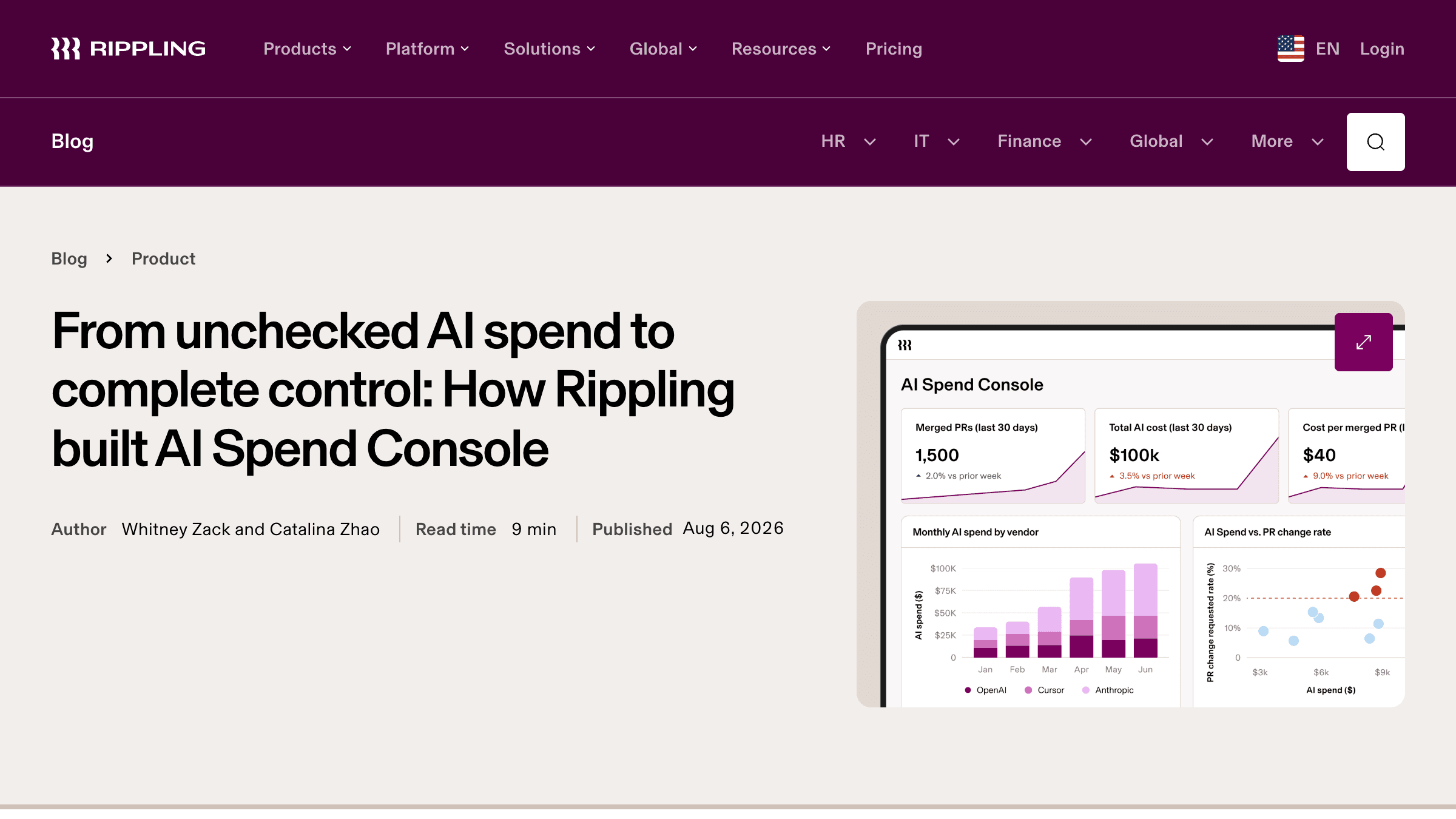
Rippling Was About to Spend 40% of Its Engineering Payroll on Tokens
A breakdown of what Rippling found when it audited its own AI token bill, why 10 to 15% of staff drove 60% of the spend, and what its per-engineer scorecard gets right and dangerously wrong.
NewsTrends & InsightsAI Costs
Four People Left Google to Automate Discovery. One of Them Named the Hard Part.
A breakdown of the Discovery Loop launch, why Google's own memo named only half the team that walked, and what a cofounder's launch day admission tells you about building on any of it.
NewsTrends & InsightsAI Agents
Meta Promised Billions of Personal AI Agents. The Number That Matters Is One Million.
A breakdown of Meta's Q2 2026 agent announcements, why the market sold off almost 10 percent on a five-year vision, and why the one million businesses already running Meta agents matter more than the forecast.
NewsTrends & InsightsAI Agents