AI Chatbot Pricing in 2026: What You Will Actually Pay (After 126 Builds)
Real 2026 AI chatbot pricing across Intercom, Tidio, Chatbase, Botpress, Zendesk, ManyChat, and Crisp. Verified vendor numbers and the hidden costs no one mentions.

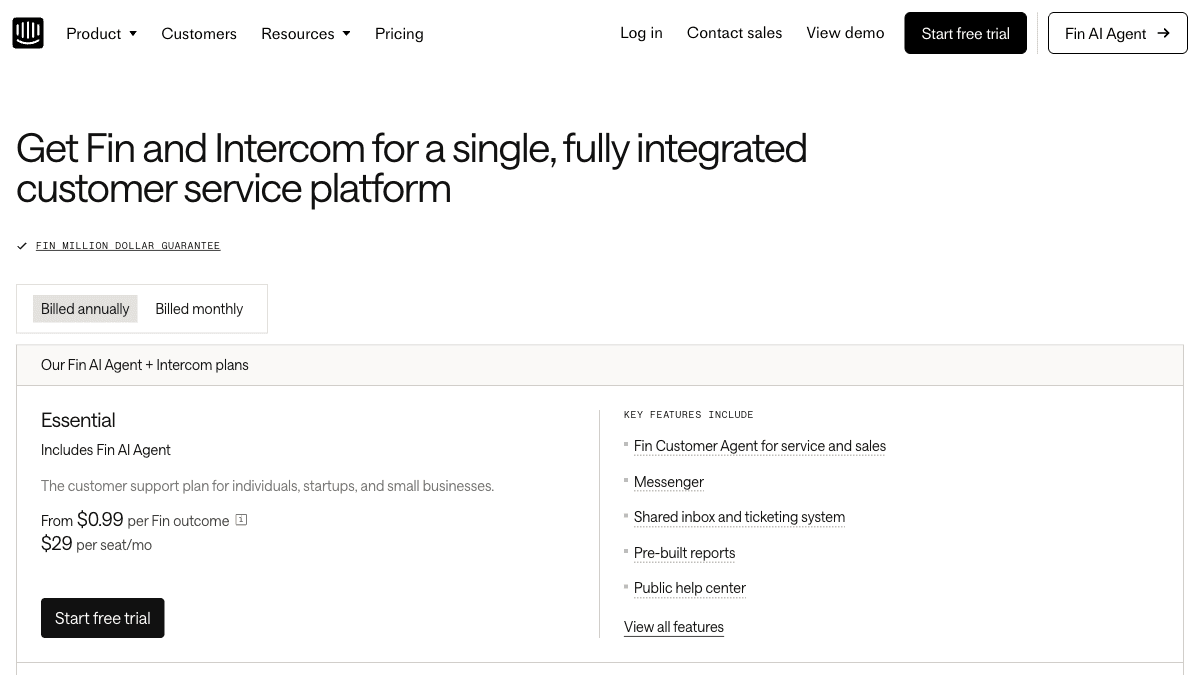
Table of Contents
The cheapest AI chatbot I have quoted a client was $19 a month and the most expensive one I run costs $11,400, and they are the same category of product. What separates them is volume and pricing model, not features. There are four models in this market: per resolution, per seat, per message credit, and flat tier, and each of them wins at a different volume, which is why comparing sticker prices across vendors tells you almost nothing.
Concretely: Intercom Fin charges $0.99 per resolution on top of $29 to $132 per seat, which gets expensive quickly above 5,000 resolutions a month. Chatbase, Botpress, and Tidio own the small business band at $24 to $400 a month with predictable caps. A custom RAG chatbot on Bedrock or OpenAI starts near $300 a month in infrastructure before build cost. Then add 20% to 40% for the things nobody quotes: overage fees, integration time, and keeping the knowledge base current.
The cheapest AI chatbot pricing I have ever quoted a client was $19 a month. The most expensive one I have shipped runs $11,400 a month. Same category of product. Different volume, different vendor, different math. If you are searching for clear numbers before you sign anything, you are in the right place.
I have built 126 production AI systems across law firms, contractors, ecommerce stores, and SaaS companies. I have seen every pricing model in the wild, and I have watched several of them quietly bankrupt support budgets that looked fine on paper. This is the post I wish my clients had read before they signed up.
What does an AI chatbot actually cost in 2026?
An AI chatbot in 2026 costs between $19 and $400 a month for most small businesses, $500 to $3,000 a month for mid market companies with moderate ticket volume, and $5,000 to $15,000 a month for enterprises running per resolution pricing at scale. Custom built chatbots add a one time build cost of $5,000 to $50,000 plus ongoing infrastructure of $300 to $2,000 a month.
If you only read one section of this post, read this table. It is the pricing reality across the platforms I deploy and audit most often.
| Platform | Entry Price | Pricing Model | Best For | Watch Out For |
|---|---|---|---|---|
| Intercom + Fin | $29 seat + $0.99 per resolution | Per seat plus per resolution | Existing Intercom shops | Resolution costs at high volume |
| Zendesk + Copilot | $155 agent + $50 Copilot | Per agent flat | Mid market and enterprise | Add ons stack quickly |
| Tidio + Lyro | $24.17 a month annual | Per conversation tiers | Ecommerce, sub 500 conversations | Lyro overage at 50 conversation cap |
| Chatbase | $32 a month annual | Per message credit | RAG over your own docs | Credit overages ($40 per 1,000) |
| Botpress | $0 + AI spend | Pay as you go on LLM tokens | Builders comfortable with AI cost variance | Token spend has no ceiling |
| ManyChat | $14 a month Essential | Per active contact tier | Instagram, WhatsApp, and Messenger flows | Per contact pricing inflates fast |
| Voiceflow | Custom, usage based | Usage with multi channel | Voice + chat agents at agency scale | Sales conversation required |
| Crisp | $45 a month Mini | Per workspace flat | Small teams who want simple billing | AI features only on Plus ($295) |
| Custom build (yours) | $300 a month infra + build | OpenAI or Bedrock token cost | Specific workflows, full data control | You own the maintenance |
If you want to talk through which one matches your ticket volume and tech stack, book a free 30 minute discovery call. I will quote you a real number for your specific case, not a marketing range.
The four AI chatbot pricing models you will see
Almost every quote you receive in 2026 will use one of four pricing models. Knowing which one a vendor uses tells you instantly whether their math will work at your volume.
1. Per resolution pricing
You pay each time the chatbot successfully closes a customer issue without human handoff. Intercom Fin charges $0.99 per resolution. Zendesk's autonomous AI agents and several other enterprise vendors use the same model. The pitch is that you only pay for value delivered. The reality is that successful resolutions scale linearly with traffic, and at 10,000 resolutions a month you are looking at $9,900 in resolution fees alone, on top of seat costs.
I deployed Fin for a B2B SaaS client last year. Their previous bill was $1,200 a month on Intercom seats. Three months after Fin went live and their support volume grew, the combined bill hit $7,800. The product worked. The pricing did not.
2. Per seat or per agent pricing
Flat fee for each human agent in the system, regardless of how many tickets they handle. Zendesk Suite Professional runs $155 per agent per month, and Copilot adds $50 per agent on top. Intercom's Advanced plan is $85 per seat. This model is predictable, but it punishes teams that hire more agents and rewards companies that lean harder on automation. Zendesk's pricing page shows how the add ons stack: Quality Assurance ($35), Workforce Management ($25), and Advanced AI agents are all separate line items.
3. Per message credit pricing
You buy a pool of message credits each month. Chatbase Standard gives you 4,000 credits for $120 a month. When you exceed the cap, you either upgrade or pay overage at $40 per 1,000 credits. This model is friendly to small businesses with predictable volume and brutal to anyone who hits a viral moment. I have seen one client blow through 18,000 credits in a single weekend after a Reddit post.
4. Flat tier or per contact pricing
You pay a tier price based on how many active users (or contacts, or workspaces) you have. ManyChat charges $14 a month for 250 active contacts and jumps to $139 a month for 25,000. Crisp charges per workspace. Botpress's Plus plan is $79 a month flat plus your raw AI spend on whichever LLM you point it at. This is the most predictable model and the easiest to budget against.
Real AI chatbot pricing breakdown by platform
Here is the actual current pricing for the platforms I deploy and audit most often, captured directly from each vendor's pricing page in April 2026.
Intercom + Fin AI Agent
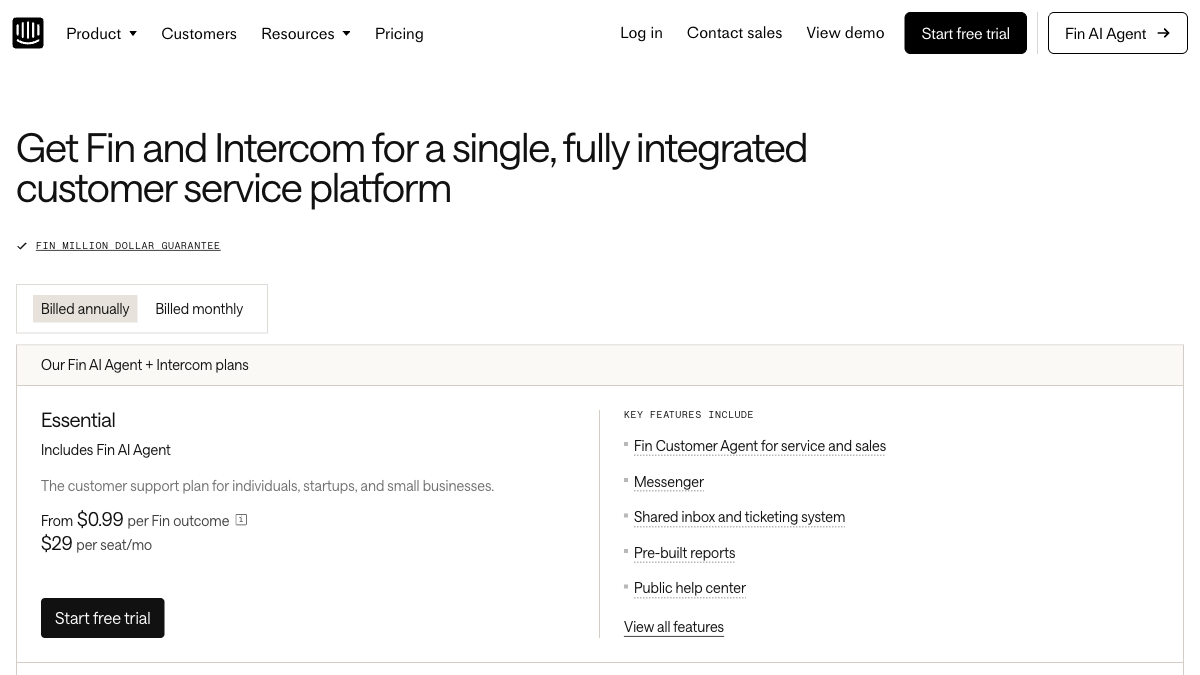
Intercom's Essential plan is $29 per seat per month, Advanced is $85 per seat per month, and Expert is $132 per seat per month. Every plan includes Fin, billed at $0.99 per resolution. Fin works on top of Intercom or as a standalone agent on Salesforce, Zendesk, and other helpdesks (also $0.99 per resolution, no seats required). The Pro add on for AI insights is $99 a month, and Copilot is $29 per agent per month for unlimited usage.
Verdict: Intercom is the right call if you already live in Intercom. If you are starting fresh and your ticket volume is high, the per resolution math will outpace cheaper alternatives by month four. Source: Intercom pricing.
Zendesk Suite + Copilot
Zendesk Suite Professional with Copilot bundled is $155 per agent per month billed annually. The standalone Suite plans (without Copilot) start at $19 per agent per month for the Team tier and run up to $169 per agent per month for the Enterprise Plus tier. Copilot as an add on is $50 per agent per month. Advanced AI agents are a separate sales conversation. Quality Assurance is $35 per agent per month and Workforce Management is $25 per agent per month.
Verdict: Zendesk is the default if you have 25+ agents and need full helpdesk infrastructure. The total cost per agent often lands at $200 to $300 once add ons stack. Source: Zendesk pricing.
Tidio + Lyro AI Agent
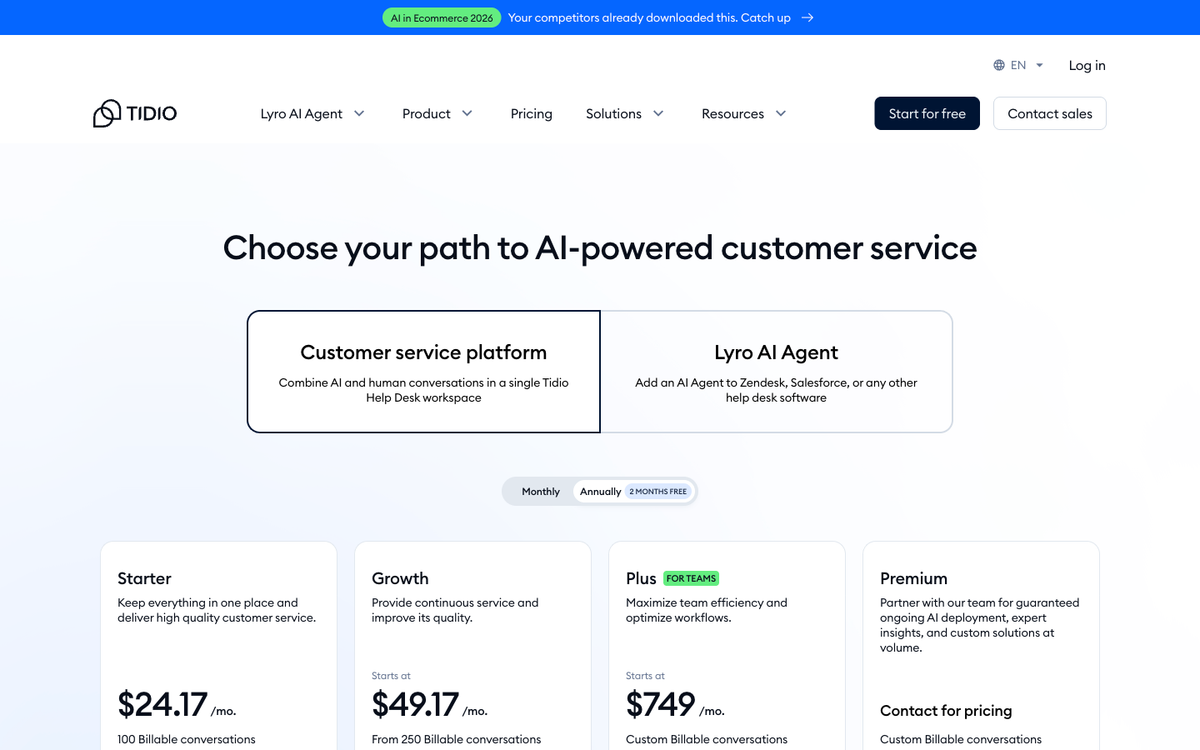
Tidio's Starter plan is $24.17 a month billed annually (100 billable conversations a month and 50 Lyro AI conversations as a one off). Growth is $49.17 a month with 250 conversations. Plus jumps to $749 a month for teams. The Lyro AI Agent itself can also be added to Zendesk, Salesforce, or any other helpdesk as a standalone product.
Verdict: Tidio is the most price friendly option for ecommerce shops doing under 500 monthly conversations. The Lyro 50 conversation cap on the cheapest plan is the gotcha to watch. Source: Tidio pricing.
Chatbase
Chatbase Free gives you 50 message credits a month. Hobby is $32 a month with 500 credits. Standard is $120 a month with 4,000 credits. Pro is $400 a month with 15,000 credits. Auto recharge is $40 per 1,000 additional credits. Voice and telephony unlock at the Standard tier. White labeling and SSO are Enterprise only.
Verdict: Chatbase is my default recommendation for businesses that want a RAG chatbot trained on their own docs without a custom build. Standard tier covers 95 percent of small business needs. Source: Chatbase pricing.
Botpress
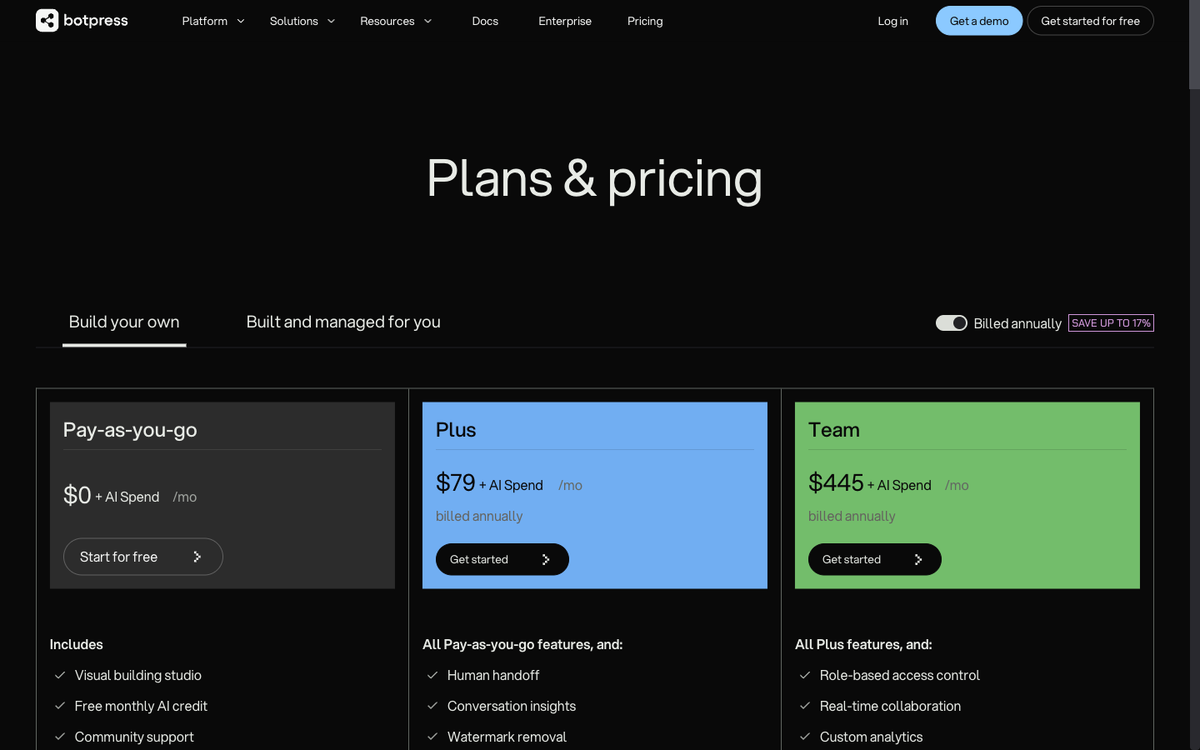
Botpress Pay as you go is $0 a month plus your AI spend (charged at provider rates). The Plus plan is $79 a month plus AI spend. Team is $445 a month plus AI spend. The fully managed plan is $1,245 a month for done for you bot building and ongoing maintenance. Every paid plan includes a $5 monthly AI credit.
Verdict: Botpress is the right choice if you want maximum control over which LLM you use and you are willing to monitor token spend yourself. The "+ AI Spend" addition is the variable that catches teams off guard. Budget at least $50 to $300 a month for typical Claude Haiku 4.5 or Gemini 2.5 Flash usage on the Plus plan. Source: Botpress pricing.
ManyChat
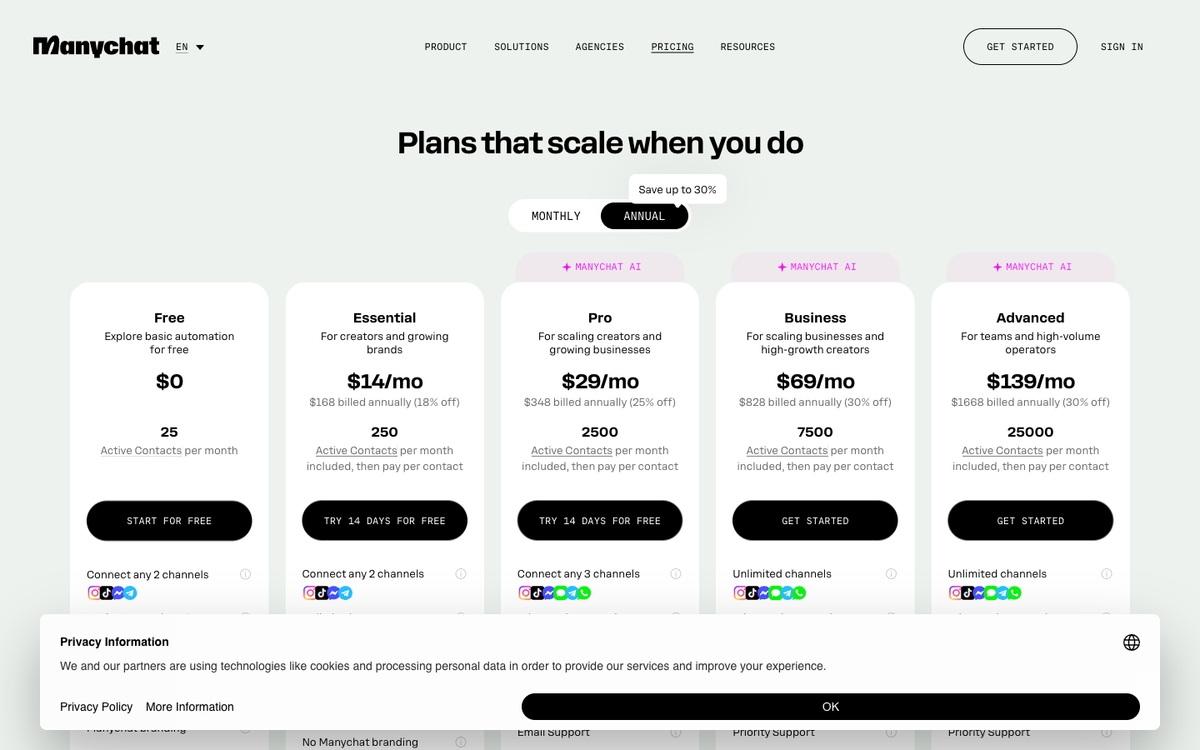
ManyChat Free gives you 25 active contacts. Essential is $14 a month with 250 active contacts. Pro is $29 a month with 2,500 active contacts. Business is $69 a month with 7,500 active contacts. Advanced is $139 a month with 25,000 active contacts. ManyChat AI is bundled into the Pro tier and above.
Verdict: ManyChat dominates Instagram, WhatsApp, and Messenger automation. It is not built for general customer support. If your funnel runs through Meta channels, this is your platform. Source: ManyChat pricing.
Voiceflow
Voiceflow moved to a custom usage based pricing model in 2026 and removed public price tiers from its site. From client quotes I have seen this year, expect to pay between $200 and $2,500 a month depending on conversation volume and channels (voice agents cost more than chat). The platform is excellent for agencies managing multiple client deployments.
Verdict: If you need voice and chat agents under one roof and your team or agency builds for clients, Voiceflow is worth a sales call. Otherwise it is overkill.
Crisp
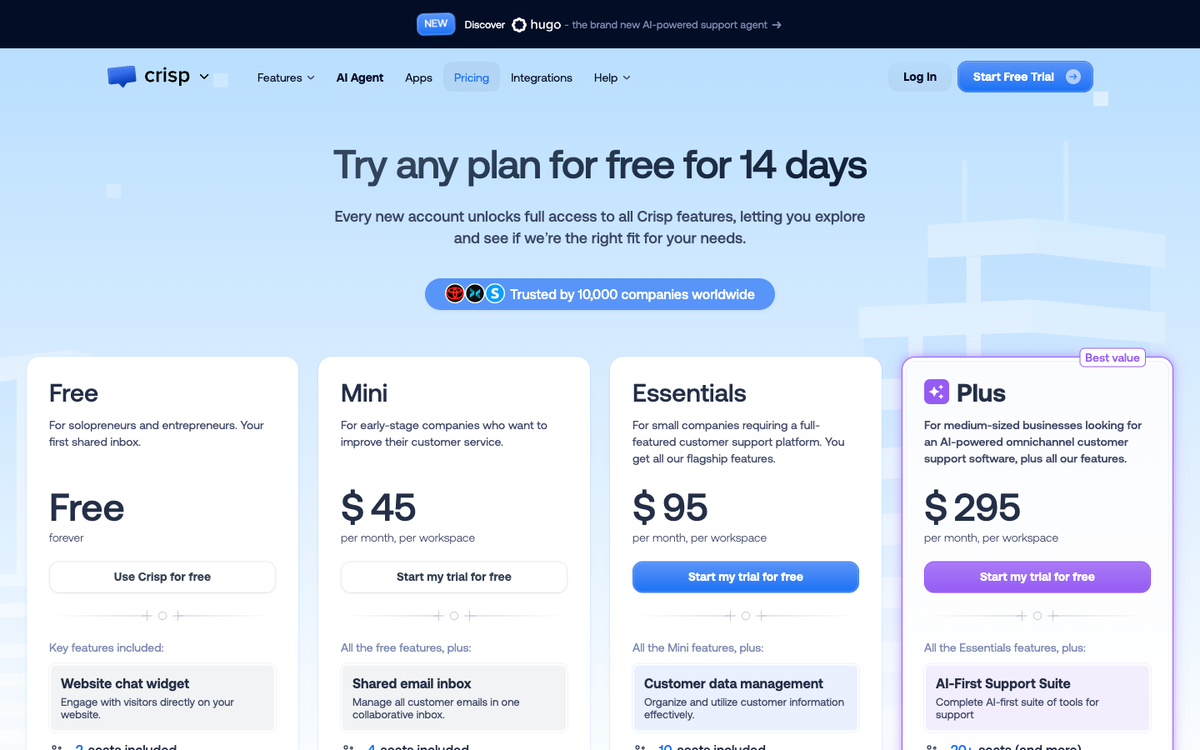
Crisp Free gives you a website chat widget for two seats. Mini is $45 per workspace per month. Essentials is $95 per workspace per month. Plus (which unlocks the AI first agent and AI co pilot) is $295 per workspace per month.
Verdict: Crisp's per workspace pricing keeps billing simple if you have a small team. The AI features only matter on the Plus tier, which puts it in the same price range as Chatbase Pro. Source: Crisp pricing.
Custom built AI chatbot (the option no platform sells you)
If you want a chatbot that lives entirely in your stack, knows your specific data, and has no per resolution fees, you build it. The infrastructure cost on AWS Bedrock with Claude Haiku 4.5 plus a managed knowledge base runs $200 to $800 a month for typical small business volume. On OpenAI it lands at $150 to $600 a month. The build cost ranges from $5,000 for a focused single use case to $50,000 for a multi channel agent with CRM integration and analytics.
I cover the build vs buy math in detail in Custom AI Chatbot vs Off the Shelf. The short version: you build when your data is sensitive, your workflows are specific, or your volume makes per resolution math impossible. You buy when you want to be live in two weeks for $200 a month.
Hidden costs no one mentions on the pricing page
Sticker prices are honest about themselves and dishonest about everything else. These are the line items that quietly add 20 to 40 percent on top of the published number, every single time.
Overage fees
Per message credit and per resolution platforms charge punishing overage rates. Chatbase overage is $40 per 1,000 credits. Intercom Fin keeps charging $0.99 per resolution forever. If you have any seasonality (holiday traffic, product launches, viral moments), build the overage into your annual budget or you will get surprised.
Setup and onboarding
Most vendors offer "free setup" but mean it loosely. Real onboarding for a production chatbot takes 20 to 80 hours of internal time across writing the knowledge base, configuring intents, building escalation flows, and testing edge cases. At a $75 per hour internal cost that is $1,500 to $6,000 in labor before the bot is useful.
Integration costs
Out of the box integrations are usually free. Custom integrations (your specific CRM, your specific shipping system, your specific calendar) are not. Plan for $1,500 to $8,000 in setup time depending on whether the integration uses native connectors, Zapier, n8n, or custom code. I write more about workflow plumbing in my n8n AI agent guide.
Knowledge base maintenance
The chatbot is only as good as what it knows. Maintaining a current knowledge base costs roughly 4 to 12 hours of internal time per month for a small business. Most teams underestimate this and watch quality degrade quietly over the first six months.
Annual lock in penalties
Annual billing usually saves 15 to 25 percent. It also locks you in. If you cancel after three months, you do not get a refund on the remaining nine. I have seen clients overcommit to annual on a platform that turned out to be wrong for them. Try monthly first for at least 60 days before signing annual.
Three real client scenarios with monthly bills
Pricing pages give you ranges. These are the actual monthly numbers from three deployments I shipped in the last 12 months, with client names removed.
Scenario 1: Solo law firm, 80 conversations a month
The client wanted a website chatbot to qualify leads after hours and book consultations. Volume was low and predictable. We deployed Chatbase Hobby at $32 a month for 500 credits, which covered their volume with headroom. Knowledge base setup took 6 hours of my time. Total monthly cost: $32. Total first month cost including build: $750.
Scenario 2: Mid market ecommerce, 1,800 conversations a month
The client was on Tidio for live chat at $89 a month and wanted to add an AI agent to handle order status, shipping, and returns. We added Lyro at the Growth tier for $49.17 a month annual, plus a custom Shopify integration that took 12 hours of my time. Combined platform bill: $138 a month. Build cost: $1,800. They saved an estimated 24 hours a week of human chat time, which they redirected to outbound sales.
Scenario 3: B2B SaaS, 7,200 resolutions a month
The client started on Intercom Advanced ($85 per seat for 8 seats = $680) plus Fin at $0.99 per resolution. At 7,200 monthly resolutions Fin alone was $7,128, bringing the combined Intercom bill to $7,808 a month. We rebuilt their support flow on a custom RAG agent on AWS Bedrock with Claude Haiku 4.5, kept Intercom for the inbox at the Essential tier ($29 x 4 seats = $116), and pointed the agent at their docs. New monthly cost: $116 (Intercom) + $620 (Bedrock + DynamoDB + S3 Vectors) = $736 a month. Build cost: $11,000. Payback: 7 weeks.
Decision framework: which AI chatbot pricing model wins for your volume?
This is the framework I walk every client through on the first call. Answer four questions and the right pricing model usually picks itself.
- How many monthly conversations or resolutions do you expect? Under 500: flat tier (Tidio, Crisp Mini, Chatbase Hobby). 500 to 5,000: per message credit (Chatbase Standard) or flat tier (Botpress Plus). Over 5,000: custom build or per seat (Zendesk + Copilot), almost never per resolution.
- How many human support agents will use the system? Zero or one: pick a flat tier platform with no seat fees. Two to ten: per seat is fine if you negotiate. Eleven or more: per seat starts to bite, evaluate custom build.
- How seasonal is your volume? Predictable: per credit or per resolution can work. Spiky: flat tier or custom build only, otherwise overage will eat you.
- How specific is your knowledge base? Generic FAQs: any platform works. Highly specific data, regulated industry, sensitive PII: custom build on Bedrock or self hosted.
If you want me to walk through your specific case, take the AI readiness assessment first. It will tell you in 5 minutes whether you are ready to deploy and which pricing model fits.
When the math stops working
Per resolution pricing breaks at scale. Per seat pricing breaks when you scale headcount. Per credit pricing breaks on viral spikes. Knowing where each model breaks down lets you avoid the trap before you sign.
The B2B SaaS client I described earlier was a textbook case. Intercom Fin at $0.99 per resolution looks reasonable at 500 resolutions a month ($495). At 5,000 it is $4,950. At 10,000 it is $9,900. The pricing scales linearly with success, which sounds fair until you realize the marginal cost of an LLM API call at that volume is closer to $0.02. The vendor is keeping $0.97 per resolution as margin. At a certain volume that math becomes impossible to defend internally and you either build custom or you cap usage artificially.
The HVAC client I deployed for last quarter hit a different wall. They were on Crisp at $45 a month for two seats. They hired three more agents, which jumped them to a $295 a month tier (Plus is the only tier that supports unlimited agents and AI). They were paying for AI features they did not yet use. We moved them to Botpress Plus at $79 a month plus about $40 in AI spend, and they kept Crisp Free for the website widget. Total: $164 a month. Saved: $131 a month. My healthcare and home services automation page has more on this kind of consolidation play.
FAQ: AI chatbot pricing in 2026
What is the cheapest AI chatbot you can actually run a business on?
Chatbase Hobby at $32 a month or Tidio Starter at $24.17 a month annual are the two cheapest credible options for businesses doing under 100 monthly conversations. Free tiers exist (Botpress Pay as you go, ManyChat Free, Crisp Free) but every one of them caps at limits that production traffic will blow through inside a month.
Is per resolution pricing always more expensive than per seat?
No. Per resolution wins at low volume because you pay nothing for tickets the bot does not handle. It loses at high volume because the marginal cost stays $0.99 forever even after the bot is making the vendor 50x margin. The crossover point is usually around 1,500 to 3,000 resolutions a month depending on seat count.
How much does ChatGPT Enterprise cost compared to a dedicated chatbot platform?
ChatGPT Enterprise pricing is custom and starts around $60 per seat per month for businesses with 150+ seats. It is a general purpose assistant, not a customer facing chatbot. For a customer support or sales chatbot you still need a platform like Intercom, Tidio, or Chatbase on top, which adds $50 to $400 a month minimum.
Should I choose monthly or annual billing for an AI chatbot?
Start monthly for the first 60 days. Annual saves 15 to 25 percent but locks you in. I have seen too many clients commit annually to a platform that turned out wrong for their workflow and lose 6+ months of unused subscription. Validate fit first, then convert to annual.
What does it actually cost to build a custom AI chatbot in 2026?
Build cost ranges from $5,000 for a single use case (lead qualification on a website) to $50,000 for a multi channel agent with CRM, calendar, and helpdesk integration. Infrastructure cost runs $200 to $800 a month on AWS Bedrock or $150 to $600 a month on OpenAI for typical small business volume. The math wins above 3,000 monthly conversations or when data sensitivity rules out off the shelf platforms.
How do I avoid overage fees on per credit AI chatbot platforms?
Three tactics work. First, set hard caps in the platform's admin panel rather than trusting yourself to upgrade in time. Second, build a fallback flow that hands off to a human form when the bot hits its limit, instead of failing silently. Third, monitor weekly, not monthly, so a viral moment does not blow your budget before you notice.
Are free AI chatbots actually viable for small businesses?
Free tiers are useful for testing and for businesses with truly tiny volume (under 25 contacts a month for ManyChat, or 50 message credits a month for Chatbase). For any real customer facing deployment you will outgrow the free tier in the first 30 days. Budget for the cheapest paid tier from day one.
What hidden cost surprises clients the most after they sign?
The cost of maintaining the knowledge base. Most clients budget for the platform fee and forget that someone has to keep the bot's training data current. For a small business that is 4 to 12 hours of internal time per month. At an internal labor rate of $50 to $100 an hour, that is another $200 to $1,200 a month in real cost that never appears on the vendor's invoice.
The real answer to "what does an AI chatbot cost?"
The right AI chatbot pricing for your business depends on three things: your monthly conversation volume, the specificity of your data, and how predictable your traffic is. For most small businesses under 500 monthly conversations, Tidio or Chatbase at $24 to $120 a month is the sweet spot. For mid market companies with moderate volume and existing helpdesk infrastructure, Zendesk or Intercom at $200 to $800 a month is usually the right call. For high volume companies where per resolution math stops making sense, you build custom on Bedrock or OpenAI for $300 to $1,000 a month in infrastructure plus a one time build cost.
If you want to skip the spreadsheet exercise, I will quote you a real number for your specific case in 30 minutes. Book a discovery call here and bring your monthly ticket volume, your current vendor stack, and one example of a customer question you want the bot to handle. I will tell you which platform fits, what you should be paying, and where the hidden costs will hit you.
AI chatbot pricing data verified against vendor pricing pages on April 26, 2026. Industry stats: global AI customer service market projected to reach $15.12 billion in 2026 (Fortune Business Insights via demandsage), 91 percent of mid market companies now deploy AI chatbots, Gartner projects $80 billion in contact center labor cost reductions by end of 2026. Sources: Intercom pricing, Tidio pricing, Chatbase pricing, Botpress pricing, ManyChat pricing, Crisp pricing, Zendesk pricing, Gartner Fortune 500 AI service prediction, Demandsage chatbot statistics 2026.
Related Posts
Best AI Chatbot Builder in 2026: 5 Platforms Compared After 126 Production Builds
Trends & InsightsAI Chatbot BuilderChatbot Platforms
I've Helped 126 Businesses Start Using AI. Here Is What Actually Works.
Industry GuidesAI For BusinessSmall Business AI
How to Use AI to Automate Your Small Business: A Practical 2026 Guide
Industry GuidesBusiness AutomationSmall Business AI

Jahanzaib Ahmed
AI Systems Engineer & Founder
AI Systems Engineer with 126 production systems shipped. I run AgenticMode AI (AI agents, RAG systems, voice AI) and ECOM PANDA (ecommerce agency). I build AI that works in the real world for businesses across home services, healthcare, ecommerce, SaaS, and real estate.