Custom AI Chatbot vs Off-the-Shelf: What Does an AI Chatbot Actually Cost in 2026?
Comparing AI chatbot costs in 2026. What you will actually pay for SaaS platforms versus custom builds, with a 7-question decision framework and real deployment numbers.

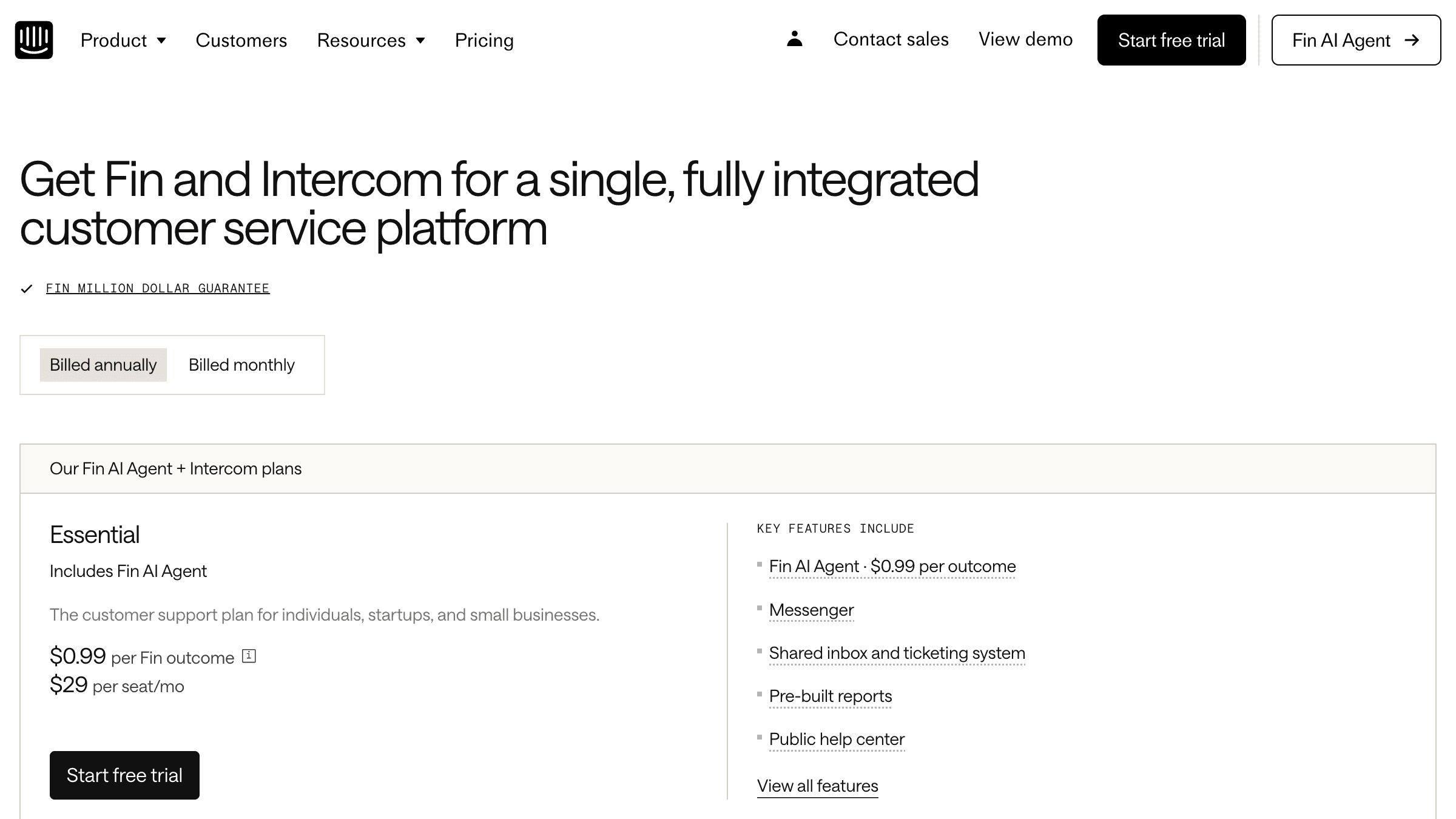
Table of Contents
Off the shelf chatbot platforms advertise $19 to $750 a month on their published self serve plans billed annually (checked October 11, 2026), and the advertised number is rarely the number you pay: per seat charges, per resolution billing and AI usage credits routinely double or triple it. Custom development starts around $5,000 for something basic and runs $35,000 to $75,000 for enterprise grade. Either way the underlying ROI usually holds, because the AI side of a support conversation now costs somewhere between under a cent in model fees on a custom build and $0.99 for each conversation Intercom's Fin resolves, a fraction of what the same conversation costs in a person's time.
So the question is not whether the maths works, it is which delivery model fits. Under about $1M in revenue, start on SaaS: the build cost is not recoverable at that volume. Once you have complex integrations or workflows specific enough that no platform models them properly, custom wins, because you stop paying a subscription to fight the product. Budget from the full bill rather than the headline tier.
The ai chatbot cost question comes up in nearly every discovery call I take. Someone has watched a demo, liked what they saw, and now wants to know: build something custom or subscribe to a platform? Most guides on this topic are written by SaaS companies pushing you toward subscriptions or by agencies trying to justify their project fees. Neither gives you the full picture.
I've built and deployed AI chatbots and conversational systems for 40+ businesses across healthcare, real estate, ecommerce, and home services. Here is what the numbers actually look like in 2026, with no agenda attached to either option.
Quick Verdict
Pick off-the-shelf if: you need something live within two weeks, your monthly budget is under $500, your use case is standard FAQ or lead capture, and you have no dedicated development resources.
Go custom if: you need deep CRM or internal system integration, data sensitivity is a concern, your use case falls outside a platform's standard capabilities, or you plan to run this for three or more years.
Still unsure? The decision framework later in this post has seven yes or no questions that will give you a clear answer. Or book a free call here and I'll tell you directly.
What We Are Actually Comparing
Before getting into numbers, here are the two options defined clearly. This comparison covers:
Off-the-shelf SaaS chatbot platforms: Subscription tools where you sign up, configure a bot using the platform's interface, and pay monthly. Examples include Tidio, Intercom Fin, ChatBot.com, Chatbase, Botpress, and Freshchat. You do not own the underlying infrastructure. The vendor handles maintenance, uptime, and model updates. Your customization options are defined by what the platform supports.
Custom built AI chatbots: Systems built specifically for your business by a developer or agency. These use your choice of LLM (GPT, Claude, Gemini, or open source models), connect to your specific internal systems, and run on infrastructure you control. You own the code and can modify it without platform restrictions. Building and maintaining this requires either internal dev resources or an ongoing agency relationship.
What this guide is not comparing: enterprise contact center platforms like Salesforce Einstein or Zendesk AI, which operate at a different price tier entirely, or internal tools built for employees rather than customers.
Off-the-Shelf SaaS Chatbot Platforms: What You Will Actually Pay
The SaaS chatbot market has fragmented dramatically over the past two years. Four distinct pricing models now exist, and the one your chosen platform uses determines your true monthly cost far more than the advertised plan price.
The Four Pricing Models in 2026
Flat subscription: Fixed monthly fee tied to a plan tier with defined usage limits. Easiest to budget. FastBots, Chatbase at lower tiers, and Crisp use this model. You know exactly what you pay each month.
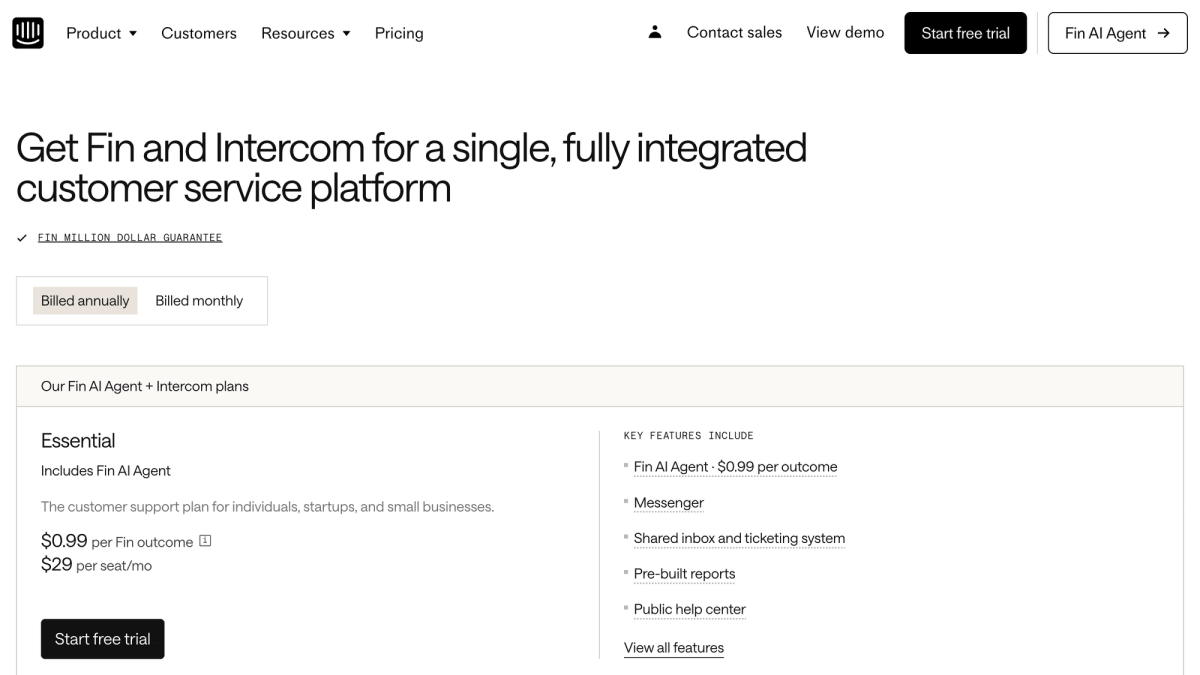
Per-seat pricing: You pay for each team member using the platform. Intercom's Essential plan is $29 per seat per month billed annually, or $39 billed monthly, on the standard version of its pricing page; a test version I saw on October 11, 2026 showed $19 annually and $29 monthly, so check the page when you buy. Fine for small teams. Gets expensive fast when more agents need access. A five seat team at Intercom's Advanced tier ($85 per seat billed annually) is already at $425 before any AI usage fees.
Per resolution or per outcome: Intercom Fin charges $0.99 per outcome on top of seat fees, and an outcome is a resolution or one of a few other completed actions, charged at most once per conversation. Intercom's own cost calculator presets a 76% resolution rate and labels it the average; I plan with 60% as a conservative figure until a bot has a few months of real traffic. Do the math for your conversation volume before signing. A business handling 2,000 conversations monthly at 60% resolution rate pays $1,188 in Fin fees alone, before the base subscription.
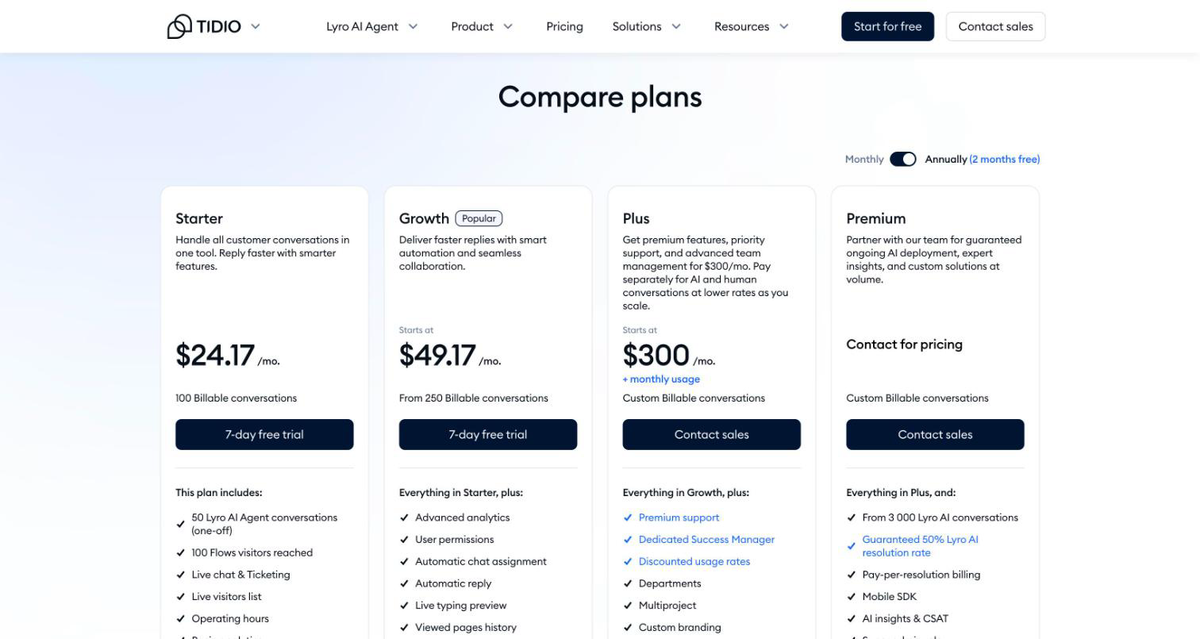
Per conversation (usage based): Tidio sells Lyro AI conversations in monthly blocks on top of whichever plan you're on: 50 for $39 up to 1,000 for $700 on monthly billing, which is $0.70 to $0.78 per Lyro conversation, or $0.58 to $0.65 billed annually with two months free (October 2026). Above 1,000 a month you need a custom plan. This model scales linearly with volume in ways flat plans do not. High traffic months create unpredictable bills.
Named Platform Pricing (April 2026)
I rechecked every price below on the vendors' own pricing pages on October 11, 2026. This post is about which delivery model costs less over time; for every plan, add on and billing rule in more detail, see my AI chatbot pricing breakdown.
| Platform | Starting Price | Mid Tier | What Drives the Real Bill |
|---|---|---|---|
| Tidio | $24.17 a month Starter, billed annually ($29 monthly) | Growth from $49.17 a month annually ($59 monthly) | Lyro AI blocks from $39 for 50 conversations to $700 for 1,000 a month; Plus now starts at $300 a month plus usage |
| Intercom Fin | $29 per seat Essential billed annually ($39 monthly); $19 in a price test | $85 per seat Advanced, billed annually ($99 monthly) | $0.99 per Fin outcome on top of all seats; Fin on another helpdesk has a 50 outcome monthly minimum |
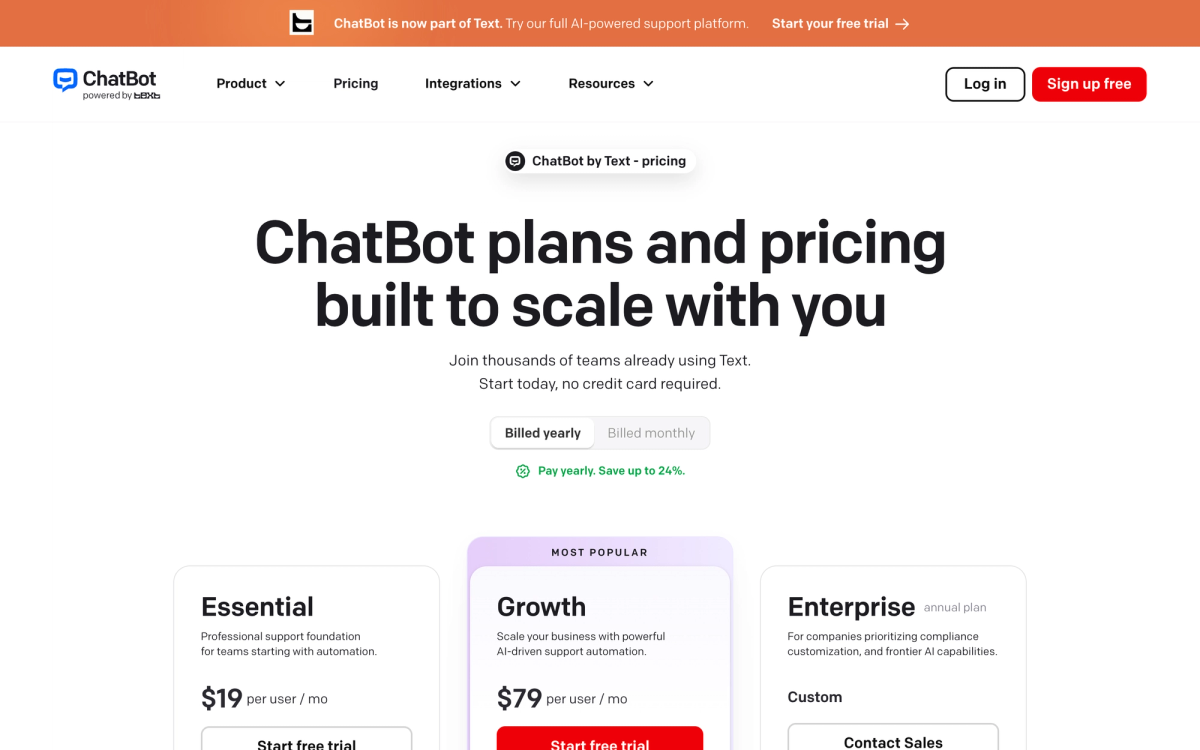
| ChatBot.com | $19 per user Essential, billed yearly ($25 monthly) | $79 per user Growth, billed yearly ($99 monthly) | Only 10 AI resolutions on Essential and 200 on Growth; extra packs of 50 cost $49.50 |
| Chatbase | Free tier (50 message credits) | $40 to $500 a month ($32 to $400 billed yearly) | Message credit limits per tier; extra credits $40 per 1,000 |
| Botpress | Free tier (100 conversations) | Plus $150 a month annually ($189 monthly); Team $750 ($939) | 250 or 1,500 conversations included, then packs of 100 at $65 or $50, with $0.10 of AI usage included per conversation |
| Freshchat | Free (up to 10 agents) | $19 per agent Growth, billed annually | Per agent pricing plus Freddy AI Agent at $49 per 100 sessions after the first 500 |
Pros of Off-the-Shelf Platforms
- Live in days or weeks, not months
- No dev resources needed to get started
- Vendor handles uptime, security patches, and model updates
- Mostly predictable monthly billing
- Pre-built integrations with popular CRMs and help desks
Cons of Off-the-Shelf Platforms
- Conversation limits cap your growth without proportionally higher fees
- Hidden costs: per-seat charges, per-resolution billing, add-on features, and branding removal all compound
- Customization is bounded by what the platform allows
- Your data lives on the vendor's infrastructure
- Vendor lock-in: switching platforms means rebuilding your entire bot configuration from scratch
- Vendor risk is real: in August 2025 attackers used OAuth tokens stolen from the Drift app to pull data out of connected customer systems (Google Threat Intelligence), and on March 5, 2026 Salesloft announced the gradual sunset of Drift, referring its customers to 1mind. Any platform can do the same.
Custom AI Chatbot Development: What It Actually Costs
Custom development spans a wide range because complexity varies enormously. Here is the honest breakdown by tier, based on current market rates and what I charge across my own client work:
| Tier | Build Cost | Timeline | Monthly Ops | Best For |
|---|---|---|---|---|
| Basic chatbot | $5,000 to $15,000 | 1 to 2 weeks | $500 to $1,000 | Small business FAQs, lead capture, ticket routing |
| NLP powered chatbot | $15,000 to $35,000 | 2 to 4 weeks | $1,500 to $3,000 | Midsized SaaS, ecommerce support with context awareness |
| Enterprise LLM system | $35,000 to $75,000 | 4 to 8 weeks | $3,000 to $8,000 | Large enterprises, complex multi-step workflows |
| Multi-agent platform | $75,000+ | 8+ weeks | $8,000+ | Custom enterprise AI, full omnichannel deployment |
The build and monthly ranges match the tiers in AI Superior's 2026 custom chatbot cost guide (rechecked October 11, 2026).
The sweet spot for most serious businesses is the NLP powered tier. For $15,000 to $35,000 you get a chatbot that understands context, integrates with your CRM, handles multi-turn conversations, and connects to your knowledge base. This is what a properly configured Intercom Fin replacement looks like when you've outgrown the platform or have data sensitivity requirements that a vendor-hosted solution cannot meet.
Hidden Costs on the Custom Build Side
Custom builds have their own version of hidden costs. The build fee is not the full cost of ownership:
- LLM inference costs: Model choice is the biggest swing. On my planning assumption of six model calls per conversation, each with 8,000 input tokens and 300 output tokens, a system processing 100,000 conversations monthly spends about $570 a month on a small model such as Claude Haiku 5.5 or OpenAI's gpt-6-luna (both $0.10 per million input tokens and $0.50 per million output tokens), and about $11,400 on a frontier model such as Claude Sonnet 5.5 or gpt-6.1-sol ($2 and $10). Prices are from the Anthropic and OpenAI pricing pages, checked October 11, 2026; my AI agent cost calculator prices tokens, infrastructure and build cost for your own volumes. Budget for 10 to 20% cost increases annually as usage grows and model prices shift.
- Integration work: Connecting to your specific CRM, ERP, or internal systems adds 20 to 40% to the build estimate. This is the piece most lowball quotes skip entirely.
- Data preparation: If your knowledge base is scattered across PDFs, Google Docs, and email threads, expect 5 to 15 hours of preparation work before the bot can be trained accurately.
- Maintenance retainer: AI systems need prompt tuning, model updates, and edge-case handling as they run in production. A realistic ongoing retainer runs $500 to $2,000 per month depending on complexity.
Pros of Custom Build
- No conversation limits. You own the infrastructure.
- Full control over data handling and storage location
- Can integrate with any internal system regardless of how proprietary it is
- Customized exactly to your business logic, not constrained by platform UI
- No vendor lock-in: you own the code
- Long-term cost advantage: monthly operational costs plateau as volume scales
Cons of Custom Build
- High upfront cost ($5,000 minimum, $15,000 or more for anything serious)
- Requires dev resources to build and maintain
- Slower to launch: 2 to 8 weeks minimum for even basic systems
- You are responsible for security, uptime monitoring, and reliability
- Model updates require active work rather than automatic vendor upgrades
Head-to-Head Comparison
| Factor | Off-the-Shelf SaaS | Custom Build |
|---|---|---|
| Time to launch | Days to 2 weeks | 2 to 8 weeks |
| Upfront cost | $0 to $500 | $5,000 to $75,000+ |
| Monthly cost (small business) | $50 to $500 | $500 to $3,000 (ops and maintenance) |
| Monthly cost (midsized business) | $500 to $2,000 | $1,500 to $5,000 |
| Customization ceiling | Platform feature set | Unlimited |
| Data ownership | Vendor's servers | Your infrastructure |
| Integration depth | Pre-built connectors only | Any system via API |
| Conversation limits | Yes, varies by plan | None |
| Vendor risk | Real (Drift sunset announced March 2026) | None |
| Dev resources needed | No | Yes |
| Break even vs SaaS | Benchmark | Typically 18 to 30 months |
Three Year Cost at 1,000 and 5,000 Conversations a Month
Here is how the totals compare over three years at October 2026 list prices. Each row is the AI layer only: you need a human inbox for handoffs in every case, custom included, so helpdesk seats are left out of all of them. I assume the AI resolves 60% of conversations, and the custom rows use the basic and NLP tier ranges from the table above, with model fees inside the monthly ops figure. A site with 50,000 visits a month where 2% of visitors start a chat (my planning assumption, not a benchmark) lands on the 1,000 conversation table.
| 1,000 a month | Build | Monthly | 36 Months |
|---|---|---|---|
| Intercom Fin, 600 outcomes at $0.99 | $0 | $594 | $21,384 |
| Tidio Lyro, 1,000 block billed annually | $0 | $583.33 | $21,000 |
| Botpress Plus billed annually, plus 8 packs | $0 | $670 | $24,120 |
| Custom basic build | $5,000 to $15,000 | $500 to $1,000 | $23,000 to $51,000 |
| 5,000 a month | Build | Monthly | 36 Months |
|---|---|---|---|
| Intercom Fin, 3,000 outcomes at $0.99 | $0 | $2,970 | $106,920 |
| Botpress Team billed annually, plus 35 packs | $0 | $2,500 | $90,000 |
| Custom NLP build | $15,000 to $35,000 | $1,500 to $3,000 | $69,000 to $143,000 |
At 1,000 conversations a month, SaaS mostly wins. The cheapest custom build edges past Botpress Plus in month 30, but it only overtakes Fin's outcome fees in month 54, only draws level with Tidio's Lyro block at month 60, and at the top of the range it never pays back. Tidio is not in the 5,000 table because Lyro above 1,000 conversations a month is a custom quote. At 5,000 the picture flips at the low end: a $15,000 build running at $1,500 a month pays back against Fin in month 11 and against Botpress Team in month 15, while a $35,000 build at $3,000 a month costs more than Fin every month and never pays back. The model calls themselves are small at both volumes: $5.70 and $28.50 a month on Claude Haiku 5.5 with the token assumptions above. To run your own numbers over 12 to 60 months, use my build vs buy AI calculator.
The Decision Framework: 7 Questions
I use these questions with every client facing the custom versus SaaS choice. Answer honestly and the answer almost always reveals itself.
1. Do you need to go live in under 30 days? If yes and there is no flexibility, go SaaS. Custom builds cannot safely be rushed below two weeks for even simple systems.
2. Does your chatbot need to pull live data from an internal system? If you need live CRM data, proprietary database queries, or internal ERP access, and that system does not have a standard SaaS connector, you need custom. This is the most common reason I end up building custom when a client originally wanted SaaS.
3. Is your data regulated or sensitive? Healthcare, legal, and financial services often cannot put customer conversation data on a third-party vendor's infrastructure without compliance review. Custom gives you full control over data storage and processing.
4. What is your expected monthly conversation volume? Model this honestly. At Tidio's list prices, 1,000 Lyro conversations per month is $700 in AI fees alone on monthly billing, and anything above 1,000 needs a custom plan. At Intercom Fin's $0.99 per outcome at a 60% resolution rate, 3,000 conversations is $1,782 in outcome fees. At some volume threshold, custom build operational costs of $800 to $2,000 per month undercut SaaS fees. Calculate your break-even point before deciding.
5. Do you have dev resources available? Custom builds need someone to maintain them. If there is no developer in the picture and no budget for an ongoing retainer, SaaS is the safer choice.
6. How specialized is your use case? If you want a bot that answers FAQs and collects leads, every SaaS platform handles this out of the box. If you want a bot that pulls live account data, processes refund requests within defined parameters, and escalates with full conversation context attached, that requires custom development.
7. What is your time horizon? Deploying for a short term project or campaign? SaaS. Building infrastructure you will run for three or more years? Run the total cost of ownership numbers. A $25,000 custom build at $1,200 per month in operational cost beats a $1,800 per month SaaS bill by month 42, even before accounting for volume scaling advantages.
What Most Comparisons Get Wrong
The most common mistake in these comparisons is treating SaaS pricing as a ceiling. It is not. Every major SaaS chatbot platform's pricing page shows you entry-level numbers. But real costs emerge when you actually use the product at production volume.
The Drift situation made this concrete. In August 2025 attackers stole OAuth tokens from the Drift app and used them to take data from customers' connected systems. On March 5, 2026 Salesloft announced a gradual sunset of Drift and began referring its customers to 1mind, so every Drift customer now has to plan a migration. That is not a cost you can budget for, but it is a real operational risk in the SaaS chatbot market.
On the custom side, the mistake goes the other way: developers quoting build costs while omitting ongoing operational costs. A $15,000 NLP powered chatbot with $3,000 per month in LLM inference and maintenance costs you $51,000 in year one. That is the honest number. It only matches Intercom Fin's year one outcome fees at about 7,200 conversations a month (60% resolved at $0.99, before seat fees); at 3,000 conversations a month, Fin's outcome fees come to $21,384 for the year, so Fin is still cheaper in year one.
The right comparison is always total year-one cost versus total year-one cost, not build cost versus subscription price. Get both numbers before making a decision.
A Real Deployment Scenario
One client I worked with runs a B2B SaaS with 8 support agents and roughly 3,500 customer conversations per month. They were on Intercom's Advanced plan ($85 per seat per month for 8 agents equals $680 per month) plus Fin AI for primary deflection. At 60% resolution rate across 3,500 conversations, that is 2,100 resolutions at $0.99 each: $2,079 per month in Fin fees. Total Intercom bill: $2,759 per month or about $33,000 per year.
We built a custom LLM powered support agent that integrated with their existing ticketing system and product documentation. Build cost: $28,000. Monthly operational cost covering LLM inference, hosting, and maintenance retainer: $1,800. Total year-one cost: $49,600.
At current trajectory they break even in month 26. But the custom system also handles conversations the previous Intercom Fin bot could not: pulling live account data, processing refund requests within set parameters, and escalating with full conversation context attached. The support team's ticket volume dropped 42% in the first 60 days.
A note on the arithmetic: at flat volume, the $959 monthly saving ($2,759 minus $1,800) pays back the $28,000 build in 29.2 months, so month 30; reaching break even in month 26 needs conversation volume, and with it the Fin bill, to keep growing.
The point is not that custom is always better. It is that the break-even calculation is often closer than people assume, and the functionality gap can be significant for businesses with anything beyond standard workflows.
If you have run through this comparison and landed on custom, my scoping process starts with understanding your current workflows and conversation data, not a pitch about which tools to use. See my packages here or book a discovery call and I'll give you a straight assessment of what makes sense for your situation.
Frequently Asked Questions About AI Chatbot Cost
How much does an AI chatbot cost per month?
It depends on which type you go with. Off the shelf SaaS platforms start around $19 to $24.17 per month billed annually at headline prices (ChatBot.com and Tidio, October 2026), but realistic costs for a production deployment with AI features land between $200 and $2,000 per month depending on conversation volume, team size, and AI usage fees. Custom built chatbots have no subscription fee but carry operational costs of $500 to $3,000 per month covering LLM inference, hosting, and maintenance. Most small businesses land in the $100 to $500 per month range on SaaS platforms.
Is a custom AI chatbot worth the cost?
Yes, when your use case requires deep integration with internal systems, when your data is sensitive, when platform conversation limits become expensive at your volume, or when you plan to use the system for three or more years. Not worth it when your use case is standard (FAQ, lead capture, basic support), you have no dev resources, or you need to launch in under two weeks.
What is the cheapest way to get an AI chatbot?
Chatbase and Botpress both have free tiers for low-volume testing. Tidio starts at $24.17 per month billed annually ($29 monthly) for a production setup. If you are on a tight budget and have standard requirements, Tidio or Chatbase can stay under $100 per month at low volume: Tidio Starter plus the smallest Lyro block of 50 AI conversations is $68 a month on monthly billing, and Chatbase Hobby is $40 with 700 message credits (October 2026). Past that, the next Lyro block of 100 conversations alone is $75 a month, so the total climbs above $100.
Why did Drift shut down and what does it mean for chatbot buyers?
Drift did not vanish overnight, but it is going away. In August 2025 attackers stole OAuth tokens from the Drift app and used them to take data from customers' connected systems, including Salesforce, according to Google's Threat Intelligence Group. On March 5, 2026 its owner Salesloft announced a gradual sunset of Drift and named 1mind as the successor it refers customers to; Salesloft's own product page now says it has transitioned from Drift to 1mind. This is a real vendor risk in the SaaS chatbot market. Any SaaS platform can be acquired, pivot its product focus, raise prices dramatically, or shut down. For businesses with mission critical chatbot infrastructure, this is a strong argument for custom builds or at minimum maintaining exportable copies of all bot configuration and conversation data.
How long does it take to build a custom AI chatbot?
A basic chatbot: 1 to 2 weeks. An NLP powered chatbot with CRM integration: 3 to 5 weeks. An enterprise LLM system: 6 to 12 weeks. The timeline depends more on how quickly you can provide system access, conversation history data, and sign off on workflow logic than on the build itself. Most delays come from the client side.
What AI model should a custom chatbot use?
For complex queries, start on a current frontier model such as Claude Sonnet 5.5 or OpenAI's gpt-6.1-sol, both listed at $2 per million input tokens and $10 per million output tokens (checked October 11, 2026). For businesses handling very high volumes where inference cost is a constraint, small models such as Claude Haiku 5.5 or gpt-6-luna, at $0.10 and $0.50, cut the model bill by 95% on the same token count, with acceptable quality tradeoffs for narrower use cases. Open source models are another route if you are prepared to host them. I start most clients on a frontier Claude or GPT model and optimize to cheaper models only after production data shows where quality actually matters.
Can I switch from a SaaS chatbot to a custom build later?
Yes, and many businesses do this around the 12 to 24 month mark as volume grows and SaaS fees mount. The main preparation: export your conversation history, document every bot flow and decision tree, and build a transition period of two to four weeks running both systems in parallel into your timeline. Migrating is manageable. Not planning it means rebuilding your training data from scratch.
What ROI should I expect from an AI chatbot?
Expect your ROI to come from your own numbers rather than an industry average. The 2026 ROI averages that circulate (first year returns of 148 to 200%, $0.50 per AI interaction against $6 for a human) trace back to vendor blogs, and I could not confirm them against a primary source in October 2026. The cost side is easy to pin down: $0.99 per Fin outcome on Intercom, or under a cent of model fees per conversation on a small model in a custom build. Define your success metric before launch: hours saved per week, revenue captured from previously missed leads, or cost per support interaction before and after deployment. Providers who cannot walk you through this math for your specific situation before you sign are a red flag.
Platform pricing checked on the vendor pages on October 11, 2026: Intercom Pricing | Fin Pricing | Tidio Pricing | ChatBot.com Pricing | Chatbase Pricing | Botpress Pricing | Freshchat Pricing. Custom development cost ranges from AI Superior Custom Chatbot Cost Guide 2026. Drift sunset from Salesloft, March 5, 2026; the 2025 token theft from Google Threat Intelligence Group.
Last updated
October 11, 2026
Category
Trends & Insights
Jahanzaib Ahmed
AI Systems Engineer & Founder
AI Systems Engineer with 126 production systems shipped. I run AgenticMode AI (AI agents, RAG systems, voice AI) and ECOM PANDA (ecommerce agency). I build AI that works in the real world for businesses across home services, healthcare, ecommerce, SaaS, and real estate.
Want this built for your business? See The AI Audit, or browse the free tools and guides.
Related articles
Best AI Chatbot for Customer Service Software 2026: Intercom Fin vs Zendesk AI vs Ada vs Sierra vs Decagon Compared
A direct comparison of Fin, Zendesk AI, Ada, Sierra and Decagon for customer service in 2026: published prices, total cost at 2,000 and 10,000 resolutions a month, and which deploys faster.
ComparisonTrends & InsightsAI Chatbot
AI Readiness Assessment: Free Tool vs Paid Consultant vs Skipping It (Honest Comparison for 2026)
An honest comparison of free AI readiness assessment tools (Cisco, Microsoft, and more), paid consultant engagements, and when skipping the whole thing is actually the right move.
ComparisonTrends & InsightsAI Readiness
Best AI Chatbot Alternatives to ChatGPT in 2026: An Engineer's Decision Guide After 126 Production Builds
A breakdown of when to keep ChatGPT, when to switch, and which alternative actually fits your job. Picks for coders, researchers, privacy first teams, and anyone tired of the upsell wall.
ComparisonAI AgentsChatgpt Alternatives