AI for HVAC Businesses: What It Actually Does (And Where to Start in 2026)
Most HVAC business owners are losing 35 to 45% of their inbound calls after hours. Here's what AI for HVAC actually does, what it costs, and where to start.

Table of Contents
Between 35% and 45% of HVAC calls arrive after hours, and 78% of leads go to whoever responds first, which is the entire business case in two numbers: the 9:30pm Thursday call in July is a system replacement job going to the next company in the search results. Only about 12% of HVAC contractors have AI embedded in daily workflows, so the edge is still available.
Where it pays beyond the phone: AI scheduling and dispatch cuts drive time by up to 20% and removes double bookings, and predictive maintenance delivers around 50% less downtime with 25% to 40% lower maintenance costs. None of it requires replacing your stack, since modern tools plug into ServiceTitan, Housecall Pro and similar. Start at your biggest revenue leak rather than the most impressive sounding technology, which for most contractors is the unanswered evening call.
It's 9:30 PM on a Thursday in July. A homeowner in Phoenix calls your HVAC company because their AC unit stopped working. Nobody answers. They Google the next company. You lost a $3,500 system replacement job while you were at dinner with your family.
This is happening to HVAC businesses across the US every single day. And it's not the only revenue leak most owners are living with. Between technician shortages, scheduling chaos, slow invoicing, and equipment failures nobody saw coming, running an HVAC company in 2026 means managing a dozen moving pieces at once.
That's exactly what AI for HVAC businesses is designed to fix. Not replace your technicians. Not overhaul your entire operation overnight. Fix the specific parts that are costing you money while you sleep.
I've deployed AI systems for HVAC and home service companies in the US and Australia. What follows is an honest breakdown of what works, what realistic costs look like, and how to figure out if your business is actually ready.
What "AI for HVAC" Actually Means (It's Not Robots)
When most HVAC business owners hear "AI," they picture humanoid robots rewiring ductwork or some $500,000 enterprise software project. Neither is what's being sold in 2026.
AI for HVAC businesses is software that learns from your data and automates repetitive decisions. Things like: which technician should take this job, when should we follow up with this customer, does this compressor reading suggest it's about to fail, and did this job get invoiced yet.
These tools fall into two broad categories:
- Operations AI: Handles scheduling, dispatch, invoicing, customer communication, and after-hours call handling. This is where most HVAC companies start because the ROI shows up fastest.
- Technical AI: Analyzes sensor data from equipment to predict failures before they happen. More common in commercial HVAC than residential, but expanding rapidly into the residential market.
The US HVAC industry is projected to generate $132.90 billion in revenue by the end of 2026, growing at 2.5% annually. At the same time, the AI-powered HVAC tools market is growing at 23.1% annually, jumping from $1.34 billion in 2025 to $1.65 billion this year. That tells you where the money is moving.
Right now, only about 12% of HVAC contractors have embedded AI into their day-to-day workflows. That gap is your competitive window, and it won't stay open indefinitely.
The 5 Problems AI Solves for HVAC Companies
1. After-Hours Calls You're Currently Missing
According to data from Epiphany Dynamics, between 35 and 45% of HVAC calls come outside business hours. Before 8 AM, after 5 PM, weekends, public holidays. If you don't have someone answering those calls, you're losing nearly half your inbound opportunities to whoever picks up first.
An AI voice agent handles those calls the way a trained office person would. It captures the caller's name, address, and the nature of the problem. It schedules them into your next available slot and sends a confirmation. If it's an emergency, it routes to your on-call technician. The caller doesn't feel like they're talking to a robot because the AI is trained on your scripts, your service area, and your pricing language.
The math on response speed is brutal. Research from LeadConnect found that 78% of leads go to the first company that responds. If your competitor is using AI to answer at 10 PM and you're not, they're winning your jobs.
2. Scheduling and Dispatch That's Costing You Drive Time
Talk to any HVAC office manager and they'll describe a morning scheduling routine that involves phone calls, a whiteboard, two spreadsheets, and at least one technician calling in to say they're running late. It works, barely.
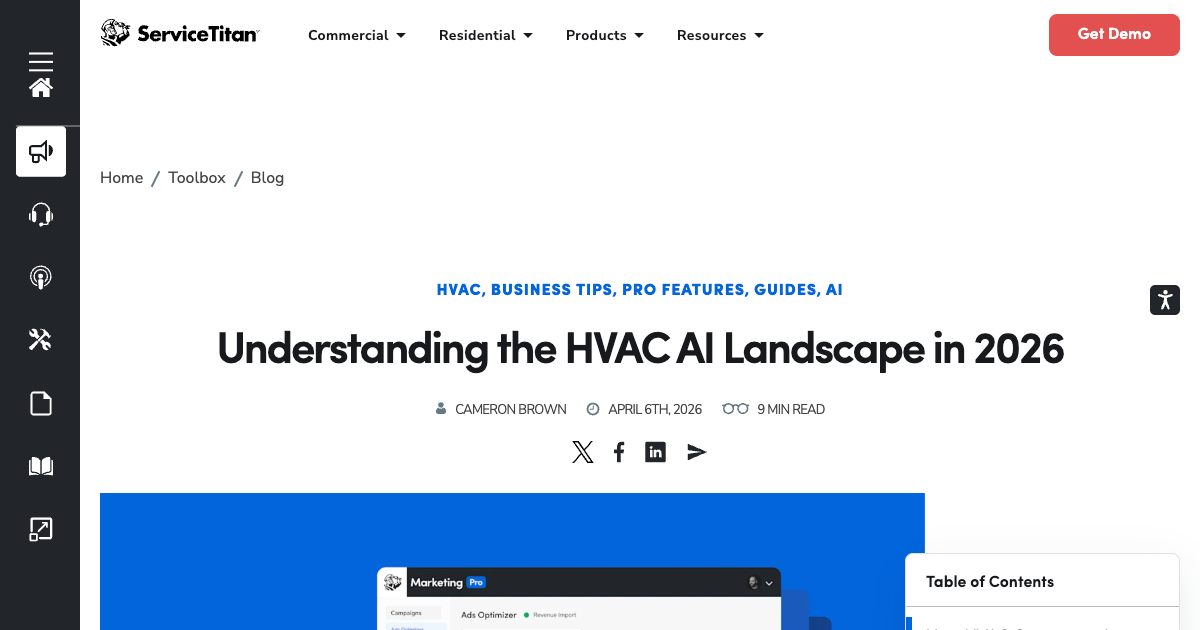
AI scheduling tools built into ServiceTitan and Housecall Pro do this differently. They factor in technician location, job duration estimates based on history, the value of each job, and real-time traffic to build a daily schedule that actually makes sense. When a technician calls in sick, the AI rebuilds the schedule automatically and sends updated notifications to affected customers.
For a company running 8 to 12 technicians, this typically means 15 to 20% less drive time per day, which translates directly into more jobs completed per technician and more revenue per route.
3. Late Invoices Killing Your Cash Flow
Most HVAC jobs get done on a Tuesday and invoiced on a Friday, if you're organized. Chasing unpaid invoices then becomes someone's part-time job. This is one of the clearest AI wins available because the process is completely ruleable.
An AI invoicing system triggers the moment a work order is marked complete. It generates the invoice, sends it with a payment link, and automatically follows up at 3 days, 7 days, and 14 days if payment hasn't been received. It syncs to your accounting software in real time. Nobody has to remember to do any of this.
HVAC companies that implement automated invoicing typically see payment cycle time drop from 14 to 21 days down to 5 to 7 days. For a business doing $2 million in annual revenue, that improvement in working capital is meaningful.
4. Equipment Failures Nobody Saw Coming
For commercial HVAC clients especially, an unplanned chiller or AHU failure is a catastrophe. The repair itself costs 3 to 4 times more than a planned maintenance intervention, and the operational disruption for the client compounds on top of that.
AI predictive maintenance uses IoT sensors to monitor temperature, vibration, refrigerant pressure, and electrical draw. It learns what "normal" looks like for each unit and flags anomalies that indicate developing problems, typically 3 to 8 weeks before a failure event occurs.
The numbers from facilities using AI predictive maintenance: 72% fewer unplanned failures, 50% less downtime, and 25 to 40% lower overall maintenance costs compared to reactive approaches. For HVAC service companies, this is also a sales opportunity. Predictive maintenance agreements are stickier than break-fix relationships and command higher recurring revenue.
5. Customer Communication That Nobody Has Time For
Appointment reminders, post-service follow-ups, seasonal tune-up campaigns, review requests after a good job. Every HVAC owner knows they should be doing all of this. Almost none of them have the bandwidth.
AI handles the full communication sequence automatically. The customer gets a reminder the day before, a "tech is on the way" notification, a follow-up two days after service, and a review request a week later. None of this requires your staff to do anything once it's configured correctly.
How AI Scheduling Actually Works in Practice
Let me walk through a real scenario so this isn't abstract.
A customer calls at 7:45 AM to say their AC isn't cooling. The AI voice agent picks up, asks the right questions, identifies it as a potential refrigerant or compressor issue, and checks your schedule. It finds a two-hour opening with a technician who's 4 miles from the address and whose job history shows strong HVAC diagnostic performance. It books the job, sends the customer a confirmation with the technician's name and photo, and logs everything into your field service management software.
Your office manager walks in at 8:30 AM and the job is already scheduled, confirmed, and in the system. No phone tag, no manual data entry.
During the job, the technician's mobile app shows the customer's unit history, past service notes, and suggested parts based on the reported symptoms. If additional work is needed, the technician can build a quote on the spot and get customer approval digitally before starting.
When the job is done, the work order closes, an invoice goes out automatically, and the customer gets a follow-up message. The whole cycle from call to payment runs with minimal manual intervention.
This isn't a future scenario. Companies running ServiceTitan, Housecall Pro, or FieldEdge with their AI features enabled are doing this today.
What Does AI Actually Cost for an HVAC Business?
Costs vary a lot depending on where you start. Here's a realistic breakdown by use case:
| AI Application | Monthly Cost Range | Typical ROI Timeline |
|---|---|---|
| AI voice agent (after-hours) | $200 to $600/month | 1 to 2 months |
| AI scheduling and dispatch (built into FSM platform) | Included in ServiceTitan/Housecall Pro plans ($200 to $500/month total) | 2 to 3 months |
| AI invoicing and payment automation | Often included in existing FSM or accounting software | Immediate |
| AI predictive maintenance (commercial accounts) | $500 to $2,000/month per facility depending on sensor network | 6 to 12 months |
| Full AI implementation across multiple systems | $2,000 to $8,000/month | 6 to 18 months |
Deloitte research from 2025 found that service businesses using AI in at least one workflow achieved 4.3 times ROI in the first year. The after-hours voice agent is almost always the fastest payback. You're paying $300 a month to capture calls that were previously going to a competitor.
Is This Right for Your HVAC Business? A Decision Framework
AI makes clear financial sense for your HVAC company if any of these apply:
- You're missing calls after 5 PM or on weekends and you know it's costing you jobs
- Your office staff spends significant time on scheduling, rescheduling, or chasing unpaid invoices
- You have 3 or more technicians and coordinating their schedules is genuinely difficult
- You service commercial clients who want maintenance agreements and faster response times
- You're competing for customers against companies that are already using these tools
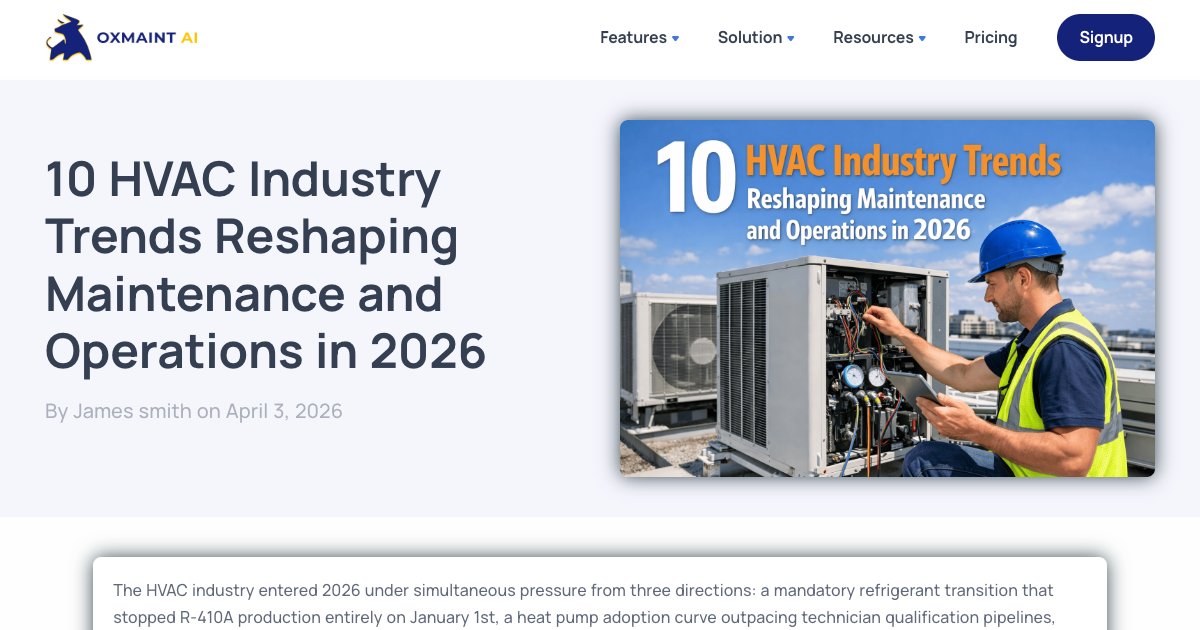
The technician shortage is also a real driver here. There are currently more than 110,000 unfilled HVAC technician positions in the US, with a 5-to-2 retirement-to-replacement ratio across the industry. The R-410A phaseout that took effect January 1, 2025 is also creating pressure, with technicians needing new certifications for A2L refrigerants and repair costs rising sharply for older systems. AI doesn't fix the labor market or the refrigerant supply chain, but it multiplies what your existing team can handle.
When AI Is NOT Right for Your HVAC Business
I want to be straight with you because too many vendors skip this part.
AI is probably not the right investment right now if:
- You're a solo operator doing under $300,000 a year. Your time is better spent on sales and referral-building first.
- Your current software and processes are disorganized. AI amplifies what's already working. It doesn't fix broken fundamentals underneath.
- You can't dedicate 2 to 4 weeks to setup and training. These tools work well once configured, but the first month requires real attention from someone on your team.
- Your staff isn't on board. The most common failure I see is a business owner buying AI tools that office staff and technicians actively avoid using because they weren't included in the decision.
There's also a misconception worth addressing. AI scheduling and AI voice agents are not the same as a basic chatbot on your website. Those simple widgets answer FAQ questions and do little else. The AI systems worth investing in are integrated with your field service management software and actually take action, booking jobs, sending invoices, routing technicians, flagging equipment anomalies. If someone is selling you a chatbot for $29 a month and calling it "AI for your HVAC business," that's a different category entirely.
A Real Client Example: Dallas HVAC Company, 11 Technicians
A client of mine, a commercial and residential HVAC company in Dallas with 11 technicians, came to me with a specific problem. They were missing roughly 20 to 25 inbound calls per week outside business hours, and they knew at least a third were new customers. At their average job value of $850, that's $5,950 to $7,650 in weekly revenue going to competitors.
We deployed an AI voice agent integrated with their ServiceTitan account. Setup took 11 days including training the AI on their service area, pricing language, emergency protocols, and common customer questions. In the first full month, they captured and booked 34 calls that would have gone unanswered. At $850 average job value, that's $28,900 in recovered revenue. Monthly cost of the voice agent: $380.
In month two, we added AI automated invoicing. Their average payment cycle time dropped from 18 days to 6 days. On roughly $180,000 in monthly revenue, faster collections materially improved their working capital position without any additional headcount.
That's what realistic looks like. Not transformational overnight, but compounding and measurable from month one.
FAQ: AI for HVAC Businesses
Can AI really handle HVAC customer calls without sounding robotic?
Modern AI voice agents trained on your scripts and service area data sound significantly more natural than most people expect. When the agent uses the caller's name, confirms their address, and references local neighborhoods and service areas, customers often don't realize they're talking to AI. Quality depends heavily on how well the agent is configured during setup, which is why the initial training period matters.
Does AI work with ServiceTitan or Housecall Pro?
Yes. Most AI tools for HVAC businesses are built to integrate with the major field service management platforms. ServiceTitan has built-in AI features including Dispatch Pro for scheduling optimization and job value prediction. Housecall Pro has its AI Team suite covering scheduling, customer communication, and reporting. Third-party AI voice agents typically connect via API or Zapier. You generally don't need to replace your current software stack to get started.
How long does setup actually take?
A voice agent or automated invoicing setup typically takes 2 to 4 weeks from contract to go-live. This includes building the AI's knowledge base, testing call flows, and training your team on how to monitor and adjust it. A full operations AI implementation covering scheduling, dispatch, invoicing, and customer communication takes 6 to 12 weeks for a company with 5 or more technicians.
Will AI replace my office staff or dispatcher?
No. What it does is handle the repetitive parts of their job so they can focus on situations that require human judgment. Complex customer complaints, escalations, unusual jobs that don't fit standard scheduling logic, relationship management with long-term commercial clients. The value isn't eliminating headcount, it's letting your existing team handle more volume without burning out.
What size HVAC business benefits most from AI?
As a rough guide, if you have 3 or more technicians and are doing $500,000 or more in annual revenue, operations AI starts making clear financial sense. Solo operators typically benefit more from AI marketing tools and lead management than from full scheduling automation. The sweet spot is companies doing $750,000 to $5 million that have real scheduling complexity but haven't yet invested in a dedicated operations team.
How does AI predictive maintenance actually work?
IoT sensors attached to HVAC equipment continuously monitor temperature, vibration, electrical draw, refrigerant pressure, and airflow. The AI establishes a baseline for what normal looks like for each unit. When readings deviate from baseline in ways that historically precede failures, it sends an alert. This gives you 3 to 8 weeks of warning before a system fails instead of finding out when the customer calls at 11 PM.
Is AI relevant for residential HVAC or just commercial?
Both, but differently. For residential HVAC contractors, the biggest wins are in operations: after-hours call handling, scheduling, invoicing, and customer communication automation. For commercial HVAC, predictive maintenance and building management system integration add significant value on top of the operations layer. Commercial contracts are where remote monitoring and maintenance agreement upsells become most financially compelling.
How do I figure out where to start?
Start with your biggest revenue leak. If you're missing after-hours calls, start with a voice agent. If your technicians are spending too much time driving inefficiently, start with AI dispatch. If invoice collection is strangling your cash flow, start with automated invoicing. You don't need to implement everything at once. The businesses that see the best results start with one clear problem and expand from there. If you're not sure where your biggest leak is, the AI Readiness Assessment can help you figure it out.
Related Reading and Next Steps
If you want to go deeper on specific applications, I've written about AI voice agents for HVAC and home services including how to evaluate different platforms and what realistic performance looks like in the first 90 days.
For broader AI use cases across trade businesses, what AI actually does for contractors covers implementation patterns across electrical, plumbing, and general contracting alongside HVAC.
If you want to know specifically where your business should start, the free AI Readiness Assessment benchmarks your current setup and identifies which AI applications are likely to deliver the fastest return given your business size and operations. It takes about 8 minutes and you'll get a personalized report at the end.
You can also see how I structure AI engagements for home service businesses on the pricing page, or reach out through the contact page if you'd prefer to talk through your specific situation first.
US HVAC market projected at $132.90B by end 2026 growing at 2.5% CAGR: ServiceTitan HVAC Statistics 2026. AI-powered HVAC market growing at 23.1% CAGR from $1.34B to $1.65B in 2026: Research and Markets AI-Powered HVAC Report. 35 to 45% of HVAC calls outside business hours: Epiphany Dynamics via ACHR News 2026. 78% of leads go to first responder: LeadConnect via Mediagistic AI Guide. 4.3x first-year ROI: Deloitte 2025 via Mediagistic. 72% fewer unplanned failures, 50% less downtime, 25 to 40% cost reduction, 110,000+ unfilled positions, 3 to 8 weeks advance warning from AI diagnostics: Oxmaint HVAC Industry Trends 2026.
Last updated
July 26, 2026
Category
Industry Guides
Jahanzaib Ahmed
AI Systems Engineer & Founder
AI Systems Engineer with 126 production systems shipped. I run AgenticMode AI (AI agents, RAG systems, voice AI) and ECOM PANDA (ecommerce agency). I build AI that works in the real world for businesses across home services, healthcare, ecommerce, SaaS, and real estate.
Related articles
I've Helped 126 Businesses Start Using AI. Here Is What Actually Works.
Most business owners know they should be using AI. Few know where to start. This is the practical framework I use with every new client, based on 126 real deployments.
How toIndustry GuidesAI For Business
How to Use AI to Automate Your Small Business: A Practical 2026 Guide
A step-by-step guide for non-technical small business owners on how to use AI to automate repetitive tasks, save 10+ hours per week, and start for under $100/month.
How toIndustry GuidesBusiness Automation
AI for Real Estate Agents: I've Deployed It for 9 Clients. Here Is What Actually Works.
I have deployed AI systems for nine real estate clients. Here is what actually moved the needle, what it cost, and the two cases where it was not worth the investment.
GuideIndustry GuidesAI For Real Estate Agents