Best AI Chatbot Builder in 2026: 5 Platforms Compared After 126 Production Builds
A field-tested comparison of Chatbase, Voiceflow, Botpress, Tidio with Lyro, and Intercom Fin. Real 2026 pricing, where each platform breaks, and how to pick without regretting it ten months in.

Table of Contents
There is no best chatbot builder, only the right one for what you are building: a FAQ bot, a sales qualifier, and a contact centre deflection agent have almost nothing in common architecturally. Five platforms cover about 90% of real demand in 2026, namely Chatbase, Voiceflow, Botpress, Tidio with Lyro, and Intercom Fin, and most teams choose badly because they shop on price rather than on how deeply the thing integrates with what they already run.
Two things worth knowing before you compare. Voiceflow quietly removed its public pricing this year and is now sales led only, which rules it out for a solo founder. And Intercom Fin charges $0.99 per resolution rather than per seat, which makes it the cheapest option on the page if your bot genuinely resolves things and the most expensive if it does not. Past roughly 25,000 conversations a month, every no code builder here costs more than a custom build within about 14 months.
Every Monday I get a version of the same email. "We need a chatbot. We're looking at four platforms. Can you tell me which one to pick?" The names change. The pitch decks change. The pricing pages change. The decision underneath doesn't.
I've shipped 126 production AI systems over the last few years. Maybe a third of those started as "we'll just use Tidio" or "we'll just use Chatbase" and ended somewhere else. Not because those tools are bad. Because the team picked on the wrong axis. They priced the platform instead of pricing the deployment.
This is the comparison I wish those Monday emails had read first. It covers the five AI chatbot builders that actually win deals in 2026, what each one is genuinely good at, where each one breaks, and how to pick without regretting it ten months in.
Quick verdict (read this first)
- Pick Chatbase if you want a website FAQ bot live this week and you don't need the bot to actually do anything beyond answer questions from your docs. Cheapest path to "shipped."
- Pick Tidio with Lyro if you're an ecommerce store or small support team that needs live chat plus AI in one workspace. Sub-$100/month is genuinely realistic.
- Pick Botpress if you have a developer on the team and you want to own the logic, the data, and the integrations. Best ceiling of the no-code platforms.
- Pick Intercom Fin if you already pay for Intercom or you run a serious support operation and you want resolution-priced AI that hands off cleanly to humans.
- Skip Voiceflow unless you have a budget for sales-led pricing and a CX team that needs voice plus chat across channels. The 2026 pricing pivot priced solo founders out.
- Still unsure? Book a 30-minute call and I'll point you at the right tier in 15 minutes.
What I'm comparing (scope)
"AI chatbot builder" is a terrible category name. It collapses three different markets into one search box.
- FAQ bots: read your docs, answer questions, deflect tickets. Chatbase, Sitebot, GPTBots, Fastbots.
- Conversational designers: visual flow builders for multi-turn conversations across chat and voice. Voiceflow, Landbot, Tars.
- Customer-support copilots: live chat plus AI plus help-desk. Tidio, Intercom, Zendesk AI, Front.
This post compares the five tools that show up in the most evaluations I sit in on. Each represents a different bet on what a "chatbot" is in 2026. The decision framework at the bottom maps your situation to the right one.
What I'm not comparing: Messenger and Instagram automation tools (ManyChat is the answer there), pure voice-agent platforms (I covered Retell vs Vapi separately), or general-purpose agent frameworks like LangChain, CrewAI, and AWS Bedrock Agents. Those are a different bucket and they show up in my AI agent builder guide.
Chatbase: cheapest path to "shipped"
Chatbase is the platform I recommend most often, and it's the platform I most often replace eight months later. That's not a contradiction. It's the right shape for one specific job.
You point Chatbase at your website, your help docs, and a few PDFs. It scrapes them, embeds them, and gives you an embeddable widget that answers questions from that content. You can wire up "AI Actions" that hit your APIs, hand off to a human, or look up a customer. The Standard plan opens up Stripe, Zendesk, and a help-desk integration for $120 per month.
What it's genuinely good at: shipping in under a day. The Hobby plan is $32 per month and gives you 500 message credits, advanced models, and basic integrations. For a SaaS startup with a docs site and a contact form, this is the right starting point. I've put deals live on Chatbase Hobby that closed real revenue.
Where it breaks: three places. First, the credit system. 500 messages a month feels like a lot until your bot goes viral on a launch day and burns through it in 90 minutes. Each overage is $40 per 1,000 credits via auto-recharge. Second, the agent-per-workspace cap. You pay $300 per year for an extra agent. If you want one bot per product line, this adds up. Third, the deeper logic ceiling. Chatbase actions are great for lookups. They're frustrating for multi-step branching where the bot has to ask three questions, validate, retry, and escalate.
Real pricing in 2026: Hobby $32/mo (500 credits), Standard $120/mo (4,000 credits), Pro $400/mo (15,000 credits). Annual billing is 20% off. Source: Chatbase pricing page as of May 2026.
Pick it if: you have an answer-this-question use case, your content lives in clean docs, and you'd rather ship in a week than build the perfect bot in a quarter.
Voiceflow: the 2026 pivot you should know about
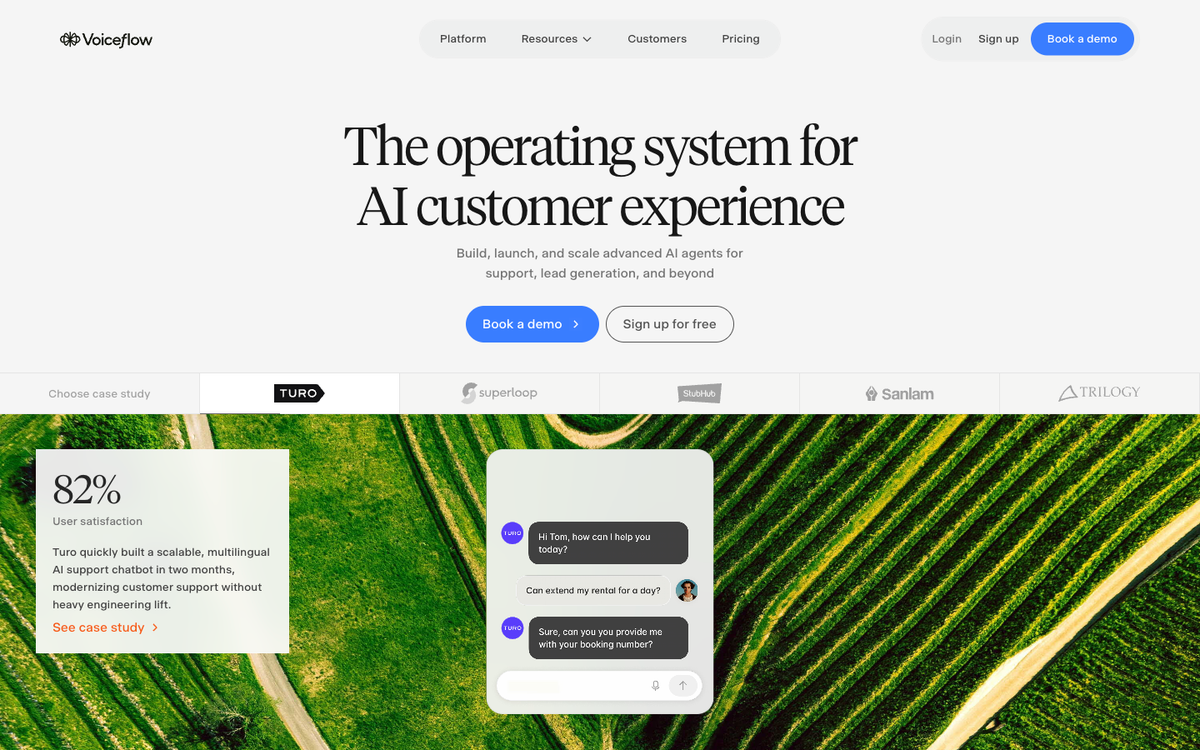
Voiceflow used to be the answer for "I want a visual conversation designer that doesn't make me write Python." The Pro plan was $50 per month, the team plan added collaboration, and you could ship complex multi-turn flows across chat and voice without bothering an engineer.
That pricing model is gone. As of 2026, Voiceflow's pricing page splits into two tracks: "For Agencies and Partners" and "For Businesses." Both lead to "Book a demo" and "Request pricing." The free trial still exists. The flat monthly tier the indie crowd used to live on does not.
What this means in practice: Voiceflow has decided its market is enterprise CX and agency partners managing client deployments. It's a real bet. The product is genuinely strong for that audience: voice plus chat across every channel, role-based access, real-time observability, white-labeling for agencies. It won a 2026 G2 Best Software award in the Agentic AI category, and the actual builder is one of the best I've used.
Where it breaks for most readers: if you're a solo founder, a small SaaS team, or anyone who wanted a $50-a-month flow builder, you are no longer the customer. Sales-led pricing means a discovery call, a custom quote, and probably a multi-thousand-dollar minimum.
Pick it if: you're an agency building bots for clients (real fit), or you're an enterprise CX team with a procurement process and a five-figure annual platform budget. Voiceflow pricing is request-only as of May 2026.
Skip it if: you're price-sensitive or want to self-serve. The product hasn't gotten worse. The fit for indie builders just disappeared.
Botpress: developer ceiling, no-code floor
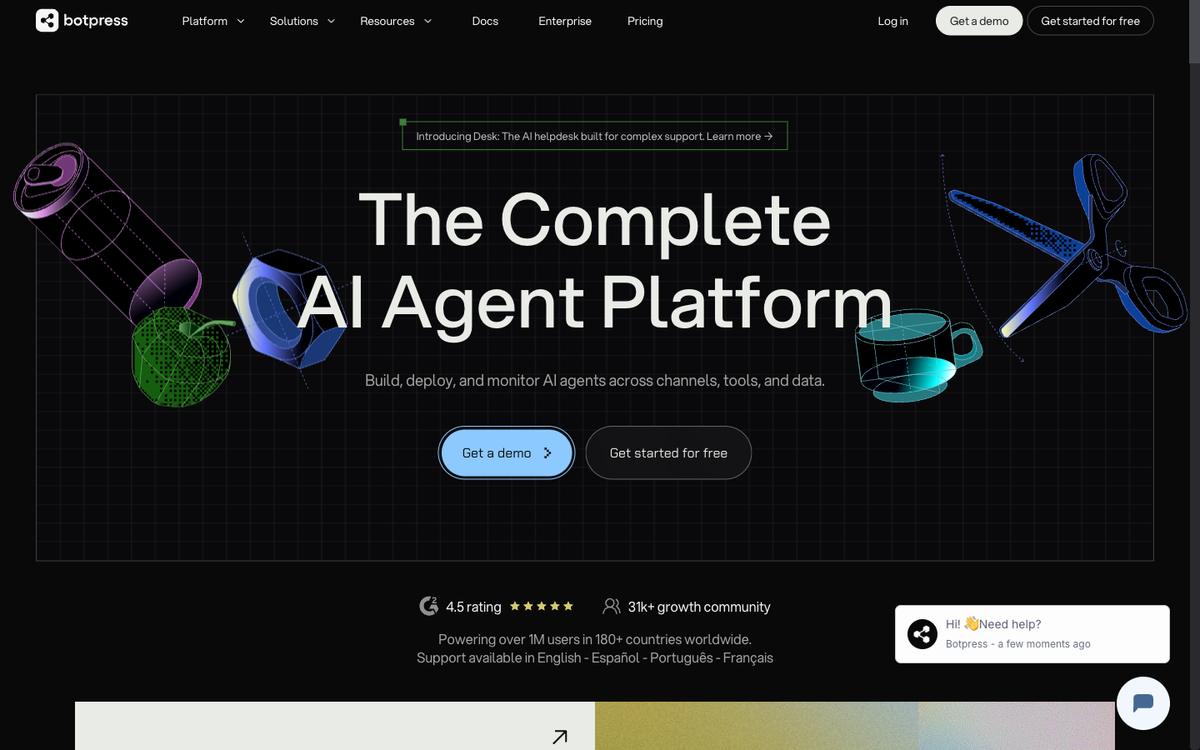
Botpress is the platform with the highest ceiling on this list. It's also the one most likely to confuse a non-technical buyer.
The good: Botpress is free to start with $5 in monthly AI credits. You build in a visual studio, but you can drop into code anywhere you need to. Knowledge bases, custom integrations, webhooks, role-based access, real-time collaboration, and a pay-as-you-go LLM spend model that bills at provider cost without markup. That last point matters. Most no-code builders bundle "credits" that hide a 30-50% margin on every API call. Botpress doesn't.
Real pricing in 2026 (annual billing): Pay-as-you-go $0/mo + AI Spend, Plus $79/mo + AI Spend (human handoff, watermark removal, conversation insights), Team $445/mo + AI Spend (RBAC, real-time collaboration, custom analytics), Managed $1,245/mo + AI Spend (Botpress builds and runs the bot for you). Source: Botpress pricing, May 2026.
Where it breaks: the visual studio is more complex than Chatbase. If your "team" is one founder and a marketer, the cognitive load is real. The free tier's $5 monthly AI credit gets vaporized fast on GPT-4-class models. And the pay-as-you-go model that I just praised becomes a liability if your usage is unpredictable. I've watched a Botpress bot do $400 in AI spend in a week because someone wired up a too-aggressive retry loop.
Pick it if: you have at least one technical person on the team, you want to actually own the bot's logic, and you'd rather pay for what you use than burn credits.
Tidio with Lyro: the live-chat-plus-AI sweet spot
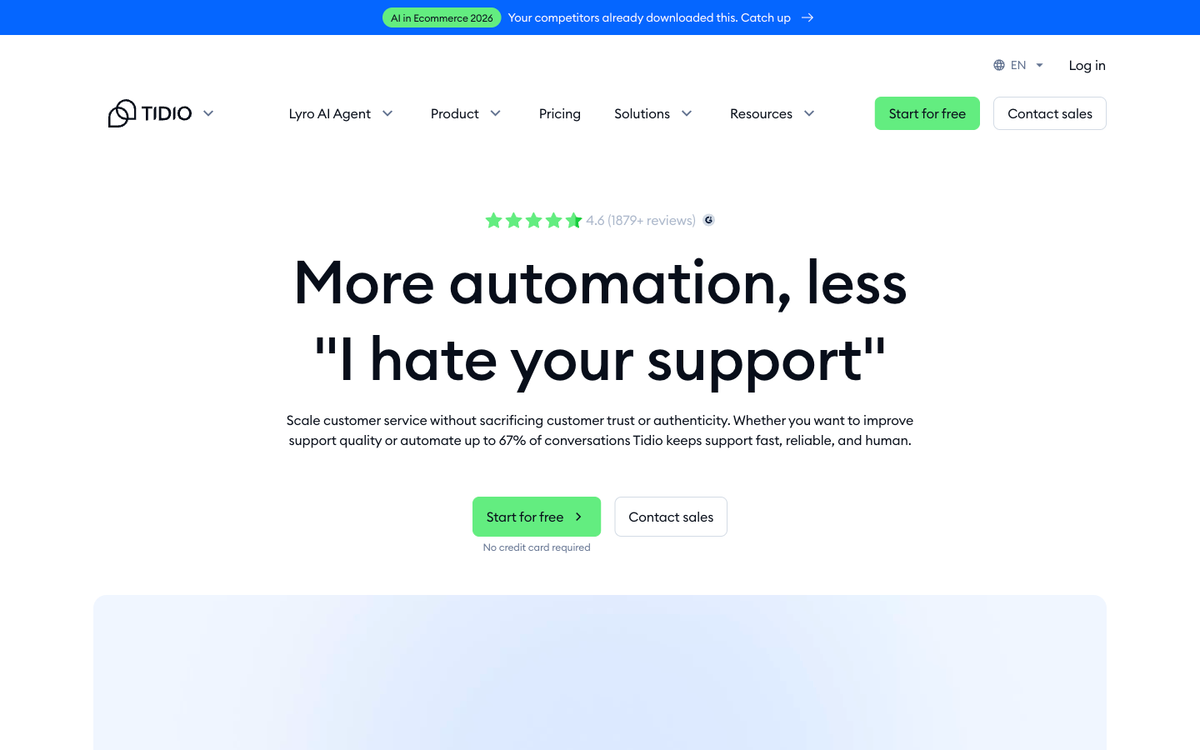
Tidio fills a gap most pure chatbot builders ignore. Real customer support is not "the AI handles everything." It's "the AI handles 70% and a human picks up the rest cleanly." Tidio is built for that handoff from day one.
The product is live chat, ticketing, and AI in one workspace. The AI piece is Lyro, available as an add-on on top of any base plan. The base plans are usage-priced by "billable conversations," which is Tidio's term for any conversation a human or bot actually engages with.
Real pricing in 2026 (monthly): Starter $24.17/mo (100 billable conversations, 50 Lyro AI conversations), Growth from $49.17/mo (250+ billable conversations), Plus from $749/mo (custom volume, departments, multi-project). Lyro AI add-on is $39 per month on top of the base plan. Source: Tidio pricing, May 2026.
What it's genuinely good at: sub-$100-per-month total cost of ownership for a small ecommerce store. Shopify, BigCommerce, and Wix integrations are clean. The Lyro AI agent learns from your help docs and product catalog and hands off to live agents when it doesn't know. The live-chat UX is years more mature than what Chatbase or Botpress ship out of the box.
Where it breaks: the "billable conversations" pricing punishes high-volume bots. If your bot resolves 5,000 conversations a month, Growth tier overages stack up. The flow builder is less powerful than Voiceflow or Botpress. And Lyro's quality is good for retail-style FAQs, weaker for technical or multi-step support.
Pick it if: you run a sub-$10M ARR ecommerce or SaaS business, you need live chat and AI in one inbox, and your team is non-technical.
Intercom Fin: the resolution-priced bet
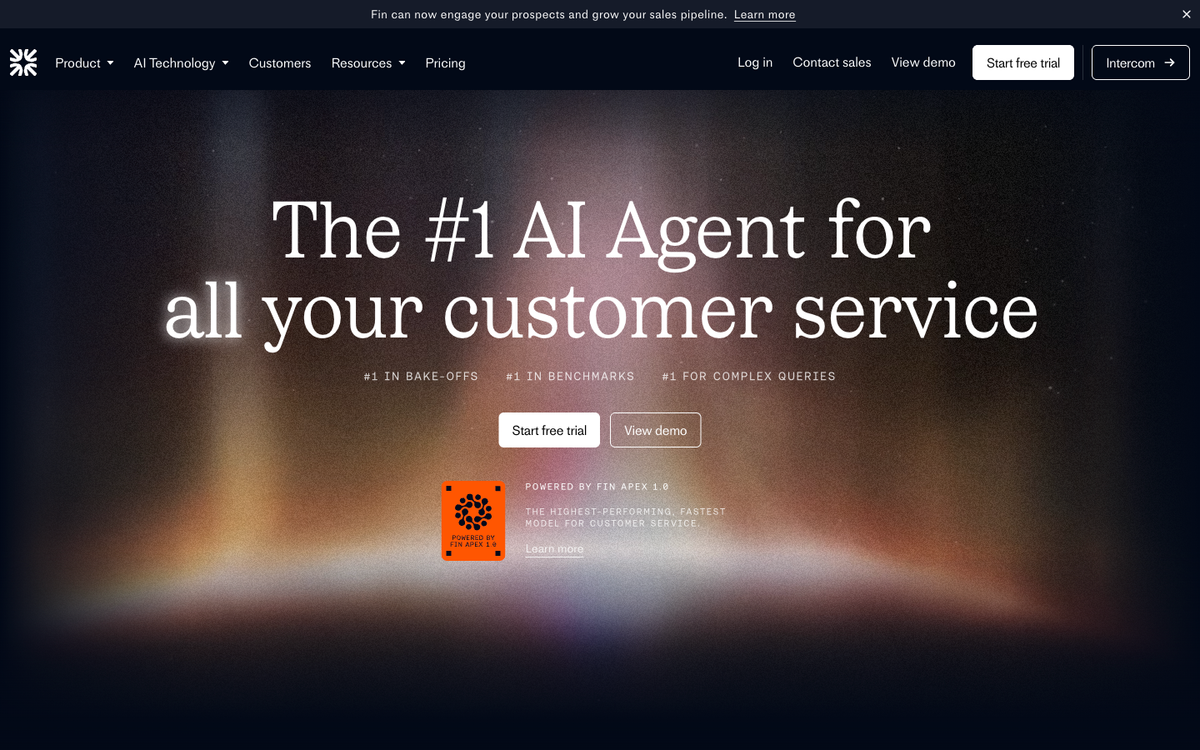
Intercom Fin is the most interesting pricing model in the space, and the most divisive. Every other tool charges you for messages, conversations, credits, or seats. Fin charges you $0.99 per "Fin outcome." A Fin outcome is a resolved customer issue. If Fin doesn't resolve it, you don't pay for it.
This sounds magical. It's also a real bet. If your bot is good, your costs scale with success. If your bot is bad, you pay nothing and your customers are still angry. Intercom is so confident in this that they ship a "Million Dollar Guarantee" page promising to refund customers whose Fin deployments don't pay back.
Real pricing in 2026: Fin standalone (works with Salesforce or any helpdesk you already pay for) is $0.99 per Fin outcome with no seat costs. Or full Intercom plus Fin: Essential $29 per seat per month, Advanced $85 per seat per month, Expert $132 per seat per month, all with $0.99 per Fin outcome on top. Source: Intercom pricing, May 2026.
What it's genuinely good at: alignment. Your CFO understands "we paid $4,950 last month and resolved 5,000 tickets." That's $0.99 per resolution, the math is clean, and it lines up with the contact-center cost-per-interaction benchmarks (Gartner pegs human agent interactions at $6 to $15 versus AI at $0.50 to $0.70).
Where it breaks: resolution-based pricing means Intercom decides what counts as a resolution, and the boundary is fuzzy. Edge cases include "the user closed the chat without confirming," "Fin gave a wrong answer the user accepted," and "the user came back two days later with the same issue." Intercom has a defensible methodology, but the meter is theirs, not yours. Also: full Intercom is genuinely expensive once you stack seats.
Pick it if: you already pay for Intercom (Fin is the obvious add-on), or you run a serious support operation where the per-resolution math beats per-seat or per-credit math at your volume.
Head-to-head comparison table
| Platform | Cheapest paid tier | Pricing model | Best at | Skip if |
|---|---|---|---|---|
| Chatbase | $32/mo (Hobby) | Message credits | FAQ bot from docs, fast ship | You need multi-step logic |
| Voiceflow | Sales-led | Custom quote | Voice + chat, agency white-label | You're price-sensitive |
| Botpress | $0/mo + AI Spend | Pay-as-you-go LLM | Developer team, full control | No engineer on team |
| Tidio + Lyro | $24.17 + $39 add-on | Billable conversations | Ecommerce live chat + AI | High-volume bot deflection |
| Intercom Fin | $0.99 per outcome | Resolution-based | Serious support ops, ROI math | You don't have Intercom yet |
The decision framework: 5 questions, one platform
Run through these in order. Stop at the first "yes."
- Is your use case "answer questions from our help docs and embed on our site"? If yes, pick Chatbase. The Hobby plan ships this in a day. Anything else is overkill.
- Do you already pay for Intercom, or do you run a contact center with 5,000+ tickets a month? If yes, pick Intercom Fin. The resolution-priced model wins on math at this volume, and it integrates cleanly with your existing helpdesk.
- Do you sell physical or digital products to consumers and need live chat plus AI? If yes, pick Tidio with Lyro. Sub-$100-per-month all-in, native ecommerce integrations, and clean handoff to humans.
- Do you have a developer who'll own the bot's integrations long-term? If yes, pick Botpress. The ceiling is highest, the AI Spend model is the most honest, and you can build anything you can imagine.
- Are you an agency building bots for clients, or an enterprise CX team with budget? If yes, get on a Voiceflow demo call. The platform is genuinely strong for that audience.
None of those a "yes"? You probably need a custom build. Skip to the last section.
What most chatbot comparisons get wrong
Almost every comparison post I read makes the same three mistakes.
Mistake 1: Comparing on price, not on integration. Chatbase Hobby costs $32 a month. Tidio Starter plus Lyro costs $63 a month. Looks like Chatbase wins. Then you go to ship and realize Chatbase doesn't have a native Shopify integration, your live chat is sitting in three different inboxes, and your support team is bouncing between tools. The $31 difference doesn't matter. The integration depth does.
Mistake 2: Ignoring the LLM bill underneath. Every platform on this list either bundles "credits" (Chatbase, Tidio) or charges AI usage separately (Botpress, custom builds, Fin's outcome model). Bundled credits are convenient and 30-50% more expensive than the underlying token cost. If you're under 5,000 conversations a month, bundled credits are fine. If you're over 25,000, every platform on this list gets more expensive than a custom build inside 14 months. I cover the math in the AI agent cost calculator.
Mistake 3: Treating "AI chatbot" as one product. A docs Q&A bot, a sales qualifier, and a contact-center deflection agent need different tools, different prompts, and different escalation paths. Picking one platform for all three is how you end up with a bot that's mediocre at everything.
Real deployment story: a B2B SaaS that picked wrong, then right
One client (a 40-person B2B SaaS, NDA so I'll call them Acme) came to me last August. They'd shipped a Chatbase bot six months earlier. It worked for the first quarter. Then their docs grew, their product added a billing module, and the bot started giving customers wrong answers about invoicing. Tickets went up. The bot was now actively making support worse.
The instinct was to switch platforms. We almost moved them to Voiceflow. The right move was simpler: split the bot into two. Chatbase stayed for product Q&A from docs (where it was strong). A separate Botpress bot took over the billing flow with custom logic that pulled from their Stripe API and validated invoice numbers before answering. Total platform cost went from $120 a month to $130 a month. Wrong-answer rate dropped from 19% to 3%. Time-to-fix was 11 days.
The lesson: most "we picked the wrong platform" problems are actually "we put the wrong job on this platform." Chatbase wasn't wrong. Asking it to be a billing system was.
FAQ
What is the cheapest AI chatbot builder in 2026?
Chatbase Hobby at $32 per month (annual billing) is the cheapest paid tier with usable features. Tidio Starter at $24.17 per month is technically cheaper but you'll need to add Lyro AI for $39 per month to get real AI capability, totaling $63.17 per month. Botpress Pay-as-you-go is $0 per month plus AI Spend, but the $5 monthly AI credit runs out quickly on real traffic.
Is Voiceflow still worth it after the 2026 pricing change?
Yes for agencies and enterprise CX teams. The platform itself is genuinely strong and won a G2 Best Software award in agentic AI categories. No for solo founders or small teams who relied on the old $50 per month Pro plan. Voiceflow now requires a sales call for pricing on both the agency and business tracks.
Can I build a chatbot for free?
You can prototype for free on Botpress (Pay-as-you-go tier with $5 monthly AI credit), Chatbase (Free tier, 50 message credits per month, agents deleted after 14 days inactive), or Tidio (free trial). None of these are realistic for production traffic. Plan to spend at least $30 to $80 per month for a usable production bot.
Which AI chatbot builder is best for ecommerce?
Tidio with Lyro for stores under $10M in revenue. Native Shopify, BigCommerce, and Wix integrations, live chat plus AI in one workspace, and clean handoff to humans. For larger stores running on Salesforce Commerce or custom builds, Intercom Fin tends to win because the resolution-priced model scales cleanly with ticket volume.
How does Intercom Fin's $0.99 per outcome pricing actually work?
You pay $0.99 each time Fin successfully resolves a customer's issue without human intervention. Intercom defines "resolution" using a methodology that includes the user not coming back within a window and not requesting a human. If the user escalates to a human, you don't pay the outcome. The model aligns cost with success but the resolution boundary is Intercom's call, not yours.
What happens when I exceed my message or conversation limit?
Each platform handles it differently. Chatbase auto-recharges at $40 per 1,000 message credits if you opt in, otherwise the bot stops. Tidio overages stack on the next bill at the conversation rate of your tier. Botpress AI Spend is metered continuously, so there's no overage, just a higher bill. Intercom Fin is per-outcome, so volume scales linearly. This overage handling is one of the most-overlooked decision factors and is worth checking before you commit.
Should I build a custom AI chatbot instead of using one of these platforms?
Build custom if you'll process more than 25,000 conversations per month, you need integrations none of these platforms ship natively, you have a developer to own it long-term, or your industry has compliance requirements (HIPAA, SOC 2) where the platform's data handling is a liability. Below that volume, no-code is almost always faster and cheaper. I cover the breakeven math in detail in Custom AI Chatbot vs Off-the-Shelf.
How long does it take to launch a chatbot on each platform?
Chatbase: a day for a docs bot. Tidio with Lyro: two to three days for ecommerce. Botpress: one to two weeks for a real production bot with custom integrations. Voiceflow: similar to Botpress for the build, plus the procurement cycle for pricing. Intercom Fin: same-day if you already run Intercom, longer if you need to migrate help desks.
If you've decided you need a custom build, here's how I approach it
If you've worked through the framework and the answer is "none of these fit," that's a useful answer. It usually means one of three things: your volume has outgrown no-code unit economics, your integrations are too custom, or your industry has compliance constraints the platforms can't meet.
That's the work I do. I've shipped 126 production AI systems on AWS Bedrock, Anthropic Claude, and OpenAI, with clean handoff to existing tooling and pricing that doesn't surprise the CFO. Most builds land in the $15K to $40K range with monthly running costs that beat the no-code unit economics inside 14 months. See the four packages here, or book a 30-minute call and I'll tell you within 15 minutes whether custom is right for you. If a no-code platform is the better fit, I'll say that and point you at the tier.
Pricing verified May 2026 against vendor pricing pages: Chatbase, Voiceflow, Botpress, Tidio, Intercom. Market data: Gartner conversational AI cost research, 2026 AI customer support statistics.
Related Posts
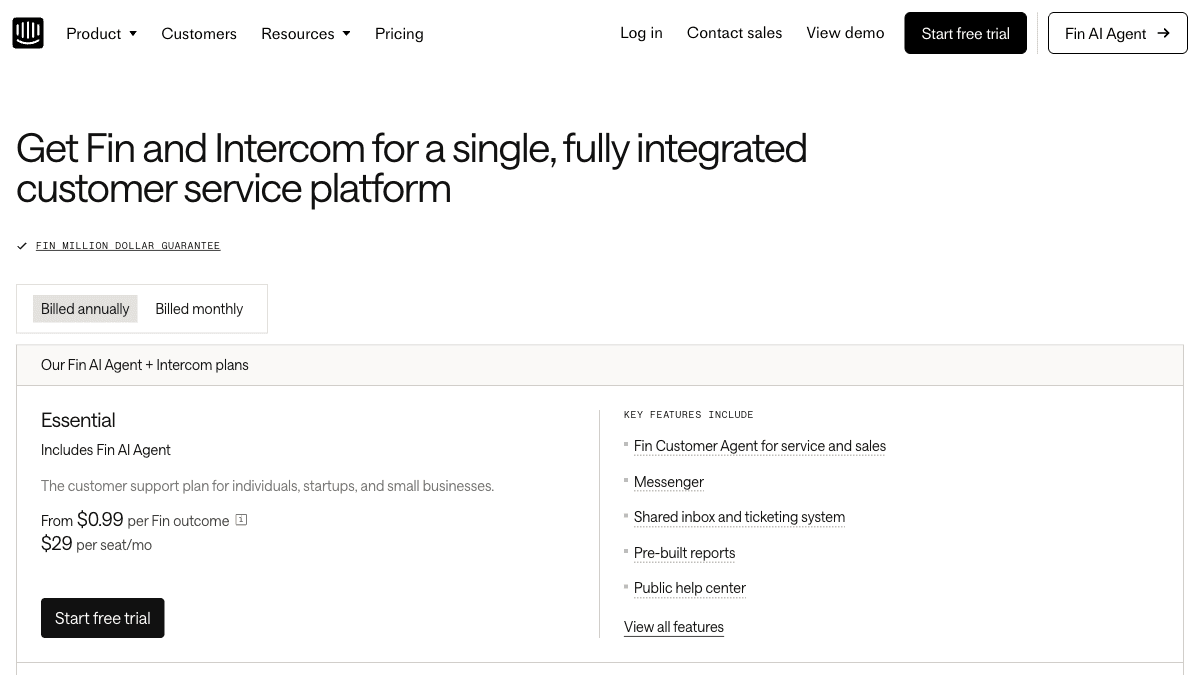
AI Chatbot Pricing in 2026: What You Will Actually Pay (After 126 Builds)
ImplementationAI Chatbot PricingChatbot Cost
Best AI Chatbot Alternatives to ChatGPT in 2026: An Engineer's Decision Guide After 126 Production Builds
AI AgentsChatgpt AlternativesAI Chatbot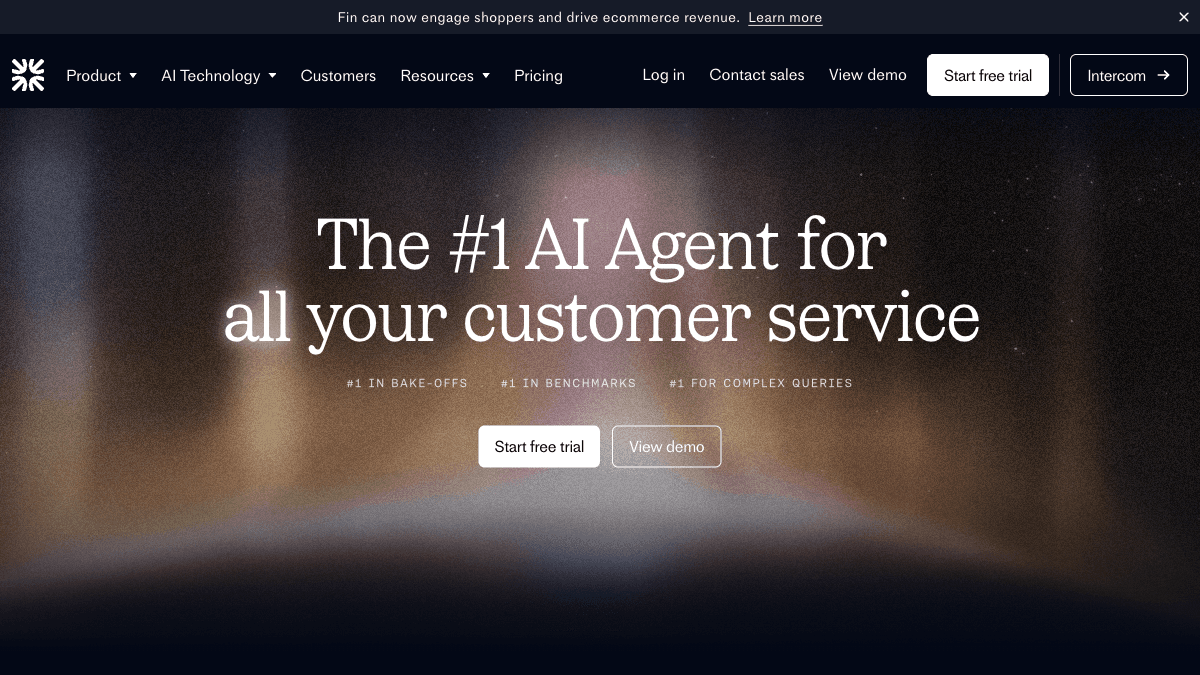
Best AI Chatbot for Customer Service Software 2026: Intercom Fin vs Zendesk AI vs Ada vs Sierra vs Decagon Compared
Trends & InsightsAI ChatbotCustomer Service

Jahanzaib Ahmed
AI Systems Engineer & Founder
AI Systems Engineer with 126 production systems shipped. I run AgenticMode AI (AI agents, RAG systems, voice AI) and ECOM PANDA (ecommerce agency). I build AI that works in the real world for businesses across home services, healthcare, ecommerce, SaaS, and real estate.