Retell AI vs VAPI: Which Voice Agent Platform Should You Actually Build On?
I have deployed voice agents on both Retell AI and VAPI. The honest breakdown, checked in October 2026: pricing, HIPAA and SOC 2 details, contact center costs, and a clear decision framework.

Table of Contents
Retell AI vs VAPI, the short answer: choose Retell AI if you ship voice agents to non technical clients or need HIPAA on a small budget, and choose VAPI if developers own the build and want to pick every model, voice and carrier themselves, or need several AI agents handing one caller between them. On price they finish closer than the headlines suggest. Without HIPAA, VAPI's calculator stacks run about 7% to 12% under comparable Retell stacks at 20,000 to 100,000 minutes a month. With VAPI's $2,000 a month HIPAA add on, Retell stays cheaper until somewhere between 119,000 and 277,000 minutes a month (prices and compliance terms checked again on October 11, 2026).
Retell bundles and VAPI does not, and that single difference explains most of the price confusion between them. Retell quotes $0.07 to $0.31 a minute all in. VAPI quotes $0.05 a minute for hosting and then passes the model, speech, and telephony through at the provider's price, which its own calculator puts at about $0.09 to $0.14 a minute for its default stack with Twilio inbound (checked October 10, 2026). At normal volumes the two finish closer together than the headline rates suggest.
Pick Retell if you ship to non technical clients: it includes 20 concurrent calls, where VAPI includes 4 on usage only and 10 on its $29 a month Core package, and the no code flow builder means a client can look at their own call logic without you. Pick VAPI if you have a developer team that wants the whole stack, particularly for multi agent handoffs through Squads. The number that actually decides it for healthcare is compliance: VAPI charges $2,000 a month per organization for its HIPAA add on, while Retell lets you self sign its BAA at no additional fee on pay as you go (both checked October 10, 2026). On a small clinic that compliance line dwarfs the usage line.
You've narrowed it down to two platforms for your voice AI build: Retell AI and VAPI. Both handle inbound and outbound phone calls. Both support the major LLMs. Both let you deploy AI agents that answer the phone for your business. So which one do you actually choose?
I've deployed voice agents on both. The Retell AI vs VAPI decision isn't about which is "better" in some abstract sense. It's about which one matches your team, your clients, and your use case. And most comparison posts get this wrong because they stop at the feature list.
Here's the breakdown with real pricing numbers checked in October 2026 and a decision framework that will point you to the right platform in under five minutes.
Quick Verdict
- Pick Retell AI if you want faster time to value, bundled pricing you can predict, or you're building for healthcare or enterprise clients who need SOC 2 reports and a HIPAA BAA without a monthly compliance fee.
- Pick VAPI if you're developer-heavy, need to swap LLMs or TTS providers freely, are building multi-agent workflows with their Squads feature, or want to optimize costs at high volume by controlling every component.
- Still deciding? Book a 15-minute call. I've deployed both in production and can tell you which fits your specific build in under 10 minutes.
What We're Actually Comparing
Both Retell AI and VAPI are voice AI orchestration layers. They sit between your business logic and the raw call infrastructure, handling the phone connection, streaming audio to speech-to-text, routing text to an LLM, converting the LLM response back to audio, and returning that audio to the caller in real time.
Neither platform is a finished product. You still write the system prompt, connect your integrations (CRM, calendar, payment processor), and define what happens in edge cases. The platform handles the hard real-time audio engineering.
Where they diverge is philosophy. Retell AI takes an opinionated, managed approach: they bundle voice infrastructure, LLM routing, and turn-taking into one offering. VAPI takes an open, modular approach: you pick every component, they orchestrate. That single difference drives every tradeoff in this post.
Retell AI: The Managed Voice Platform
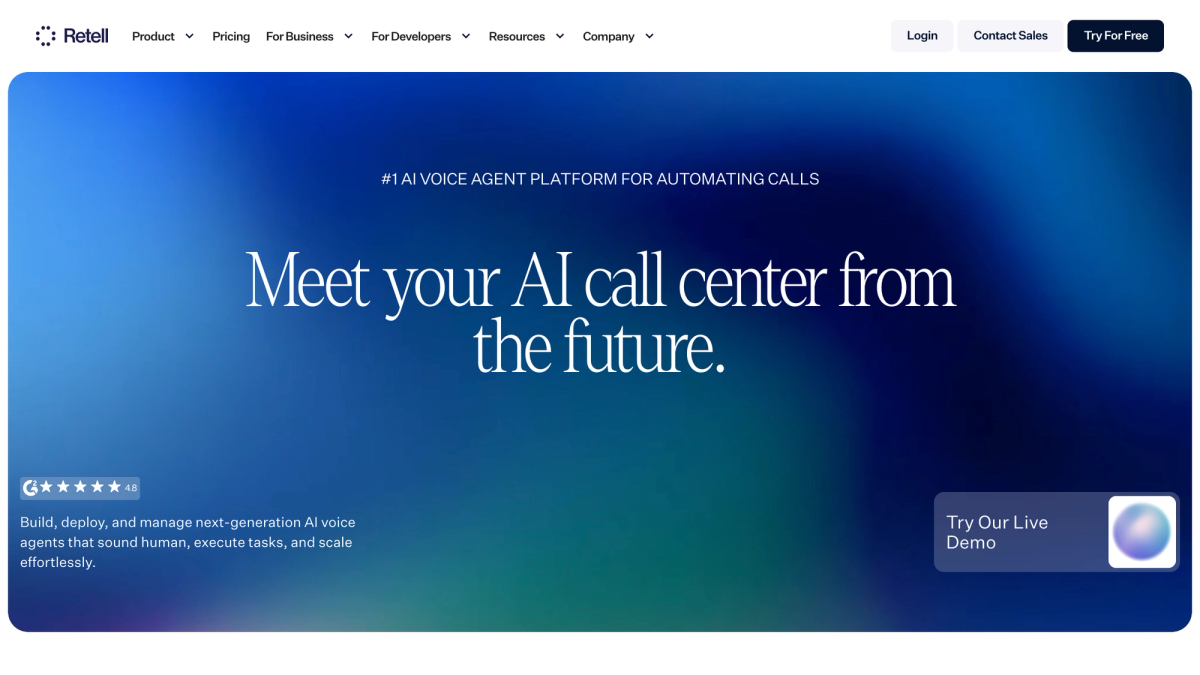
Retell AI came out of Y Combinator (accepted November 2023, per its own timeline) and says thousands of businesses now run on it. G2 named it a winner in the Best Agentic AI Software Products category of its 2026 Best Software Awards, according to Retell's announcement in February 2026.
The platform's core pitch is managed simplicity. You bring a system prompt and your integrations. Retell handles the voice infrastructure, LLM routing, turn-taking, and orchestration. Their proprietary voice orchestration layer is what separates them from platforms that just wire together commodity providers.
Retell AI Pricing (October 2026)
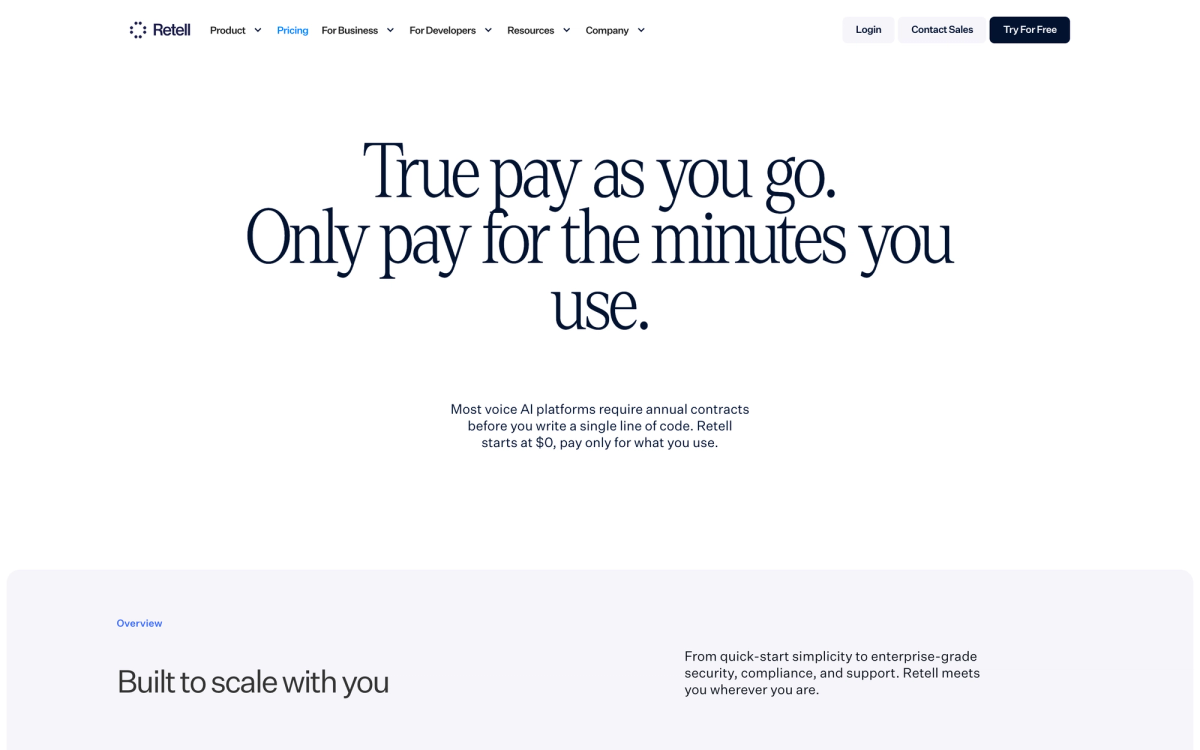
Retell uses all in, per minute pricing. As of October 10, 2026, Retell quotes $0.07 to $0.31 per minute for the Pay As You Go tier. The simplest configuration (Retell Voice Infra plus a $0.015 voice plus GPT 4.1 nano) is about $0.07, and an ElevenLabs v3 voice with GPT 5.4 on the Fast Tier is about $0.32. The quoted range is not a ceiling: the priciest model on the page, GPT 6 Astra on the Fast Tier, with an ElevenLabs v3 voice comes to about $0.80 per minute. Billing is tracked to the nearest second with no rounding up per call, with two exceptions on Retell's own list: a call under 10 seconds that opens with a dynamic AI greeting is billed as 10 seconds, and prompts over 4,000 tokens stretch the billed duration (more on that in the contact center section below). The $10 signup credit buys roughly 90 minutes of test calls at the $0.11 per minute default in Retell's calculator, or about 136 minutes on the GPT 4.1 nano stack above.
Here's how the components stack:
- Retell Voice Infra (base): $0.055/min on every call
- TTS: $0.015/min (Retell Platform, Cartesia, Minimax, Fish, OpenAI, Inworld), $0.040/min (ElevenLabs Flash), up to $0.10/min (ElevenLabs v3 and v4)
- LLM: $0.0016/min (GPT 5 nano) to $0.32/min (GPT 6 Astra) at standard speed; the Fast Tier costs 1.5x to 2x the standard rate on models that offer it, so GPT 5.4 is $0.08/min standard or $0.16/min fast
- Telephony via Retell's Twilio numbers in the United States: $0.015/min ($0.06/min toll free); free if you bring your own SIP
- Phone numbers: $2/month each
- First 20 concurrent calls included; additional at $8/slot/month
- Knowledge Base: $8/KB/month (first 10 free), plus $0.005/min on calls that use one
One thing that catches people off-guard: billing continues during silence. If a caller puts you on hold, the STT stays active and you keep paying. At average call lengths that's negligible. For workflows with long hold sequences, it adds up.
What Retell AI Does Well
- No-code flow builder: drag-and-drop agentic conversation flows, no backend engineering required for branching logic
- Latency: approximately 600ms by Retell's own figure, with a proprietary turn taking model that handles natural interruptions
- Compliance: SOC 2 Type 1 and Type 2 plus ISO 27001:2022, and a HIPAA BAA you can self sign at no additional fee on pay as you go (October 2026)
- Simulation testing: run test calls against your agent before going live, catching edge cases before real callers do
- Conductor: Retell's copilot for building and maintaining agents, live since July 2, 2026, which simulates each proposed change against your agent before it ships. Retell Workflows (August 24, 2026) is a separate feature for the work that happens before a call connects and after it ends (pulling in tools like Slack, Google Drive and Salesforce), and it has nothing to do with the VAPI Workflows builder that was retired in August
- AI Quality Assurance: post-call analysis at $0.10/min (first 100 minutes free) for continuous monitoring
- Batch calling: outbound campaigns with conversion tracking and a $0.005/dial add-on
- Verified Phone Numbers: spam prevention for outbound at $10 per number
- AI Chat Agents: separate product from $0.002 per message for use cases without voice
Where Retell AI Has Limits
ElevenLabs Flash costs 2.67x Retell's $0.015 voices ($0.040 vs $0.015 per minute), and ElevenLabs v3 or v4 costs $0.10, which is 6.67x. If you want the most polished-sounding voice, you're paying a meaningful premium at scale. And while custom LLM endpoints are supported, getting there requires engineering work that bypasses the no-code flow builder's appeal. The Enterprise On-Prem option (deploy within your own infrastructure) is now listed, but custom configurations like that mean you're beyond the self-serve path.
VAPI: The Developer-First Voice API
VAPI positions itself as the AWS of voice AI: powerful primitives, maximum configurability, and you bring the expertise to assemble them. Their tagline targets developers directly: "Build, test, and deploy advanced voice AI agents in minutes with Vapi." For engineers, that's genuinely true. For teams without backend developers, it's a more involved process than the tagline suggests.
They shipped fast in 2025 and 2026. Squads (multi agent handoffs) got its launch post in November 2025. Structured outputs from calls in November 2025. Evals, an automated testing framework, in December 2025. Enhanced Security Mode on April 1, 2026. Vapi Monitoring (call analytics and observability) on April 15, 2026. Simulations and the retirement of the visual Workflows builder in August 2026, followed by rebuilt outbound Campaigns at the end of that month. That's a platform in active development, which is good and occasionally fiddly when things shift under you.

VAPI Pricing (October 2026)
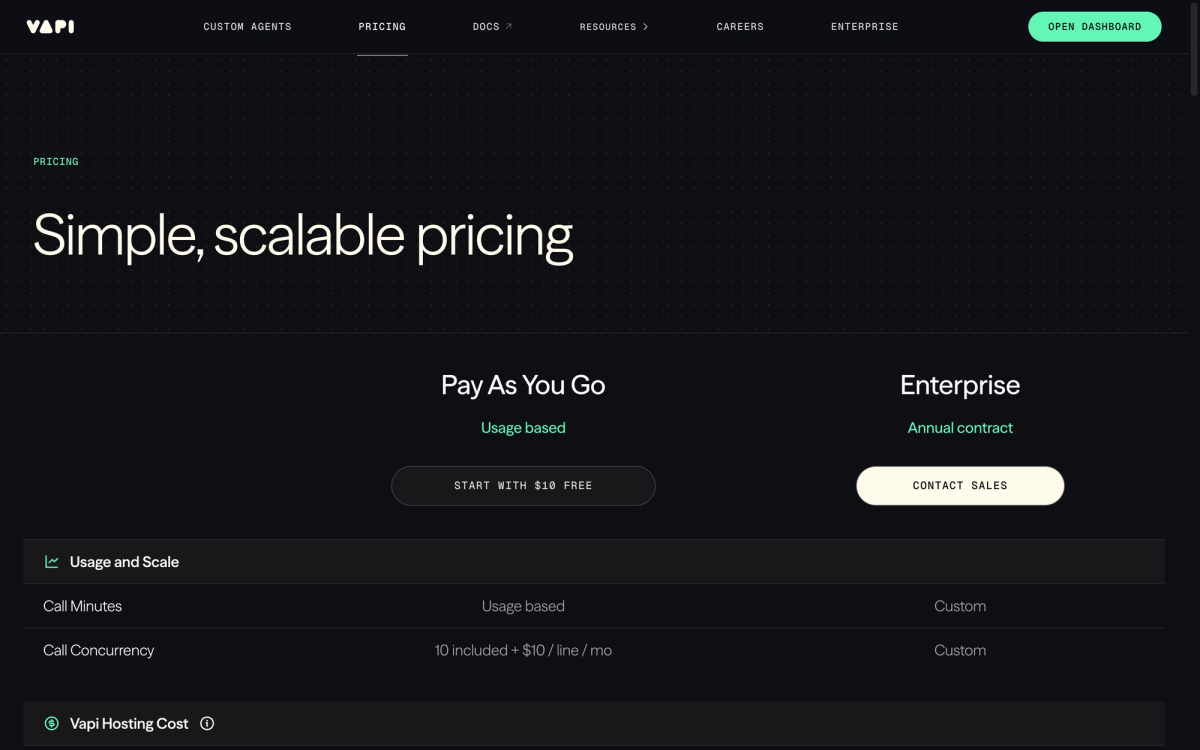
VAPI's number is $0.05/min, but that's only their hosting fee. Real all in cost adds speech to text, the LLM, text to speech, and transport, each billed at the provider's listed price with no markup. VAPI's own calculator puts its default stack (Deepgram, OpenAI, ElevenLabs) at $0.0819 to $0.1290 per minute before transport, which is $82 to $129 per 1,000 minutes (checked October 10, 2026; totals below use unrounded component prices). Across every provider in that calculator, the range runs from about $0.07 to $0.15 per minute including transport.
| Component | Provider | Low | High |
|---|---|---|---|
| VAPI hosting | VAPI | $0.0500/min | $0.0500/min |
| STT (speech to text) | Deepgram | $0.0095/min | $0.0099/min |
| LLM | OpenAI | $0.0077/min | $0.0452/min |
| TTS (voice synthesis) | ElevenLabs | $0.0146/min | $0.0238/min |
| Total before transport | All of the above | $0.0819/min | $0.1290/min |
| Transport | Twilio inbound (billed by Twilio; VAPI telephony, the calculator default, is free) | $0.0080/min | $0.0080/min |
| Total with Twilio inbound | Stack plus transport | $0.0899/min | $0.1370/min |
Or swap in Vapi Voices, VAPI's own TTS (first announced in March 2025), which the calculator lists at $0.0070 to $0.0193 per minute: the low end of the same stack drops to about $0.074 per minute before transport. VAPI's own telephony numbers carry no transport fee. At scale, teams that optimize their VAPI stack this way can undercut Retell's equivalent configuration. But you need to know what you're optimizing.
HIPAA compliance on VAPI is a $2,000 a month add on per organization, available on usage only or any Success Package, and it comes with a standard DPA and BAA (checked October 10, 2026). Zero Data Retention is a separate mode that comes with any Success Package, and VAPI does not let you run HIPAA mode and ZDR at the same time. For a three person healthcare startup, that's significant before you've proven the product. Concurrent lines: 4 on usage only, 10 on Core ($29 a month), 30 on Pro (10% of VAPI hosting fees with a $999 monthly minimum), then $10 per line per month. Premier pricing is custom.
What VAPI Does Well
- Provider flexibility: swap any LLM, STT, or TTS provider independently. GPT-5, Claude, Gemini, Llama, Mistral, DeepSeek, or your own custom endpoint
- Squads: multiple AI assistants that can hand off to each other within a single call. Triage agent routes to booking agent routes to billing agent, all AI, no human transfers
- Developer tooling: CLI, MCP server (integrates VAPI into AI coding tools), automated testing framework, Vapi Monitoring observability dashboard
- Latency: VAPI's homepage advertises under 500ms average latency, while its own docs FAQ says typically around 800 milliseconds end to end, and its latency guide notes that the dashboard figure leaves out endpointing and transport
- Structured outputs: extract validated, typed data from calls (November 2025)
- Composer: an assistant inside the dashboard, still in alpha as of October 2026, that builds and configures agents from plain language requests, and since September 2026 can create and run simulations for you. VAPI retired its visual Workflows builder on August 18, 2026, so Assistants and Squads are the supported build paths
- Cost optimization path: Vapi Voices plus a cost-efficient LLM is the route to lowest per-minute costs at high volume
Where VAPI Has Limits
The $0.05/min headline is the most misleading number in this space right now. It looks cheaper than Retell until you realize you're assembling your own stack and each component adds to the bill separately. For a team without backend engineers, managing three vendor relationships for one call is a real operational burden.
Raw call data on usage only persists 14 days (30 on Core, 180 on Pro). For regulated industries that need call records, that's a compliance issue. And the $2,000 a month HIPAA add on means VAPI's healthcare story only makes sense once call volume can carry it. As of October 2026, VAPI sells its Success Packages to new customers only, while accounts on legacy pricing keep their old terms. That's a signal about pricing stability.
Retell AI vs VAPI: Head-to-Head Comparison
| Category | Retell AI | VAPI |
|---|---|---|
| Pricing model | All in bundled per minute | Orchestration fee plus provider pass through |
| Entry level cost (October 2026) | ~$0.07/min | ~$0.07 to $0.15/min all in, $0.0899 to $0.1370/min for the default calculator stack with Twilio inbound |
| Latency (vendor claims) | ~600ms | Under 500ms average on the homepage; around 800ms end to end in the docs FAQ |
| LLMs supported | GPT 4.1, GPT 5 and GPT 6 series, Claude 4.5 to 5.5, Gemini 3.x, custom | OpenAI, Anthropic, Google Gemini, Groq, DeepSeek, Mistral, xAI, custom |
| TTS voices | Retell, ElevenLabs, Cartesia, Minimax, Fish, OpenAI, Inworld | Vapi Voices, ElevenLabs, Cartesia, Deepgram, MiniMax, RimeAI, Inworld, OpenAI, Azure and more |
| SOC 2 | Type 1 and Type 2 (next Type 2 period November 2025 to November 2026) | Type II for July 1, 2025 to July 31, 2026, plus SOC 3 |
| HIPAA compliance | BAA self signed, no additional fee, on pay as you go | $2,000/month add on per organization, BAA included |
| Free concurrent calls | 20 | 4 on usage only, 10 on Core ($29/month), 30 on Pro |
| Additional concurrency | $8/slot/month | $10/line/month |
| Multi agent workflows | Agentic flow builder (branching) | Squads (true multi agent handoff) |
| Visual workflow builder | Drag and drop flow builder, plus Conductor, a building copilot (July 2026) | None since Workflows was retired on August 18, 2026; Composer (alpha) builds agents from plain language |
| Testing tools | Simulation testing plus AI QA add on | Evals (December 2025) and Simulations (August 2026) |
| Observability | Post call analytics and transcripts | Vapi Monitoring (April 2026) |
| Call data retention | Set per agent, 1 day to 2 years | 14 days on usage only, 30 on Core, 180 on Pro |
| Backed by | Y Combinator | Venture backed |
| Free credits | $10 on signup | $5 on signup |
HIPAA, SOC 2 and GDPR Details (Checked October 10, 2026)
This is the line item that changed most since I first wrote this comparison. Retell now lets you sign its BAA yourself with no extra fee, and VAPI's HIPAA add on costs $2,000 a month per organization, which is $24,000 a year before the first call. Every row below comes from each vendor's own pricing page, docs, or trust center, and I checked each one again on October 11, 2026 with no changes. In one line: Retell holds SOC 2 Type 1 and Type 2 reports plus ISO 27001:2022 and lets you self sign a BAA at no additional fee, while VAPI holds a SOC 2 Type II and SOC 3 report covering July 1, 2025 to July 31, 2026 and charges $2,000 a month for HIPAA.
| Compliance item | Retell AI | VAPI |
|---|---|---|
| HIPAA BAA | Self signed through Retell's agreements portal, no additional fee. The pricing page ticks HIPAA and BAA on both pay as you go and Enterprise; a custom BAA is Enterprise only | Paid add on at $2,000 a month per organization with a standard DPA and BAA. Available on usage only or any Success Package; VAPI emails the BAA after you request it in the dashboard, and HIPAA mode activates once it is signed |
| What HIPAA mode changes | A signed BAA is required before sending PHI. Retention is set per agent from 1 day to 2 years, with PII controls and signed recording URLs | Applies to the whole organization, cannot be enabled through the API, and limits you to HIPAA compliant model, voice and transcriber providers |
| Zero data retention | Opt out of recording and transcription is listed on both plans | ZDR needs no separate purchase and comes with any Success Package; it cannot run at the same time as HIPAA mode |
| SOC 2 | SOC 2 Type 1 and Type 2 reports in the Retell Trust Center; a confirmation letter points to an upcoming Type 2 report covering November 2025 to November 2026, a window still open in October 2026 | SOC 2 Type II and SOC 3 covering July 1, 2025 to July 31, 2026, announced in September 2026 in the VAPI Trust Center; the full report is shared under NDA |
| Other attestations | ISO 27001:2022, HIPAA attestation letter, CCPA | PCI DSS v4.0.1, CCPA |
| GDPR | DPA with EU Standard Contractual Clauses, self signed. Retell runs on AWS and says it does not currently operate services within the European Union | Transfers outside the EU rely on standard contractual clauses. An EU hosted region is available only on the Premier package |
Two things to check before you sign either way. First, a BAA covers the platform, not your whole stack: on VAPI you must also switch every assistant to a provider on its HIPAA list, and on either platform a custom LLM endpoint you host yourself is your own compliance problem. Second, SOC 2 reports describe a past audit window, so ask for the current report and its period rather than trusting a badge.
Cost at Contact Center Volume: 20,000 and 100,000 Minutes a Month
Headline rates hide the fixed costs, so here is the same maths run in a script at two contact center volumes, using the prices above as of October 10, 2026. I assumed calls spread over 22 business days, 10 hours a day, with the busiest hour at 2.5 times the average, which works out to 4 simultaneous lines at 20,000 minutes and 19 lines at 100,000. Retell's 20 included lines cover both. On VAPI, 4 lines fit usage only at 20,000 minutes, and at 100,000 minutes the cheapest option is Core plus 9 extra lines ($119 a month). Phone number rental is left out for both. For scale, 100,000 minutes a month is about 4,545 minutes per business day, or the talk time of roughly 9.5 full time agents on the phone 8 hours a day, which is what I mean by a small to mid size contact center here. 20,000 minutes is about 1.9 agents' worth, closer to a small office. Prices were checked again on October 11, 2026 and had not moved.
| Stack | Per minute | 20,000 min/month | 100,000 min/month | 100,000 min with HIPAA |
|---|---|---|---|---|
| Retell: Retell voice, GPT 4.1 mini, Retell Twilio numbers | $0.0978 | $1,956 | $9,780 | $9,780 |
| Retell: ElevenLabs Flash, GPT 4.1, Retell Twilio numbers | $0.1550 | $3,100 | $15,500 | $15,500 |
| VAPI calculator low: Deepgram, OpenAI, ElevenLabs, Twilio inbound | $0.0899 | $1,797 | $9,106 | $11,106 |
| VAPI calculator high: Deepgram, OpenAI, ElevenLabs, Twilio inbound | $0.1370 | $2,740 | $13,819 | $15,819 |
Without HIPAA, VAPI's low stack comes in 7% to 8% under Retell's budget stack, and VAPI's high end with ElevenLabs runs about 11% under Retell's ElevenLabs stack. Add HIPAA and the picture flips at 20,000 minutes: VAPI's low stack goes from $1,797 to $3,797 a month while Retell stays at $1,956. On these assumptions, VAPI's low stack with HIPAA only catches Retell's budget stack at about 277,000 minutes a month, while VAPI's high end with HIPAA catches Retell's ElevenLabs stack at about 119,000 minutes. Below those volumes, the $2,000 compliance line decides the answer for a healthcare contact center. One more lever: Retell charges nothing for telephony if you bring your own SIP trunk. Paying Twilio's own $0.008 inbound rate instead, Retell's budget stack drops to $0.0908 per minute, and the budget pair finishes within about 1% of each other at both volumes ($1,816 vs $1,797 at 20,000 minutes, $9,080 vs $9,106 at 100,000).
Two rules matter more at contact center volume than in a demo. First, Retell scales the billed duration when an agent's prompt passes 4,000 tokens (global prompt, tool descriptions, node prompt, transcript and retrieved knowledge all count): its billing exceptions page bills a 60 second call that used 4,800 tokens as 72 seconds, so long scripts and big knowledge bases push the per minute figures above up. Second, peaks: when inbound traffic hits Retell's limit, a new call waits about 40 seconds for a free slot, then goes to your fallback number if you set one or ends if you did not, and the optional concurrency burst mode lets calls run past the limit for an extra $0.10 a minute on the whole call (Retell concurrency docs). On VAPI, once every slot is busy you cannot accept another inbound call until one frees up, so buy lines for your real peak (all three docs checked October 11, 2026). To run your own minutes, peak lines and HIPAA choice across VAPI, Retell and three other vendors, use my voice agent cost calculator, and to set the result against staff wages, the AI vs human employee cost calculator.
6 Questions That Point You to the Right Platform
Answer these honestly. They'll tell you more than any feature list.
1. Does your team have a dedicated backend engineer? If yes: VAPI. If no: Retell AI. The VAPI advantage is meaningless if nobody on your team can assemble and maintain a multi-provider stack.
2. Are you building for healthcare clients right now? If yes and you're not at enterprise volume: Retell AI. VAPI's $2,000 a month HIPAA add on is expensive before you've proven the product. Retell's BAA is self signed with no additional fee on pay as you go (October 2026), which makes it the better path for most healthcare deployments.
3. Do you need multi-agent orchestration? Multiple AI agents handing off to each other within a single call flow? VAPI's Squads is purpose-built for this. Retell's flow builder handles branching well, but it's not the same architecture as true multi-agent handoffs.
4. Will you need to swap LLMs frequently? Testing GPT-5 against Claude 4.6 Sonnet against Gemini Flash for cost and quality on your specific use case? VAPI's provider-agnostic architecture makes this a config change. Retell supports the same LLMs, but VAPI's pass-through pricing gives you cleaner cost visibility per provider.
5. Do you need predictable monthly billing? Retell's bundled model is easier to forecast. You know roughly what each minute costs before you write the system prompt. VAPI's add-up-the-components model is more flexible but harder to predict until you've settled on a stack and measured it.
6. Are you an agency shipping agents for SMB clients? If you're deploying 5 to 20 voice agents per month for non-technical clients, Retell's no-code flow builder, simulation testing, AI QA, and Branded Call ID will save you hours per deployment. VAPI retired its visual Workflows builder in August 2026 and its Composer assistant is still in alpha, so Retell's deployment workflow is more polished for client handoffs right now.
What Most Comparisons Get Wrong About This Decision
Every other Retell AI vs VAPI post compares feature lists and calls it analysis. But the real question isn't which platform has more capabilities. It's which platform matches what your team can actually operate.
VAPI has more configuration options. But that's also a liability when you don't have the bandwidth to manage a five-vendor call pipeline. Provider outages, API version changes, TTS voice degradation between model versions. Those are real operational events when you're assembling your own stack. On Retell, their team is responsible for the orchestration layer working. On VAPI, you are.
I've watched teams pick VAPI because the headline pricing looked lower, then spend three weeks integrating providers and chasing a latency issue that turned out to be a Deepgram region routing problem. And I've watched teams pick Retell for simplicity, then hit a wall when they needed a custom LLM endpoint that required engineering work anyway.
The best platform is the one your team will actually maintain six months after the initial deploy. Not the one with the most features on launch day.
A Real Deployment: What This Looks Like in Practice
A 14-seat US law firm doing plaintiff personal injury intake came to me needing a voice agent to handle after-hours calls, qualify leads against their intake criteria, and book consultations directly in their calendar. They had no technical staff. A paralegal handled their tech issues. I used Retell AI.
Setup took about four hours: system prompt for intake qualification, Cal.com integration for booking, Retell's Twilio telephony for the phone number. The flow builder let me map the full conversation tree: opening, injury type, statute of limitations, insurance status, then booking or warm transfer if qualified. Simulation testing let me run 40 test calls before going live. We caught 7 edge cases in simulation that would have been embarrassing on real prospect calls.
The agent handled 189 calls in month one. 71 were qualified leads. 43 booked consultations. Cost: about $58 in Retell usage for the month, roughly $0.31/min because I used ElevenLabs for a polished voice. They closed 6 new cases that month. The retainer paid for itself inside week two.
For a different project, a SaaS company building a white-label voice AI platform where each of their customers could configure their own LLM and TTS, I would have used VAPI. That multi-tenant, bring-your-own-model architecture is exactly what VAPI was designed for. That's the real answer to the Retell AI vs VAPI question. They're both solid. They're just built for different situations.
You can read more production deployments in my case studies and see how the right platform choice played out across different industries.
If You've Decided You Need a Custom Voice Agent Built
Both platforms are tools. Someone still has to build the agent, write the system prompt, handle the integrations, test the edge cases, and maintain it when production gets weird. That's where I come in, and my AI agent development page explains how I run those builds.
I've built voice agents and AI automation systems across law, healthcare, real estate, HVAC, and ecommerce, and I've been doing it for long enough to know which platform will save you headaches on which client type. For context on the full range of what voice AI costs, the AI voice agent pricing breakdown covers what you should budget across build options.
The Revenue Capture System ($5,000 to $7,500 plus $500 to $800/month) is where most voice agent projects land. That's a production agent handling your inbound calls, qualified and integrated with your calendar or CRM, with a 60-day support retainer. If you're earlier in the process and want to map the right architecture before committing, the AI Revenue Blueprint ($1,500 to $2,500) gets you that plan in two weeks.
Not sure if you need a voice agent at all? The AI readiness assessment will tell you whether this is the right first system for your business. And if you want a direct comparison of AI answering services versus human receptionists before deciding on a platform at all, the AI vs human answering service breakdown is the place to start.
FAQ
Is Retell AI or VAPI cheaper?
It depends on your stack. Retell's all in pricing runs $0.07 to $0.31 per minute depending on LLM and TTS choices. VAPI's hosting fee is $0.05 per minute, and its own calculator puts the default stack at $0.0819 to $0.1290 per minute before transport (October 2026). In my 100,000 minute contact center example, VAPI's low stack runs about 7% under Retell's budget stack, and VAPI's high end runs about 11% under Retell's ElevenLabs stack. Add VAPI's $2,000 a month HIPAA add on and Retell stays cheaper below roughly 277,000 minutes a month for the budget stacks, or roughly 119,000 minutes for the ElevenLabs stacks.
Which has lower latency, Retell AI or VAPI?
Both numbers are vendor claims. VAPI's homepage advertises under 500ms average latency, while its docs FAQ says typically around 800 milliseconds end to end. Retell claims approximately 600ms. In practice, latency depends heavily on your LLM choice regardless of platform. A slower LLM adds delay on both. VAPI's latency guide explains that its dashboard figure excludes endpointing and transport, so compare like with like. Retell's proprietary turn-taking model handles natural conversation interruptions well even at slightly higher latency.
Does Retell AI support HIPAA compliance?
Yes. As of October 2026, Retell's BAA is self signed with no additional fee, and its pricing page lists HIPAA and BAA on pay as you go as well as Enterprise, which adds a custom BAA. VAPI also supports HIPAA, but as a $2,000 a month add on per organization, and HIPAA mode cannot run alongside its Zero Data Retention mode. For small healthcare practices or early stage healthcare startups, Retell is the more accessible path on total cost.
Can I use my own LLM with Retell AI or VAPI?
Both support custom LLM endpoints. You bring your own model by pointing the platform at your API. Retell supports this on Pay As You Go. VAPI makes it a core architectural feature. For VAPI, the custom LLM is just another swappable component in the same way you swap TTS providers.
How many concurrent calls can each platform handle?
Retell AI includes 20 concurrent calls on Pay As You Go at $8/slot/month for additional capacity, and Enterprise concurrency is custom from 50 calls up. VAPI includes 4 concurrent lines on usage only, 10 on Core ($29 a month) and 30 on Pro, at $10 per line per month for additions (October 2026). For high volume outbound campaigns, Retell's 20 free slots give more headroom before additional costs kick in.
Which platform is better for agencies building voice agents for clients?
Retell AI. The no-code flow builder, simulation testing, AI Quality Assurance, and Branded Call ID add-on are all purpose-built for agencies deploying agents to SMB clients. VAPI retired its visual Workflows builder on August 18, 2026, and Composer, which builds agents from plain language, is still in alpha, so Retell's deployment workflow is more polished for client handoffs to non technical teams right now.
What is VAPI Squads and how does it work?
Squads let you define multiple AI assistants that can hand off to each other during a single call. Example: a triage assistant gathers initial information, transfers to a booking specialist, then escalates to a billing agent if needed. All AI, no human transfers. VAPI's launch post for Squads is dated November 2025, and this is one of VAPI's clearest technical advantages for complex workflows with several steps where Retell's flow builder reaches its limits.
Can I use Retell AI or VAPI for outbound calling campaigns?
Both platforms support outbound calling. Retell's Batch Call feature runs outbound campaigns with conversion tracking and a $0.005/dial add-on. VAPI launched outbound call campaigns in June 2025 and rebuilt them in August 2026. Both let you trigger calls via API with contact lists. Retell's Branded Call ID ($0.10/outbound call) and Verified Phone Numbers ($10 per number) add ons improve answer rates on outbound calls significantly.
Retell AI pricing and features from retellai.com/pricing and docs.retellai.com (checked October 10, 2026). VAPI pricing and feature data from vapi.ai/pricing and docs.vapi.ai (checked October 10, 2026). Compliance details from trust.retellai.com and security.vapi.ai (October 2026). VAPI product launch dates from vapi.ai/blog. Retell AI case studies (Pine Park Health, Swtch, Medical Data Systems) from retellai.com/customers.
Last updated
October 11, 2026
Category
Voice AI
Jahanzaib Ahmed
AI Systems Engineer & Founder
AI Systems Engineer with 126 production systems shipped. I run AgenticMode AI (AI agents, RAG systems, voice AI) and ECOM PANDA (ecommerce agency). I build AI that works in the real world for businesses across home services, healthcare, ecommerce, SaaS, and real estate.
Want this built for your business? See Inbound Voice Agent, or browse the free tools and guides.
Related articles

How to Qualify Leads by Phone With an AI Voice Agent: Call Flow, Scoring and What 600 Calls Cost
How an AI voice agent qualifies leads on the phone: the call flow, how to score callers, which platforms fit, what 600 calls a month costs, and the TCPA, recording and disclosure rules.
How toVoice AIVoice AI
n8n vs Zapier in 2026: After 126 Production Systems, Here Is My Honest Verdict
A practitioner comparison of n8n and Zapier in 2026 with verified pricing, a clear decision framework, and two real client deployment stories.
ComparisonTrends & Insightsn8n
ChatGPT for Business vs Custom AI Agents: What 126 Deployments Taught Me About the Real Choice
Should you use ChatGPT Business at $20 to $25 per user a month or build a custom AI agent? October 2026 seat prices, workspace agent credits and cost math, from 126 deployments.
ComparisonAI AgentsChatgpt For Business