Microsoft's OpenAI Vendor Drama: What the Court Emails Mean for How to Create an AI Chatbot in 2026
Court emails just revealed Microsoft's CTO feared OpenAI would 'storm off to Amazon' in 2018. Here's what that vendor drama means for how to create an AI chatbot in 2026.

Table of Contents
Court emails released in the Musk v. Altman trial on May 8, 2026 show Microsoft's leadership in 2018 genuinely unsure whether OpenAI was worth backing. Kevin Scott worried in January that OpenAI would leave for Amazon and disparage Azure on the way out. OpenAI burned $60M in discounted Azure credits at twice the planned rate then asked for $300M more, against an internal analysis showing a $150M loss. Eighteen months later Microsoft invested $1B and locked OpenAI into Azure for a decade, a compute exclusivity now central to Musk's $134B damages claim.
The useful part is structural rather than gossip. If Microsoft, with full visibility, could not be confident in its own vendor bet, you should not architect as though yours is certain. Build so a model swap is a configuration change: the pattern I see from careful founders is OpenAI for general reasoning, Claude for tool use, and an open weight fallback such as Llama, Qwen or DeepSeek held ready for the day pricing or terms move.
The short version: A federal court released emails this week showing that in 2018, Microsoft's senior leadership (Satya Nadella, Kevin Scott, and a dozen executives on a long thread) didn't know if OpenAI was worth backing. They funded it anyway, mostly out of fear that Amazon would. That fear is the reason ChatGPT runs on Azure today, and it's why every AI chatbot built on the OpenAI API inherits the politics of a vendor relationship that was lukewarm from the start. If you're building right now, the lesson isn't “pick the winner.” It's “design so you can be wrong about the winner.”
What the Court Documents Actually Said
The trial is Musk v. Altman, in federal court in San Francisco. The emails, introduced as evidence on Thursday May 7, 2026, cover August 2017 through January 2018. Sam Altman had just watched OpenAI's bot beat a professional Dota 2 player. Ten days later he wrote to Nadella asking for $300 million in Azure compute. Microsoft had already given OpenAI $60M of compute at a steep discount, and OpenAI had burned through it twice as fast as projected.
Inside Microsoft, the discussion was not about the technology. It was about competitive optics. Brett Tanzer, then a director on Azure, restarted the thread on January 10, 2018 with a note that Altman was offering to license OpenAI's gaming AI to Xbox in exchange for $35-50M in additional Azure credits. Xbox couldn't justify the spend. Nadella forwarded the email to 15 executives and wrote: “Overall I can't tell what research they are doing and how if shared with us it could help us get ahead. From what Elon is telling everyone, he feels Open AI is at verge of some big AGI breakthroughs.”
Then Kevin Scott, Microsoft's CTO, replied with the line that is now in court evidence: “I guess the other thing to think about here is the PR downside of us not funding them, and having them storm off to Amazon in a huff and shit-talk us and Azure on the way out. They are building credibility in the AI community very fast, recruiting well, and are going to be an influential voice. All things equal, I'd love to have them be a Microsoft and Azure net promoter. Not sure that alone is worth what they're asking.”
That's the foundation under your OpenAI API key. Eighteen months after that email, Microsoft did the $1B exclusive compute deal anyway. Scott himself later admitted, in a separate 2019 email to Nadella and Bill Gates, that he had been “highly dismissive” of the AI work at OpenAI and Google DeepMind. The single biggest enterprise AI partnership of the decade started as a hedge against bad PR.
Why Does This Matter for How to Create an AI Chatbot?
Direct answer: The Microsoft-OpenAI deal isn't just trivia. It's a live constraint on every chatbot built on GPT-4, GPT-5, or any future OpenAI model. Microsoft owns 27% of OpenAI through 2032 (per the October 2025 restructuring). Azure has exclusive compute rights. When you call the OpenAI API, your latency, pricing, and rate limits route through a partnership that was reluctant on Microsoft's side from day one and is now under federal scrutiny. Your job, when you create an AI chatbot in 2026, is to make sure that politics can't break your product.
I've shipped 126 AI systems for clients (chatbots, voice agents, internal tools). The pattern that survives vendor drama is the one I see win quarter after quarter: prompts and tools live in your code, the model is a swappable backend, and the data layer (vector store, conversation logs, user state) is yours. Founders who tied their whole architecture to one provider's quirks (function-calling syntax, JSON mode flags, system-prompt behavior) are the ones rewriting in panic when prices change or terms shift.
The court testimony adds an under-discussed layer: even your vendor's senior leadership might be trying to retire on the partnership ($1.75 trillion in xAI's expected IPO valuation, per Bloomberg's reporting on the SpaceX/xAI filing) or, in Microsoft's case, may be holding the relationship together because $20B of upside makes early skepticism inconvenient to remember. Build like the deal could blow up. It very nearly did, twice already (the November 2023 Altman firing, and now this trial).
How Do You Pick a Model When the Vendors Are at War?
Direct answer: Don't pick a model. Pick an interface. Use a thin abstraction (LiteLLM, OpenRouter, your own three-method client) that lets you swap GPT-5 for Claude Sonnet 4.6 for Llama 3.3 in one config change. Hard-code nothing about token limits, function-calling syntax, or streaming format into your prompts or tools. Every quirk you absorb today is a migration cost tomorrow.
Here's the matrix I run through with founders who ask me how to create an AI chatbot they can actually maintain:
| Decision | Locked-in approach | Vendor-resilient approach | Why it matters |
|---|---|---|---|
| Model client | OpenAI Python SDK direct | LiteLLM, OpenRouter, or 3-method wrapper | Swap in 1 config line vs. 200 lines of refactor |
| System prompts | Provider-specific (OpenAI tool format) | Generic, reformatted at the boundary | Anthropic and OpenAI tool schemas are not interchangeable |
| Embeddings | OpenAI text-embedding-3-large baked into vector store | BAAI/bge-small-en, Voyage, or self-hosted | OpenAI raised embedding pricing 14% in 2024 with 30 days notice |
| Conversation memory | Vector store managed by chatbot vendor | Postgres + pgvector or Pinecone you own | If your vendor pivots, your conversation history goes with them |
| Function calling | OpenAI tools schema in code | Tool registry in your code, formatted per-provider at call time | Claude's tool format is JSON; Gemini uses function declarations; Llama needs JSON mode |
| Streaming | OpenAI SSE format consumed directly | Normalize to one event shape in your client | Provider stream formats differ by 3-5 fields |
| Cost ceiling | Provider-side rate limits | Daily $ cap per service, fail-closed when ledger unreachable | One bad prompt loop can rack up $4K in 6 hours |
Notice what's not on this list: model selection. The model is the single easiest thing to change if everything else is portable. The hard parts are your data, your prompts, and your team's habits.
What Did the Trial Tell Us About the Money?
Direct answer: The numbers in evidence are bigger than most founders realize. Musk is seeking up to $134 billion in damages from OpenAI and Microsoft. OpenAI is reportedly racing toward an IPO at a valuation near $1 trillion. xAI plus SpaceX are filing for a combined IPO at $1.75 trillion. The capital flowing through these AI partnerships dwarfs the entire SaaS industry of ten years ago, and the legal terms governing them are still being argued in federal court.
Two things to take from this. First, the AI vendor market is still consolidating. The relationships you sign today (terms of service, data retention, training opt-outs) might be governed by a different parent company in 24 months. Second, the people running these companies have rivalries that are now public. Brockman testified that Musk wanted “absolute control” over OpenAI's for-profit arm. Shivon Zilis testified that Musk asked OpenAI's Andrej Karpathy “to send a list of top OpenAI people to poach” for Tesla. Mira Murati's text messages with Altman during his 2023 firing were entered as evidence. The leaders are not stable. Don't build like they are.
How Should a Small Business Actually Create an AI Chatbot in 2026?
Direct answer: If you have under 50 employees and you're building an AI chatbot for customer support, sales qualification, or internal knowledge, here's the structure that survives both vendor drama and your own learning curve. Pick a builder platform for the chatbot UI (Voiceflow, Botpress, or a hosted RAG tool). Wire the model layer through OpenRouter or LiteLLM so you can switch from GPT-5 to Claude in 60 seconds. Keep your knowledge base in your own Postgres or Pinecone instance. Log every conversation to your data warehouse, not the vendor's.
That structure costs maybe 20% more in setup time than the “just use OpenAI directly” path. It saves you 90% of the rebuild cost the day a model is deprecated, a price changes, or a court ruling forces a vendor to restructure (which, given the Musk v. Altman trial, is no longer hypothetical).
If you want to go deeper on the implementation patterns, I've written specifically about how non-technical owners should create an AI agent for their business and three self-hosted stacks I actually ship. For the chatbot side, my honest comparison of 5 chatbot builder platforms after 126 production builds is the post that gets the most reader email.
What's the Connection Between Cloud Drama and Federal AI Vendor Decisions?
Direct answer: The Pentagon just made a similar bet in March 2026, distributing classified AI work across 8 vendors instead of locking in with one. They saw the same risk Microsoft was hedging in 2018: if you put all the compute behind one model and that model's company goes through a power struggle, the agency that depended on it has no fallback. Government procurement is the most paranoid customer in tech, and they're modeling the same diversification small businesses should be modeling.
I broke down that vendor strategy in the post on the Pentagon's 8-vendor classified AI bet last week. The pattern is the same: avoid single points of failure, even when one vendor is clearly winning right now. OpenAI is winning right now. So was IBM in 1985. So was BlackBerry in 2008.
What Most Coverage of the Emails Missed
Direct answer: The mainstream tech press covered this story as gossip (“Microsoft was rude about OpenAI in private!”). The actual signal for builders is the part nobody framed: Microsoft's $1B investment in 2019 came from a Microsoft analysis that projected a $150M loss over several years on the compute deal. They invested anyway because of fear of Amazon, not because the technology was clearly going to work. The most successful AI partnership in history started as a defensive move based on incomplete information and ended in a partnership that even the executives involved called “dismissive” for a year afterward.
If that's how the people at the top of the industry pick winners, your shipping a chatbot tomorrow with a 6-month vendor lock-in is taking on more risk than the people who designed the lock-in. Match their hedging behavior. Don't bet harder than they did.
FAQs
What was actually in the Microsoft executive emails about OpenAI?
A 2017-2018 email chain on a thread that included Satya Nadella, Kevin Scott, Bill Gates, and roughly 12 other executives. The chain shows Microsoft initially gave OpenAI $60M of Azure compute at a discount, OpenAI burned through it 2x as fast as planned, Altman asked for $300M more, and Microsoft executives debated whether to fund it or risk OpenAI moving to Amazon. The famous “shit-talk Azure” line is from CTO Kevin Scott in January 2018. The chain was introduced as court evidence in the Musk v. Altman trial on May 7, 2026.
Does this affect anyone using the OpenAI API today?
Indirectly, yes. The Musk v. Altman trial could force OpenAI to unwind its 2024 restructuring (when its for-profit subsidiary became a public benefit corporation). That would change the terms under which Microsoft holds 27% access to OpenAI models through 2032. None of that breaks production chatbots tomorrow, but it could change pricing, rate limits, and data terms within 12-18 months. The right hedge is to keep your code abstracted from any one provider's quirks.
Should I switch from OpenAI to Claude or open-source models because of this?
No. Switching providers reactively is the worst possible response. The right response is to make switching cheap. If your code calls one specific OpenAI endpoint with one specific function-calling format, you have a problem regardless of who's at fault. If your code calls a generic chat-completions interface (OpenRouter, LiteLLM, or a 100-line wrapper of your own), you can A/B test GPT-5 vs Claude Sonnet vs Llama 3.3 70B in an afternoon. The decision becomes data-driven, not panic-driven.
What's the simplest way to create an AI chatbot that won't break when vendors change?
Three layers, all under your control: (1) a hosted chatbot platform for the UI and conversation flow (Voiceflow, Botpress, or a custom Next.js front-end), (2) a model abstraction layer (OpenRouter is the easiest, LiteLLM if you want self-hosted), (3) a data layer you own (Postgres for state, pgvector or Pinecone for retrieval, your own conversation logs). With this stack, switching the underlying model is a config change, not a rewrite. I describe the actual file structure in the build-your-own-AI-agent post.
Is xAI a real alternative to OpenAI for production chatbots in 2026?
Not yet for most use cases. xAI's Grok 4 is competitive on reasoning benchmarks but the API tooling, function-calling, and developer ecosystem lag OpenAI and Anthropic by 12-18 months. The trial is interesting because it suggests xAI plus SpaceX could IPO at $1.75T this June, which would inject capital into the API ecosystem fast. For a production chatbot today, OpenAI plus Anthropic plus one open-weight fallback is the durable mix. Watch xAI in the second half of 2026.
How much does vendor-resilient architecture actually cost in extra dev time?
For a small chatbot project (under 50,000 conversations a month), the extra setup is roughly 4-8 hours of engineering. The model abstraction layer is the only real overhead. Everything else (your prompts, your tools, your data) you'd build the same way. The payoff comes the first time you need to migrate, which usually happens within 18 months on any AI project I've shipped. Net win.
What's the right way to think about cloud lock-in if my chatbot uses Azure OpenAI Service specifically?
Azure OpenAI Service has tighter compliance posture (HIPAA, SOC 2 Type II, FedRAMP High) than the OpenAI direct API. If you need that compliance, the lock-in is worth it. If you don't, the direct API is more flexible. Either way, the abstraction principle still applies: write your code so the difference between “Azure OpenAI” and “direct OpenAI” and “Anthropic” is a config flag, not a refactor. The compliance team's decision shouldn't dictate your code architecture.
Where This Leaves Us
The court emails are noisy. The signal underneath is quiet and useful: the AI vendor market is held together by money, fear of competitors, and partnerships that look stable in press releases and shaky in private. Build accordingly. Pick a model that works today, an architecture that survives the model going away, and a data layer that's yours regardless of who acquires whom.
If you want a structured starting point, the 2026 how-to-make-an-AI-agent post walks through the same vendor-resilience principles applied to agentic systems (tool use, multi-step reasoning, autonomous workflows). Same pattern, slightly different stack.
And if you want to talk through your specific build (whether that's a customer support bot, a sales qualifier, or an internal RAG tool), my AI Readiness Quiz takes about 4 minutes and gives you a stack recommendation that's actually based on your team size and risk tolerance, not a vendor's marketing budget.
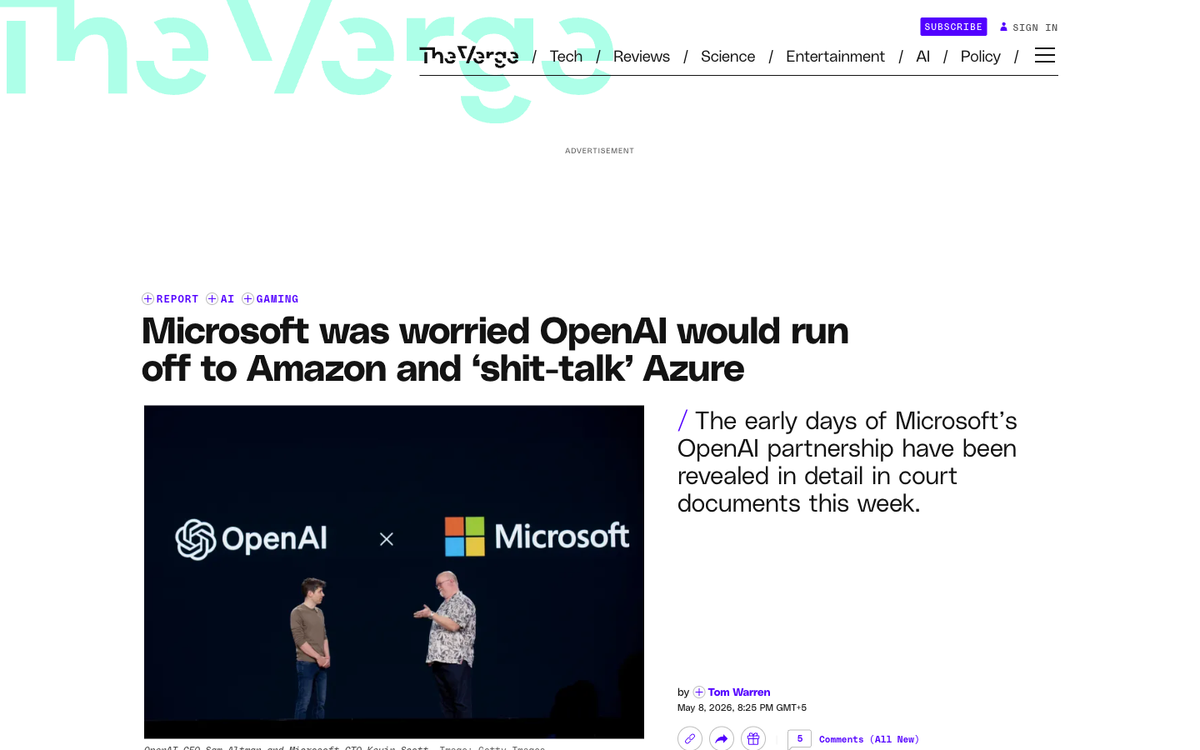
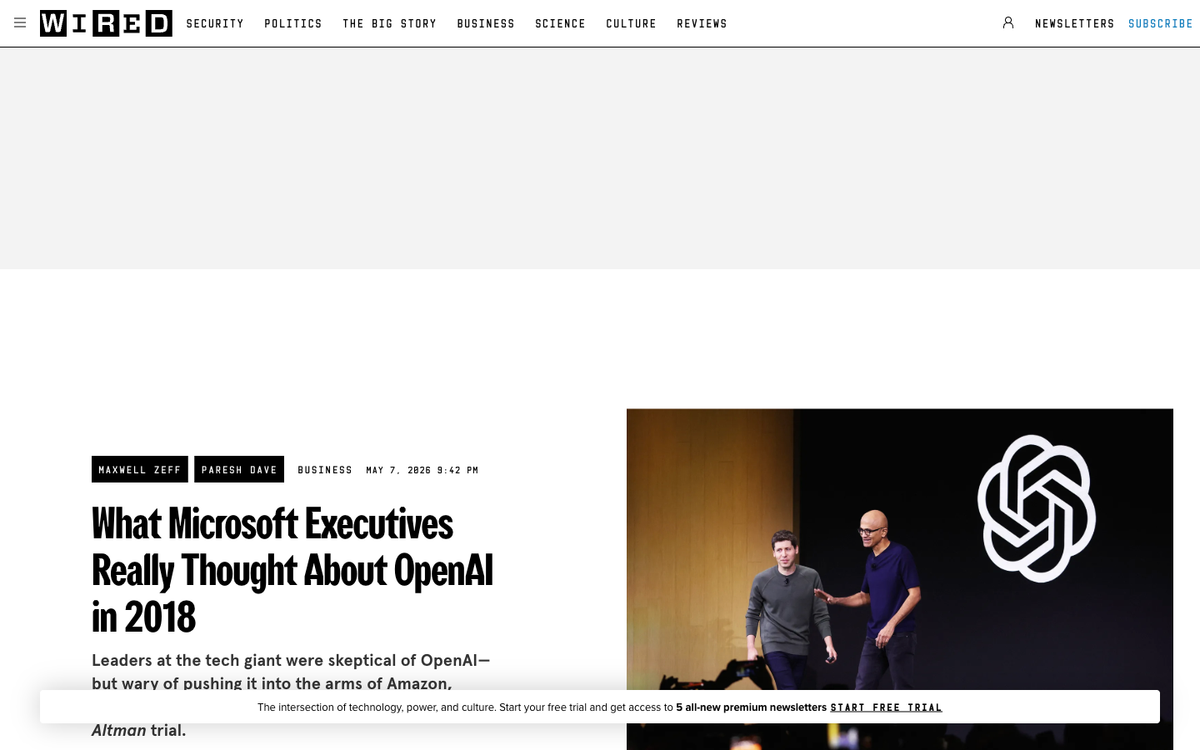
Microsoft executive emails from August 2017-January 2018 (Court Exhibit, Musk v. Altman trial, May 7-8, 2026). Reporting via The Verge (May 8, 2026) · Wired (May 7, 2026) · MIT Technology Review (May 8, 2026). Microsoft's $1B investment announcement: news.microsoft.com (July 22, 2019). Court exhibit emails: filed exhibit (Box). Stanford 2026 AI Index referenced via MIT Tech Review. Damages figure ($134B): CourtListener filing.
Published
May 9, 2026
Category
AI Agents
Jahanzaib Ahmed
AI Systems Engineer & Founder
AI Systems Engineer with 126 production systems shipped. I run AgenticMode AI (AI agents, RAG systems, voice AI) and ECOM PANDA (ecommerce agency). I build AI that works in the real world for businesses across home services, healthcare, ecommerce, SaaS, and real estate.
Related articles
How to Create an AI Chatbot in 2026: What OpenAI's New Voice API Means for Builders
OpenAI just shipped three new voice models in the Realtime API. Here's a builder's read on what changed, the pricing math nobody else is doing, and how to decide if voice is the shape your chatbot project actually needs.
How toAI AgentsAI News
How to Make an AI Agent in 2026: GPT-5.5 Just Changed the Rules (And the Lawsuits Are Telling You Why It Matters)
OpenAI shipped GPT-5.5 Instant the same day Pennsylvania sued an AI chatbot for posing as a doctor. Here is what both stories actually mean if you are building an AI agent for a real business in 2026.
How toAI AgentsAI News
Pentagon Just Cut Anthropic From Classified AI: An 8-Vendor Bet Every AI Builder Should Read
A breakdown of the Pentagon's May 2026 deal with eight AI vendors for classified networks, why Anthropic was cut, and what every AI builder should take from the eight-vendor bet.
GuideTrends & InsightsAI News