Muse Spark Open Needs Two Mac Studios and Trails Kimi K3 at Coding
Meta released the weights for Muse Spark Open, an 816B model it says runs on two Mac Studios. The memory math, the license strings and Meta's own benchmark table tell a narrower story.

Table of Contents
Meta released the weights for Muse Spark Open on October 15, an 816 billion parameter model it says runs on your desk, if your desk holds two Apple M5 Ultra Mac Studios. The model is real and downloadable today. The desk setup is a late October purchase, and Meta's own benchmark table has Muse Spark Open behind Kimi K3 and GLM 5.3 on both coding rows in the table.
What Meta released with Muse Spark Open
Muse Spark Open is a natively multimodal mixture of experts model with 816B total parameters and 42B active per token, a 1M token context window, and input for text, images, video and audio (output is text only). Meta's announcement positions it for coding and agent work and calls it the most capable US open weight model to date.
Weights are on Hugging Face, Amazon SageMaker AI, Google Cloud Model Garden and Microsoft Foundry Models. Hosted access runs through Baseten, Fireworks AI, Groq, Modal, Nebius, OpenRouter and Together AI. Meta lists support for SGLang, vLLM, TensorRT-LLM, Transformers, Apple MLX, llama.cpp and Unsloth.
The Apple angle is the headline. Meta says the model was tuned with Apple for the M5 Ultra Mac Studio, which can give its GPU up to 512 GB of unified memory, so two machines hold the whole model. Both MacRumors and Engadget report the 512 GB configuration has no price yet and is due in late October.
Memory ladder: where two Mac Studios land
A mixture of experts model computes with only its active slice, but every expert has to sit in memory. Hugging Face puts it plainly: deployment needs the memory of an 816B model and runs at the speed of a 42B one. The BF16 checkpoint is about 1.5 TB on disk, and the model card asks for 2 TB of GPU memory to serve it.
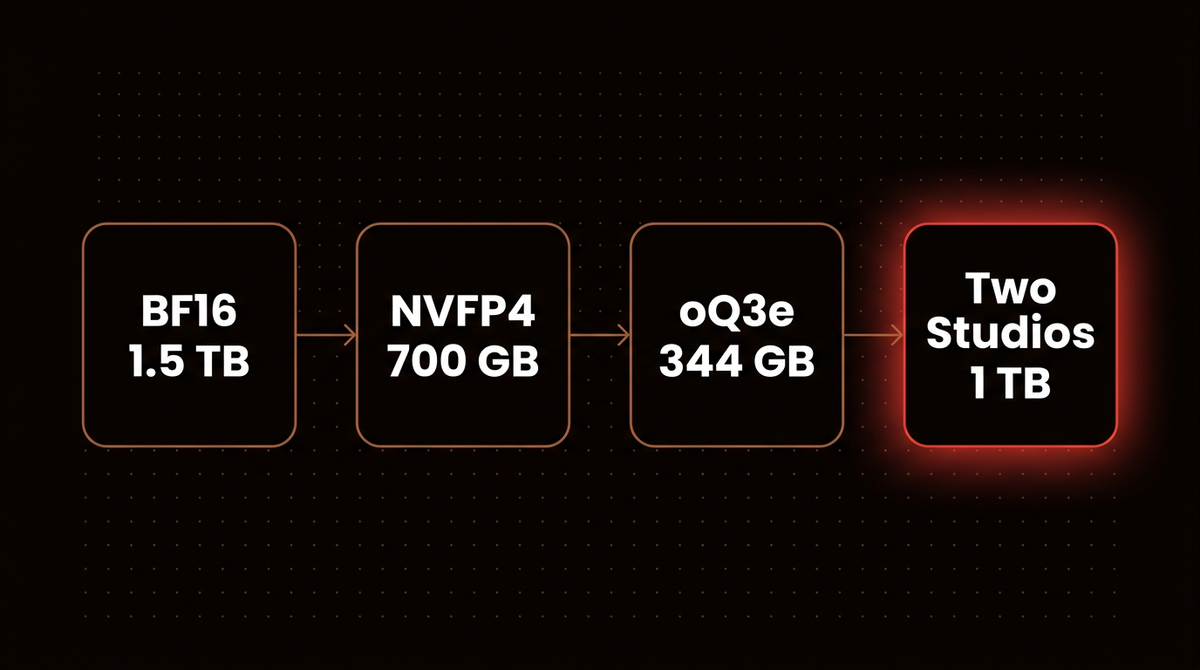
Look at that ladder against Meta's pitch. Two Studios give you 1 TB. BF16 needs about 1.5 TB. So whatever runs on the pair is a quantized build, and Meta's post does not say which. That is my inference from the numbers, not something Meta states, and it matters because quality at 3 or 4 bits is not the quality in the benchmark table, which was run at xhigh reasoning effort.
Hugging Face did publish one real Mac measurement, on a single M3 Ultra with 512 GB. The oQ3e quant takes about 344 GB and ran at roughly 225 tokens per second prefill and 21 tokens per second generation on a 1,024 token prompt. I found no M5 Ultra speed from Meta.
At 21 tokens per second, a 2,000 token reply takes about 95 seconds. Generating a million tokens takes about 13 hours on one stream. Fine for an overnight batch. Painful for an interactive coding loop with a person waiting.
What the 1M context window costs in memory
The model card gives the attention layout: 62 layers, 16 key value heads, head dimension 64. If every layer keeps a full 16 bit cache, that is 2 x 62 x 16 x 64 = 126,976 values per token, or about 254 KB. Hugging Face's vLLM recipe serves 128K tokens of context, which would cost roughly 33 GB of cache. The full 1M window would cost roughly 266 GB. Treat both as upper bounds; I could not confirm whether any layers use a cheaper scheme. Add the 344 GB quant and the full window comes to roughly 610 GB, which still fits in 1 TB. Memory is not the limit there. Speed is.
Meta's own table: ahead on tools, behind on code
Meta compared Muse Spark Open with seven other open models on the model card. These are Meta's numbers, run at its settings, and I have not reproduced any of them. Against the two Chinese leaders it picked as rivals:
| Benchmark | Muse Spark Open | GLM 5.3 | Kimi K3 |
|---|---|---|---|
| MCP-Atlas | 89.2 | 84.2 | 82.3 |
| JobBench | 61.8 | 61.4 | 54.3 |
| ZeroBench (with tools) | 50.0 | not reported | 41.0 |
| Terminal-Bench 2.1 | 76.4 | 83.9 | 85.0 |
| DeepSWE 1.1 | 60 | 67 | 68 |
| Artificial Analysis Intelligence Index | 39 | 45 | 44 |
Engadget summarized this as beating both models on agentic tasks and visual reasoning. The table says something narrower: it leads on tool use (MCP-Atlas) and a job style benchmark, and it trails by 7 to 9 points on terminal coding. My read: if your agents mostly call tools over MCP, this is worth a test. If they mostly write and run code, the model Meta chose as its rival is better on Meta's own numbers. I covered what Kimi K3 changed in an earlier post.
License strings you have to carry
The Muse Model License reads like MIT with three strings attached. Any product or service using the model or a derivative must show "Built with Muse Spark Open". A company that resells model access over an API, and whose gross revenue passes $20 million in any 12 months, needs a separate agreement with Meta; using the model inside your own product is exempt. And an attached Usage Policy bars uses including military work, operating critical infrastructure and heavy machinery. If you build client products on it, that attribution line goes in the interface.
Before you spend money on this
- Test through a host first. Pick one of the seven API providers and run your own tool calling evals. I could not confirm a price from a provider's own page today, so check before you budget.
- Do not buy hardware yet. The 512 GB Studio has no price, and Engadget's rough figure for four 256 GB machines is $38,000. As a hypothetical, if your token bill were $5,000 a month, that is about 7.6 months of spend, before power and before anyone waits on 21 tokens per second. It is also a price for a different setup than the one Meta recommends.
- Set reasoning effort on purpose. The default is
xhigh. Meta suggestslowormediumfor faster, shorter answers. - Read the model card's safety section. Meta reports 99.2% refusal on its internal cyber jailbreak set against 75.5% for Kimi K3. That is Meta's test, so rerun it against your own agent's tools.
Earlier this week I priced Meta's Muse Wonder API, and my September model supply chain post covers why you should pin and verify any weights you pull. If you want a model choice like this tested against your actual workload and monitored afterward, that is the work I do: see how I build AI agents.
Frequently asked questions
Can I run Muse Spark Open on one Mac?
Only a heavily quantized build. Hugging Face ran a 3 bit quant, about 344 GB, on a single M3 Ultra with 512 GB at roughly 21 tokens per second generation. Meta's own recommendation is two M5 Ultra Mac Studios with 512 GB each, and that configuration is not yet on sale.
Is Muse Spark Open open source?
It is open weight, not open source in the strict sense. The Muse Model License lets you use, fine tune, distill and redistribute the model, but requires a visible "Built with Muse Spark Open" credit, bars certain uses, and requires an agreement with Meta for large API resellers.
How much memory does Muse Spark Open need?
All 816B parameters must be in memory even though 42B are active per token. Meta's model card asks for at least 700 GB of GPU memory at NVFP4 and 2 TB at BF16. Context cache comes on top, so a long prompt adds tens of gigabytes at 128K and hundreds at the full 1M window.
Is Muse Spark Open better than Kimi K3 for agents?
On Meta's published table it leads Kimi K3 on MCP-Atlas, 89.2 to 82.3, and trails it on Terminal-Bench 2.1, 76.4 to 85.0. These are Meta's own results. For tool calling agents it is worth testing; for coding agents, Kimi K3 scores higher on Meta's numbers.
Published
October 16, 2026
Category
AI Agents
Jahanzaib Ahmed
AI Systems Engineer & Founder
AI Systems Engineer with 126 production systems shipped. I run AgenticMode AI (AI agents, RAG systems, voice AI) and ECOM PANDA (ecommerce agency). I build AI that works in the real world for businesses across home services, healthcare, ecommerce, SaaS, and real estate.
Related articles
OpenClaw's Security Crisis: What 346,000 Stars and 135,000 Exposed Instances Teach Us About AI Agent Security
OpenClaw, the fastest-growing open source AI agent with 346,000 GitHub stars, triggered the first major AI agent security crisis of 2026. Nine CVEs in four days, 135,000 exposed instances, and 12% of the skill marketplace compromised. Here is what happened and how to stay safe.
NewsTrends & InsightsOpenClaw
Meta's Muse and the Personal AI Agent Security Problem
A breakdown of the security architecture behind Meta's Muse agent, why the trust question every outlet asked was the wrong one, and the five isolation patterns any team can copy in a weekend.
NewsAI AgentsAI Agents
Everyone Wrote iMessage. OpenAI's Own Docs Say SMS and RCS Too.
OpenAI shipped an Apple Messages plugin for ChatGPT on the Mac. The coverage said iMessage. The docs say iMessage, SMS and RCS, and that changes which macOS permissions actually matter.
NewsAI AgentsAI Agents