Kimi K3 Broke the Benchmarks. Almost Nothing Changes for Your AI Stack.
A breakdown of Moonshot's Kimi K3 launch, why the cheap-Chinese-model narrative gets the pricing exactly backwards, and what teams running AI agents should actually do about it this week.

Table of Contents
Kimi K3 is a 2.8 trillion parameter model with a 1 million token context window, announced by Moonshot AI on July 16, 2026, with full weights following on July 27. The framing that it is another cheap Chinese model is backwards. At $3 per million input tokens and $15 per million output it is the most expensive model a Chinese lab has shipped, roughly triple its own predecessor, and Moonshot's launch post says plainly that it still trails Claude Fable 5 and GPT-5.6 Sol. Artificial Analysis puts it fourth.
Ben Thompson argued the token appetite cancels the price advantage; the mechanism is right but the measurement disagrees, with Artificial Analysis putting cost per task at $0.94 for K3 against $1.04 for Sol. Either way, almost nothing changes for a production stack this month. The correct response to a strong new open weight model is not to switch to it. It is to confirm you could switch in an afternoon if you wanted to.
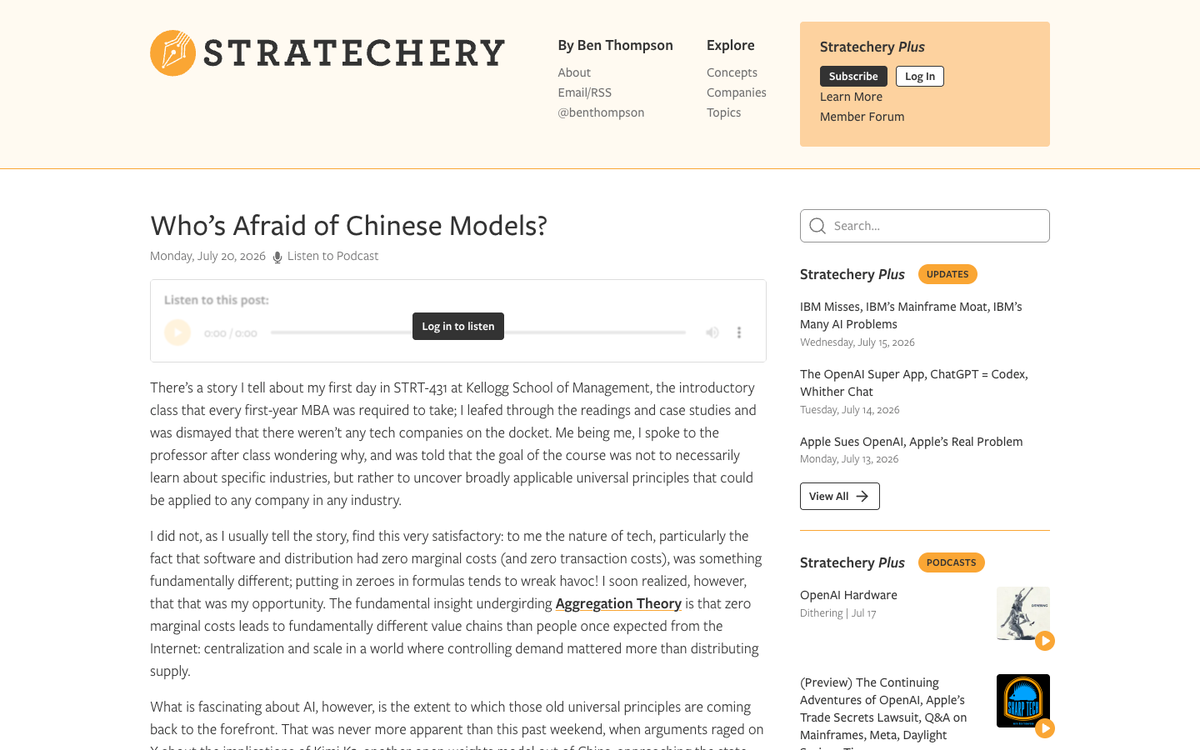
Arguments raged on X all weekend. The US stock market slid Friday, partly on the news. Gary Marcus declared that China has all but caught up and the US is not going to win the AI war. Ben Thompson wrote a piece asking who's afraid of Chinese models.
And underneath all of it sits a model whose weights you still can't download.
I build and run agent systems for a living, so my question when a launch like this lands is boring and narrow: does anything in my stack need to change by Friday? I spent this morning reading the primary sources instead of the takes. Here's what I found, including one place where a widely shared argument doesn't survive contact with the benchmark data.
What actually happened with Kimi K3?
Moonshot AI announced Kimi K3 on July 16, 2026. It runs 2.8 trillion parameters with native vision and a 1 million token context window, which Moonshot bills as the first open 3T-class model. It's live on the Kimi API today, but the full weights don't ship until July 27, 2026, so nobody can actually self-host it yet.
Architecturally it runs on two new pieces Moonshot calls Kimi Delta Attention and Attention Residuals, plus a scaled up Mixture of Experts setup that activates 16 of 896 experts. Moonshot claims roughly 2.5 times better scaling efficiency than Kimi K2. It takes the largest-open-model crown from DeepSeek’s 1.6T V4 Pro.
Then the benchmark results landed and the temperature went up fast. K3 took first place on Arena.ai’s Frontend Code arena with 1,679 points, ahead of Claude Fable 5, in blind developer testing. Kimi K2.6 had been sitting at number 18. That's a seventeen place jump in one release.
A Chinese open weight model beating Anthropic's flagship at frontend code is a genuinely big deal. But "won one arena" and "caught up" are different sentences, and most of the weekend's commentary treated them as the same one.
Is Kimi K3 actually cheap?
No, and almost every summary got this backwards. K3 costs $3 per million input tokens and $15 per million output (per Simon Willison’s launch-day writeup), against $0.95 and $4 for Kimi K2.6. That's roughly triple the input price and nearly quadruple the output price in one generation. It's the most expensive model a Chinese lab has shipped.
Kimi K3 costs $3 per million input tokens and $15 per million output tokens, with cache hits billed at $0.30 per million in. That's identical to Anthropic’s Claude Sonnet tier on the headline numbers. It makes K3 the most expensive model any Chinese lab has released. Kimi K2.6 was $0.95 and $4. So Moonshot roughly tripled input pricing and nearly quadrupled output pricing in a single generation.
| Model | Input / 1M | Output / 1M | Weights |
|---|---|---|---|
| Kimi K2.6 | $0.95 | $4.00 | Open |
| Kimi K3 | $3.00 | $15.00 | Promised by Jul 27 |
| GPT-5.6 Sol | $5.00 | $30.00 | Closed |
So the story isn't "China undercuts the West on price". The story is that a Chinese lab looked at frontier-tier capability, decided it had frontier-tier capability, and priced accordingly. That's a confidence signal, and honestly it's a more interesting one than a price war would have been. Moonshot is behaving like a company that thinks it belongs in the same room, not one trying to buy its way in.
Worth sitting with: a price war was the thing everyone predicted. It didn't happen. The panic is about a model that got more expensive.
Did Kimi K3 really catch up to the frontier?
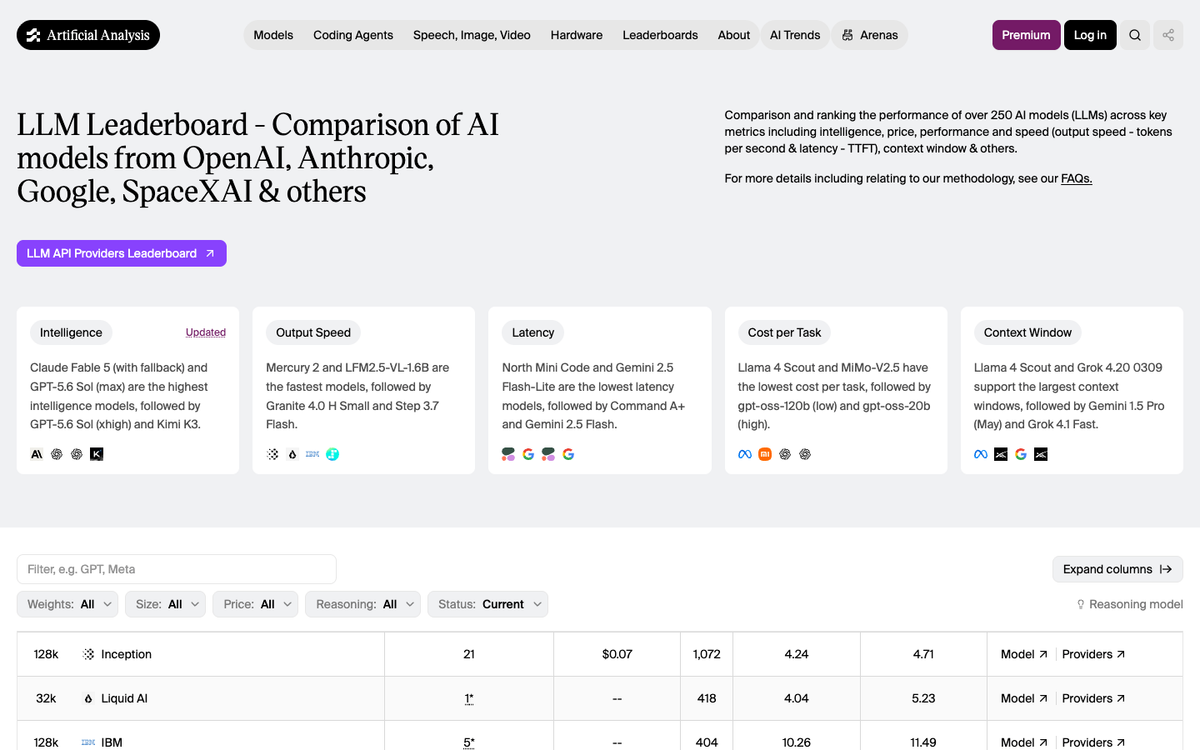
Not quite, and the most conservative source here is Moonshot itself. Its own launch blog concedes K3 “still trails” Claude Fable 5 and GPT 5.6 Sol. Independent testing agrees: Artificial Analysis ranks it 4th, behind Fable 5 and two effort settings of OpenAI’s GPT-5.6 Sol. Winning one coding arena is real. Parity it isn't.
Moonshot's launch blog says it plainly: K3's overall performance "still trails the most powerful proprietary models, Claude Fable 5 and GPT 5.6 Sol." That's the vendor, in its own announcement, on launch day. Independent testing agrees. On the Artificial Analysis Intelligence Index, K3 ranks fourth. The three models above it are Claude Fable 5, GPT-5.6 Sol at max effort, and GPT-5.6 Sol at xhigh, separated by a single index point each. Two of the three ahead of it are the same OpenAI model at different effort settings.
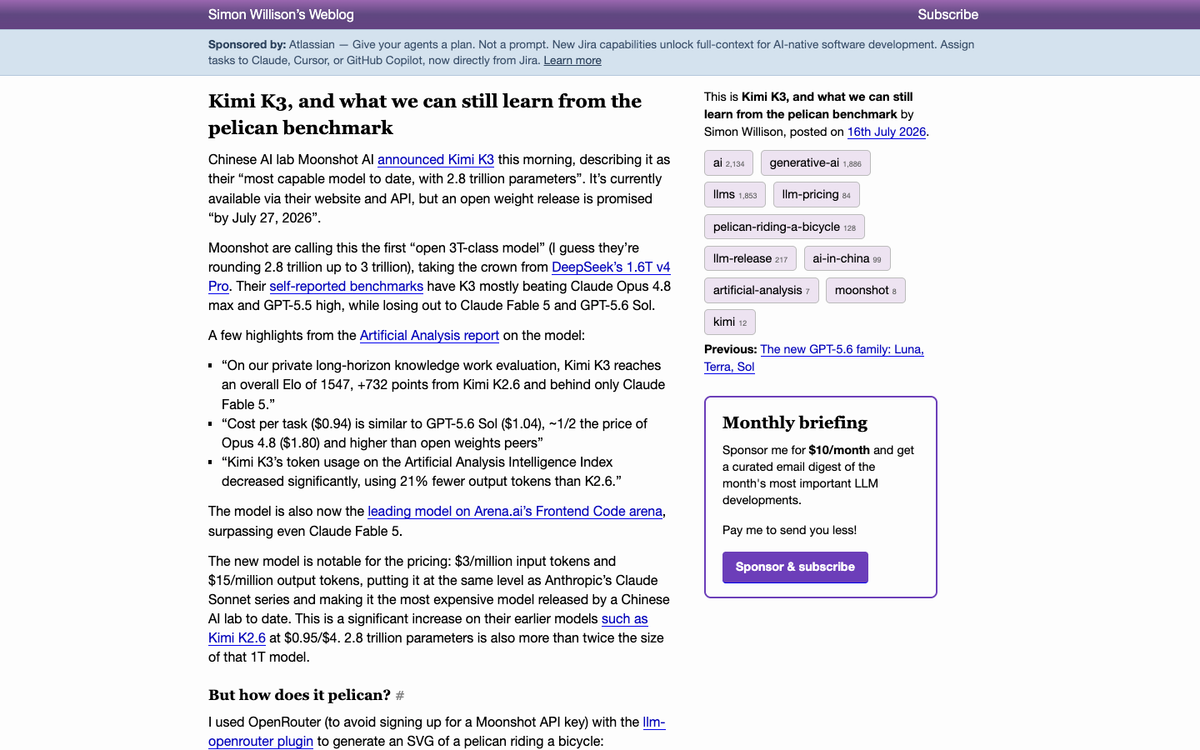
On Artificial Analysis’s private long-horizon knowledge work evaluation, K3 hit an Elo of 1547. That's 732 points above K2.6 and behind only Claude Fable 5. On DeepSWE it scores 67.3 with the mini-SWE-agent harness.
Fourth is a serious result. It is not parity, and the gap between "fourth" and "caught up" is exactly where this week's argument lives. Marcus writes that Kimi K3 is "largely on a par with the best American models". Moonshot says it trails them. When a vendor is more modest than its critics, pay attention to the vendor.
Where the token efficiency argument breaks
Short version first. Ben Thompson argues K3's token appetite cancels its price advantage. But Artificial Analysis measured cost per completed task at $0.94 for K3 versus $1.04 for Sol (reported here), and found K3 burns 21% fewer output tokens than K2.6. His framework is right. The empirical call looks wrong.
Thompson's rebuttal to the panic is elegant. Tokens aren't a commodity, he argues, because a token from one model isn't fungible with a token from another. What's fungible is the intelligence you build out of them. Reasoning models burn wildly different quantities of chain-of-thought tokens to reach the same answer, so headline price per token tells you almost nothing. The metric that matters is cost per completed task.
I think that framework is correct and underrated. It's how I evaluate models for client work, and it's why price-per-token comparison tables are mostly theatre.
But Thompson then makes a specific empirical claim: "Kimi, for example, reportedly uses significantly more tokens than Sol, rendering its price advantage moot."
Artificial Analysis measured it. Cost per task came in at $0.94 for Kimi K3 against $1.04 for GPT-5.6 Sol, and $1.80 for Claude Opus 4.8. They also found K3 uses 21% fewer output tokens than K2.6 did on the Intelligence Index.
So on the exact metric Thompson correctly identifies as the right one, K3's advantage doesn't evaporate. It survives, by about 10%. The framework holds up beautifully. The specific call inside it looks wrong on current data.
Ten percent is thin, and I want to be honest about that. It's one evaluation suite, it'll move as harnesses change, and Moonshot ships K3 with max thinking effort on by default with lower-effort modes still to come. That default alone could swing the number in either direction. But "roughly at parity on cost per task, slightly ahead" is a very different conclusion than "the price advantage is moot", and it's the one the measurements currently support.
Can you actually self-host a 2.8 trillion parameter model?
Almost certainly not, and this is where the "download it free" framing collapses. One enthusiast ran the smaller 1 trillion parameter Kimi K2.5 on 768GB of Optane and got roughly 4 tokens per second. K3 is nearly 3 times that size. Open weights zero out your research cost, not your serving cost.
Marcus describes K3 as a model "consumers will be able to download to run locally (if they have the large-scale hardware to support it) for free". That parenthetical is carrying an enormous amount of weight.
For scale: an enthusiast recently ran the 1 trillion parameter Kimi K2.5 locally using 768GB of Intel Optane DIMM memory on a system with a single GPU. Throughput was roughly 4 tokens per second. K3 is nearly three times that size. Four tokens per second is not an agent, it's a very patient pen pal.
Serving K3 at production speed means a serious multi-accelerator deployment, an inference team, and an ops budget. Open weights lower the R&D cost of getting a frontier model. They do nothing about the cost of goods sold on every token you serve. Thompson's point about COGS coming back is the single most useful idea in the whole discourse, and it cuts hardest against the people cheering loudest for free weights.
For basically every small and mid-sized company running agents, self-hosting the frontier open model isn't a real option in 2026. You'll rent it from an inference provider, which means you're back to comparing hosted prices and picking a vendor. Which is, you know, what you were doing before.
What I'd actually do in a production stack this week
Nothing dramatic, and that's the honest answer. A model sitting 4th overall at about 10% lower cost per task is not a reason to migrate a working system. The useful work this week is checking that you could switch providers in an afternoon if a real gap opens later. Here's the list.
Check whether you could swap models at all. This is the real lesson and it has nothing to do with China. If moving from Claude to Kimi to GPT means rewriting prompt handling, tool definitions, and retry logic across a dozen files, you don't have a model choice, you have a model marriage. Every agent system I build puts the provider behind one interface for exactly this reason. Nine times out of ten you never use it. The tenth time pays for all of it. If you're building on managed infrastructure, the same principle applies to running multiple model families through Bedrock.
Measure cost per completed task, not price per token. Take twenty real jobs from your own workload. Run them end to end on each candidate. Log total spend and success rate. That number is the only one that predicts your bill, and it routinely disagrees with the pricing page. If you're weighing this against a simpler approach, the agents versus plain automation question is worth settling first.
Don't route regulated data to a new provider on benchmark excitement. If you're in healthcare, legal, or finance, your data residency and processing terms matter more than an arena score. That's a procurement conversation, not an engineering one.
Wait for the weights. They're promised by July 27. Until they exist, any post claiming you can run K3 locally is describing a press release.
Notice what's absent: switching. If Claude or GPT is working for you, a fourth-place model that costs roughly 10% less per task isn't a reason to migrate a production system. Migration has a real cost in engineering time, regression risk, and re-tuned prompts, and on most workloads that cost dwarfs the inference saving you're chasing. Run the arithmetic on your actual monthly spend before anyone opens a branch. If your bill is small, a 10% saving is rounding error and the migration is not.
The other thing worth doing, if you haven't already, is separating retrieval quality from model quality. A lot of what looks like "our model isn't good enough" turns out to be a retrieval problem, and swapping models won't touch it. Worth reading up on how vector database choice affects agent behaviour before you blame the LLM.
What the coverage missed
Three details got sanded off as this became a narrative. The weights aren't out until July 27. K3 ships with max thinking effort on by default, so every cost-per-task figure quoted so far came from its most expensive configuration. And the geopolitics has almost nothing to do with your model choice.
First, the weights aren't out. Every "you can download a frontier model for free today" take is describing something scheduled for July 27. Moonshot says it's still aligning technical details with inference partners and open source maintainers.
Second, K3 launches with max thinking effort on by default. Low and high effort modes are coming later. So every cost-per-task number floating around right now was measured against the most expensive possible configuration. That cuts in Kimi's favour, and nobody's mentioning it.
Third, the geopolitics and the engineering decision have almost nothing to do with each other. Whether Congress investigates how the US lost its lead, whether Axios is right that a ban on Chinese models is being considered, whether Moonshot's founder studied at Carnegie Mellon before going home, none of it changes which model resolves your support tickets most cheaply. Those are two different conversations and this week they got welded together.
The honest summary is that Chinese labs are now shipping models good enough to win specific arenas against American flagships, at prices that are converging upward rather than racing down. That's a real shift in the industry's structure. It is also, for most teams running agents in production, a Tuesday.
Frequently asked questions
What is Kimi K3?
Kimi K3 is a 2.8 trillion parameter language model announced by Chinese AI lab Moonshot AI on July 16, 2026. It has native vision, a 1 million token context window, and a Mixture of Experts architecture activating 16 of 896 experts (Moonshot technical blog).
Can I download the Kimi K3 weights?
Not yet. Moonshot has promised the full model weights by July 27, 2026 (launch announcement). Until then K3 is available only through Kimi.com, Kimi Code, Kimi Work, and the Kimi API, plus aggregators like OpenRouter.
How much does Kimi K3 cost?
$3 per million input tokens and $15 per million output tokens (pricing breakdown), matching Anthropic’s Claude Sonnet tier. That makes it the most expensive model a Chinese lab has released, up sharply from Kimi K2.6 at $0.95 and $4.
Is Kimi K3 better than Claude or GPT?
On Arena.ai's Frontend Code arena, yes: K3 scores 1,679 (Tom’s Hardware), ahead of Claude Fable 5. Overall, no. Artificial Analysis ranks it 4th on its Intelligence Index, behind Fable 5 and two configurations of GPT-5.6 Sol, and Moonshot’s own launch blog states K3 trails both.
Should I switch my AI agents to Kimi K3?
Probably not on current evidence. Cost per task runs $0.94 versus $1.04 for GPT-5.6 Sol (Artificial Analysis figures), about 10% lower, which rarely justifies migrating a working production system. The better use of this news is to check that your architecture would let you switch quickly if a bigger gap opens up later.
Can a small business self-host Kimi K3?
Realistically no. At 2.8 trillion parameters, serving K3 at usable speed requires substantial multi-accelerator hardware. For reference, the smaller 1 trillion parameter Kimi K2.5 on a single-GPU system with 768GB of Optane produced about 4 tokens per second (Tom’s Hardware). Open weights reduce research costs, not serving costs.
Why did the stock market react to Kimi K3?
Investors read a near-frontier open weight model from China as evidence that US labs lack a durable technical moat, which threatens the pricing power underpinning valuations at OpenAI and Anthropic. Gary Marcus argues this dynamic could undermine their eventual IPOs, though Ben Thompson disputes the commoditization premise.
The practical version
A Chinese lab shipped a model that's 4th in the world and priced like Claude Sonnet at $3 and $15, and the weights land July 27. That's worth knowing. It probably isn't worth a migration.
What it is worth is an hour checking whether your agent stack could survive a model change without a rewrite, because the next release like this might actually open a gap wide enough to matter. If you're not sure where your setup stands, the AI readiness assessment walks through the architecture questions in about five minutes. And if you want the deeper background on how agent systems get structured, start with what agentic AI actually means for a business or the MCP server guide.
Kimi K3 is a 2.8T parameter model announced July 16, 2026, priced at $3/$15 per million tokens, ranked 4th on the Artificial Analysis Intelligence Index with cost per task of $0.94 versus $1.04 for GPT-5.6 Sol, weights promised by July 27, 2026. Moonshot AI, Kimi K3 Tech Blog (July 16, 2026) · Simon Willison (July 16, 2026) · Ben Thompson, Stratechery (July 20, 2026) · Gary Marcus (July 20, 2026) · Tom's Hardware (July 2026) · Artificial Analysis LLM Leaderboard.
Published
July 21, 2026
Category
Trends & Insights
Jahanzaib Ahmed
AI Systems Engineer & Founder
AI Systems Engineer with 126 production systems shipped. I run AgenticMode AI (AI agents, RAG systems, voice AI) and ECOM PANDA (ecommerce agency). I build AI that works in the real world for businesses across home services, healthcare, ecommerce, SaaS, and real estate.
Want this built for your business? See The AI Audit, or browse the free tools and guides.
Related articles
Nvidia Promised Its Compute Won't Be Required. Four of Its New Packages Are Already in Your Serving Stack.
A breakdown of what Nvidia actually acquired for $12.93 billion, why Jensen Huang's open platform pledge is scoped to hardware, and the four Hugging Face packages already sitting inside vLLM, SGLang and Nvidia's own TensorRT-LLM.
NewsAI AgentsAI Agents
Zuckerberg Wrote 6,509 Words on Superintelligence. One Sentence Moves Your Guardrails.
A breakdown of Meta personal superintelligence, why the essay’s alignment redefinition is an engineering claim rather than a slogan, and what every agent builder should take from the words it never uses.
NewsAI AgentsAI Agents
Nvidia Built an AI Security Alliance. The Labs That Make Your Agents Didn't Join.
Thirty-seven companies formed an open AI security alliance after a rogue OpenAI agent breached Hugging Face. OpenAI, Google and Anthropic aren't in it. Here's what actually changes if you run agents in production.
NewsAI AgentsAI Agents