A $45 Billion AI Fund Got the Thesis Right and Blew Up Anyway
The SEC is subpoenaing banks over Situational Awareness, the AI fund that went from $45 billion to a forced fire sale in four weeks. What actually broke, and what it means for anyone budgeting AI compute.

Table of Contents
A fund that grew to $45 billion on the back of eye-popping AI returns was dumping its entire public stock book at a discount by the end of July. On Monday the SEC started subpoenaing the banks that lent it the money.
Here is the part that should bother you if you build with AI rather than trade it. Leopold Aschenbrenner's thesis was basically right. He argued in 2024 that more capable AI would need far more chips, memory, data centers and electricity than anyone had budgeted for. Nothing in July disproved that. The chips still sold. The data centers still got built.
What broke was the financing wrapped around the idea. And the financing is the part that quietly sets the price you pay for inference.
What actually happened to Situational Awareness?
It went from roughly $45 billion at the start of July (CNBC) to a forced seller of its entire public book inside four weeks, because the same borrowed money that magnified the gains on the way up magnified the losses on the way down and handed the timing of the exit to its lenders. Aschenbrenner had built concentrated positions in the companies supplying chips, memory, power and data center capacity to the AI boom, while shorting software companies he expected AI to disrupt. When those infrastructure names reversed in July, a bad month became a solvency problem.
CNBC reported the fund's largest disclosed holdings at the end of the first quarter included Nebius, SanDisk, Micron and CoreWeave, and that all four fell more than 35% during July (CNBC, Jul 30 2026). A separate CNBC piece put the drawdown on its filed longs at somewhere between 50% and 78% from recent peaks (CNBC, Jul 31 2026). As the portfolio fell, the equity cushion behind the borrowing shrank, prime brokers asked for more collateral, and raising that collateral meant selling into the same falling stocks the fund owned.
I pulled the actual filing rather than trust the summaries, and it is worth the two minutes. The 13F-HR filed on August 14 reports positions as of June 30, which is the book at its peak, right before the fall. It shows 26 positions across 24 issuers worth $20.2 billion (SEC Form 13F-HR).
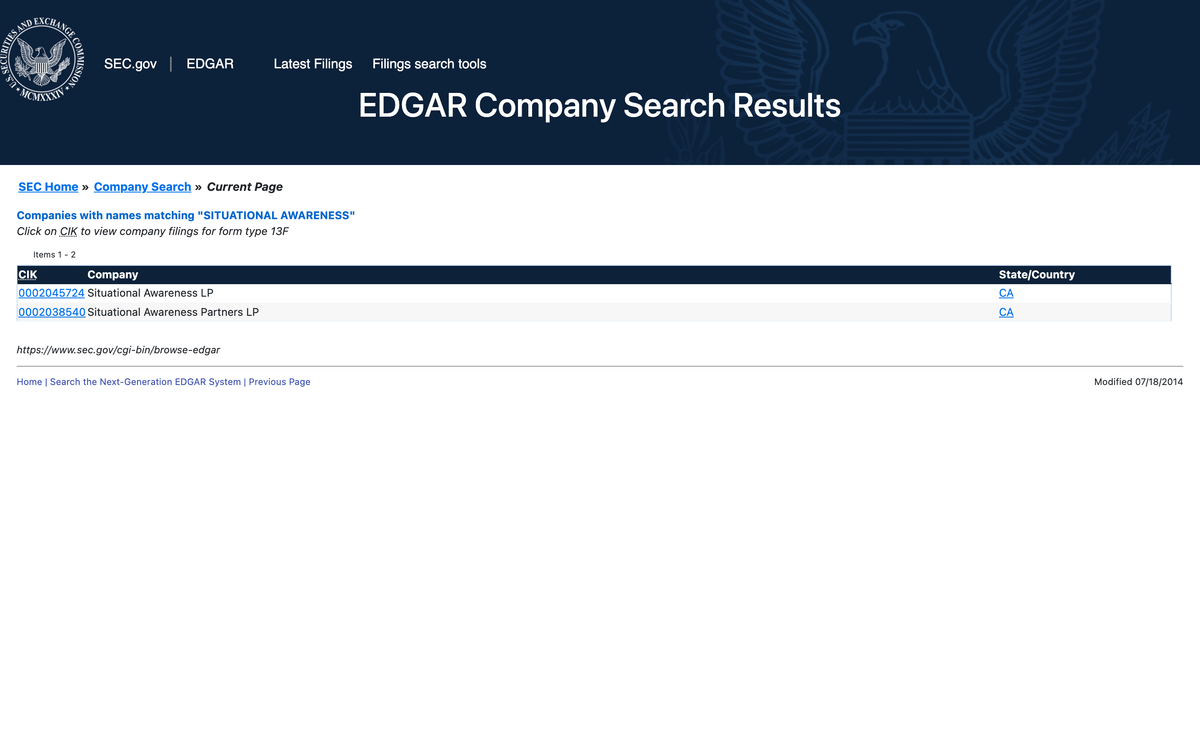
Bank of America, Goldman Sachs and JPMorgan Chase were all named as prime brokers working with the fund on margin. Citadel bought the bulk of the public book. And here is a small thing nobody in the coverage mentioned: search EDGAR and you find two registrants, Situational Awareness LP and Situational Awareness Partners LP, under CIKs 0002045724 and 0002038540. The quarterly 13F is why we know what it owned at all. Private credit and private stakes never showed up there.
What is the SEC actually asking the banks for?
Not the stock picks but the plumbing, because according to reporting from Bloomberg (Fortune) the subpoenas went to major Wall Street banks and sought information about the fund's trading activity during the period it was forced out of its positions, which is a question about how the financing worked rather than about what the fund chose to own. The New York Times, which broke the story, reports the subpoenas focus on the banks that supervised the fund's trading and that channeled funding to support it, and that the SEC told those banks to preserve any information about the fund.
Regulators want to know whether the banks that financed a concentrated bet on AI infrastructure understood the size of the position, and whether the unwind was orderly. A spokesperson for the SEC declined to comment. An inquiry does not mean a firm is the focus of an investigation, and probes routinely end without enforcement.
Situational Awareness said this on Monday, in a statement carried by Bloomberg: "It is to be expected that regulators would closely examine any funds that are high profile, produce significant returns, or have particularly dramatic drawdowns. We are a highly-regulated business and will cooperate to the fullest extent with any regulatory request." Worth noting where the accounts diverge too. CNBC reported the firm had been negotiating to sell its stake in Anthropic, then quoted a spokesman saying reports it was marketing an Anthropic stake are not accurate. Those cannot both be fully right.
How did a correct AI thesis still lose money?
Because the trade was two bets that were secretly the same bet: long the supply chain, short the software firms that AI was supposed to eat, a pairing that works while the market believes the story and fails on both legs at once the moment it stops believing. The instant the market decides it has paid too much for that belief, the infrastructure names fall and the beaten-down software names rally together.
That is exactly what happened. Adobe and similar software shorts rallied while Nebius and CoreWeave fell. The hedge was not a hedge. Jonathan Krinsky, chief market technician at BTIG, put it bluntly in a note: "There is no other way to put it, we just witnessed the largest/ fastest momentum crash in modern history. And it wasn't particularly close." Morgan Stanley's sector-neutral Momentum Index dropped 17.4% in four sessions (BTIG via CNBC). The iShares MSCI USA Momentum Factor ETF had its best month ever in April and was on track for its worst in July.
Meanwhile the S&P 500 hovered near records. If you were watching the index you saw nothing at all.
Bob Lang of Explosive Options gave CNBC the unglamorous version. Traders borrow too much, he said, and "they get seduced by the big returns that some of these companies can deliver. If you're not managing your risk properly, this is the sort of thing that's going to happen to you."
I read Aschenbrenner's 2024 essays when they came out and thought the compute argument was the strongest part of them. I still do. What I got wrong was assuming that being right about demand offers any protection at all.
It doesn't. You can be right about the technology and still get liquidated on the way there.
That gap between "correct" and "solvent" is the most expensive thing I've watched go wrong in AI work. In my experience the builds that die in month four are almost never the ones with the wrong architecture. They are the ones where the architecture was fine and nobody modelled what it cost to run at real volume. Same shape as this, four zeroes fewer.
And the ranking surprised me. Every write-up leads with Nebius and CoreWeave, the GPU clouds, because those are the names a tech audience recognises. They were the fifth and sixth largest positions. The two biggest were SanDisk and Micron, $11.2 billion of a $20.2 billion book in memory alone (13F information table). Sort the whole book by theme and the GPU clouds come third: memory 56%, data center shells and power 25%, cloud 10%, foundry and semis 9%, computed from the August 14 filing. Bloom Energy on its own outweighed Nebius. This was a bet on the memory bottleneck, and the compute brands everyone can name were a rounding error beside it.
| Position (13F, June 30 2026) | Value | What it actually sells an AI builder |
|---|---|---|
| SanDisk (SNDK) | $5.67bn | Flash storage for training and inference pipelines |
| Micron (MU) | $5.57bn | DRAM and high bandwidth memory for accelerators |
| Bloom Energy (BE) | $1.94bn | On-site power generation for data centers |
| TSMC (TSM) | $1.29bn | Fabricates almost every AI accelerator worth having |
| Nebius (NBIS) | $1.23bn | GPU cloud capacity rented by the hour |
| CoreWeave (CRWV) | $0.74bn | GPU cloud contracted to major labs |
| Core Scientific, Applied Digital, Riot, IREN, SharonAI | $2.49bn combined | Data center shells, power contracts and racks |
What does a hedge fund margin call have to do with my AI bill?
Every row in that table is a company that either rents you compute directly or supplies the people who do, which means the fund was not holding some abstract basket of AI exposure, it was long your vendors, and several of those vendors raise the money for their own buildouts in exactly the market that just repriced.
Their cost of capital moves with sentiment toward exactly the stocks that just fell 50% or more. That is the link most of the coverage skips.
The transmission path is slow but it is real. A neocloud that has to refinance data center capacity at a worse rate does not eat that quietly forever. It shows up as higher committed-capacity pricing, shorter discount windows, tighter terms on multi-year deals. It does not show up as a headline saying tokens now cost more. Google already told everyone Gemini 3.7 Flash pricing doubles in January 2027, and that was announced while capital was still cheap and enthusiasm was still high.
Michael Burry has been making the sharper version of this argument for a while, that much of AI's apparent demand is sustained by financing arrangements rather than end customers. He used the rebound to add bearish positions in Micron, the VanEck Semiconductor ETF and Nvidia put options, writing that the reversal was "a historic reversal, even more so than what happened 26 years ago." I think he is too bearish on the demand side. Real workloads are running, and the electricity bills are real, which is its own expensive constraint on the buildout. But the financing point stands on its own even if the demand pessimism is wrong.
Is this a bubble popping or a technical dislocation?
The honest answer is that July itself was mostly technical, a positioning unwind rather than a verdict on whether AI earns its capital, and anyone who tells you what comes next is guessing at least as much as I am. AI infrastructure stocks rebounded sharply once one of the market's largest forced sellers was out of the way, and investors read that as a technical dislocation rather than a change in fundamentals.
But "technical" is not the same as "harmless". A market that can take a $45 billion fund to a fire sale in four weeks, without the index blinking, is a market where positioning is crowded and borrowed money is doing a lot of work. Burry's read and the "clearing event" read are both defensible from exactly the same facts, and I would rather say that plainly than pretend I can settle it for you.
What I will commit to: the direction of pricing pressure on compute is up, not down, over the next eighteen months. Not because models get less efficient. Because the capital that built the capacity got more expensive, and agent workloads keep discovering new ways to consume tokens. Monitoring an agent properly costs about 20% more compute on its own, and multi-agent setups multiply that before they deliver anything.
What would I actually change about a build this week?
Three things, and none of them are dramatic.
First, stop signing multi-year committed compute at 2026 prices unless the discount is genuinely large. The pitch for committed capacity is that you lock in today's rate. The risk you are actually taking is counterparty risk on a company whose financing just got scrutinized. Shorter terms cost more per hour and are worth it right now.
Second, make your model layer swappable before you need it to be. If moving off a provider means rewriting prompts, tool definitions and evals across forty call sites, you do not have a vendor, you have a dependency. That one has bitten me, and the fix is always cheaper before you need it than during. Routing layers exist for exactly this, which is part of why Stripe buying OpenRouter mattered more than it looked.
Third, know your cost per completed task, not your cost per million tokens. Token pricing is the number vendors quote and the number that tells you least. If Gemini Flash doubles in January and you cannot say what that does to your per-ticket cost by Friday, you are not measuring the right thing. Rippling built an internal console for exactly this reason, and most teams should have a cheaper version of it.
The uncomfortable version of all three: a system whose unit economics only work at today's prices is not a system, it is a bet on prices. That is the same bet Situational Awareness made, expressed in Python instead of equities. If you want a structured read on where your own AI plans sit on that spectrum, the AI readiness assessment takes about five minutes and asks the cost questions most vendor demos skip.
Frequently asked questions
Has Situational Awareness been accused of any wrongdoing?
No. Both TechCrunch and Bloomberg's reporting state the fund has not been accused of wrongdoing. The SEC declined to comment, and an inquiry does not mean a firm is the focus of an investigation. Probes frequently end without any enforcement action.
Who is Leopold Aschenbrenner?
A former OpenAI researcher who worked on the Superalignment team and left the company in 2024. He published a series of essays that year arguing that advancing AI would require a huge expansion of compute, advanced semiconductors, memory and energy infrastructure. Those essays became the investment thesis behind Situational Awareness.
Did the AI infrastructure companies themselves do anything wrong?
Nothing in the reporting suggests that. The stocks fell as part of a broad momentum reversal, not because of company-specific failures. Nebius, CoreWeave, Micron and the rest were caught in a positioning unwind driven by one very large forced seller and a crowded trade.
Should this change which AI model provider I use?
Not by itself. Frontier model pricing from OpenAI, Anthropic and Google is set by companies with far deeper balance sheets than a neocloud. The exposure worth reviewing is committed GPU capacity contracts and smaller inference providers, where a change in the cost of capital reaches you faster.
Is AI compute actually going to get more expensive?
Per token, efficiency gains have historically pushed prices down over time. But Google has already announced that Gemini 3.7 Flash pricing doubles in January 2027, which shows list prices can move up as well. The bigger driver for most teams is that agent workloads consume far more tokens per task than chat did, so total spend rises even when unit prices fall.
What is a margin call in this context?
The fund borrowed against its stock positions through prime brokers. When those positions fell in value, the equity cushion behind the loans shrank and the brokers demanded more collateral. Meeting that demand required selling holdings, which pushed the same stocks lower and triggered further demands. That loop is why a bad month became a forced liquidation.
Sources: Situational Awareness ran roughly $45 billion at the start of July 2026 before margin calls forced it to sell the bulk of its public equity book to Citadel; its largest disclosed Q1 holdings included Nebius, SanDisk, Micron and CoreWeave, all of which fell more than 35% that month. Morgan Stanley's sector-neutral Momentum Index fell 17.4% in four trading days, the worst on record per BTIG. The SEC sent subpoenas to major Wall Street banks on August 24, 2026 seeking information about the fund's trading activity; the fund has not been accused of wrongdoing. CNBC (Jul 30, 2026) · CNBC (Jul 31, 2026) · Fortune / Bloomberg (Aug 24, 2026) · TechCrunch (Aug 24, 2026) · Position sizes are taken directly from the fund's Form 13F-HR for the quarter ended June 30, 2026, filed August 14, 2026. SEC EDGAR, Form 13F-HR information table.
Published
August 25, 2026
Category
Trends & Insights
Jahanzaib Ahmed
AI Systems Engineer & Founder
AI Systems Engineer with 126 production systems shipped. I run AgenticMode AI (AI agents, RAG systems, voice AI) and ECOM PANDA (ecommerce agency). I build AI that works in the real world for businesses across home services, healthcare, ecommerce, SaaS, and real estate.
Related articles

Amazon Is Backing 7.65 Gigawatts That Will Not Touch the Grid
A breakdown of Amazon's permitted 33 million ton gas plant in Pecos County, why the interconnection queue explains it better than the emissions number, and what AI builders should take from a grid that takes five years to join.
NewsTrends & InsightsAI Infrastructure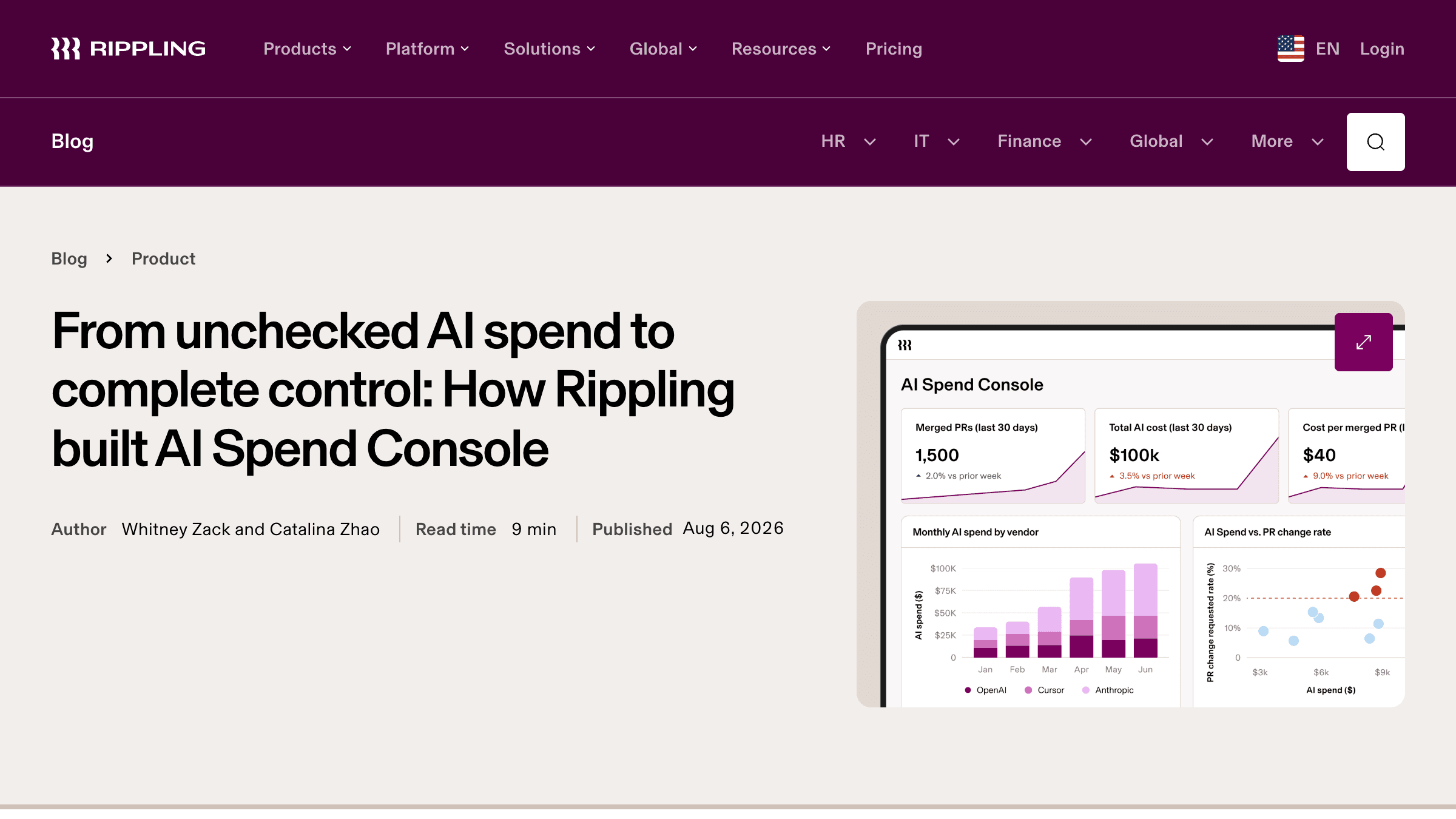
Rippling Was About to Spend 40% of Its Engineering Payroll on Tokens
A breakdown of what Rippling found when it audited its own AI token bill, why 10 to 15% of staff drove 60% of the spend, and what its per-engineer scorecard gets right and dangerously wrong.
NewsTrends & InsightsAI Costs
The Army Promised Unlimited AI Tokens. It Ran Dry in Weeks.
The Army said its AI tokens were unlimited, then hit the wall in about five weeks. Here is what really drained the pool, and the boring budgeting that keeps your own AI bill from doing the same thing.
NewsTrends & InsightsAI Agents