Google's Gemini Flash Models Are Cheap Until January 1. Then They Double.
Gemini 3.7 Flash costs $0.75 and $3.75 per million tokens until December 31, then $1.50 and $7.50. Rechecked October 9, 2026, with 3.8 Flash, cost math and levers.

Explore with AI
Table of Contents
Gemini 3.7 Flash costs $0.75 per million input tokens and $3.75 per million output tokens through December 31, 2026. Google's pricing page, last updated October 7, still lists $1.50 and $7.50 from January 1, 2027. The date and prices have not moved since the August 13 launch, but the scope has: 3.6 Flash and the newer 3.8 Flash carry the same switch.
Update, October 9, 2026. I rechecked the pricing page, Google's latest model guide, the release notes and the deprecations page. Since I published on August 14:
- The schedule is unchanged. Google's guide says introductory pricing applies to Gemini 3.8 Flash, 3.7 Flash and 3.6 Flash through December 31, 2026, and standard pricing takes effect January 1, 2027.
- Gemini 3.8 Flash became generally available on September 2 at the same introductory price. Google says it can use more tokens on long tasks by design, and that 3.7 Flash remains fully supported. The deprecations page lists no shutdown date for 3.7 Flash.
- On September 30 Google announced Gemini 4 Argon, with an introductory price of $2 input and $10 output that rises to $4 and $20. It is not generally available yet.
- As of October 9 there are 84 days left, not 140.
I also corrected two points from August. The expiry footnote is in Google's launch post, not on the pricing page. And I said caching gives no protection from the increase. It does not stop the doubling, but it shrinks the bill that doubles, as the numbers below show.
What did Google actually ship on August 13?
Gemini 3.7 Flash, the next Flash after 3.6 Flash, which shipped about three weeks earlier. Google's launch post frames it as the result of developer feedback and algorithmic work, with better coding and agentic performance. It went live in the Gemini API, AI Studio, Android Studio, Antigravity and the Gemini Enterprise Agent Platform.
What it was not: Gemini 3.5 Pro. Ars Technica reported on August 13 that Google promised that flagship for June, and that a Flash release three weeks after the last one may be more about the appearance of constant improvement than the improvement itself. The cadence has not slowed: Google's 3.8 launch post calls 3.8 Flash the third Flash release in six weeks. As of October 9 no 3.5 Pro appears on the pricing page or the deprecations table.
Why does Gemini 3.7 Flash pricing double on January 1, 2027?
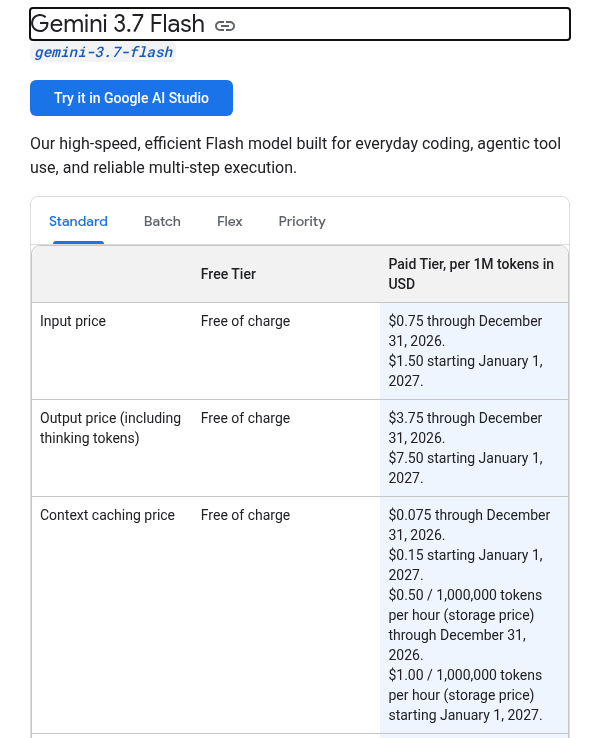
Because $0.75 and $3.75 are introductory rates with a stated end date. The pricing page lists both prices on every row, and input reads "$0.75 through December 31, 2026. $1.50 starting January 1, 2027." Google's launch post repeats it in a footnote. The model stays the same on that date. Only the price changes.
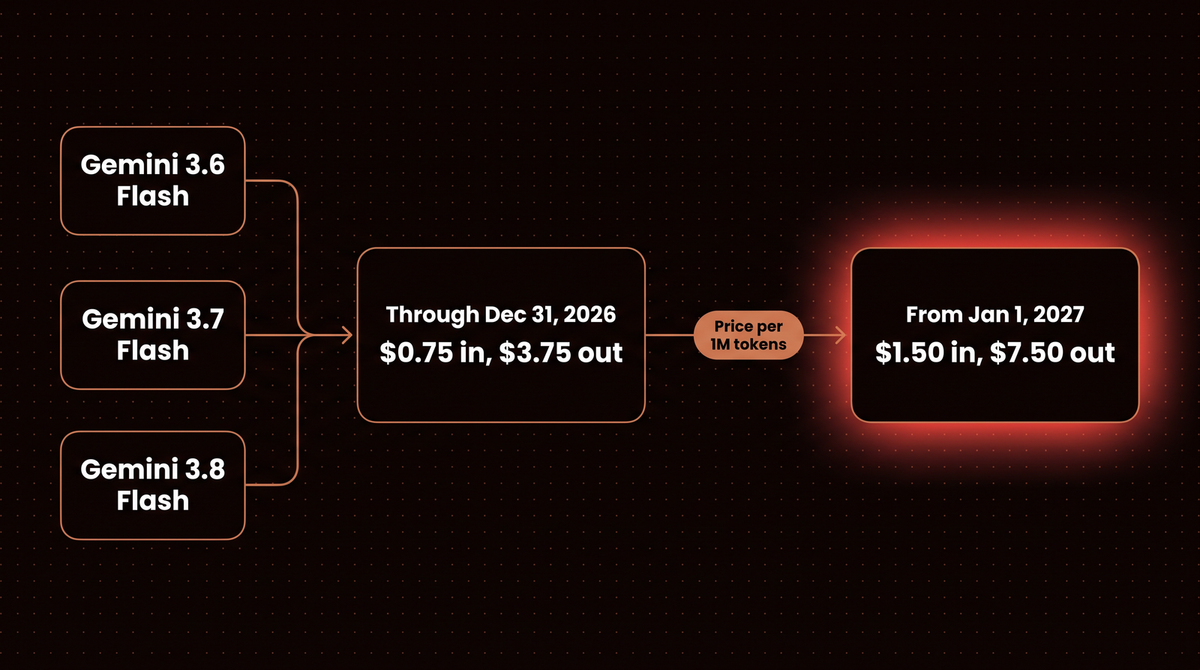
One framing point I missed in August. Google's launch post describes the introductory price as half the original 3.6 Flash cost per million tokens, and Ars says the same. So January 1 is a 50% launch discount ending. My read: that puts $1.50 and $7.50 at the original 3.6 Flash price. For budgeting that changes nothing, because the bill still doubles. It does change how I read the number: it is Google's real list price, not a surprise surcharge.
The other tiers double on the same date. The table shows the paid tier prices per million tokens as listed on the pricing page. I checked the ratios in code: on the input, output and cached input lines, Flex and Batch are exactly 50% of standard and Priority is exactly 1.8 times standard, before and after January 1. Storage for explicit caches is the same on every tier.
| Tier (3.6, 3.7 and 3.8 Flash) | Input, through Dec 31 to Jan 1 | Output, through Dec 31 to Jan 1 | Cached input, through Dec 31 to Jan 1 | Relative to standard |
|---|---|---|---|---|
| Standard | $0.75 to $1.50 | $3.75 to $7.50 | $0.075 to $0.15 | Full price |
| Flex | $0.375 to $0.75 | $1.875 to $3.75 | $0.0375 to $0.075 | 50% of standard |
| Batch | $0.375 to $0.75 | $1.875 to $3.75 | $0.0375 to $0.075 | 50% of standard |
| Priority | $1.35 to $2.70 | $6.75 to $13.50 | $0.135 to $0.27 | 1.8 times standard |
Context caching doubles with the rest: $0.075 to $0.15 per million cached input tokens, and storage for explicit caches goes from $0.50 to $1.00 per million tokens per hour. The cached input rate is 10% of the input rate in both periods.
Caching is the first thing I reach for when an agent's bill gets ugly. Long system prompt, big tool schema, a retrieved document set that barely changes between turns: cache it once, pay a fraction on every later call. The doubling still applies: every line, cached rate included, goes up by exactly 2.0 times, so a cached bill and an uncached bill both double. Caching changes the size of the bill that doubles. Implicit caching is on by default, so your real bill already carries some hit rate; read usage.total_cached_tokens in your responses and start from that number.
One line that does not double: Grounding with Google Search gives 5,000 free requests a month, shared across all Gemini 3.x models, then $14 per 1,000. Your Gemini 3.x agents share one 5,000 request allowance.
What does the increase cost a real agent workload?
It depends on your output to input ratio, because output costs five times input at these rates. The table prices three sample workloads. They are assumptions, not measurements: monthly token volumes on the standard tier, text only, where output includes thinking tokens, because Google bills thinking as output.
The formula is bill = (uncached input tokens × input rate + cached input tokens × cache rate + output tokens × output rate) ÷ 1,000,000. Cached tokens are billed at the cache rate instead of the input rate, and I model no storage fee because I assume implicit caching. The cached columns assume 80% of input tokens are cache hits, which is my assumption, not a Google figure.
| Monthly workload (assumed) | Input / output tokens | Bill today, no cache | Bill Jan 1, no cache | Extra per year, no cache | Bill Jan 1, 80% cached | Extra per year, 80% cached |
|---|---|---|---|---|---|---|
| Small: support triage agent | 20M / 4M | $30.00 | $60.00 | +$360.00 | $38.40 | +$230.40 |
| Mid: document pipeline | 200M / 40M | $300.00 | $600.00 | +$3,600.00 | $384.00 | +$2,304.00 |
| Large: coding agent fleet | 800M / 250M | $1,537.50 | $3,075.00 | +$18,450.00 | $2,211.00 | +$13,266.00 |
The support agent going from $30 to $60 is noise. I would not reforecast over thirty dollars. The coding fleet going from $1,537.50 to $3,075 is $18,450 a year that appeared on your P&L without a meeting, on a date you didn't pick. With 80% of input cached, the January bill for that fleet is $2,211, about 28% lower, and the yearly increase is $13,266 instead. For the two input heavy workloads, caching cuts the January bill by 36%. Output can't be cached, which is why the output heavy fleet saves less.
Against an uncached baseline, caching alone cannot get you back to today's bill. To bring the January bill down to today's uncached bill with caching only, input would have to be at least 6.25 times output and every input token a cache hit. These three workloads run at 5 to 1, 5 to 1 and 3.2 to 1, so none of them gets there. Other levers can, as the lever table below shows.
The middle row is easy to miss, because $300 a month is a bill few teams watch closely. I wrote about a version of this failure when the Army promised its people unlimited AI tokens and ran dry in weeks, and again when Rippling found itself heading toward 40% of R&D payroll on tokens.
Is 3.7 Flash actually better than 3.6 Flash?
On Google's own benchmarks, yes, and by more than a rounding error. The agentic and document numbers moved the most, which is consistent with a model tuned for tool loops rather than for chat. The relative changes in the last column are my arithmetic on Google's published scores.
| Benchmark (Google, August 13, 2026) | 3.6 Flash | 3.7 Flash | Change |
|---|---|---|---|
| FrontierCode 1.1 Main | 34.4 | 43.6 | +9.2 pts (+26.74% relative) |
| DeepSWE v1.1 | 49 | 65.3 | +16.3 pts (+33.27% relative) |
| WebDev Arena (Elo) | 1538 | 1588 | +50 Elo |
| GDP.pdf | 22 | 34 | +12.0 pts (+54.55% relative) |
| AutomationBench | 17 | 30.4 | +13.4 pts (+78.82% relative) |
AutomationBench measures how well a model executes common business workflows, and it went from 17 to 30.4. That's the biggest relative jump on the board. But read the absolute number, not the delta. Thirty percent. My read: a score of 30.4% on a vendor benchmark is a reason to keep a human in the loop and a rollback path on any customer facing process. For scale, Google's September 30 Argon post puts its new frontier model first on that benchmark at 51.3%, which is still about half.
Google's September 2 table puts 3.8 Flash at 73.7% on DeepSWE v1.1 against 65.3% for 3.7 (8.4 points) and 35.0% on GDP.PDF against 34.0%. Same price, more capability, but Google says 3.8 can use more tokens. If it emitted 25% more output than 3.7 on your task (my assumption, Google gives no figure), the coding fleet's January bill would go from $3,075 to $3,543.75, up 15%. Measure it on your own requests first.
What is OpenAI's Ultrafast mode, and what does it cost?
Ultrafast is a preview mode that runs GPT-5.6 Sol at up to 750 output tokens per second, which OpenAI calls 14x standard speed, according to TechCrunch on August 13. It went to a small group of customers first, and TechCrunch notes Anthropic's fast mode is not as fast. TechCrunch carried no price, and I have not found a published Ultrafast rate in the sources I checked on October 9. Taking OpenAI's best case numbers and an example 2,000 token agent step, it takes 37.3 seconds at standard speed and 2.7 at 750, so a twelve step loop saves about 6.9 minutes.
Anthropic's fast mode docs are the comparison: up to 2.5x higher output tokens per second on Claude Opus 5.5, Opus 5 and Opus 4.8 at premium pricing, listed as $8 input and $40 output per million tokens for Opus 5.5 and $10 and $50 for Opus 5. It is a research preview on the Claude API only. That is the level of detail I want before I put a speed tier in a production path. My rule after OpenAI shipped a voice engineering post with zero latency numbers is simple: a speed claim without a price is incomplete until the docs catch up.
The days you have left, and what I'd do with them
Four things are worth doing before then.
Price your current workload at the January rate today. Not the introductory rate. Pull last month's token counts, double them in a spreadsheet, and look at the number. If that number would require a conversation with someone, have the conversation now, while it's a forecast instead of an invoice. My AI agent cost calculator is one place to start.
Pin your model version and instrument the swap. Google's 3.8 post counts three Flash releases in six weeks, so whatever you pin is stale in weeks and whatever you don't pin drifts under you in production. I pin, and I keep a small eval set of real requests from the actual workload so that upgrading is an afternoon of measurement rather than a leap.
Separate the speed decision from the model decision. Flash is cheap capability for high volume loops. Fast mode and Ultrafast are latency purchases for the narrow set of paths where a human is waiting. Check that the flag is not set globally in a config file nobody rereads, or a nightly batch job quietly pays a latency premium for months.
Don't replatform for the discount. This is the one I'd argue about. A short introductory rate is not a reason to move a working agent onto a new model, because the migration cost, the eval rebuild and the prompt retuning will outlast the discount. Move for the capability gains if they map to your workload. Move for the price only if you've priced it at $1.50 and $7.50 and it still wins.
Which cost levers does Google actually document?
Four, and each has a number or a rule in Google's own docs. I priced them on the coding fleet at January rates so you can see their size.
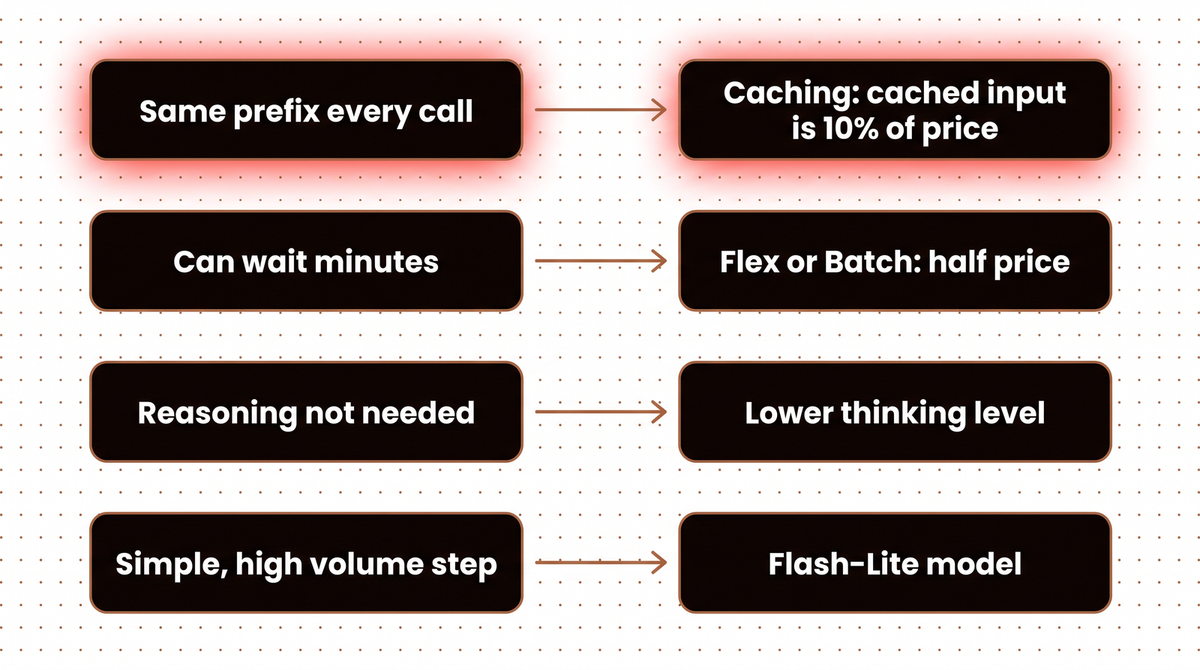
- Context caching. Implicit caching is on by default, and the minimum input for it is 4,096 tokens on 3.6, 3.7 and 3.8 Flash. Google says to put large, common content at the start of the prompt and send similar prefixes close together in time. The response reports cache hits in
usage.total_cached_tokens. - Flex and Batch. Both cost 50% of standard. Flex is synchronous with a target of one to 15 minutes, best effort and still in preview, and Google's guide positions it for evals and background agents rather than a live loop. The Batch API is asynchronous with up to 24 hours. Google's batch docs say a cache hit inside a batch is billed at the standard caching rate, while the pricing page shows a half price cached rate for Batch, so I modelled Flex, not Batch, when stacking.
- Thinking level. 3.7 and 3.8 Flash support low, medium and high, and Google's thinking guide says to lower the level to cut cost or latency instead of setting a small
max_output_tokens, because a hard cutoff truncates the answer and still bills the thinking tokens. - A cheaper model for simple steps. Gemini 3.5 Flash-Lite is $0.30 input and $2.50 output with no January change on the pricing page, and Google's release notes describe it as a low latency, cost effective option for high volume automation. Going back to 3.5 Flash does not help: it is $1.50 and $9.00, so its output costs more than 3.8 Flash does after January 1. If you still run 3.1 Flash-Lite, Google's deprecations page lists May 7, 2027 as the earliest shutdown date, with 3.5 Flash-Lite as the replacement.
| Option for the coding fleet (800M input, 250M output a month) | Bill at January 1 rates | Change against baseline |
|---|---|---|
| Baseline: standard tier, no caching | $3,075.00 | None |
| Caching: 80% of input tokens cached | $2,211.00 | minus 28.1% |
| Flex for all traffic, no caching | $1,537.50 | minus 50.0% |
| 40% of tokens on Flex, the rest standard, 80% of input cached on both | $1,768.80 | minus 42.5% |
| Caching plus a lower thinking level (output down 25%, assumed) | $1,742.25 | minus 43.3% |
| All three stacked | $1,393.80 | minus 54.7% |
| Model swap: Gemini 3.5 Flash-Lite, no caching | $865.00 | minus 71.9% |
The thinking level rows rest on my assumption that output falls 25%, and the Flex rows on my assumption that 40% of tokens can wait. Google publishes no such figure, so test your own workload. The model swap row is a price comparison only: whether Flash-Lite is good enough for your steps is an eval question, and I would not move a customer facing step without one. Priority does the opposite of all of these. It costs 1.8 times standard and fits only the paths where a user is waiting.
For the provider comparison, see how I choose between OpenAI and Claude after shipping 126 production builds and why Claude Opus 5 halving frontier pricing left most agent bills unchanged. If you are earlier than that, read custom code versus frameworks versus no code. If you would rather have the agent built, priced and monitored for you, that is the work I do: see how I build AI agents.
Frequently asked questions
When exactly does Gemini 3.7 Flash pricing increase?
January 1, 2027. The introductory rate of $0.75 per million input tokens and $3.75 per million output tokens runs through December 31, 2026. From January 1 the rates are $1.50 and $7.50. I confirmed this on Google's pricing page on October 9, 2026, and the same schedule covers 3.6 Flash and 3.8 Flash.
Does the price increase apply to context caching too?
Yes. Context caching goes from $0.075 to $0.15 per million tokens, and cache storage goes from $0.50 to $1.00 per million tokens per hour. Caching does not avoid the doubling, but a cached bill starts lower. With 80% of input cached, my coding fleet example pays $2,211 a month in January instead of $3,075.
Are thinking tokens billed at the output rate?
They are. Google's pricing page labels the row "Output price (including thinking tokens)". For reasoning heavy agents this matters more than the headline rate, because a large share of what you pay for at $3.75, soon $7.50, is never shown to the user.
Should I move from 3.7 Flash to 3.8 Flash?
The price is the same through December 31 and the same afterward. Google's table shows 3.8 ahead, for example 73.7% against 65.3% on DeepSWE v1.1, but Google also says 3.8 can use more tokens. Run your own eval set at a lower thinking level first. Google says 3.7 Flash remains fully supported, and its deprecations page lists no shutdown date.
What does Gemini 4 Argon cost?
Google's September 30 announcement gives an introductory $2 per million input tokens and $10 per million output, with cached input 95% off the input price, rising to $4 and $20 after the introductory period. It was rolling out to trusted cyber defenders first, with broader availability promised later, and it was not on the pricing page when I checked on October 9.
Last updated
October 9, 2026
Category
Trends & Insights
Jahanzaib Ahmed
AI Systems Engineer & Founder
AI Systems Engineer with 126 production systems shipped. I run AgenticMode AI (AI agents, RAG systems, voice AI) and ECOM PANDA (ecommerce agency). I build AI that works in the real world for businesses across home services, healthcare, ecommerce, SaaS, and real estate.
Want this built for your business? See The AI Audit, or browse the free tools and guides.
Related articles
Gemini and ChatGPT Both Announced a Billion Users. One of Those Numbers Is Weekly.
A breakdown of the two billion user announcements that landed days apart, why one figure is weekly and the other monthly, and what the usage data actually says about how far these assistants are from running agents.
NewsTrends & InsightsAI Agents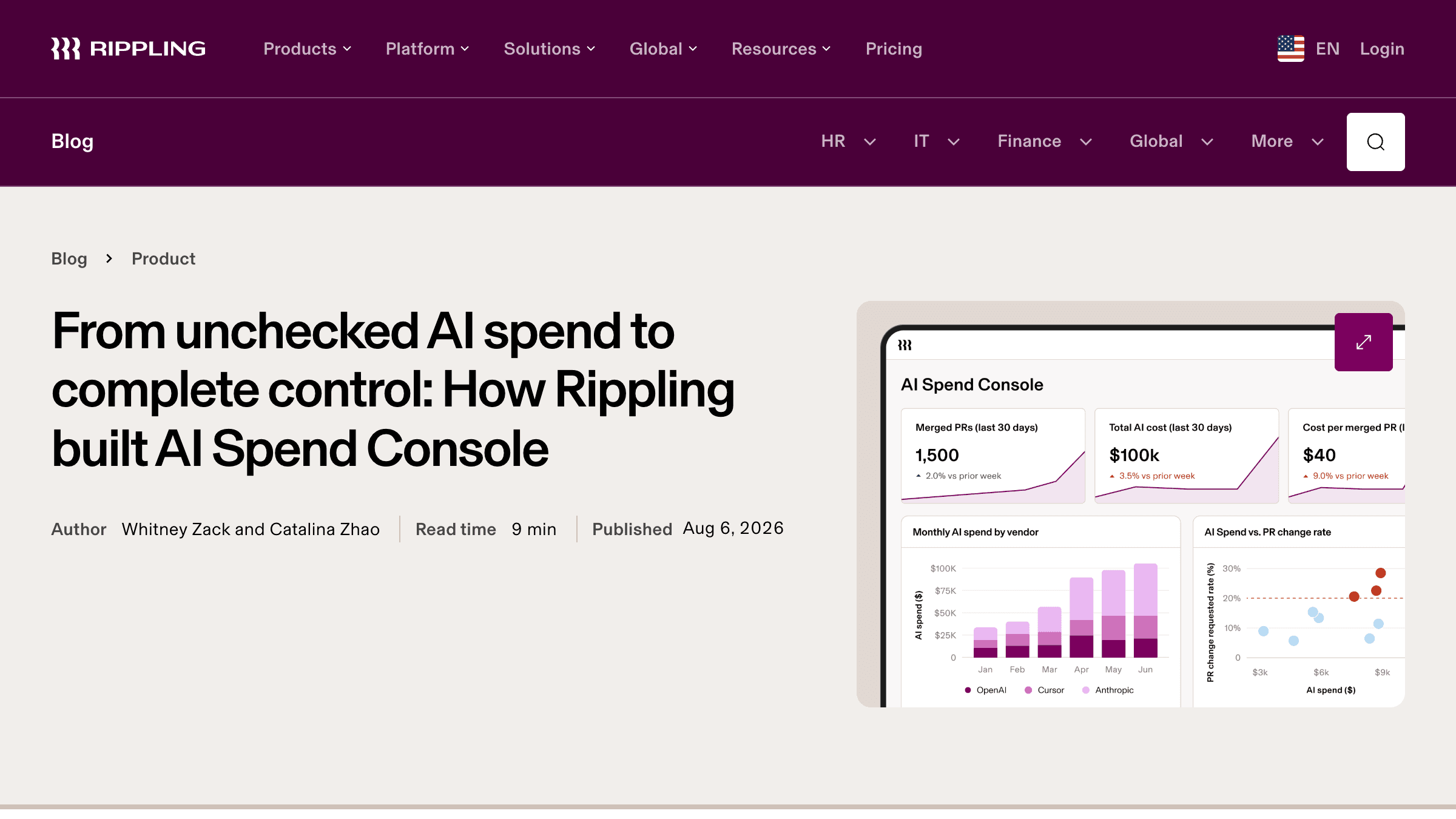
Rippling Was About to Spend 40% of Its Engineering Payroll on Tokens
A breakdown of what Rippling found when it audited its own AI token bill, why 10 to 15% of staff drove 60% of the spend, and what its per-engineer scorecard gets right and dangerously wrong.
NewsTrends & InsightsAI Costs
Claude Opus 5 Pricing Halved the Frontier. Your Agent Bill Probably Won't Move.
A breakdown of what Anthropic's Opus 5 launch really changed, why price per token is the wrong number to watch, and the two settings that move your AI bill more than any model swap.
NewsTrends & InsightsAI Agents