How to Qualify Leads by Phone With an AI Voice Agent: Call Flow, Scoring and What 600 Calls Cost
How an AI voice agent qualifies leads on the phone: the call flow, how to score callers, which platforms fit, what 600 calls a month costs, and the TCPA, recording and disclosure rules.


Table of Contents
AI voice agents for lead qualification answer a call, ask four to six questions, score the answers with rules you wrote, then book a meeting, hand the caller to a person or close politely. For 600 four minute calls a month they cost $196 to $418 on Vapi or Retell, from small models up to a Sonnet class model on Retell, based on vendor pages I read on October 17, 2026. That platform spread is about $220. One AI callback without the right consent can cost $500 under the Telephone Consumer Protection Act (TCPA), 47 USC 227(b)(3), and more if a court finds it willful, so the legal setup deserves more of your time than the vendor comparison. I ran no live calls, and none of this is legal advice.
Inbound or outbound qualification calls
I focus on inbound calls, where the lead calls you, because the legal risk is lower and because inbound is what my voice agent service covers. If you want outbound speed to lead, where an agent calls a form submission within seconds, step 6 covers the rules. For the text and email side of follow up, see AI lead follow up automation. For how the pipeline works, see the STT, LLM and TTS pipeline entry.
Step 1: Define who counts as a qualified lead
Start from your closed deals. Pull the last 20 to 30 won and lost leads and ask what you knew on the first call that predicted the outcome. Your own data will show which few facts carry the signal. Sort them into three layers: hard gates that end the conversation if false (outside your service area), scored signals that raise or lower fit (need, timeline, budget, decision maker), and routing thresholds that decide what happens next. Keep it to four to six questions, and drop any field that does not change the route.
Tip: Give every field three states: yes, no and unknown. Collapsing unknown into no turns a missing answer into a rejected lead.
Step 2: Design the call flow
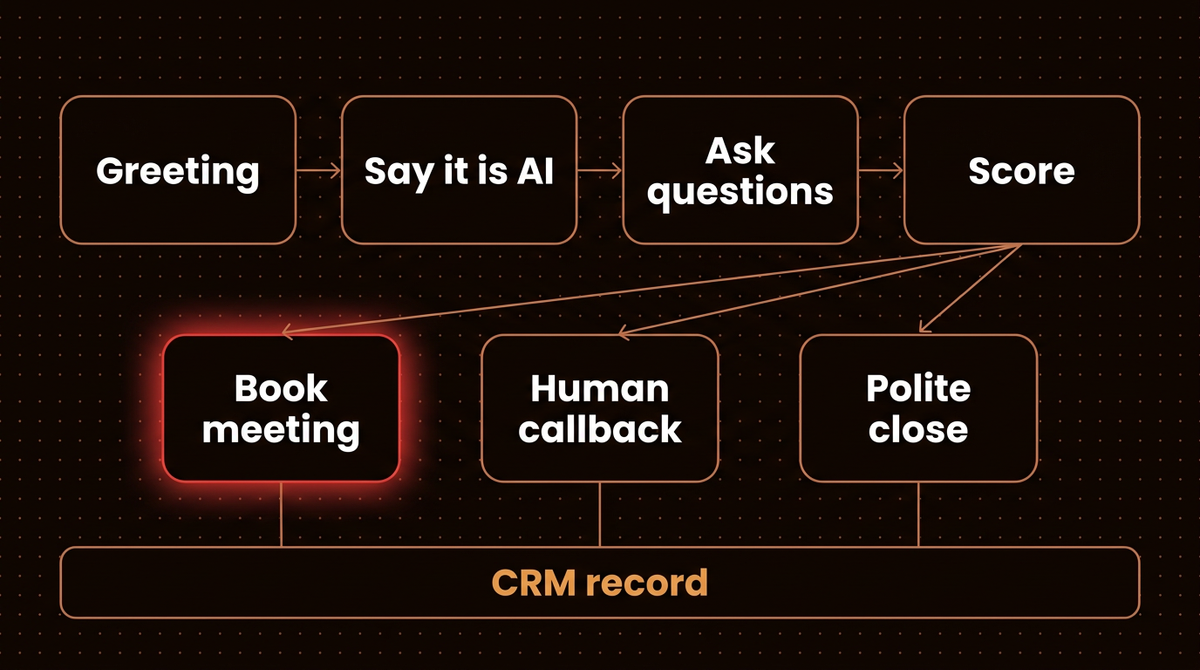
Greeting and AI disclosure
Say who is answering, say it is an AI, and say the call may be recorded, all in the first fifteen seconds. An example with a made up business name:
Thanks for calling Example Roofing. I'm an AI assistant, and this call may be recorded so the team can follow up properly. What can I help with?
One sentence covers identity, AI disclosure and the recording notice. Disclose on every call. It costs a sentence, and the Federal Communications Commission (FCC) has proposed requiring it for AI generated calls, as step 6 explains.
Qualifying questions
Ask one question at a time and let the caller answer in their own words. Put the questions that can end the call first: service area and need, then timeline, budget and who decides. Turn each answer into a typed field. Retell's post call extraction offers boolean, text, number and selector fields, which map onto qualification: a yes or no for in area, a number for budget, a selector for timeline. Have the agent read back every phone number and email to catch transcription errors.
Scoring
Do not ask the language model to invent a score. Have it extract the fields, then compute the score in code or a rules step where the weights are written down.
I wrote a small rubric for this post and ran it on four made up callers. The weights and thresholds are placeholders, and unknown fields add no points:
WEIGHTS = {"need_matches_service": 30, "timeline_within_30_days": 25,
           "budget_in_range": 20, "decision_maker": 15,
           "contact_details_confirmed": 10}

def route(caller):
    if caller.get("in_service_area") is False:       # hard gate
        return {"score": 0, "route": "polite_close"}
    if caller.get("asked_for_human"):                # override, unscored
        return {"score": None, "route": "human_now"}
    score = sum(w for k, w in WEIGHTS.items() if caller.get(k) is True)
    if score >= 70: return {"score": score, "route": "book_meeting"}
    if score >= 40: return {"score": score, "route": "human_callback"}
    return {"score": score, "route": "polite_close"}
Output for the four callers:
A: clear need, soon, in budget          {"score": 100, "route": "book_meeting"}
B: good fit, vague timeline, no budget  {"score": 55, "route": "human_callback"}
C: out of area                          {"score": 0, "route": "polite_close"}
D: asked for a person                   {"score": null, "route": "human_now"}
Caller B shows why unknown matters: a good fit with no stated timeline or budget scores 55, lands in the callback band and goes to a person, not the bin.
Calendar booking
Booking is a tool call: check availability, offer two slots, confirm one, write the event. Lookups leave silence on the line, so have the agent say it is checking. And writes can time out. Vapi's documentation states that its API Request tool does not retry after a timeout or a non 2xx response, that the default timeout is 20 seconds, and that a timed out request may still have been processed by your server. If your booking endpoint accepts an idempotency key, a unique token that lets the server ignore a repeat of the same request, use it so a retry cannot create a second appointment. More in what breaks when AI writes to your calendar.
CRM handoff
Write the record in your customer relationship management (CRM) system after the call, from the transcript and the extracted fields, not in the middle of the conversation. Mid call writes add latency and can duplicate on retries. Retell fires a call_ended webhook, an HTTP callback to your server, and then a call_analyzed webhook once extraction finishes, so one handler can create or update the contact. Match on phone number, store the score, route, reason and recording link, and write a record for every outcome.
Escalation to a human
Decide the triggers before launch: the caller asks for a person, the caller is angry, the agent misunderstands the same answer twice, an emergency is described, or the score lands in the callback band. A warm transfer keeps the agent on the line to brief the person first, and a cold transfer hands the call over at once. If nobody answers, take a message and promise a time. See the escalation path entry.
Step 3: Pick a platform
I read each vendor's own pricing and documentation pages on October 17, 2026. Prices move. Concurrent calls are the number of simultaneous calls a plan allows.
| Platform | How it bills | Published price | Tools listed | Concurrent calls listed |
|---|---|---|---|---|
| Retell | Per component: platform, model, voice and phone line billed separately | $0.07 to $0.31 per minute, pay as you go | Cal.com, HubSpot, Salesforce, cold and warm transfer | 20 included |
| Vapi | Hosting plus model, voice and transcriber at cost | $0.05 per minute hosting; HIPAA add on $2,000 a month | Transfer call, Google Calendar, GoHighLevel | 4 on the usage only package |
| Bland | Flat rate, model, transcription and voice included | $0.14 per minute on Start; $0.12 plus $299 a month on Build | Appointment scheduling, warm and live transfers listed | 10 on Start, 50 on Build |
| Synthflow | Enterprise contract scoped to volume | From $30,000 a year; no self serve price on the page I fetched | HubSpot, Salesforce, Cal.com integrations listed | Scoped in contract |
| ElevenAgents (ElevenLabs) | Plan buys included minutes; model billed separately | Plans $6 to $990 a month; extra minutes $0.08 | Not verified in this run | 4 on free, 20 on Pro |
For a head to head on the two developer favorites, read my Retell AI vs Vapi comparison. Without an engineer, pick the platform with built in calendar and CRM tools. With one, pick the platform that lets you change models. If you need recordings as evidence of what a caller was told, check retention first: Vapi's usage only package lists 14 days of raw data.
Step 4: Calculate the total monthly cost
- Estimate minutes. Calls per month times average minutes, including transfers and voicemail.
- Sum the per minute components. Platform, model, voice, speech to text and telephony. A flat rate vendor folds some into one line.
- Add fixed fees. Plan fees, phone numbers and extra concurrent lines (Vapi lists $10 a month per extra line).
- Add extras you will use. Retell lists a knowledge base at $0.005 per minute, PII removal at $0.01 and safety guardrails at $0.005. Vapi lists HIPAA handling at $2,000 a month.
- Divide by qualified leads. Per minute prices only compare once you divide by qualified leads.
I ran one assumed workload through a script: 600 calls a month at four minutes, which is 2,400 minutes. That workload is my assumption. The inputs, per minute, come from the Vapi and Retell pricing pages linked above, including Vapi's calculator. Vapi: hosting $0.05, Deepgram transcription $0.0095 to $0.0099, OpenAI model $0.0077 to $0.0452, ElevenLabs voice $0.0146 to $0.0238, Twilio inbound $0.008. Retell: voice infrastructure $0.055, voice $0.015 to $0.040, model $0.008 (GPT 5 mini) to $0.064 (Claude 5.5 Sonnet, as Retell spells them), Twilio line $0.015.
| Option | Per minute | Monthly at 2,400 minutes | Left out |
|---|---|---|---|
| Vapi, Vapi number | $0.082 to $0.129 | $196 to $309 | Optional extras |
| Vapi, Twilio inbound | $0.090 to $0.137 | $216 to $329 | Optional extras |
| Retell, Twilio line | $0.093 to $0.174 | $223 to $418 | Optional extras |
| Bland Start | $0.14 | $336 | Phone line, transfers at $0.05 a minute |
| Bland Build | $0.12 plus $299 a month | $587 | Phone line, transfers at $0.04 a minute |
| ElevenAgents, paid plan | $0.08 per extra minute | About $192 | Model charges and the carrier |
The last three rows leave out line items, so they are not like for like with the first three, and ElevenAgents looks cheapest here only because its model and carrier are missing. Within Retell alone, the model and voice choice moves the bill by about $195 a month at this volume.
Now divide. A call costs $0.33 to $0.70 on Vapi and Retell. If one call in four qualifies, a placeholder you must replace with your own rate, that is $1.31 to $2.78 per qualified lead. For your own volumes, use the voice agent cost calculator, and for the human receptionist comparison read my AI voice agent pricing breakdown.
Flat rate versus per component pricing
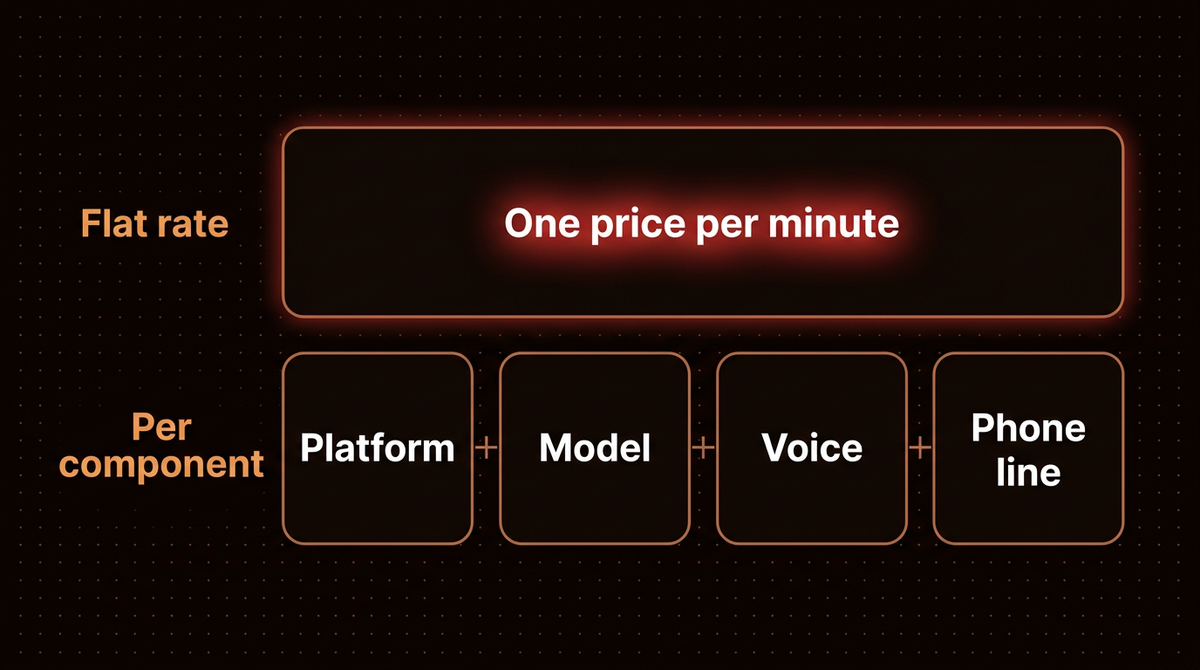
Per component pricing bills each line separately, so a cheaper model shows up on the bill. Flat rate pricing quotes one figure that is easier to forecast. Bland describes its rate as covering the model, transcription and voice, and argues on its pricing page that rivals' headline rates cover the platform layer only. That is Bland's claim about competitors.
At 2,400 minutes Bland Start costs $336 against $196 to $309 on Vapi with its own number, though Bland's figure leaves out the phone line. Build's $0.02 lower rate pays back its $299 fee only above 14,950 minutes a month, about 3,740 calls of four minutes. I would pay for flat rate only if nobody will ever touch the model. Read the concurrency limits before the price, because they decide what happens when an ad lands twenty callers at once, and Bland Start also caps calls at 100 a day and 100 an hour. One more oddity: Bland's billing docs still list a Scale plan at $499 and $0.11 a minute, while its pricing page shows only Start, Build and Enterprise.
On ElevenAgents, the plan fee buys included minutes at the same $0.08 rate as extra minutes, so at 2,400 minutes the Starter, Creator and Pro plans all land within a few cents of $192. The higher plans buy concurrency.
Step 5: Test latency and quality before launch
Vapi's guide to voice to voice latency makes two points that change how I plan. The latency shown in the dashboard is a sum of medians that leaves out endpointing, meaning detecting that the caller has finished speaking, and transport. And the model's time to first token is often the largest component, with more capable models usually slower. The full chain is transport, endpointing, transcription, first token and speech synthesis. See also the latency budget entry.
For qualification I would put a fast model on the conversation and keep scoring in code. Then test these before launch, along with the contact detail read backs and slow tool calls covered earlier:
- Promises the business did not make. The agent must not quote prices or promise arrival times unless your knowledge base says so. Retell and Vapi both list call simulation, so write hostile test calls first.
- Voicemail, if you add outbound callbacks. Retell's extraction includes an
in_voicemailfield, so an attempt that reaches a machine is not counted as a conversation.
After launch, listen to a sample of calls every week for the first month and adjust the weights where a person would have decided differently.
Step 6: Check the rules before any call goes out
Warning: This section summarizes primary sources I read on October 17, 2026. It is not legal advice. Laws differ by state and country and change often, and I did not survey state laws, so have a lawyer who handles telemarketing review your setup.
The TCPA is the federal telemarketing law. In a declaratory ruling adopted on February 2, 2024 and released on February 8, 2024, the FCC confirmed that the rules on an artificial or prerecorded voice cover AI technologies that generate human voices. A call that uses one needs the called party's prior express consent, absent an emergency purpose or an exemption, and a call that introduces an advertisement or is telemarketing needs prior express written consent. In paragraph 5, the ruling cites a 2023 Ninth Circuit decision, Trim v. Reward Zone USA, which had already described an artificial voice as including sound resembling a human voice that is originated by artificial intelligence.
| Situation | What applies | Source |
|---|---|---|
| The lead calls you | The ruling addresses AI that initiates calls and is silent on inbound ones, so a caller who dials you is not receiving an AI robocall. A callback you place afterward is outbound, and texts have their own rules. | FCC 24-17, paragraph 9 |
| You call a lead back with an AI voice | Prior express consent is required, and written consent if the call is telemarketing. Written consent needs a signature, which can be electronic, and a statement that signing is not a condition of buying. For telemarketing, a web form counts only if its wording covers calls with an AI voice. | 47 CFR 64.1200(f)(9) |
| What the artificial voice must say | Name the business at the start and give a callback number during or after. Telemarketing messages need an automated opt out. | 47 CFR 64.1200(b) |
| When you may call | Telephone solicitations to residential lines are barred before 8 a.m. and after 9 p.m. at the called party's location. Numbers on the national do not call registry are protected unless, for example, the subscriber gave signed written permission. | 47 CFR 64.1200(c)(1) and (c)(2) |
| A caller says stop | Today, any reasonable method of revoking consent counts, and the request must be honored within ten business days. That row is about to change. | 47 CFR 64.1200(a)(10) |
Two rule changes are in motion. On September 30, 2026 the FCC adopted FCC 26-67, which lets a caller designate one exclusive way for consumers to revoke consent, such as an automated opt out, a standard reply word or a stated website or number. It takes effect 30 days after Federal Register publication, which had not happened when I checked on October 17. Separately, the FCC proposed in August 2024 to require an AI disclosure at the start of each AI generated call and in consent forms (FCC 24-84). As of October 17, 2026, I could not find an adopted final rule. Check the FCC docket, number 23-362, before relying on that.
Call recording is a separate question. Federal law lets a party to a call record it, or lets it be recorded with one party's consent, under Title 18, section 2511(2)(d). California is stricter: Penal Code section 632 penalizes recording a confidential communication without the consent of all parties, with fines up to $2,500 per violation. Other states have all party rules too. You usually cannot tell where an inbound caller is standing, so design to the strictest rule and tell every caller at the start that the call may be recorded.
Where my inbound voice agent fits
The inbound voice agent page describes what I build: an agent that answers, qualifies the caller and books your calendar in about three weeks, with a transfer to a person or a message when it is unsure. For the same flow in a trade business, read AI voice agents for home services.
Frequently asked questions
What is lead qualification with an AI voice agent?
The agent asks a short, fixed set of questions on a phone call, such as need, timeline, budget and who decides. It stores each answer as a typed field, scores the fields with rules a person wrote, and routes the lead to a booking, a callback or a polite close. Every outcome gets a CRM record.
How much does an AI voice agent for lead qualification cost per month?
Multiply minutes by the per minute components, add fixed fees, then divide by qualified leads. In my 2,400 minute example, at one qualified call in four, that came to $1.31 to $2.78 per qualified lead on Vapi and Retell. Replace the one in four with your own rate before you trust the figure.
Do I need consent before an AI voice agent calls a lead?
The FCC ruled in February 2024 that AI generated voices are artificial voices under the TCPA, so an outbound call needs prior express consent unless an exemption applies, and telemarketing needs written consent. A caller who dials you is a different case, but any callback you place is outbound. Ask a lawyer before you launch outbound calling.
Do I have to tell callers they are talking to an AI?
Federal rules do not clearly require it for every call today, but the FCC has proposed requiring it at the start of AI generated calls, and some states have their own rules. Disclosing in the greeting is cheap and avoids the argument.
Is flat rate or per component voice pricing cheaper?
Flat rate wins on predictability, and per component wins when you tune models and have volume. In my example Bland Start came to $336 against $196 to $329 on Vapi, but Bland's figure leaves out the phone line, so the rows are not like for like.
Published
October 16, 2026
Category
Voice AI
Jahanzaib Ahmed
AI Systems Engineer & Founder
AI Systems Engineer with 126 production systems shipped. I run AgenticMode AI (AI agents, RAG systems, voice AI) and ECOM PANDA (ecommerce agency). I build AI that works in the real world for businesses across home services, healthcare, ecommerce, SaaS, and real estate.
Want this built for your business? See Inbound Voice Agent, or browse the free tools and guides.
Related articles
Retell AI vs VAPI: Which Voice Agent Platform Should You Actually Build On?
I have deployed voice agents on both Retell AI and VAPI. The honest breakdown, checked in October 2026: pricing, HIPAA and SOC 2 details, contact center costs, and a clear decision framework.
ComparisonVoice AIVoice AI
Eleven v4 Turbo Is Not a Drop In Swap for Your Voice Agent
ElevenLabs launched Eleven v4 and v4 Turbo with 150ms time to first speech and 90 languages. For voice agents, Turbo also means a new WebSocket, a per plan session cap and a discount that ends October 12.
NewsVoice AIElevenlabs
Virtual Receptionist Appointment Booking: What Actually Breaks When AI Writes to Your Calendar
A practical guide to virtual receptionist appointment booking, with the four failure modes that break calendar write backs, verified platform pricing, and a decision gate from 40 voice deployments.
GuideVoice AIVoice AI