ChatGPT for Business vs Custom AI Agents: What 126 Deployments Taught Me About the Real Choice
Should you use ChatGPT Business at $20 to $25 per user a month or build a custom AI agent? October 2026 seat prices, workspace agent credits and cost math, from 126 deployments.

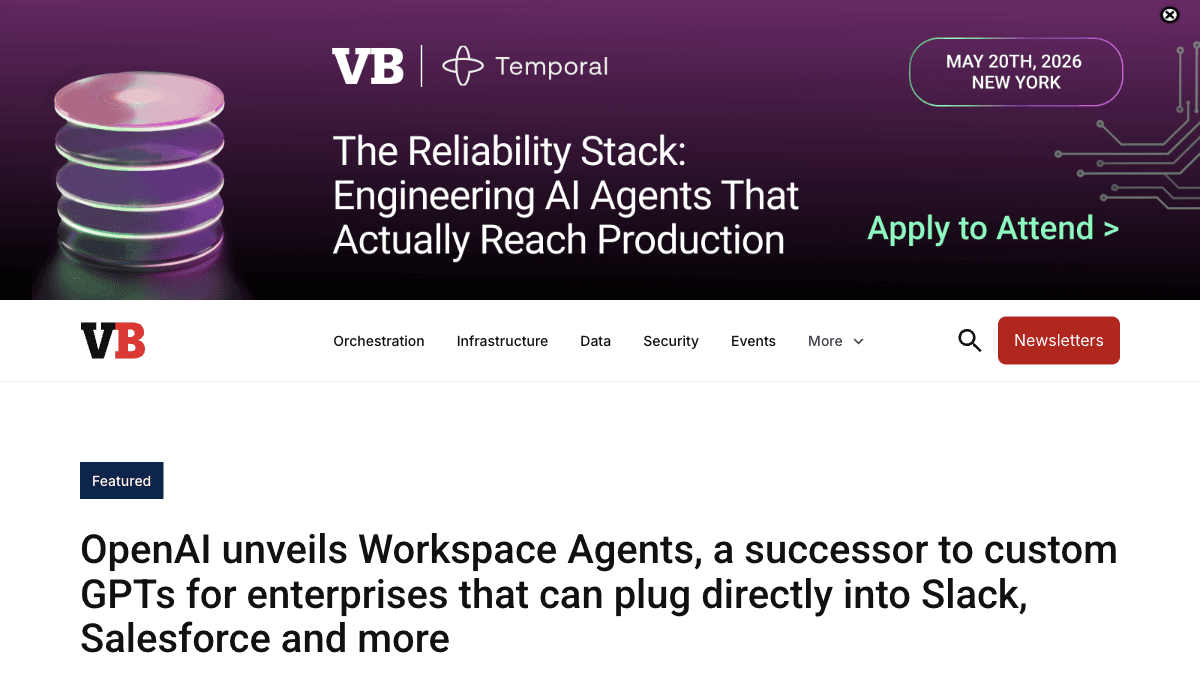
Table of Contents
OpenAI launched Workspace Agents on April 22, 2026. That announcement blurred a line that used to be clear, and now I'm fielding the same question from every business owner I talk to: "Should we just use ChatGPT for business, or do we need a custom AI agent built for our workflows?"
I've deployed AI systems for 126 businesses. Some of those got ChatGPT Business accounts and thrived. Others needed custom agents that took months to build and are now running autonomously across their entire operation. I've seen both approaches succeed, and I've seen both approaches fail. The difference has nothing to do with the tools themselves and everything to do with fit.
This is the comparison I wish existed when I was starting out. Prices, plan names and limits below were checked against OpenAI's and Hostinger's own pages on October 11, 2026.
Quick Verdict: ChatGPT for Business vs Custom AI Agents
- Pick ChatGPT Business ($20/user/month billed annually, $25/user/month billed monthly) if your team needs general AI assistance, document Q&A, meeting summaries, email drafts, and basic workflow support. You have fewer than 50 employees, your use cases are common, and you want results this week.
- Go with a custom AI agent ($25K to $120K to build) if you have proprietary workflows that no off-the-shelf tool supports, operate in a regulated industry (healthcare, legal, finance), or are automating a process that handles $500K or more in annual revenue.
- Still unsure? Take our free AI Readiness Assessment and get a scored report in under 10 minutes.
What We're Actually Comparing
Before we go deep, let's be clear about scope, because "ChatGPT for business" means different things depending on who you ask.
On the ChatGPT side, I'm comparing two products:
- ChatGPT Business ($20/user/month on annual billing or $25/user/month on monthly billing for a Standard seat; a Premium seat with 5x the usage and no 5 hour limit is $100 annual or $125 monthly; minimum 2 seats): OpenAI's team collaboration tier, renamed from ChatGPT Team on August 29, 2025. Includes dedicated workspace, admin controls, SAML SSO, MFA, no training on your business data by default, and Workspace Agents.
- ChatGPT Enterprise (custom pricing, contact sales): adds SCIM, enterprise key management, role based access controls, IP allowlisting, data residency in ten regions, a Compliance API, and 24/7 priority support with SLAs. OpenAI publishes no per seat Enterprise price.
On the custom agent side, I'm talking about purpose-built AI systems designed around your specific workflows, integrated into your existing software stack, and deployed on infrastructure you control.
These are fundamentally different things. One is a platform you configure. The other is software you commission. And the right answer depends entirely on what problem you're solving.
The difference between ChatGPT and a specialized AI agent for a business, in one sentence: ChatGPT Business is a general AI workspace that each person on the team drives, while a specialized agent is software built around one business process that runs that process without anyone starting it.
ChatGPT for Business: What You Actually Get
Let's start with what changed on April 22. OpenAI launched Workspace Agents as a research preview across all Business, Enterprise, Edu, and Teachers plans. These are persistent, shared AI agents powered by Codex that run in the cloud, keep working when nobody is logged in, and can run on a schedule or be deployed in Slack. OpenAI says they gather context and take action across dozens of tools, and you can require an approval before sensitive steps like sending an email or editing a spreadsheet.
This matters because it pushes ChatGPT Business significantly closer to what custom agents used to do exclusively. OpenAI calls workspace agents an evolution of GPTs. Its April announcement said GPTs would remain available while teams test workspace agents. Since then OpenAI's help center has scheduled custom GPTs to retire on December 11, 2026 (February 11, 2027 for Enterprise workspaces with an approved deferral), and it points teams to migrate them to plugins. Existing GPTs keep working until then, and the original becomes read only after migration. OpenAI's own pages also disagree on status: the announcement page headline calls workspace agents generally available, while its body still says research preview.
Pricing note: Workspace Agents were free until May 6, 2026. OpenAI's rate card now prices them by tokens in credits (GPT-5.6: 100 credits per million input tokens, 10 per million cached input tokens, 500 per million output tokens) and says a typical end to end run may use 5 to 25 credits. Workspace agents, ChatGPT Work, Excel, PowerPoint, Word and Codex draw on a shared allowance and credit pool, and a workspace owner can buy extra credits in billing settings. A ChatGPT Business subscription does not include API usage, which is billed separately.
What ChatGPT Business does well:
- General AI assistance for knowledge workers: research, summarization, content creation, code review
- Document Q&A against uploaded files and connected data sources
- Meeting summaries and async communication
- Basic multi-step workflows via Workspace Agents across popular SaaS tools
- Fast deployment: most teams are up and running in under a day
- Data privacy: OpenAI says it does not train its models on your business data by default
Where it breaks down:
- Workspace agent runs draw on a shared allowance and credit pool, so heavy production use means buying credits and watching spend. A run is typically 5 to 25 credits on GPT-5.6, which makes the cost per run variable
- You cannot build multi-agent orchestration systems, coordinate specialized agent fleets, or handle complex branching decision logic
- Any workflow that requires connecting to proprietary internal systems, legacy databases, or tools not on OpenAI's integration list requires workarounds. OpenAI lists apps that connect to internal tools and a beta developer mode on Business, so this is no longer a flat no, but the connector work still falls on you
- Compliance teams in healthcare, legal, or financial services will need Enterprise tier at minimum, and often still need custom builds for audit requirements. OpenAI's HIPAA eligible list names ChatGPT for Enterprise with Regulated Workspace, not ChatGPT Business, and it points BAA requests to a contracted offering
- You're entirely dependent on OpenAI's infrastructure, pricing decisions, and feature roadmap
ChatGPT Business vs Custom GPTs vs Workspace Agents
Searches for "ChatGPT for business custom GPTs comparison" mix three different things. A custom GPT is a shared, preconfigured version of ChatGPT that a person chats with, and Standard seats include GPTs for now, alongside Projects, apps, company knowledge, ChatGPT Agent and deep research, but OpenAI has scheduled GPTs to retire on December 11, 2026. Members can build and share GPTs inside the workspace, and OpenAI applies its business data commitments to them. A workspace agent goes a step further and does work on its own. A custom AI agent is the engineered version, built around your systems. Here is how they differ as of October 2026.
| Option | What it is | Runs without a person | Who builds it | Cost |
|---|---|---|---|---|
| Custom GPT | A shared, preconfigured ChatGPT you chat with | No, a person starts every chat | A team member in ChatGPT | Included in the seat until GPTs retire on December 11, 2026 |
| Workspace agent | A shared Codex powered agent that uses connected apps and keeps working in the cloud | Yes, on a schedule or in Slack, with optional approval steps | A team member in ChatGPT | Seat allowance, then credits (5 to 25 credits per typical run) |
| Custom AI agent | Software built for one process and your systems | Yes, with your own retries, logging and escalation | An engineer | $25K to $120K to build, plus LLM and hosting costs |
ChatGPT Business Plans and Seat Prices (October 2026)
| Plan | Price per user per month | Seats | What it adds |
|---|---|---|---|
| Business, Standard seat | $20 annual billing, $25 monthly billing | Minimum 2 seats in total | ChatGPT, ChatGPT Work and Codex, plus GPTs (retiring December 11, 2026), Projects, apps, company knowledge, deep research and workspace agents |
| Business, Premium seat | $100 annual billing, $125 monthly billing | Mix with Standard seats | 5x the usage of a Standard seat and no 5 hour usage limit |
| Enterprise | Custom, contact sales | Sales led contract | SCIM, key management, role based access controls, IP allowlisting, data residency in ten regions, Compliance API, 24/7 priority support |
Business is aimed at teams of 2 to 200 employees. Edu and Teachers plans also exist and are outside this comparison. Business admins control how long data is retained, and deleted conversations leave OpenAI's systems within 30 days unless the law requires otherwise or retention is needed to prevent harm.
Custom AI Agents: The Full Story
A custom AI agent is purpose-built software. It's not a product you subscribe to and not a configuration exercise. It's a system designed from scratch (or assembled from components) to handle your specific workflow, speak your domain language, integrate with your exact stack, and operate within your compliance boundaries.
I've built these using LangGraph, CrewAI, n8n, Flowise, and raw API integrations. The architecture varies enormously depending on the use case. A customer support agent for a healthcare clinic looks nothing like a lead qualification agent for a commercial real estate firm.
What custom AI agents can do that ChatGPT Business cannot:
- Connect to any internal system, including legacy databases, proprietary APIs, and custom data formats
- Handle multi-agent orchestration: coordinator agents that delegate to specialist agents, each optimized for a specific task
- Maintain persistent memory across sessions, building context over months of customer interactions
- Enforce custom compliance rules, audit trails, and data handling policies specific to your regulatory environment
- Run complex branching decision logic with fallback handling, retry strategies, and escalation paths
- Operate across voice, chat, email, and SMS channels simultaneously from a single agent system
What custom agents actually cost:
ProductCrafters' 2026 guide puts custom AI agent development at anywhere from $5,000 for a basic build to $180,000 or more, and says most mid sized companies spend $15,000 to $100,000 to implement AI agents, and that hosting, monitoring and optimization then add $2,000 to $10,000 a month. The $25,000 to $120,000 range I use in this post sits inside that spread. That's the upfront build cost, and you also pay LLM API tokens, cloud infrastructure and model maintenance on top. My guide to AI agent development services breaks down the cost ranges and what drives them, and you can price a specific build with the AI agent cost calculator.
The ROI case is strong when the scope is right, and it comes down to simple division: payback in months is the build cost divided by the net monthly saving after running costs. A $30,000 build that saves $7,500 a month pays back in 4 months. The same build saving $3,000 a month takes 10 months, and a $120,000 build saving $10,000 a month takes 12. That is why volume matters more than the headline price, and why a high volume, repetitive workflow like customer support routing tends to pay back sooner.
Head-to-Head: ChatGPT Business vs Custom AI Agents
| Factor | ChatGPT Business | Custom AI Agent |
|---|---|---|
| Upfront cost | $20 to $25/user/month for a Standard seat | $25K to $120K build |
| Time to deploy | Hours to days | 4 to 16 weeks |
| Integrations | Connectors to Google Workspace, Slack, GitHub, Microsoft 365 and more, plus apps for internal tools | Any system you can API into |
| Usage allowance | Included allowance per seat, then workspace credits you buy | No seat cap, you pay LLM token costs |
| Data control | OpenAI's servers (no training on your business data by default) | Your infrastructure, your rules |
| Compliance | Not on OpenAI's HIPAA eligible list; BAAs come with contracted offerings such as Enterprise with Regulated Workspace | Fully customizable audit trail |
| Multi-agent orchestration | Limited, via Workspace Agents | Full orchestration (LangGraph, CrewAI) |
| Proprietary workflows | Limited to what connectors and agents can reach | Yes, by design |
| Ongoing cost | Per seat subscription plus credits for heavy agent use | LLM API tokens + infrastructure |
| Vendor dependency | High (OpenAI roadmap controls features) | Low (you own the architecture) |
| Best for | General knowledge work, standard workflows | Proprietary processes, regulated industries |
ChatGPT Business vs Hostinger AI Agents
When people search "ChatGPT vs Hostinger AI agents", they are usually asking a cost question: a workspace AI that every employee uses, against a low priced assistant bundled with a web host. Hostinger Agent launched on September 2, 2026 and replaced Kodee across Hostinger's customer touchpoints. It also replaced the earlier Hostinger Agents bundle of seven named agents, and Hostinger's own note says the old $6.99 a month bundle no longer describes the product.
Hostinger describes Agent as a team of specialist agents for strategy, writing, SEO, marketing, legal documents, customer communications and sales. It offers 150+ ready to use skills, connects to 1,000+ apps, runs recurring tasks on a schedule, and works from WhatsApp. Support requests cost no credits, while business requests are charged in credits by complexity. For the trial, Hostinger's product page says 7 days with 100 credits and its support article says 20 credits, and I could not reconcile the two. The product page I read lists no team seats, SSO or admin controls, so it is priced and designed more like an assistant for a business owner than a workspace for a team.
| Factor | ChatGPT Business | Hostinger Agent |
|---|---|---|
| Price | $20 annual billing or $25 monthly billing per Standard seat; $100 or $125 per Premium seat | $9.99 a month on a 1 month term (renews at $8.99), $7.99 on 3 months, $6.99 on 12 months (one price, no seat price listed) |
| Included usage | Allowance per seat, extra credits on purchase | 1,000 credits a month |
| Built for | A team workspace: chat, files, ChatGPT Work, Codex, workspace agents | Business tasks such as SEO, content, marketing, legal documents and sales, plus WhatsApp |
| Admin and security | SAML SSO, MFA, admin console, usage analytics, no training on business data by default | None listed on the product page |
| Your own systems | Connectors, apps for internal tools, workspace agents | Skills and connections to 1,000+ apps |
On cost, a task assistant like Hostinger Agent and a full workspace AI are not close, and they are also not substitutes. A 10 person team on Standard seats pays $200 a month on annual billing ($250 monthly), which is $2,400 over 12 months. The same team on Premium seats pays $1,000 a month, or $12,000 over 12 months. One Hostinger Agent plan costs $6.99 to $9.99 a month, 28.6 times less than those 10 Standard seats on annual billing at the $6.99 price, and 20 times less at $9.99. The cheap option helps one owner write posts and plan campaigns. The workspace option gives ten people shared files, connectors and agents. Pick on the job, not the price gap.
ChatGPT Business vs Automation Platforms (n8n, Zapier, Make)
ChatGPT Business gives each person an AI to work with. n8n, Zapier and Make run a fixed sequence of steps every time a trigger fires and call an LLM only where you put one. So "ChatGPT business operations vs automation platforms" is really a question about whether the work needs judgment from a person or the same path every time. The platforms bill by volume, so the right comparison is the monthly price at your volume.
The table prices one workflow with a trigger and 4 action steps. n8n counts one execution per run, Zapier counts successful action steps but not triggers (4 tasks per run), and Make counts one credit per module (5 credits per run). LLM token fees are extra on all three. Prices are USD, read from each vendor's pricing page on October 10, 2026.
| Runs a month | Platform | Plan and tier | Annual billing | Monthly billing |
|---|---|---|---|---|
| 1,000 | n8n Cloud | Starter, 2,500 executions | $20 | $24 |
| 1,000 | Zapier | Professional, 5,000 tasks | $89 | $133.50 |
| 1,000 | Make | Core, 10,000 credits | $9 | $10.59 |
| 10,000 | n8n Cloud | Pro, 10,000 executions | $50 | $60 |
| 10,000 | Zapier | Professional, 50,000 tasks | $289 | $433.50 |
| 10,000 | Make | Core, 80,000 credits | $55 | $64.71 |
ChatGPT Business has no per run price for the same job. A workspace agent run is typically 5 to 25 credits on GPT-5.6, so 10,000 runs would be 50,000 to 250,000 credits drawn from the seat allowance and your credit pool. That is why I send fixed, high volume processes to an automation platform or a custom agent and keep ChatGPT Business for work that needs a person in the loop. n8n also offers a free self hosted Community Edition, and n8n shows euro prices to visitors in some countries, so check the USD view. You can rerun these numbers at your own volume in my n8n vs Zapier vs Make cost calculator, and my Zapier Agents vs n8n comparison covers where each one fits.
The Decision Framework: Six Questions That Tell You Which Way to Go
After 126 deployments, these are the questions I ask every client before recommending either path.
- Does your use case exist in ChatGPT's integration list? If yes, start there. If you need to connect to a proprietary ERP, a legacy system, or a custom database, you need a custom build.
- Will your agents burn through the included allowance? Workspace agents draw on a shared allowance and credit pool, and a typical run is 5 to 25 credits on GPT-5.6. A team of 10 running agents all day will end up buying credits or moving to Enterprise, at which point the cost comparison shifts.
- Are you in a regulated industry? Healthcare, legal, and financial services teams typically need audit trails, specific data residency, and compliance controls that go beyond what ChatGPT Enterprise provides. Custom is usually the only viable path.
- Is this workflow unique to your business? If it's something generic (meeting summaries, email drafts, research), ChatGPT does it well. If it's a proprietary pricing model, a custom intake process, or a specialized qualification workflow, you're building.
- What's the annual revenue impact? If the process you're automating touches less than $100K in annual operations, ChatGPT Business ROI is clear. Above $500K, a custom system's efficiency gains typically justify the build cost many times over.
- How much do you want to own the infrastructure? ChatGPT Business means OpenAI controls your AI roadmap, pricing, and availability. Custom agents mean you own the system, which is a maintenance burden but also permanent leverage.
What Most Comparisons Get Wrong
Most articles compare ChatGPT Business and custom agents as if they're competing for the same job. They're not. ChatGPT Business is a general-purpose AI layer for your team. Custom agents are process automation built to specific tolerances.
The split between productivity and process automation is the cleanest way to see it. Productivity means a person does the work faster with an AI beside them, and that is what a ChatGPT Business seat is for. Process automation means the work happens without that person starting it. Workspace agents now reach into that second category, because they run on a schedule or in Slack and can ask for approval on sensitive steps. Processes that must run every time, at volume, with an audit trail still belong in a custom agent or an automation platform. If you want the plain language version of the agent side, my post on AI agents vs chatbots explains it.
The comparison that actually matters is not "which is better" but "which problem am I solving?" A law firm that needs to summarize 200 discovery documents a week needs ChatGPT Business. A law firm that needs to automatically classify incoming case documents, extract key facts, cross-reference against case databases, and route to the right attorney based on specialty and availability needs a custom system.
A second thing most comparisons miss: the hybrid path. I've deployed both for the same client more than once. ChatGPT Business for the general knowledge work across the team, custom agents for the two or three workflows that are genuinely proprietary. This is often the most cost-effective architecture, and the April 2026 Workspace Agents launch makes the integration between these two approaches easier than it used to be.
For more context on how this compares to other workflow automation decisions, my analysis of Make.com vs n8n across 20+ client deployments covers the automation layer that often sits below both of these choices. And if you're still working through the fundamentals, my post on AI agents vs chatbots explains what you're actually comparing when you say "agent."
A Real Scenario: What I'd Actually Recommend
Last quarter I worked with a 35-person property management firm. They came to me wanting a custom AI agent. After the initial discovery, here's what we actually deployed:
ChatGPT Business for the whole team at $25/user/month, covering maintenance request summaries, tenant communication drafts, and document Q&A against their lease library. Setup took two days and the team was actively using it within a week.
A custom agent for one specific workflow: intake and routing for new maintenance requests. This system connects to their property management software (proprietary API), categorizes requests by urgency and trade type, checks contractor availability from their internal database, generates and sends the work order, and follows up with the tenant automatically. The build took 6 weeks and cost $35,000. It paid back in 5 months through reduced coordinator headcount and faster response times that improved their renewal rate.
ChatGPT Business alone would have handled about 60 percent of what they needed. The custom system handles the other 40 percent, the part that actually differentiates their business from every other property manager using the same software stack.
That's the pattern I see repeatedly. The off-the-shelf platform wins for the generic work. The custom build wins for the proprietary process that's worth protecting.
Frequently Asked Questions
How much does ChatGPT Business cost per user per month?
A ChatGPT Business Standard seat costs $20 per user per month on annual billing or $25 per user per month on monthly billing, and a Premium seat (5x the usage, no 5 hour limit) costs $100 annual or $125 monthly. A workspace needs at least 2 seats in total. OpenAI renamed the Team plan to Business on August 29, 2025. Workspace Agents (launched April 22, 2026) are included, and they draw on a shared allowance and credit pool that you can top up with purchased credits. These are USD list prices and can vary by country. Prices checked October 11, 2026.
Are OpenAI Workspace Agents the same as custom AI agents?
No. Workspace Agents are agents that you build inside the ChatGPT platform, powered by Codex, and they connect to the apps OpenAI supports (Slack, Google Workspace, GitHub, Microsoft 365 and more). Custom AI agents are purpose-built software systems that you design and deploy, with the ability to connect to any system, enforce proprietary logic, and operate without a seat allowance. Workspace Agents are much faster to deploy. Custom agents are far more powerful for specialized workflows.
When should a small business use ChatGPT Business instead of a custom agent?
Use ChatGPT Business if your team's AI needs fall into standard knowledge work categories (writing, research, summarization, Q&A), your workflows match the integrations OpenAI supports, and you want fast deployment without a build investment. For most businesses under 50 employees with common workflows, ChatGPT Business delivers strong ROI at a predictable cost. Custom agents make sense when the process you're automating is unique to your business, involves proprietary data systems, or touches high-revenue workflows where a dedicated system pays back quickly.
How long does it take to build a custom AI agent?
Simple agents, such as a customer support chatbot connected to a knowledge base, typically take 2 to 4 weeks. Mid-complexity systems with multiple integrations and decision routing take 6 to 12 weeks. Full multi-agent orchestration systems for enterprise workflows can take 3 to 6 months. The timeline depends heavily on the quality of your existing APIs, the complexity of the decision logic, and how well-defined the workflow is at the start of the project.
Is ChatGPT Business secure for confidential business data?
OpenAI says it does not train its models on your ChatGPT Business data by default, and Business includes a dedicated workspace, SAML SSO, MFA, and SOC 2 Type 2 compliance. Admins control retention, and deleted conversations are removed from OpenAI's systems within 30 days unless the law requires longer retention or it is needed to prevent harm. For most businesses, this is adequate. For healthcare, legal, and financial services firms, you typically need ChatGPT Enterprise (which adds enterprise key management, SCIM, role based access controls and data residency in ten regions), a HIPAA eligible offering such as ChatGPT for Enterprise with Regulated Workspace under a BAA, or a fully custom system where you control the infrastructure and audit trail entirely.
What are the hidden costs of building a custom AI agent?
The most underestimated cost is integration work: ProductCrafters' 2026 guide puts each API integration at $3,000 to $10,000, and says cleaning and structuring data adds 20 to 40 percent to the timeline. Ongoing costs include LLM API tokens (which scale with usage), cloud infrastructure, and model maintenance as the underlying models evolve. That guide puts hosting, monitoring and optimization at $2,000 to $10,000 a month for mid sized companies. Always budget for these before comparing against a flat subscription price.
Can ChatGPT Business integrate with my CRM or existing software?
ChatGPT Business connects to Google Workspace, Slack, GitHub, Microsoft 365 and more, and OpenAI lists apps that connect to internal tools plus a beta developer mode. If your CRM or software is on that list, yes. If you're running a niche industry tool, a proprietary internal system, or anything not on OpenAI's supported list, you'll need a custom solution or a significant API layer between them. Workspace Agents, launched April 22, 2026, expanded these integrations but they still represent a curated set, not unlimited connectivity.
What is the ROI on a custom AI agent compared to ChatGPT Business?
A ChatGPT Business Standard seat on annual billing is $20 a month, so at $50 an hour for staff time it pays for itself in 0.4 hours (24 minutes) a month, and at $30 an hour in about 0.67 hours. That break even point uses the hourly value you choose, not a measured saving. Custom agents are judged the same way, as build cost divided by net monthly saving: a $30,000 build saving $7,500 a month pays back in 4 months, and the same build saving $3,000 a month takes 10. The key variable is volume: custom agent ROI scales with how often the automated workflow runs. If it runs 500 times a day, the math is compelling. If it runs 10 times a week, ChatGPT Business is almost certainly the better use of budget.
If You've Decided You Need a Custom Build
Most of my clients arrive at custom AI agents after starting with off-the-shelf tools and hitting the ceiling. That's a good sequence. If you've run through the decision framework above and you're ready to build, the next step is understanding what a properly scoped project looks like before you talk to anyone.
I've packaged the approach I use across every custom AI deployment into AI Systems packages, with clear scope, fixed timelines, and production-grade delivery. If you want to understand the process before committing, the AI Readiness Assessment tells you exactly where your workflows fall on the build-vs-buy spectrum with a scored report in under 10 minutes. My AI agent development service page covers how a build runs.
And if you've been through a failed AI project or an underwhelming ChatGPT deployment and want an honest conversation about what went wrong, book a call. I'll tell you exactly what I'd do differently.
ChatGPT Business seat prices ($20 annual, $25 monthly, Premium $100 and $125) via OpenAI Business pricing and the ChatGPT Business help article, checked October 11, 2026. Workspace Agents announcement (April 22, 2026) via OpenAI Blog; credit rates via the OpenAI ChatGPT rate card. Data commitments via OpenAI Enterprise privacy; HIPAA eligible products via OpenAI HIPAA help article. Custom GPT retirement dates via the OpenAI custom GPT retirement FAQ. Hostinger Agent plans via Hostinger and its Agent pricing article. n8n, Zapier and Make prices via their pricing pages, read October 10, 2026. Enterprise coverage via VentureBeat April 2026. Custom AI agent cost ranges via ProductCrafters 2026.
Last updated
October 16, 2026
Category
AI Agents
Jahanzaib Ahmed
AI Systems Engineer & Founder
AI Systems Engineer with 126 production systems shipped. I run AgenticMode AI (AI agents, RAG systems, voice AI) and ECOM PANDA (ecommerce agency). I build AI that works in the real world for businesses across home services, healthcare, ecommerce, SaaS, and real estate.
Want this built for your business? See AI Agent Development, or browse the free tools and guides.
Related articles
n8n vs Zapier in 2026: After 126 Production Systems, Here Is My Honest Verdict
A practitioner comparison of n8n and Zapier in 2026 with verified pricing, a clear decision framework, and two real client deployment stories.
ComparisonTrends & Insightsn8n
Retell AI vs VAPI: Which Voice Agent Platform Should You Actually Build On?
I have deployed voice agents on both Retell AI and VAPI. The honest breakdown, checked in October 2026: pricing, HIPAA and SOC 2 details, contact center costs, and a clear decision framework.
ComparisonVoice AIVoice AI
Best AI Chatbot Alternatives to ChatGPT in 2026: An Engineer's Decision Guide After 126 Production Builds
A breakdown of when to keep ChatGPT, when to switch, and which alternative actually fits your job. Picks for coders, researchers, privacy first teams, and anyone tired of the upsell wall.
ComparisonAI AgentsChatgpt Alternatives