DeepSeek Search API Costs $0.75 per 1,000 Requests, Against $10 for Claude
DeepSeek's in house Search and page Fetch APIs cost $0.75 per 1,000 successful requests each, and searches run through server side tools are not billed. Here is the cost against Claude and Tavily.

Explore with AI
Table of Contents
DeepSeek has opened its in house web search to developers as the DeepSeek Search API, and the numbers are low. Search and a companion Fetch API each cost $0.75 per 1,000 successful requests. Claude's web search tool costs $10 per 1,000.
Under the same change log date, the Flash model behind the deepseek-flash name was swapped for a new build at an unchanged price. Everything below comes from DeepSeek's own docs and the pricing pages of the vendors I compare it with. The cost math is mine, and I show the inputs so you can swap in your own.
The DeepSeek Search API and the Flash 1017 update
Two things sit in the DeepSeek API change log under one date, November 13, 2026, next to a wider release that lets the existing APIs run web search, file input and URL reading for you. First, the search engine that already powers DeepSeek's web and app answers is now an API. DeepSeek says it indexes hundreds of billions of pages and filters SEO spam, GEO manipulation and low quality AI generated text. That is a vendor claim, and I have not tested it.
Second, the Flash model became DeepSeek-V4.1-Flash-1017. The call name stays deepseek-flash and, per the change log, calling method and pricing do not change. DeepSeek reports 77.0 on DeepSWE v1.1 (run with the Mini-SWE-V2 framework) and 42.3 on Terminal-Bench 4.0 (run with the Claude Code framework). Those are DeepSeek's numbers. I have not reproduced them.
How the Search and Fetch endpoints work
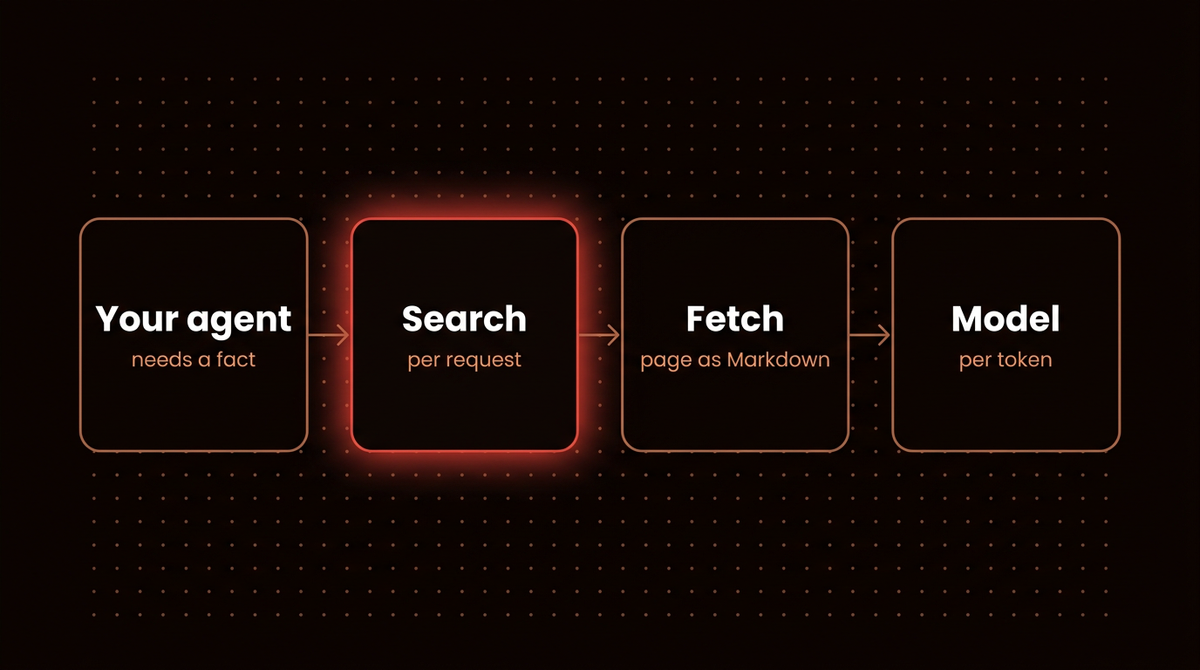
Both are plain JSON over HTTPS with a bearer key, the same key as the chat API. Search is POST https://api.deepseek.com/v1/tools/search and Fetch is POST https://api.deepseek.com/v1/tools/fetch, according to the Search and Fetch guide.
Here is a first call in Python:
import requests
r = requests.post("https://api.deepseek.com/v1/tools/search",
    headers={"Authorization": "Bearer <DeepSeek API Key>"},
    json={"query": "DeepSeek V4.1 release", "count": 5, "need_content": False})
print([(x["title"], x["authority"]) for x in r.json()["results"]])
Search takes a query of up to 128 characters and a count from 1 to 50. Set need_content to true and each result carries the page text, otherwise you get a snippet and a model facing summary of roughly 600 to 800 characters. The query keeps its operators, so site:, lang:, after: and before: all work. Each result also has an authority score from 0 to 4, where 3 or above means a highly authoritative source. I would filter on authority first, in code, before any text reaches the model. A value of -1 means unknown, so decide whether unknown pages stay or go. The response also carries a rerank_score, a relevance score from 0 to 3.
Fetch takes one URL and returns the page as Markdown. It has a per domain rate limit on top of the account limit, and it returns 403 when its security policy rejects a request and 404 when it cannot get usable content.
What counts as a billable request
Billing is per successful request. A request counts only if it returns HTTP 200 and a real result: a non empty results array for Search, page content for Fetch. Failures, empty results and timeouts are free. count does not change the price, so asking for 50 results costs the same as asking for 5.
Searches the model runs for you through server side tools are not billed at all; you pay only for the model tokens. As of November 21, 2026 the Search and Fetch guide counts DeepSeek's web tools, the web_search tool in the Responses API, Web Search in Claude Code, and DeepSeek Harness (DeepSeek's agent runtime) when its search provider is server side search or Auto, the default. Calls you send to the Search and Fetch endpoints yourself are billed at the list price, and so are Harness set to the Search API provider and Codex Alpha Search.
Token pricing for the model has a wrinkle too. The pricing page sets off peak rates at half the peak rates. Peak hours are 01:00 to 04:00 and 06:00 to 10:00 UTC, Monday through Friday, excluding Chinese public holidays. Weekends and Chinese public holidays are off peak all day, so batch research jobs belong there.
DeepSeek Search API cost for 1,000 tasks, against the rest
Take an agent that answers a research question with 6 searches and 4 page fetches. Run it 1,000 times. That is 6,000 searches and 4,000 fetches. The table prices only the search layer, using each vendor's published rate.
| Search layer | Rate used | 1,000 tasks |
|---|---|---|
| DeepSeek Search and Fetch | $0.75 per 1,000 requests | $7.50 |
| Tavily, pay as you go | $0.008 per credit, 1 credit per basic search, 1 credit per 5 basic extractions | $54.40 |
| Tavily, Growth plan | $0.005 per credit | $34.00 |
| Claude web search tool | $10 per 1,000 searches, fetch has no extra charge | $60.00 |
The rates come from Tavily's credits page and the Claude pricing page. Claude's fetch tool is free, but you still pay input tokens for every page it pulls in, and search results count as input tokens as well.
Now add the model. I assumed 60,000 input tokens and 4,000 output tokens per task, which is a guess for a loop that reads several pages. At those sizes, with no cache hits (a cache hit is input the provider has already seen and bills at a lower rate), the token bill for 1,000 tasks is about $22.80 on deepseek-flash at peak rates, $11.40 off peak, $8.00 on Claude Haiku 5.5 and $160.00 on Claude Sonnet 5.5.
My read: with Sonnet 5.5 the search bill is noise. With a cheap model it is the biggest line. Pair Haiku 5.5 with Claude's search tool and the $60 search bill is 7.5 times the $8 token bill. Pair deepseek-flash with DeepSeek's own search and the search bill is about a third of the tokens. If your agent searches a lot and reasons a little, the search layer is where you should shop first.
Four risks to check
- Quality is unproven. Price tells you nothing about whether the top results answer your questions. Run 30 real queries from your own logs through DeepSeek and your current provider and compare what the agent ends up citing.
- Data handling. Your queries go to DeepSeek's servers. I have not checked its retention terms. Read them before a customer's name, email or case details appear in a search string.
- Pinned model names. The docs say
deepseek-v4-flashanddeepseek-v4-flash-vision-expare retired and now served by the 1017 build at the Flash price. If you pinned either one for repeatable evals, your results moved to the 1017 build without a code change. - An account wide rate limit (QPS means queries per second): 100 for Search and 25 for Fetch, counted across all your keys, with a per domain limit on Fetch as well. A busy agent fleet can still hit 429s, so queue calls and back off on 408, 429 and 5xx as the docs advise.
Who should test it this week
If you run an agent that already uses a paid search API and your searches outnumber your model calls, run the 30 query test now. If you test through Claude Code, or Harness on its default search setting, the searches the model runs are not billed, only the tokens. If you call the endpoints directly, 30 queries with 3 fetches each cost about $0.09 at the list rate, so measure anyway.
If you are on a frontier model with a small search volume, nothing changes. A few hundred searches a month will not change your bill whichever vendor you pick. I would also wait if your work involves regulated or client data, until you have read where the queries go.
- Get a key. Create one on the DeepSeek platform and send a single Search call with
need_contentset to false. - Filter in code. Keep results with
authorityof 3 or above ([x for x in results if x["authority"] >= 3]), then fetch the top two. - Log the meter. Count successful Search and Fetch calls per task, so your cost per task is a number you read, not a guess.
- Compare answers. Score the same 30 questions on your current provider. Switch only if the answers hold up.
For the model side of the bill, see Gemini 4 Argon's two step price, GPT-6.1 Sol's cache rate and what Claude Opus 5 pricing does to an agent bill. If you are still choosing a vendor, how I choose between OpenAI and Claude covers the decision. A search tool is the grounding step inside an agentic loop, and it pairs well with prompt caching, because repeated pages are exactly what a cache rewards. If you want a research agent built and monitored, this is how I build them.
Frequently asked questions
How much does the DeepSeek Search API cost?
DeepSeek charges $0.75 per 1,000 successful Search requests and the same for Fetch. A request is billed only when it returns HTTP 200 with a result. Failures, empty results and timeouts are free, and the number of results you ask for does not change the price. Model tokens are billed separately.
Is the DeepSeek Search API free right now?
Partly. Searches the model makes through server side tools (DeepSeek's web tools, the Responses API web_search tool, Web Search in Claude Code, and DeepSeek Harness on its default search setting) are not billed, so you pay only for tokens. Direct calls to the Search and Fetch endpoints, Harness set to the Search API provider, and Codex Alpha Search are billed at $0.75 per 1,000 successful requests.
What are the Search and Fetch rate limits?
Search is limited to 100 requests per second and Fetch to 25, per account and counted across all your keys, separate from the model concurrency limits. Fetch also has a per domain limit. Going over returns HTTP 429, and the docs say to wait and retry on 408, 429 and 5xx errors but not to retry other 4xx errors unchanged.
Does deepseek-flash cost more after the 1017 update?
No. DeepSeek's change log says calling method and pricing stay the same for the DeepSeek-V4.1-Flash-1017 build. At peak, cache miss input is $0.30 and output is $1.20 per million tokens, and off peak rates are half that. The old v4 flash names still work and are billed at the Flash price.
Published
November 21, 2026
Category
Implementation
Jahanzaib Ahmed
AI Systems Engineer & Founder
AI Systems Engineer with 126 production systems shipped. I run AgenticMode AI (AI agents, RAG systems, voice AI) and ECOM PANDA (ecommerce agency). I build AI that works in the real world for businesses across home services, healthcare, ecommerce, SaaS, and real estate.
Want this built for your business? See Workflow Automation, or browse the free tools and guides.
Related articles
Gemini 4 Argon API Pricing: $2 and $10 Now, $4 and $20 From December 1
Google opened Gemini 4 Argon to developers on October 13 at $2 and $10 per million tokens. On December 1 it becomes $4 and $20. Here is what to test before then.
NewsImplementationGoogle
Meta Muse Wonder Costs Exactly What Claude Opus 5.5 Costs
Meta's first frontier model costs exactly what Claude Opus 5.5 costs per token. Here is how it prices against GPT-6 Astra and Sol on real workloads, and what the model card says about its benchmarks.
NewsImplementationMeta
GPT-6.1 Sol Halves the Cache Rate and Leaves Every Other Price Alone
OpenAI's GPT-6.1 Sol keeps GPT-6 Sol's $2 input and $10 output prices and cuts only cached input. Here is what that saves on real agent loops, and why Chat Completions users cannot just swap the model name.
NewsImplementationOpenAI