OpenAI vs Claude for Small Business: I've Shipped 126 Systems on Both. Here Is How I Actually Choose.
A practical guide to choosing between OpenAI and Claude for your business AI agent, with verified August 2026 pricing, a modelled monthly cost table, and the decision framework I use across 126 production builds.

Table of Contents
A client called me in June with a spreadsheet. They had been running their support agent on OpenAI for eight months, and their bill had climbed from $180 a month to just under $900. Nothing about the product had changed. Volume had roughly doubled. The rest was output tokens, and nobody had ever looked at the output rate.
That conversation is why I keep having the openai vs claude argument with business owners rather than engineers. The two platforms are close enough on capability now that the deciding factors are boring ones: what you pay per million output tokens, whether a promotional price is going to expire on you, and which failure mode you can live with. I've shipped 126 production systems, and I've built on both.
Here is the short version. As of August 2026, Claude Opus 5 and GPT-5.6 Sol cost exactly the same on input, $5 per million tokens. On output, Opus 5 is $25 and Sol is $30. For a typical support agent that's a difference of about $12.50 a month, which is nothing. The real decision is which tier you drop down to, and that is where the two vendors diverge sharply.
If you would rather skip the analysis and have someone size this against your actual call volume, book a discovery call and bring your last three months of invoices.
What OpenAI and Claude actually charge in August 2026
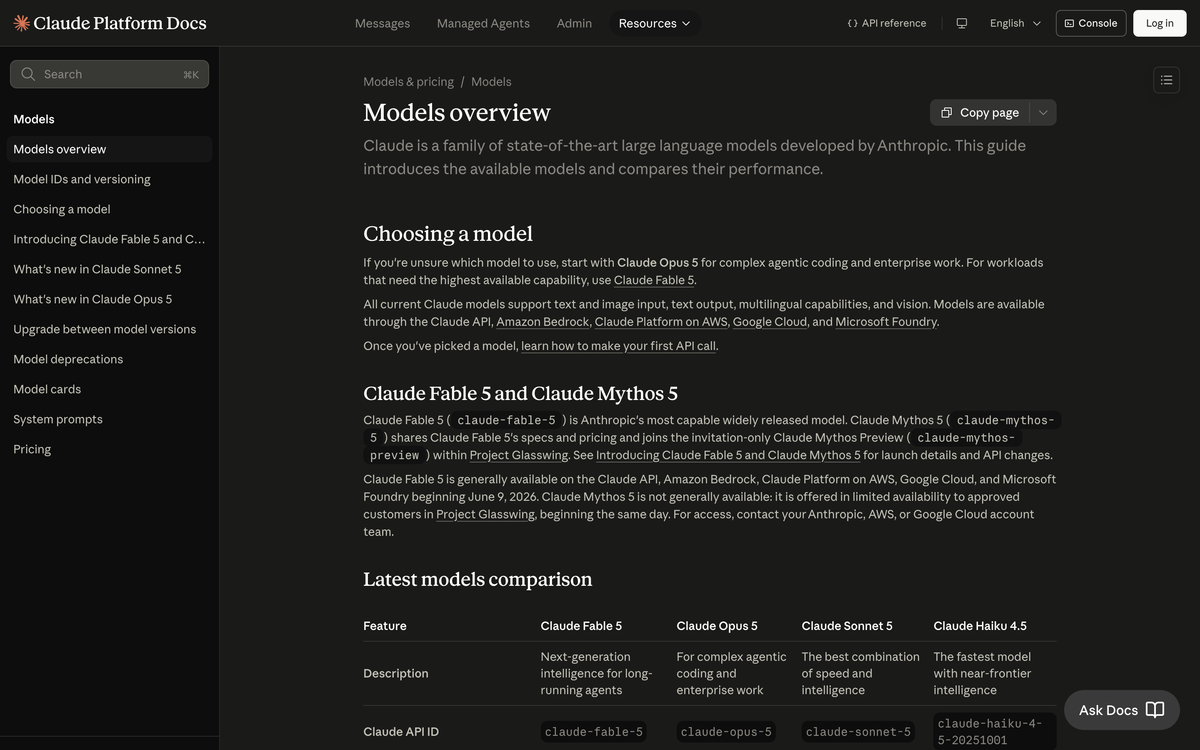
Every price below is the published list rate, checked on 3 August 2026 against Anthropic's own model documentation and OpenRouter's live model pages. I'm listing the current lineup, not last year's. Most comparison articles still ranking for this query are quoting GPT-5.4 and Claude Opus 4.6, both of which have been superseded.
| Model | Input / 1M tokens | Output / 1M tokens | Context window |
|---|---|---|---|
| Claude Fable 5 | $10 | $50 | 1M |
| Claude Opus 5 | $5 | $25 | 1M |
| Claude Sonnet 5 | $3 | $15 | 1M |
| Claude Haiku 4.5 | $1 | $5 | 200K |
| GPT-5.6 Sol | $5 | $30 | 1M |
| GPT-5.6 Terra | $2 | $12 | 1M |
| GPT-5.6 Luna | $0.20 | $1.20 | 1M |
Three things jump out. Anthropic has a tier above Opus 5 that most comparisons skip entirely: Fable 5, at $10 in and $50 out, aimed squarely at long running agents. At the tier people actually compare, Opus 5 against Sol, Claude is cheaper on output. And OpenAI's bottom tier, Luna, is dramatically cheaper than anything Anthropic offers, at $0.20 in and $1.20 out.
Claude Sonnet 5 also carries an introductory rate of $2 and $10 per million tokens, but that expires on 31 August 2026. If you are budgeting past September, use the $3 and $15 list rate. I've watched three separate teams build a business case on a promotional number and then get surprised. Don't be the fourth.
What that means in real monthly cost
Rate cards are useless until you put a workload against them. So here is one, and I am showing my assumptions so you can run it again with your own numbers.
Assume a support agent handling 1,000 conversations a month. Each conversation burns roughly 40,000 input tokens once you count the system prompt, retrieved documents and the growing message history, plus about 2,500 output tokens. That works out to 40 million input tokens and 2.5 million output tokens a month. In my experience these are the numbers a mid sized deployment actually lands on.
| Model | Monthly API cost | Multiple of cheapest | Notes |
|---|---|---|---|
| GPT-5.6 Luna | $11.00 | 1.0x | Currently 50% off, promo not permanent |
| Claude Haiku 4.5 | $52.50 | 4.8x | Cheapest Claude, smaller context |
| GPT-5.6 Terra | $110.00 | 10.0x | Currently 50% off, promo not permanent |
| Claude Sonnet 5 | $157.50 | 14.3x | Intro rate $2 / $10 until Aug 31 2026 |
| Claude Opus 5 | $262.50 | 23.9x | Anthropic's default pick, with Fable 5 above it |
| GPT-5.6 Sol | $275.00 | 25.0x | OpenAI flagship tier |
| Claude Fable 5 | $525.00 | 47.7x | Anthropic's highest tier, long running agents |
The spread between the cheapest and most expensive option is nearly 48x. That's the actual finding. Picking OpenAI or Claude is worth about $12.50 a month at the top tier. Picking the right tier is worth $264, and that is before you consider whether Fable 5 is doing anything for you that Opus 5 is not.
This is what my client had gotten wrong. They weren't on the wrong vendor. They were running every single request, including "what are your hours", through a flagship model. We moved intent classification and simple lookups to a cheap tier and kept the expensive model for genuine reasoning. Their bill went to $310 and their customers noticed nothing.
OpenAI vs Claude: where the two genuinely differ
Output pricing is the gap that compounds
Opus 5 charges $25 per million output tokens against Sol's $30. On input the two are identical. That sounds trivial, and on a chat product it is. On an agent it is not, because agents generate far more output per request than a chatbot does. Every tool call, every reasoning step and every retry is billed as output.
Across the voice agents I've deployed, output is between 30 and 40 percent of total spend even though it is a fraction of the token count. If your workload is agentic rather than conversational, weight the output column heavily. I wrote about how that shakes out in practice in taking AI agents to production.
Context windows are effectively a tie
Claude Fable 5, Opus 5 and Sonnet 5 all offer a 1M token context window. So does every model in the GPT-5.6 family. This is a straight tie, and nobody should pick a vendor on a number both sides publish identically. Claude Haiku 4.5 is the outlier at 200K, which is still more than enough for most support and booking work but will bite you on long document analysis.
What matters far more is what you put in the window. Most teams stuff it and pay for it. Retrieval done properly keeps the window small, and I covered the mechanics of that in the business guide to RAG.
The discount trap
This one costs people real money. Right now OpenAI is running a 50 percent promotion on the Terra and Luna tiers. On OpenRouter, Terra shows as $1 and $6 per million tokens with the list price of $2 and $12 struck through.
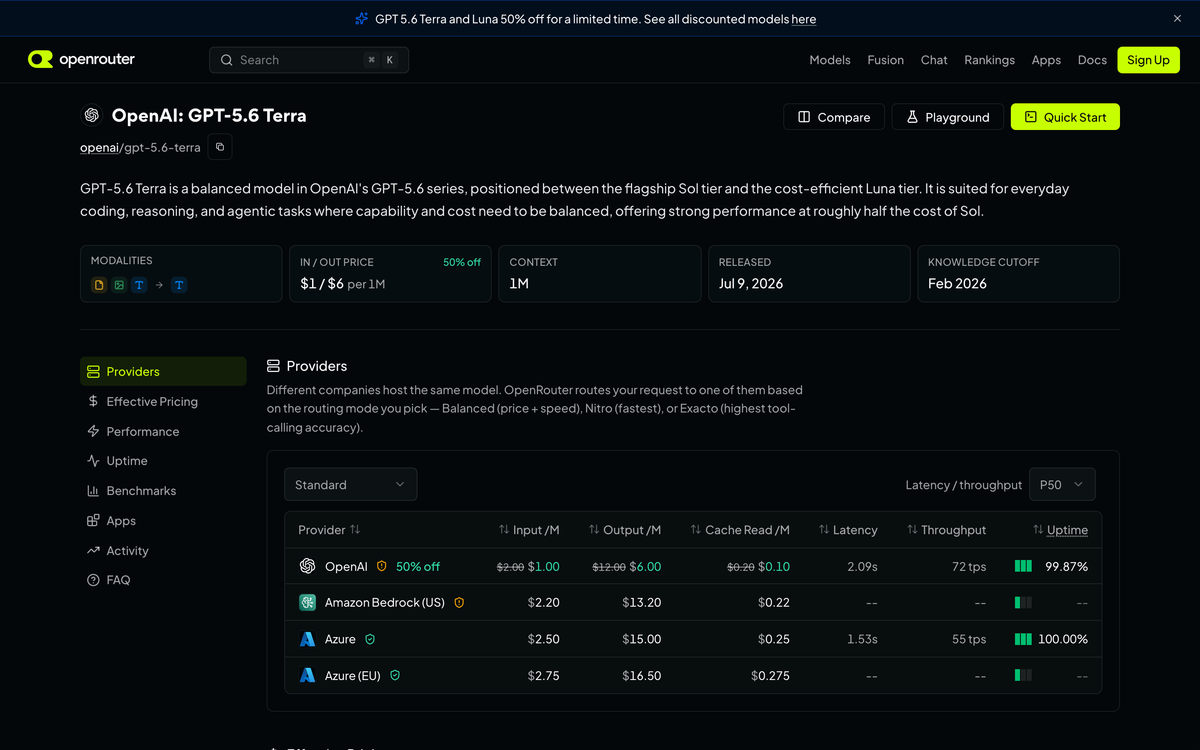
Two lessons sit in that screenshot. First, the promotional rate is explicitly described as limited, so budget on the $2 and $12 list price and treat the discount as a bonus. Second, look at the provider column. The identical model runs $2.20 through Amazon Bedrock and $2.50 through Azure against $2.00 list from OpenAI directly. If your agency or platform resells you model access, you're very likely paying that markup without seeing it itemized.
I ask every new client one question early: who is billing you for tokens, and can you see the raw usage? If the answer is no, that's usually the cheapest thing to fix.
What I actually choose, and when
Across the builds I've shipped, my selection rarely comes down to brand preference. It comes down to three questions.
Is the task reasoning or retrieval? If the agent needs to weigh options, chain several tools together or handle genuinely novel requests, I use a top tier model and I lean Opus 5, because its output rate is 17 percent lower than Sol's for work that is output heavy. If the task is classification, extraction or looking something up, I use the cheapest tier that passes evaluation, and OpenAI's Luna tier at $0.20 and $1.20 is currently unbeatable on price.
How much does a wrong answer cost? A booking agent for a dental practice that books the wrong appointment slot costs a little time and some goodwill. A quoting agent that misprices a job costs margin on every quote until someone notices. On the second kind I spend more per token without hesitating and I add a verification pass. On the first I optimize for cost.
Are you locked in? Both vendors ship breaking changes. Anthropic deprecates on a published schedule with a migration guide. OpenAI moves faster and communicates less. Neither is disqualifying, but if you build so that swapping the model means changing one configuration value rather than rewriting your prompts, this whole debate stops being expensive. Every system I ship is built that way, and it's the single highest return decision in the stack.
For most of the small and mid sized businesses I work with, the answer ends up mixed. A cheap tier handles 70 percent of traffic, a top tier handles the rest, and which vendor supplies each one changes about once a year. That's a normal, healthy setup, and it's roughly what the operations autopilot and knowledge agent packages are built around.
Is this decision even right for you yet?
Be honest about where you are, because picking a model is the wrong problem for a lot of businesses.
- You haven't shipped anything yet. Pick either one and build. At prototype volume the entire monthly bill is under $20 on any tier. Deciding this now is procrastination wearing a spreadsheet.
- Your bill is under $200 a month. Your time is worth more than the difference. Revisit when you cross $500.
- Your bill is over $500 a month and rising. This is the right conversation, and tier routing will save you more than vendor choice will.
- You're quoted a flat monthly fee with no token visibility. Ask for the underlying usage before anything else. You may be paying a markup of 20 to 25 percent on top of a flagship model you didn't need.
- You're not sure whether you need an agent at all. Quite often the answer is that you need a workflow, not an agent. I laid out the difference in when to use AI agents versus automation, and the AI readiness assessment will tell you in about five minutes.
Frequently asked questions
Is Claude cheaper than OpenAI?
It depends which tier you mean. Comparing the two models most businesses actually weigh, Claude Opus 5 and GPT-5.6 Sol, both cost $5 per million input tokens, and Opus 5 is $25 on output against Sol's $30, so Opus 5 is about 17 percent cheaper there. At the bottom tier OpenAI is far cheaper: GPT-5.6 Luna runs $0.20 and $1.20 per million tokens against Claude Haiku 4.5 at $1 and $5. At the very top Anthropic is the pricier of the two, because Claude Fable 5 lists at $10 and $50 and the GPT-5.6 lineup has nothing above Sol.
Which is better for building an AI agent, OpenAI or Claude?
Both are capable enough that the difference rarely decides a project. Claude has an edge on output pricing, which matters for agents because agents generate a lot of output through tool calls and reasoning steps. OpenAI has a much cheaper low end tier, which matters if you route high volume simple tasks separately. Most production systems I build use both.
How much does an AI agent cost per month?
For a support agent handling 1,000 conversations a month, expect roughly $11 on the cheapest tier and $275 to $525 at the top, using 40 million input and 2.5 million output tokens. Most businesses land between $50 and $300 once traffic is routed sensibly across tiers. I broke down the full picture in AI chatbot pricing.
What is the context window difference between Claude and GPT-5.6?
They are the same. Claude Fable 5, Opus 5 and Sonnet 5 all offer 1 million tokens, and so does the GPT-5.6 family. Context window is not a decision factor between these two vendors. Claude Haiku 4.5 is the exception at 200,000 tokens, which is fine for support work but limiting for long document analysis.
Should I worry about the Claude Sonnet 5 introductory pricing expiring?
Yes, if you're budgeting past August 2026. Sonnet 5 currently bills at $2 and $10 per million tokens, but the list rate of $3 and $15 takes effect after 31 August 2026. Build your business case on the list rate so a scheduled price change does not read as a surprise increase.
Am I paying more by going through AWS or Azure?
Usually yes. The same GPT-5.6 Terra model lists at $2 per million input tokens direct, $2.20 through Amazon Bedrock and $2.50 through Azure. That's a markup of 10 to 25 percent for the same output. It can still be worth it if you need the compliance posture or already have committed cloud spend, but you should know you're paying it.
Can I switch between OpenAI and Claude later?
If the system is built for it, switching is a configuration change and an evaluation run, usually under a day. If prompts are hardcoded to one vendor's quirks, it can take weeks. I tell clients to ask whoever built the system how long a swap would take. The answer tells you a lot about the quality of what you bought.
Which vendor is more stable for a business to build on?
Anthropic publishes deprecation dates and migration guides ahead of retiring models. OpenAI ships faster and communicates changes less formally. Neither has been disqualifying in the systems I run, but if your team is small and can't absorb surprise migrations, the published schedule is worth something.
As of 3 August 2026, Claude Opus 5 costs $5 per million input tokens and $25 per million output tokens, against GPT-5.6 Sol at $5 and $30. Claude Sonnet 5 lists at $3 and $15 with an introductory rate of $2 and $10 through 31 August 2026. GPT-5.6 Terra lists at $2 and $12 and Luna at $0.20 and $1.20, both currently discounted 50 percent on a limited promotion. Claude Fable 5 lists at $10 and $50. Claude Fable 5, Opus 5, Sonnet 5 and the full GPT-5.6 family all offer a 1M token context window. Sources: Anthropic Models Overview 2026, OpenRouter GPT-5.6 Terra 2026, OpenRouter GPT-5.6 Sol 2026, OpenAI Platform 2026.
The thing worth doing this week
Pull your last three invoices and find the split between input and output spend. If output is more than a third of the bill, you're running an agentic workload and the output rate matters, which nudges you toward Claude. If your traffic is mostly simple and repetitive, the cheapest OpenAI tier will save you more than any vendor argument.
Then check what percentage of requests genuinely need a flagship model. In every audit I've run the honest answer was under 30 percent, and in one case it was 6 percent.
If you want that done properly against your own numbers rather than my modelled ones, book a discovery call and I'll go through your usage with you. If you're earlier than that and still working out what to automate first, start with the AI readiness assessment or look at how the agent packages are scoped.
Related Posts

How to set up agentic email without letting it send
ImplementationAgentic EmailAI Email Agent
Google's Vibe Coding Whitepaper, Explained in Plain English
Trends & InsightsVibe CodingAgentic Engineering
AI Automation for Business in Australia: What It Really Costs a Small Business Owner
Industry GuidesAI AutomationAustralia

Jahanzaib Ahmed
AI Systems Engineer & Founder
AI Systems Engineer with 126 production systems shipped. I run AgenticMode AI (AI agents, RAG systems, voice AI) and ECOM PANDA (ecommerce agency). I build AI that works in the real world for businesses across home services, healthcare, ecommerce, SaaS, and real estate.