Gemini 4 Argon API Pricing: $2 and $10 Now, $4 and $20 From December 1
Google opened Gemini 4 Argon to developers on October 13 at $2 and $10 per million tokens. On December 1 it becomes $4 and $20. Here is what to test before then.

Table of Contents
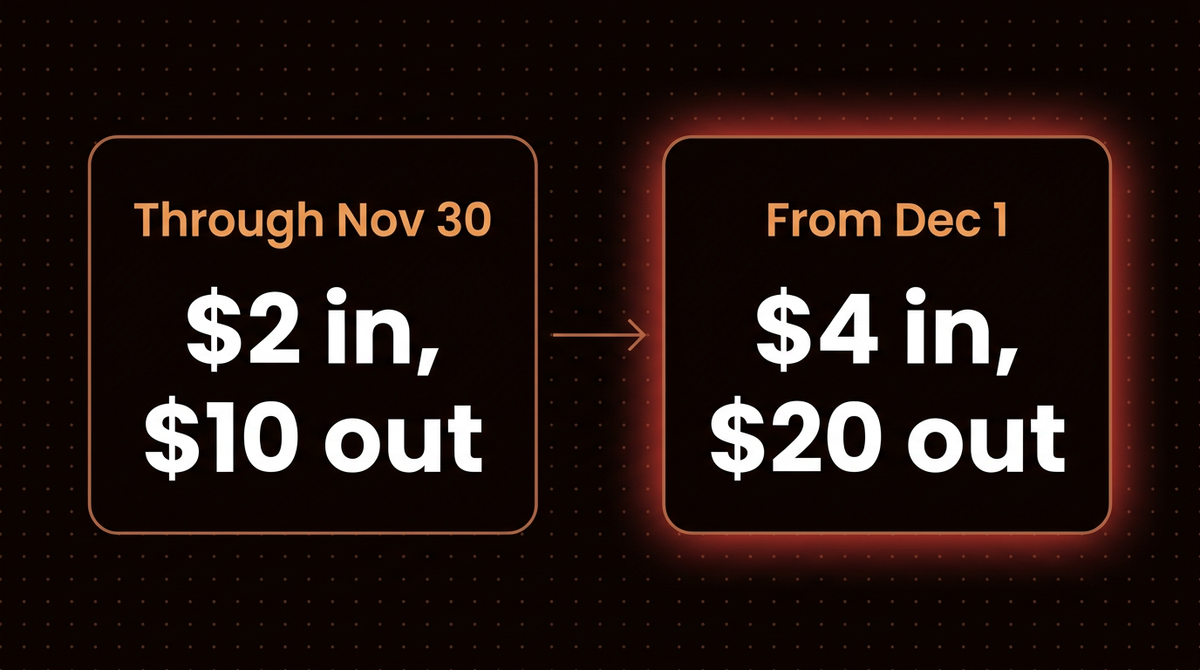
Google made Gemini 4 Argon available to developers on October 13, and the Gemini 4 Argon API pricing has a date baked into it: $2 per million input tokens and $10 per million output tokens through November 30, then $4 and $20 from December 1. The introductory price matches Claude Sonnet 5.5 and the December price matches Claude Opus 5.5, so whatever you test this month, price it at $4 and $20.
Where Gemini 4 Argon is available today
Google's launch post calls Argon its frontier model for software engineering, enterprise knowledge work and cybersecurity defense. Access depends on who you are. Developers use the paid tier of the Gemini API in Google AI Studio and Android Studio. Google AI Ultra subscribers get it in Antigravity and AI Studio, and Pro and Ultra subscribers get it in the Gemini app. Cyber defenders can apply to the Fairwind Program for a version without the cyber guardrails. The Verge notes the public rollout follows a limited release to trusted cyber defenders.
The model ID is gemini-4-argon. It takes text, image, video, audio and PDF in and returns text. Google lists function calling, structured outputs, code execution, search grounding and computer use (in preview). It does not support the Live API, image generation or audio generation. And it is not on the free tier or the Google AI Pro plan for the API, so a free key will not reach it.
Google's launch post reports two benchmark results. Argon leads the Gray Swan indirect prompt injection benchmark, cutting attack success across 15 adaptive attempts to 0.7%, and scores 87% on the ERQA embodied reasoning test. Those are Google's numbers, so I would run my own evals before relying on them. The prompt injection figure is the one worth checking first if your agent reads web pages or email.
Gemini 4 Argon API pricing and the December 1 step
Google's pricing page lists every Argon rate twice, with an end date for the first. Output is billed including thinking tokens, and Argon thinks at a medium level by default.
| Mode | Input per 1M | Cached input per 1M | Output per 1M |
|---|---|---|---|
| Standard, through Nov 30 | $2.00 | $0.10 | $10.00 |
| Standard, from Dec 1 | $4.00 | $0.20 | $20.00 |
| Batch, through Nov 30 | $1.00 | $0.05 | $5.00 |
| Batch, from Dec 1 | $2.00 | $0.10 | $10.00 |
Google did the same thing with its Flash models, which I covered in Gemini Flash is cheap until January 1, then doubles. Two launches in a row now follow the same shape: a low price that gets people to build, then a scheduled doubling. My read: budget every Argon project at the December rate. Anything you save before then is a gain.
Argon against Sonnet 5.5, Opus 5.5 and GPT-6.1 Sol
I read list prices from the vendor pages this morning: Anthropic's pricing page and the GPT-6.1 Sol model page. Then I worked out two workloads in code. The first is one long document pass: 600K input tokens, uncached, and 8K tokens out. The second is an agent run of 40 turns, each turn carrying 110K cached tokens of context plus 10K fresh input and writing 3K tokens. Both assume the cache hits every turn and leave cache write fees out.
| Model | Input | Cached input | Output | 600K document pass | 40 turn agent run |
|---|---|---|---|---|---|
| Gemini 4 Argon, through Nov 30 | $2.00 | $0.10 | $10.00 | $1.28 | $2.44 |
| Gemini 4 Argon, from Dec 1 | $4.00 | $0.20 | $20.00 | $2.56 | $4.88 |
| Claude Sonnet 5.5 | $2.00 | $0.10 | $10.00 | $1.28 | $2.44 |
| Claude Opus 5.5 | $4.00 | $0.20 | $20.00 | $2.56 | $4.88 |
| GPT-6.1 Sol | $2.00 | $0.10 | $10.00 | see note | $2.44 |
Through November 30, Argon costs what Sonnet 5.5 and GPT-6.1 Sol cost. From December 1, it costs what Opus 5.5 costs. OpenAI charges a premium on prompts over 272K tokens, which I walk through in my GPT-6.1 Sol pricing breakdown, so I left Sol's document cell out rather than guess. Argon's rows show a single rate with no split by prompt size.
The table cannot tell you everything. Price per token is not price per task: Google's migration guide says Argon can spend more of its output limit on thinking than earlier models, and thinking is billed as output, so high can cost noticeably more than low on the same prompt. And the cached column only holds on a cache hit. Prompt caching now does most of the work in an agent bill, which is the same lesson as in my GPT-6 Sol cost breakdown.
In this loop the hit rate moved the bill by more than 4x, which the choice between these models does not. I reran the agent loop at three hit rates: with every cacheable token hitting, it costs $2.44 now and $4.88 from December. At a 50% hit rate it costs $6.62 and $13.24. With no hits it costs $10.80 and $21.60. Argon uses implicit caching only, so you cannot force the hits. Put your own token mix into the AI agent cost calculator before you trust either row.
Six changes to make before you swap the model ID
Google's migration checklist is short, and several items change behavior rather than syntax.
- Drop explicit caching. Calls to
cachedContentsorcaches.createare not supported on Argon. Implicit caching is on by default for prompts of at least 4,096 tokens and discounts cached input by 95% on a hit. You no longer control the cache, so measure your real hit rate. - Remove sampling parameters.
temperature,top_pandtop_kare ignored if you send them. If your evals depended on a low temperature for stable output, they need rerunning. - Raise max_output_tokens. Google recommends at least 32,768, because thinking and answer share the same limit. A limit of 8,000 can cut an answer off mid sentence.
- Pick a thinking level. The default is
medium. Testlow,mediumandhighand keep the lowest one that clears your quality bar. - Use background execution for long output. Anything past 64K tokens needs
background: trueand amax_output_tokensabove 65,536. If you setbackgroundwithout a limit, the server stops at 64K. - Raise client timeouts to 15 minutes. Hard prompts can take several minutes. A default 60 second HTTP timeout will fail runs you are still paying for.
Watch out: Google's examples use the Interactions API, with conversation state kept on the server through previous_interaction_id. Google says client side continuation for long decode is coming to the Interactions API and already works in GenerateContent. Check which API your framework calls before you assume the swap is one line.
Who should test this week and who should wait
Test this week if you run long coding or refactoring agents on Opus 5.5 today, or if you are fixed on Google's stack and Gemini 3.x is your ceiling for hard tasks. The introductory rate lets you run a real evaluation at Sonnet money, so a December decision rests on your own numbers.
Skip it for now if your agents mostly do short, cheap work, because a small model at a fraction of these rates will beat a frontier model on cost per task. The same goes for anything needing the Live API or built in image output, which Argon does not support, or explicit caching. If your agent runs untrusted input, read my notes on agent containment after Google's sandbox escape report first. 0.7% on one benchmark is a measurement, not a guarantee, so I would still sandbox the agent.
A fair test should take an afternoon. Pick 20 real tasks from your own logs. Run each at low, medium and high, and record cost, latency and a pass or fail. Then price the same tasks at December rates and compare against your current model. I build and run agents like this for clients, and the details are on my agents page. For the wider model choice, my OpenAI versus Claude comparison for business agents still frames the questions to ask.
Frequently asked questions
How much does the Gemini 4 Argon API cost?
Through November 30, 2026, Standard pricing is $2 per million input tokens and $10 per million output tokens, with cached input at $0.10. From December 1 those become $4, $20 and $0.20. Batch runs at half the Standard rate in both periods. Output includes thinking tokens, so the real cost per task depends on the thinking level you choose.
What is the Gemini 4 Argon model ID?
The model ID is gemini-4-argon. It is available in Google AI Studio and the Gemini API paid tier. Google's model page lists a 1,048,576 token context window, a default output limit of 65,536 tokens, and up to 1,048,576 output tokens when you use long decode with background execution.
Can I use Gemini 4 Argon on the free tier?
No. Google's pricing page says Argon is not available on the Free tier or on the Google AI Pro plan for the API. You need the paid Gemini API tier. Google AI Ultra subscribers can also try it in AI Studio and Antigravity, and Pro and Ultra subscribers can use it in the Gemini app.
Does Gemini 4 Argon support context caching?
Only implicit caching. Explicit caching with cachedContents is not supported. Implicit caching applies to prompts of at least 4,096 tokens and discounts cached input tokens by 95% on a cache hit. Because you cannot create the cache yourself, check your usage data to confirm how often hits actually occur.
Published
October 14, 2026
Category
Implementation
Jahanzaib Ahmed
AI Systems Engineer & Founder
AI Systems Engineer with 126 production systems shipped. I run AgenticMode AI (AI agents, RAG systems, voice AI) and ECOM PANDA (ecommerce agency). I build AI that works in the real world for businesses across home services, healthcare, ecommerce, SaaS, and real estate.
Related articles
Meta Muse Wonder Costs Exactly What Claude Opus 5.5 Costs
Meta's first frontier model costs exactly what Claude Opus 5.5 costs per token. Here is how it prices against GPT-6 Astra and Sol on real workloads, and what the model card says about its benchmarks.
NewsImplementationMeta
GPT-6.1 Sol Halves the Cache Rate and Leaves Every Other Price Alone
OpenAI's GPT-6.1 Sol keeps GPT-6 Sol's $2 input and $10 output prices and cuts only cached input. Here is what that saves on real agent loops, and why Chat Completions users cannot just swap the model name.
NewsImplementationOpenAI
GPT-6 Sol Costs Half of Opus 5.5 Per Token. On an Agent Loop, It Doesn't.
OpenAI halved API prices for GPT-6 Sol and Luna ninety minutes after Anthropic shipped Opus 5.5. I priced a real agent loop on both, and checked whose benchmark table was already stale.
NewsTrends & InsightsLLM Pricing