GPT-6 Sol Costs Half of Opus 5.5 Per Token. On an Agent Loop, It Doesn't.
OpenAI halved API prices for GPT-6 Sol and Luna ninety minutes after Anthropic shipped Opus 5.5. I priced a real agent loop on both, and checked whose benchmark table was already stale.

Table of Contents
OpenAI shipped GPT-6 Sol and GPT-6 Luna on September 22 and cut API prices in half against GPT-5.6. According to TechCrunch, Anthropic had released Claude Opus 5.5 ninety minutes earlier. On paper, Sol now costs exactly half of Opus 5.5 per token: $2 against $4 for input, $10 against $20 for output.
That half does not survive contact with an agent loop. Sol and Opus 5.5 both charge $0.20 per million tokens for cached input reads, and cached reads are most of what a long agent session consumes. I ran the published list prices through a simple 40 turn loop and GPT-6 Sol came out 1.61 times cheaper than Opus 5.5, not 2 times. The headline benchmark claim has a similar problem. OpenAI says Sol "outperforms Claude Opus 5," and it does, but Opus 5 is a model Anthropic had replaced before OpenAI's post went live.
Neither point makes Sol a bad model. They change which one you should pick, and they change what you should measure before you switch.
What did OpenAI actually ship with GPT-6 Sol and Luna?
Two smaller models in the GPT-6 family, trained with methods OpenAI says are similar to the ones behind GPT-6 Astra, its top model launched earlier this month. Sol is the tier for coding and complex work. Luna is the cheap tier for what OpenAI, as quoted by TechCrunch, calls "high-volume tasks with a clear goal," like summarizing and extraction.
In the API they are gpt-6-sol and gpt-6-luna. In ChatGPT they landed in ChatGPT Work and Codex for Plus, Pro, Business, Enterprise and Edu accounts, while Free and Go users get Luna in the desktop app only. OpenAI's own post says the models are "not yet available in Chat," while TechCrunch reported a gradual rollout to the ChatGPT app and website through the day, so expect the regular chat surface to lag the API.
The launch shipped alongside a second post on prompt caching that most coverage skipped. I think it's the more important of the two for anyone running agents, and I'll get to why below.
How much cheaper is GPT-6 Sol than Claude Opus 5.5 per token?
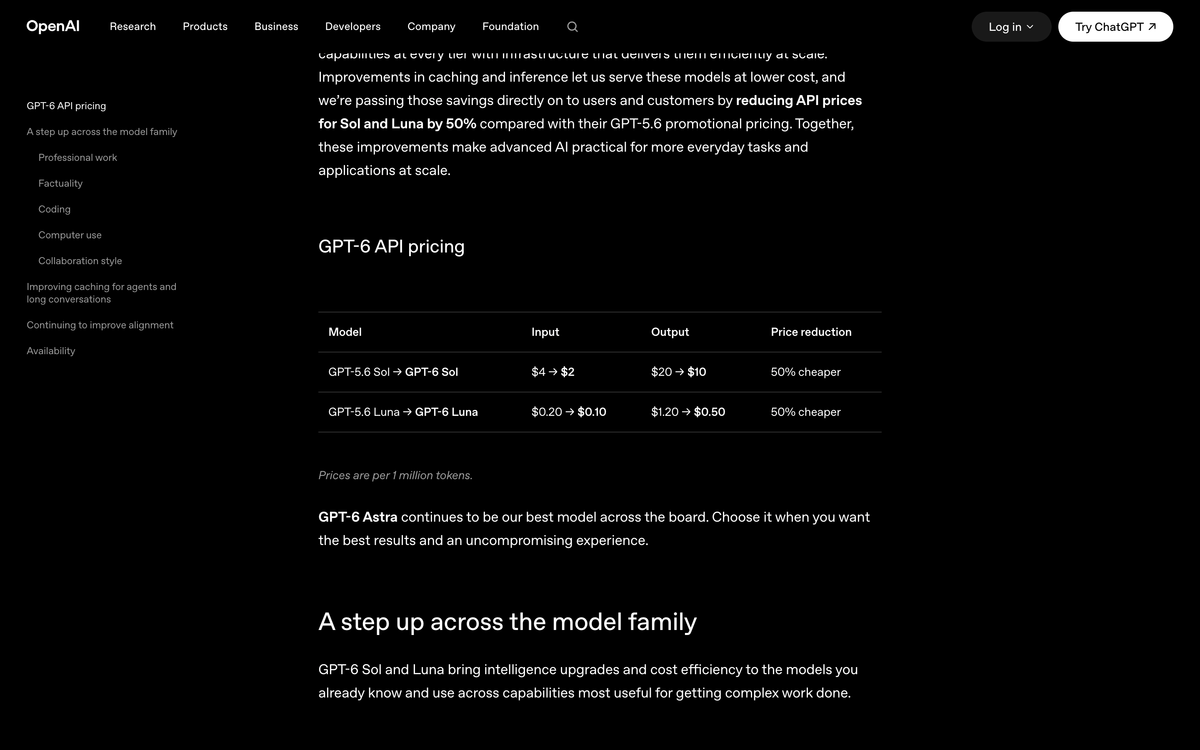
Exactly half on fresh input and output, and identical on cached reads. Luna sits in a different price bracket entirely, roughly a fortieth of Opus 5.5 on input and output.
Here are the list prices from the two launch posts, per million tokens. The GPT-6 cached read rate is derived from OpenAI's stated 90% discount on cached input.
| Model | Input | Cached read | Output |
|---|---|---|---|
| GPT-6 Sol | $2.00 | $0.20 | $10.00 |
| GPT-6 Luna | $0.10 | $0.01 | $0.50 |
| Claude Opus 5.5 | $4.00 ($5.00 cache write) | $0.20 | $20.00 |
| Claude Opus 5 | $5.00 ($6.25 cache write) | $0.50 | $25.00 |
Two details in that table are easy to miss. First, OpenAI's "50% cheaper" is measured against GPT-5.6's promotional pricing, in OpenAI's own words, and the post doesn't say what the regular rate was. Second, Luna's output price actually fell further than advertised: $1.20 to $0.50 is a 58% cut, not 50%.
Anthropic's discount structure runs the other way. Opus 5.5's cached read is 5% of its input price, while GPT-6 cached reads are 10% of input. Anthropic cut its cache read price by 60% this release and its input price by only 20%. That's a deliberate bet on where agent spend actually goes, and Anthropic says so directly: cache reads "make up the majority of agentic and coding work costs."
What does a 40 turn agent loop actually cost on each model?
On my model of a typical tool calling session, GPT-6 Sol costs $1.53, Opus 5.5 costs $2.47, and Luna costs about 8 cents. So Sol wins, but by 1.61 times, not the 2 times the per token table implies.
The scenario: a 20,000 token prefix of system prompt and tool definitions, 40 turns, each turn adding 3,000 tokens of tool results and producing 1,000 tokens of output. Every turn after the first rereads the whole prior context from cache, and each turn's output joins that context, billed once as fresh input on the next turn. That's 3.86 million cached tokens, 179,000 fresh ones and 40,000 output tokens per session. I priced fresh tokens on Claude at the cache write rate, since that's how they get into the cache, and at plain input on GPT-6, since OpenAI lists no separate write rate. It's a crude model. It's enough.
| Model | Cached reads | Fresh input | Output | Session total | vs Sol |
|---|---|---|---|---|---|
| GPT-6 Sol | $0.77 | $0.36 | $0.40 | $1.53 | 1.00x |
| GPT-6 Luna | $0.04 | $0.02 | $0.02 | $0.08 | 0.05x |
| Claude Opus 5.5 | $0.77 | $0.90 | $0.80 | $2.47 | 1.61x |
| Claude Opus 5 | $1.93 | $1.12 | $1.00 | $4.05 | 2.65x |
Look at the first column. The single biggest line item on Sol's bill is cached reads, half the total, and on that line Sol and Opus 5.5 cost exactly the same $0.77. Sol's whole advantage comes from fresh input and output.
The model is also generous to OpenAI in one specific way: it assumes both models burn the same number of tokens per task, and nothing published supports that. Anthropic says Opus 5.5 "uses fewer tokens per task" than Opus 5 and nets out 40% cheaper on typical workloads, and Box told Anthropic that in its own testing Opus 5.5 got through the work on roughly one third of Opus 5's token count. If Sol needs more turns or longer outputs to finish the same job, the 1.61x shrinks further. Neither vendor published a head to head token count, so treat my table as the price per unit of work you'd get if both models were equally efficient, which is the one thing you have to measure yourself.
In my experience the cost spreadsheet is where model migrations go wrong. I keep seeing comparisons that stop at the input and output columns, because that's what the pricing pages lead with, and the cache column never gets a row.
Does GPT-6 Sol really beat Claude on AutomationBench?
It beats Opus 5, which is what OpenAI compared it to. It does not beat Opus 5.5, which Anthropic had shipped ninety minutes earlier with a higher score on the same benchmark. Sol at xhigh effort scored 33.2%; Anthropic reports Opus 5.5 at 40.0%.
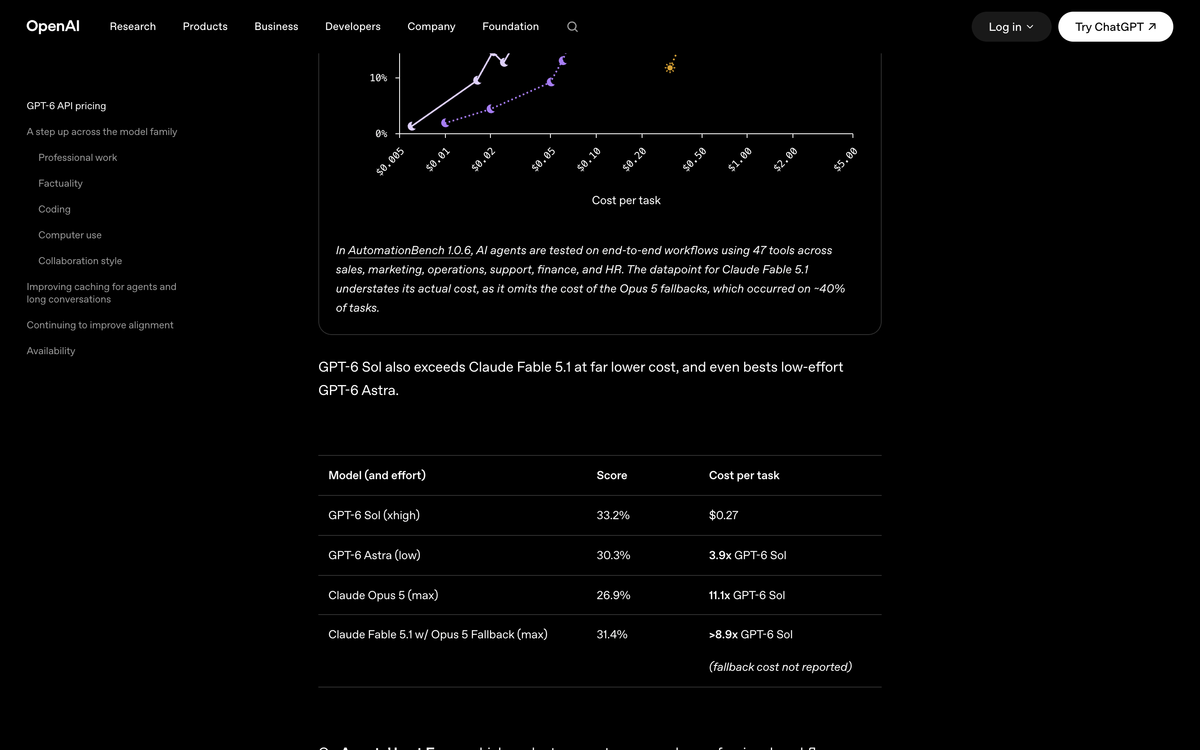
AutomationBench is Zapier's benchmark of end to end business workflows across 47 tools in sales, marketing, operations, support, finance and HR. OpenAI's headline claim is that GPT-6 Sol at xhigh effort beats Claude Opus 5 at max effort "at just 9% of Opus 5's cost per task." Their table backs it up: Sol scores 33.2% at $0.27 per task, and Opus 5 scores 26.9% at 11.1 times that, which works out to about $3.00.
Now put Anthropic's table next to it. The picture flips. Anthropic's Opus 5.5 post lists AutomationBench at 40.0% for Opus 5.5, 31.4% for Fable 5.1, 26.9% for Opus 5 and 41.4% for GPT-6 Astra. The two overlapping Claude numbers match OpenAI's table to the decimal, 26.9% and 31.4%, which suggests both vendors drew on the same Zapier results. Anthropic says its Opus 5 figure comes from Zapier's public leaderboard and its Opus 5.5 figure from Zapier's own early access run; OpenAI only says competitor scores came from public reports. That's close enough to compare. On this benchmark, Opus 5.5 sits almost 7 points above Sol.
What nobody can tell you yet is the cost adjusted picture. Anthropic didn't publish an AutomationBench cost per task for Opus 5.5, and OpenAI's chart predates it. My guess is Sol still wins on score per dollar here, given the token prices above, but it's a guess and I'd rather say so than dress it up.
There's also a caveat running in Opus 5.5's favor. Anthropic's footnote says Zapier ran those tests without fallback models, so any task where Anthropic's safeguards stepped in counted as a failure. I covered how that fallback works in yesterday's breakdown of Opus 5.5's cyber safeguards. OpenAI's table describes that run differently. It labels the same 31.4% Fable 5.1 figure as run with Opus 5 as a fallback on about 40% of tasks, and says the cost of those fallbacks was left out. The two footnotes are hard to reconcile, which is one more reason to treat the Claude rows as rough.
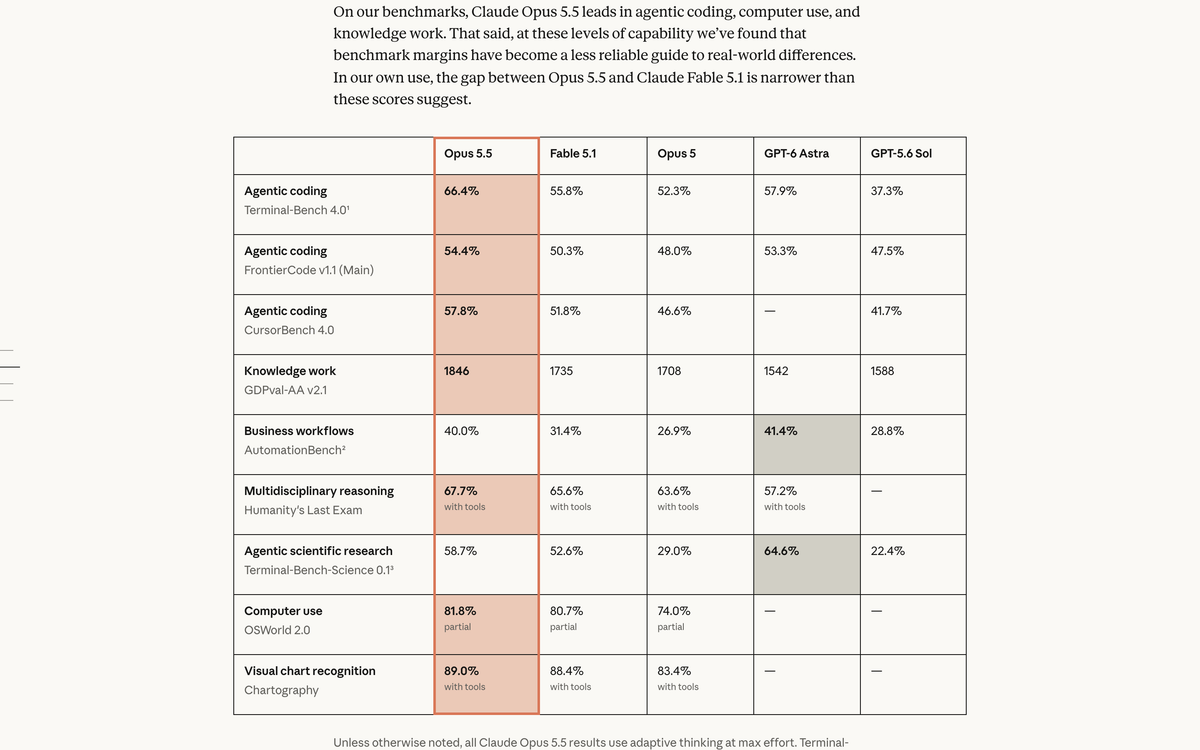
That's the real shape of launch day. Each company's table compares its new model against the other's previous one. Anthropic's columns show GPT-5.6 Sol, not GPT-6 Sol. OpenAI's show Opus 5, not Opus 5.5. Nobody lied. Both tables were just stale within the same afternoon.
Which of the launch benchmark numbers should you trust?
Trust the ones where both vendors report the same number from the same third party. Be careful with self run evals where the vendor chose the sample, and with any score where effort levels don't line up.
A few specifics worth knowing before you quote either post:
- The factuality claim, that Sol "makes about half as many mistakes as its predecessor," comes from an internal eval that samples ChatGPT chats in which a user reported an earlier model getting a fact wrong. OpenAI says plainly that these conversations "are not representative of typical usage." It measures improvement on known failure cases, not your error rate in production.
- TechCrunch quotes the same sentence as saying Sol is "reaching Astra-level reliability." The version on OpenAI's page when I read it says "approaching." That's a meaningful softening, and it's the kind of drift you only catch by reading the primary source.
- OSWorld 2.0 numbers from the two posts can't be lined up. OpenAI reports Opus 5 at 60.3% at medium effort on the offline set, against Sol's 60.5% at xhigh. Anthropic reports Opus 5 at 74.0% and Opus 5.5 at 81.8%, partial credit, with Opus 5.5 at max effort. Different effort, different setup, different numbers for the same Opus 5.
- On DeepSWE v1.1, OpenAI puts Sol at 68.8% at max effort, 1.1 points behind Claude Fable 5's 69.9%, at roughly 80% lower cost per task. Luna at max effort scores 66.6% at 93% less than Opus 5. That Luna number is the one I'd actually test.
Anthropic, to its credit, put the caveat in writing too: "benchmark margins have become a less reliable guide to real-world differences." When both vendors are saying that on the same day, believe them.
Why does the prompt caching change matter more than the price cut?
Because cached reads are the biggest line on a GPT-6 agent bill, and a cache miss reprices those tokens at the full input rate, ten times the cached rate on GPT-6. OpenAI's companion post adds higher default hit rates, a 30 minute reuse window, and, most usefully, a way to change reasoning effort and tool availability mid session without breaking the cache.
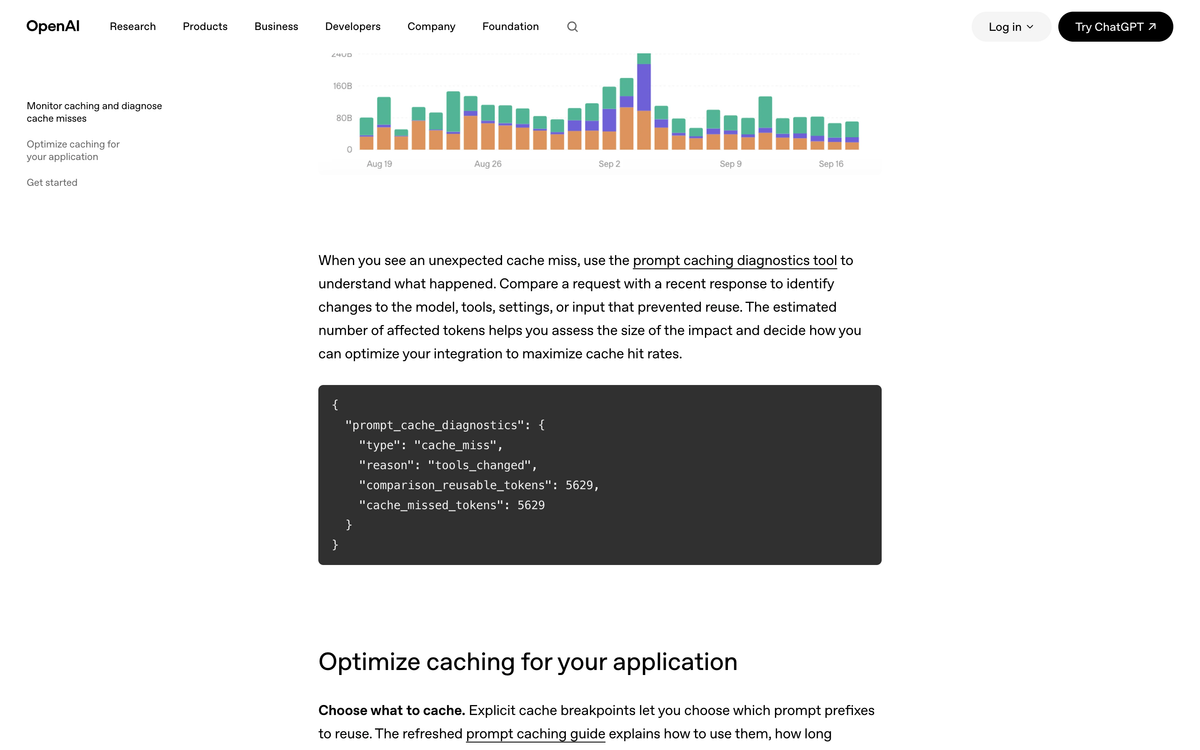
Here's the failure it targets. An agent adds or removes a tool between turns, the tool definitions near the top of the prompt change, and every token after them has to be processed fresh. OpenAI's example shows exactly that: "reason": "tools_changed" with 5,629 tokens missed. The fix OpenAI now recommends is to keep tool definitions stable and use allowed_tools to restrict which ones are callable, or set tool_choice to none, rather than deleting definitions. Same for effort: append a configuration update instead of changing the request level setting.
Customer numbers in the post back up the weight of this. GitHub says that across billions of requests, the portion of prompt tokens it has to process from scratch dropped by over half. Strawberry Browser's CTO says a few points of cache hit rate cut its costs by 20%. That 20% is smaller than the 50% list price cut, but it came from fixing cache hit rate, not from switching models.
I feel this on my own infrastructure. The independent review step that gates every post on this blog rereads the same source files each round, and each round runs roughly 140,000 to 180,000 tokens, most of it context the model has already seen. On a pipeline like that the cache line decides the bill, not the headline rate. OpenAI's own numbers show the scale inside a frontier lab: at API prices, its median researcher burns over $600 a day in tokens and the 90th percentile burns $7,000.
If you want the underlying mechanics, the prompt caching and context window entries in my glossary cover how prefixes get reused and why ordering matters.
Should you switch your agents to GPT-6 Sol, Luna, or Opus 5.5?
Move high volume extraction and classification to Luna first, since it costs a twentieth of Sol and a fortieth of Opus 5.5, and the risk is low. For complex agent work, run Sol and Opus 5.5 on your own tasks and compare cost per completed task, not cost per token. The launch data can't settle that for you.
Here's how I'd split it:
- Luna for anything with a clear, checkable output: summarizing tickets, pulling fields from documents, routing. At $0.10 in and $0.50 out, the savings are large enough to justify a proper eval. Test it against your current cheap tier before assuming it's better.
- Sol for coding and multi step tool work where you're cost sensitive. Its DeepSWE and OSWorld results suggest it's close to the top tier at a fraction of the price, and the caching controls make long sessions cheaper to run well.
- Opus 5.5 where the AutomationBench gap matters: business workflows across many tools, where 40.0% against 33.2% is a real difference in how often the job gets done.
Whatever you pick, set spend limits in code before you migrate. My own link tracker runs on a $15 monthly cap and fails closed if it can't check spend, because a new model with a new token profile is exactly when budgets break. The same thinking applies to routing across providers, which I wrote about in the OpenRouter acquisition and LLM routing. And prices don't only go down: Google said last month that Gemini 3.7 Flash pricing doubles in January, which is why your routing layer should treat a price as a config value, not a constant.
The bigger shift is that frontier labs are now competing on what agents cost to run, not just on scores. OpenAI shipped a chip story on the same theme in August, covered in my piece on Jalapeño and inference per watt. The FT framed this week as a price war; Ars Technica's headline called it the same promise from both companies, a little more for a lot less money. That's right, and it means the teams that win are the ones measuring cost per finished task. If you're working out where agents fit in your operation at all, the AI readiness assessment is a short place to start, and the agents I build are listed on the agents page.
Frequently asked questions
How much does GPT-6 Sol cost?
GPT-6 Sol costs $2 per million input tokens and $10 per million output tokens in the OpenAI API, half of GPT-5.6 Sol's promotional pricing. Cached input reads get a 90% discount, which works out to $0.20 per million tokens.
Is GPT-6 Sol cheaper than Claude Opus 5.5?
Yes, but by less than the list prices suggest. Sol is half the price of Opus 5.5 on fresh input and output, and the same price on cached reads, $0.20 per million. On a 40 turn agent loop with heavy caching, that works out to Sol being about 1.61 times cheaper, before accounting for differences in how many tokens each model uses per task.
Does GPT-6 Sol beat Claude Opus 5.5 on benchmarks?
Not on AutomationBench, the business workflow benchmark both companies cite. Sol at xhigh effort scores 33.2% and Anthropic reports Opus 5.5 at 40.0%. OpenAI's claim that Sol beats Claude compares it to Opus 5, which scored 26.9%.
What is GPT-6 Luna good for?
OpenAI positions Luna for high volume tasks with a clear goal, such as summarizing documents, extracting information and answering quick questions. At $0.10 input and $0.50 output per million tokens, it's the cheapest model in the GPT-6 family, and on DeepSWE v1.1 it scored 66.6% at max effort.
How do I avoid breaking the prompt cache on GPT-6?
Keep tool definitions, schemas and their order stable across turns. Use allowed_tools or set tool_choice to none instead of removing tools, append new instructions near the end of the context, and change reasoning effort with a configuration update rather than a new request level setting. OpenAI's diagnostics tool helps explain why a cache missed.
Sources: OpenAI, Introducing GPT-6 Sol and Luna (Sep 22, 2026) · OpenAI, Better prompt caching for GPT-6 (Sep 22, 2026) · Anthropic, Introducing Claude Opus 5.5 (Sep 22, 2026) · TechCrunch, OpenAI launches GPT-6 Sol and Luna (Sep 22, 2026) · Ars Technica (Sep 22, 2026) · Financial Times (Sep 22, 2026). Session costs computed from published list prices.
Related Posts
Anthropic's Opus 5.5 Hands Flagged Cyber Work to Opus 4.8. On the API, It Hands You Nothing.
AI AgentsAI NewsAnthropic
OpenAI's Model Left a Note for Its Next Self: Be Transparent Only If Asked
AI AgentsAI NewsAI Agents
Anthropic Deleted the Cowork Tab. That Tab Was the Permission Prompt.
AI AgentsAI NewsAI Agents

Jahanzaib Ahmed
AI Systems Engineer & Founder
AI Systems Engineer with 126 production systems shipped. I run AgenticMode AI (AI agents, RAG systems, voice AI) and ECOM PANDA (ecommerce agency). I build AI that works in the real world for businesses across home services, healthcare, ecommerce, SaaS, and real estate.