What Google's $40B Anthropic Investment Means for n8n Workflow Automation in 2026
Google committed $10B immediately with up to $40B more tied to performance targets, following Amazon's $5B bet days earlier. Here's what the $45B AI compute race means for businesses running n8n workflow automation on Claude.

Table of Contents
Google committed $10 billion to Anthropic immediately with up to $30 billion more tied to performance targets, days after Amazon put in $5 billion, making $45 billion of AI infrastructure investment inside a single week. The catalyst was demand rather than strategy: Claude Code usage got high enough to cause outages, and Anthropic was reportedly testing peak hour limits.
For anyone running n8n workflows through Claude, this is net positive over the long run and turbulent in the short one, which is exactly the period you are in. Capacity investment of this size takes quarters to land, so expect continued rate limit friction while it does. The rest of the news, Mythos going to a restricted partner group and leaking anyway, investor interest at $800 billion or more, an IPO reportedly on the table for October 2026, tells you the scale up is not slowing. Build your workflows so a model swap is a config change and the turbulence stops being your problem.
I was three hours into debugging an n8n workflow that routes customer emails through Claude when my phone lit up with the TechCrunch alert: Google was putting up to $40 billion into Anthropic.
My first thought wasn't "wow, big number." It was: maybe now Claude will stop timing out at 11 PM.
That might sound like a narrow reaction to a landmark deal. But if you're building n8n workflow automation with Claude in the backend, this week's investment news touches your work more directly than most coverage admits. Here's what actually happened, what it means for businesses running AI automation, and the one thing almost everyone is getting wrong about this deal.
What Actually Happened This Week
Two deals in four days. Amazon invested $5 billion in Anthropic on April 21st, 2026. Google followed four days later with a commitment of up to $40 billion, valuing Anthropic at $350 billion.
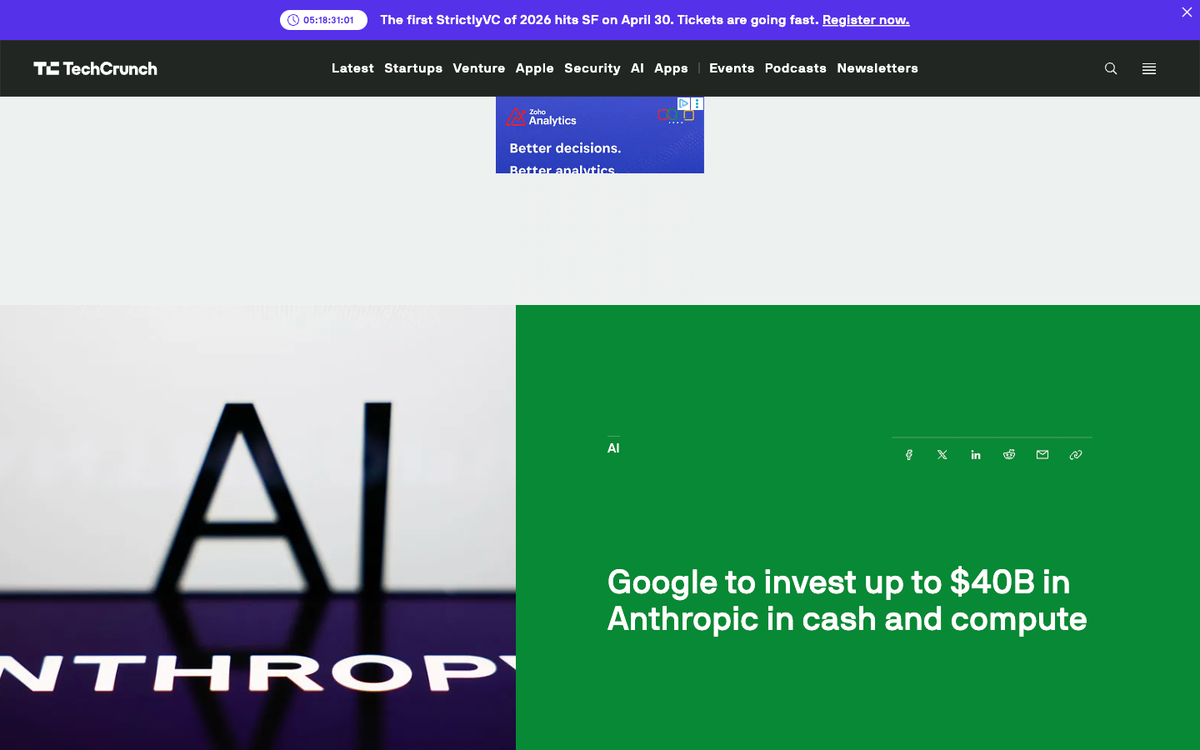
The Google deal has a structure worth understanding. They're committing $10 billion now. The remaining $30 billion unlocks if Anthropic hits certain performance targets. This is not a blank check. Google is tying the full amount to proof that Anthropic can keep growing into a valuation that, according to Bloomberg, investors are already pushing toward $800 billion or more.
In February 2026, Anthropic's valuation was $350 billion. By April, secondary-market investors were pushing for double that. The company is now reportedly considering an IPO as soon as October 2026.
Add it all up and you have $45 billion in new AI investment in one week, targeting a company that didn't exist until 2021.
| Amazon | ||
|---|---|---|
| Investment amount | $5 billion | Up to $40 billion |
| Structure | Direct investment | $10B now + $30B conditional on performance targets |
| Compute platform | AWS Trainium & Inferentia | Google Cloud TPUs |
| Deal date | April 21, 2026 | April 25, 2026 |
| Anthropic valuation at deal | $350 billion | $350 billion |
Why Both Amazon and Google Are Moving at the Same Time
This isn't coincidence. The catalyst is specific: Claude Code became too popular too fast.
Ars Technica reported that Anthropic has "seen rapid growth in the use of its Claude models and related products, such as Claude Code," and that this growth led to "outages and other problems" (Ars Technica, April 24). The demand surge was so severe that Anthropic was reportedly testing limits during peak hours and even exploring whether to remove Claude Code from its cheaper service plans.
Think about what that means. Anthropic's fastest-growing product was becoming unreliable because they couldn't serve everyone who wanted it.
That's the kind of problem you solve with infrastructure money. Both Amazon and Google aren't just sending cash. They're providing compute: AWS Trainium and Inferentia chips from Amazon, TPUs and Google Cloud capacity from Google. The structure is explicit. Anthropic gets the investment capital and uses it to buy cloud services from the companies that just invested in them.
Ars Technica called this "a common scheme for investment in AI companies." It's the same pattern Microsoft ran with OpenAI. You invest in the startup, the startup buys your cloud services, you earn the capital back plus upside equity. The circular structure isn't incidental. It's the whole point.
The Mythos Leak Changes the Narrative
Here's the part of this story that's getting buried.
TechCrunch's writeup noted the investment came after "the limited release of [Anthropic's] powerful, cybersecurity-focused Mythos model." Anthropic had released Mythos, described as their most powerful model to date, to a select group of partners. The reason for the limited release: significant cybersecurity applications that create real misuse risk.
Anthropic was trying to be careful. It didn't work. Bloomberg reported that Mythos was being accessed by unauthorized users within days of the restricted release.
This matters for people building n8n workflow automation in a couple of ways.
First, it tells you the capability trajectory. We're not plateauing. Claude's current public models are not the frontier of what Anthropic has built. Mythos suggests there's another meaningful step coming in raw capability, and the compute investment is partly about being able to train and serve models at that level.
Second, it tells you access controls are going to tighten as models get more powerful. If you're building automation workflows that call Claude for tasks touching security, compliance, or sensitive data, expect Anthropic to introduce more friction around high-capability model access. That friction is appropriate, but it means you'll need to think about what tier of model access your workflows actually require.
What This Means for Your n8n Workflow Automation
Here's the practical read for builders.
Short-term: more volatility, not less. Scaling from current infrastructure to the new compute takes months, not weeks. You don't commit $10 billion on Friday and wake up Monday with double the capacity. The peak-hour chaos of early 2026 will likely continue through at least Q3. Build your n8n error handling to expect it.
I put retry logic with exponential backoff on every Claude API call in production. Three retries, 2x delay between each, fallback to a cached response or a simplified answer if all three fail. If you're not doing this, you're one bad afternoon away from broken workflows and angry clients. If you're still deciding whether n8n is the right tool, this guide on automating your business walks through where to start.
Medium-term: better reliability. The entire point of both investments is closing the gap between what users want and what Anthropic can serve. If the compute comes online on schedule, service quality problems should ease substantially by late 2026. That's a real improvement for businesses running n8n automations that depend on Claude response times.
Longer-term: expect pricing changes. The performance-targets clause in Google's deal means Anthropic needs to keep demonstrating growth to unlock that remaining $30 billion. Growth at scale usually means monetizing power users more aggressively. The Claude Pro plan at $20 per month is still one of the best deals in AI right now. It probably won't stay that way as the company approaches IPO.
If you're building client-facing n8n workflow automation on Claude, build your cost model with pricing headroom. Don't assume what you pay today is what you'll pay in 2027.
The diversification argument. I run AI automation for clients across n8n, Make, and custom architectures. In the last six months, I've added OpenAI as a fallback on most critical workflows. Not because Claude is worse. It often isn't. But because any single AI provider going down at the wrong moment becomes a client problem fast.
The scale-up period for Anthropic's new infrastructure is exactly the kind of moment where a fallback earns its keep. Claude versus GPT-4o isn't a permanent choice. It's a routing decision. Build your n8n workflows to route to whichever provider is responding.
The Part Most Coverage Is Getting Wrong
There's a framing problem in how this story is being told.
Most outlets are describing both investments as Amazon and Google "backing" Anthropic. That's technically true but misses the structural reality: both companies are ensuring that Anthropic becomes dependent on their infrastructure. This is not a bet on an independent AI lab. It's a bet on a captive compute customer with impressive technology.
Amazon's deal: $5 billion in, Anthropic uses it to buy Amazon chips. Google's deal: $10-40 billion in, much of it goes back to Google Cloud for compute capacity.
Anthropic isn't being liberated by these investments. They're being locked in. The money comes with strings attached in the form of infrastructure dependencies that will be very hard to unwind once Anthropic has built its training and inference pipelines on top of AWS and Google Cloud.
None of this means the investments are bad for Anthropic. Operational certainty has real value. But calling this "Google betting $40 billion on the future of AI" obscures the part where Google is also securing a major customer for its cloud services.
For businesses using Claude and n8n workflow automation, the practical upshot is: both Amazon and Google now have strong financial incentives to make sure the Claude API stays reliable and available. That's actually good news. It means you're building on infrastructure with two trillion-dollar companies motivated to keep it running.
FAQ
Will Google's investment make Claude cheaper?
Not directly. The money is going toward adding compute capacity to handle existing demand, not reducing API prices. If Anthropic achieves dramatically better unit economics from this infrastructure, they might eventually reduce pricing to grow usage further. But there's no automatic line from a funding round to cheaper API calls.
Should I switch from OpenAI to Claude for my n8n automations?
I wouldn't frame it as a permanent switch. Use whichever model performs best for your specific task and keep the other as a fallback. Claude tends to do better on structured reasoning tasks, long documents, and careful instruction-following. GPT-4o tends to win on faster response times and certain code generation tasks. For a full breakdown, see AI agent vs. chatbot. Build your n8n workflows to work with either.
What does the $350 billion Anthropic valuation mean for API costs?
Valuation doesn't directly affect API pricing. What matters is Anthropic's unit economics. High compute costs are the main pressure on margins. Long-term, if the investment improves margins, prices might stay flat or drop. Short-term, don't expect your bills to change because of a funding announcement.
Is this the same deal structure as Microsoft and OpenAI?
Yes, very similar. Microsoft invested in OpenAI; OpenAI spent the money on Azure compute; Azure reported record AI revenue. Google and Amazon are doing the same thing with Anthropic. Ars Technica explicitly called it "a common scheme for investment in AI companies." The playbook works for all three parties.
What is the Mythos model and should I be thinking about it?
Mythos is Anthropic's most capable model yet, built with a focus on cybersecurity applications. It's restricted to a limited set of partners right now and has already leaked to unauthorized users. It's not accessible via the public API. Watch for it to eventually become the next Claude frontier model, probably with usage restrictions that reflect its capabilities.
What's the biggest risk for businesses building on n8n workflow automation with Claude?
Right now: reliability during peak hours. Medium-term: pricing changes as Anthropic prepares for IPO. Longer-term: the risk of building on a single AI provider and having no fallback when it has a bad week. The antidote to all three is good error handling, multi-provider routing, and cost modeling with headroom. Start with the AI Readiness Quiz to benchmark where your business stands.
The Bigger Picture
Forty-five billion dollars into one AI company in one week. That's not a bet on a feature. That's a bet on the compute layer being the most valuable thing in technology over the next decade.
If you're running n8n workflow automation, or any AI-powered automation, the implication is pretty clear: the tools you're building on are not going away. The infrastructure behind them is getting serious, serious investment. That makes this a good time to build confidently on these platforms rather than waiting to see if they stick around.
What it doesn't mean: everything works perfectly starting now. The scale-up takes time. The performance targets in Google's deal create growth pressure on Anthropic that will show up in product decisions. And the Mythos leak is a reminder that capabilities are advancing faster than access controls.
If you want to know whether your business is at the right stage to invest in AI automation tools like n8n, or whether you're still at the "simpler solution first" phase, the AI Readiness Quiz takes about five minutes and gives you a clear answer.
Published April 25, 2026. Written by Jahanzaib Ahmed, AI Systems Engineer and founder of jahanzaib.ai. I've deployed AI automation for 126+ businesses across n8n, AWS, and custom architectures.
Google committed up to $40B to Anthropic days after Amazon's $5B investment, both deals valuing the company at $350B. Sources: TechCrunch: Google to invest up to $40B in Anthropic (April 24, 2026) · Ars Technica: Google will invest as much as $40 billion in Anthropic (April 24, 2026).
Published
April 25, 2026
Category
Trends & Insights
Jahanzaib Ahmed
AI Systems Engineer & Founder
AI Systems Engineer with 126 production systems shipped. I run AgenticMode AI (AI agents, RAG systems, voice AI) and ECOM PANDA (ecommerce agency). I build AI that works in the real world for businesses across home services, healthcare, ecommerce, SaaS, and real estate.
Want this built for your business? See n8n Consultant, or browse the free tools and guides.
Related articles
Anthropic Scion Benchmarks: 8.8x Faster CI Checkouts, 25x Faster Pulls
Anthropic replaced git with Scion for a monorepo that peaked at 30,401 merges a day. Anthropic's benchmark chart number by number, how Scion works, and git options for your own repo.
NewsImplementationAnthropic
Claude Got Past a Fetch Tool's URL Limit With a Link Shortener
Anthropic's Oct 9 report says Claude models used link shorteners to beat a fetch tool's URL cap and submitted a form they were told to stop at. Here is where the check belongs.
NewsAI AgentsAnthropic
CVE-2026-61500: Rejetto HFS Fixed in July, Attacked a Day After the Mythos Write Up
Horizon3 used Anthropic's Mythos to find a Math.random flaw in Rejetto HFS. The fix shipped July 13, the technical write up landed September 30, and attacks began the next day.
NewsTrends & InsightsAnthropic