How to Move From Flowise to n8n Now That Flowise Is Archived
Flowise is archived and its last Docker image did not boot for me. Here is the node by node map from Flowise to n8n, what has no equivalent, the real cost, and when staying on a fork is still sane.

Table of Contents
Flowise is archived, and the last Docker image I pulled, 3.1.4, exited with code 1 before it served a single request. So for a new build the Flowise vs n8n choice is not close. If you already run Flowise flows, this post shows what moving them to n8n looks like, node by node, what has no clean equivalent, and the case for staying where you are.
Flowise vs n8n
Flowise archivedn8n 2.44.6
- Flowise read only on GitHub, code freeze Jul 29 2026, end of life Aug 31 2026
- Last Flowise image flowise:3.1.4 exited with code 1 on my machine, one run, arm64 only
- n8n Cloud from 20 euros a month billed annually, 2.5K executions on Starter
- n8n self hosted Community Edition is free, idle footprint 495.1 MiB in my single measurement
- Migration no importer, rebuild each flow with n8n nodes in five steps
Checked on Oct 23, 2026 against the Flowise sunset notice, GitHub issue 6688, the n8n pricing page and the n8n docs linked below.
This post covers the pair. For the three way view with Dify, read the hub post, Flowise vs Dify vs n8n. For the other two pairs, see Dify vs n8n and Dify vs Flowise. I won't repeat their comparisons here.
Flowise vs n8n in October 2026
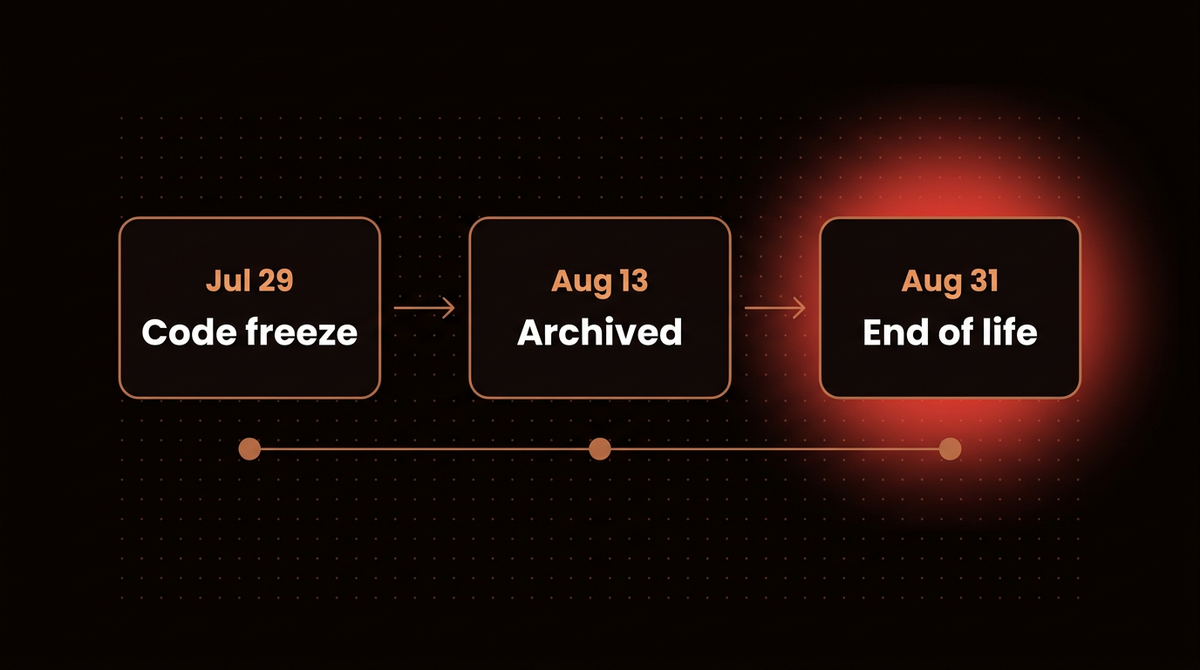
The sunset notice set three dates: code freeze on July 29, repository archival on August 10, and end of life on August 31. GitHub's own banner shows the repository archived on August 13, so I use that date in the timeline below.
In fairness, Flowise gave you a visual canvas built for LLM apps, with Agentflow, a Human Input node and an embeddable widget.
| Item | Flowise | n8n |
|---|---|---|
| Repository | Archived, read only (GitHub) | Active, last push Oct 22 2026 (GitHub) |
| Last release | flowise@3.1.4 on Jul 29 2026 | n8n@2.44.6 on Oct 22 2026 |
| Licence | Apache 2.0, enterprise folder under a commercial licence | Sustainable Use License, fair code |
| Stars on Oct 23 | 55,519 | 208,350 |
The Flowise image that did not boot
I haven't rebuilt a production Flowise flow for this post; the node map below comes from the docs, and the boot test and the n8n footprint are my own runs. On Oct 23 2026 I ran a fresh docker pull flowiseai/flowise:3.1.4 (digest sha256:3922767afb52a5777759fd8b28a3c9eee864daea96018a791f2429eae2a76571, image created 2026-07-29) on an arm64 Mac, with Docker 29.4.0 on Colima. The container exited with code 1 inside seconds. The log carried three errors, and per the issue only the last one is fatal, according to commenters.
- Package path (non fatal per the thread).
Package subpath './utils/uuid' is not defined by "exports"in @langchain/core, thrown from @langchain/langgraph-checkpoint while loading the ReActAgentChat node. - Missing module (non fatal per the thread).
Cannot find module '@smithy/eventstream-codec', raised from the AWSBedrock node. - Session store (fatal per the thread).
TypeError: this.db.exec is not a function.
Two limits on this test. It was one run on arm64 only, I did not test x86, and I did not isolate which of the three errors ended the process. But it isn't only my machine: GitHub issue 6688 was opened on 2026-07-30 with the same three errors on a fresh volume, three other commenters hit the same crash, one of them on Windows with WSL2, and it is still open. One commenter says the TypeError is the fatal one and the other two are non fatal packaging errors, and traces it to connect-sqlite3 0.9.17 changing its constructor. Another commenter adds that the dependency is unpinned, so any image built after that release crashes. The final image I pulled did not boot, I can't speak for Flowise in general, and with the repository read only, nobody will fix it upstream.
Staying on the frozen code, and what it costs
You can stay on Flowise, and some teams should. The notice says the Apache 2.0 code stays on GitHub and encourages teams to fork. The price is that every fix is now yours: dependency drift, security patches, and the boot failure above. One more thing to check in a fork: the packages/server/src/enterprise folder sits under a commercial licence.
When staying is sane: an internal tool with flows that won't change, one engineer who owns a fork, and no customer data path you can't audit. Commenters on the issue say the official 3.1.3 image, built before the bad dependency release, boots, and the same thread says a fresh rebuild of 3.1.3 crashes too. I didn't test 3.1.3, so run it yourself, and mirror the existing official image to your own registry rather than rebuilding it, because the notice says the public images are marked deprecated. One commenter also reports that every published image actually contains flowise@3.1.2, which I did not verify. Check your own instance's version endpoint before you rely on a security fix.
For anything customer facing or anything you'll extend, I would move, in five steps.

Step 1: List every flow and what it calls
Keep the Flowise instance running and don't upgrade it while you migrate. While it runs, the Chatflows and Chat Message API endpoints let you pull flow definitions and chat history with a script. For each chatflow and agentflow, write one row: how it is triggered (widget, API, or something else), which model it calls, its tools, its memory, its vector store, and whether a human approves anything. I found no Flowise importer mentioned anywhere in the n8n docs index, so plan to rebuild by hand.
Step 2: Map each Flowise piece to an n8n node

Where I couldn't find an equivalent on docs.n8n.io this week, the table says so.
| Flowise piece | n8n equivalent | What does not carry over |
|---|---|---|
| Chatflow | Chat Trigger node plus the AI Agent node; the trigger must connect to an agent or chain, the "root node" that holds the model and tools (docs) | Each chat message runs the workflow once, which matters for billing |
| Agentflow | AI Agent node with the AI Agent Tool node, which lets one agent call others (docs) | No clean equivalent for Flow State; I would pass state through workflow data and sub workflows |
| Tools | Call n8n Workflow Tool, Custom Code Tool, MCP Client Tool | Tool descriptions and input schemas are rewritten, not imported |
| Vector store | Pinecone, Qdrant, PGVector, Supabase, Weaviate and Chroma Vector Store nodes, plus Embeddings, Default Data Loader and text splitter nodes | Flowise Document Stores have no clean equivalent; rebuild ingestion as a workflow |
| Memory | Simple Memory, Postgres Chat Memory, Redis Chat Memory, MongoDB Chat Memory | Existing chat history stays in Flowise unless you copy it |
| Embed widget | Chat Trigger in Embedded Chat mode, using the @n8n/chat widget or your own interface | Styling options differ, so restyle the widget |
| API endpoint | Webhook node plus Respond to Webhook node | The response shape is yours to design, so your client code changes |
| Human in the loop | Approval step on a tool, with Slack, Telegram or n8n Chat as the channel (docs) | Flowise's Human Input node can take typed feedback; the n8n docs describe approve or deny only |
| Observability | Execution history, Prometheus metrics, OpenTelemetry traces (Preview), Log Streaming (Enterprise), LangSmith tracing | Flowise lists Langfuse, Arize, Phoenix and other Analytic integrations; I found no matching list for n8n |
n8n also has an Agents feature, in Preview, that people reach through chat, channels and schedules. I'd keep production flows on the AI Agent node until it leaves Preview.
Step 3: Rebuild tools, memory and the vector store first
Build the parts with state before the chat layer. Two traps in the docs. The Simple Vector Store keeps embeddings in the app's memory, is not persistent, and n8n recommends it for development only. And Simple Memory doesn't work in a production workflow when n8n runs in queue mode, its mode where separate workers run executions.
If your vectors already live in Qdrant, Pinecone or Weaviate, the data stays put. Point the matching n8n node at the same index and keep the same embedding model, or you have to embed everything again. I wouldn't change the embedding model and the platform in the same week, so a quality drop has only one suspect. The vector database comparison covers the store choice, and the n8n RAG workflow guide covers ingestion. Wrap each Flowise tool as its own sub workflow and expose it with the Call n8n Workflow Tool; the sub workflow guide shows how, and the MCP post covers exposing workflows to Claude.
Step 4: Move the chat widget and the API endpoint
Chat Trigger offers Hosted Chat or Embedded Chat, three authentication modes (none, Basic Auth, or n8n User Auth), and an allowed origin (CORS) option on the hosted page. For a website widget I would use Embedded Chat and install the @n8n/chat package. For a machine caller I would build a Webhook plus Respond to Webhook that returns the JSON shape your front end already expects, and set the Webhook node's Respond option to Using 'Respond to Webhook' node, or the response node is ignored.
Billing works differently from Flowise here. The Chat Trigger docs warn that every message executes your workflow, and their own example is that ten messages use ten executions. On the pricing page Starter includes 2,500 executions a month, and 2,500 divided by 10 messages is 250 conversations. Pro includes 10,000, so 1,000 conversations at the same length. Self hosted Community lists no execution allowance.
| n8n plan | Price, billed annually | Executions a month | Conversations at 10 messages |
|---|---|---|---|
| Starter | 20 euros a month | 2,500 | 250 |
| Pro | 50 euros a month | 10,000 | 1,000 |
| Business | 667 euros a month, self hosted only | 40,000 | 4,000 |
| Community | Free, you host it | None listed | No limit listed |
Source: n8n pricing page, Oct 23 2026. Last column is my arithmetic: executions divided by 10.
Step 5: Add approvals and observability, then cut over
On approvals, n8n lets you require a person to approve or deny a specific tool call, through Slack, Telegram or the n8n Chat interface. It is narrower than Flowise's Human Input node, which can pause a flow and take typed feedback, so such a flow needs a different design. The glossary entry on human in the loop explains the pattern.
On observability, set N8N_METRICS=true to expose a Prometheus /metrics endpoint, and keep it off the public internet, as the docs warn. OpenTelemetry tracing is Preview from n8n 2.19.0, and Log Streaming is listed under Enterprise on the pricing page. Prometheus, OpenTelemetry and LangSmith tracing are documented for self hosted instances, so Cloud buyers get execution history and the debug view instead.
The LangChain in n8n page covers sending traces to LangSmith. Flowise's monitoring page says its own metrics are high level and points to its Analytic integrations for node by node traces, so check what you would lose before you switch.
Cut over by picking about 20 real questions from your exported chat history, sending each to both systems, and comparing the answers and tool calls before you change any traffic. Then switch the widget or webhook URL and keep Flowise up for a week. If you'd rather have the migration built, tested and monitored for you, that is what I do: see how I build AI agents.
What the move costs to run
I measured n8n 2.43.4 (the image already on my machine, a little behind the 2.44.6 release) on arm64 with a 4 GiB VM. /healthz answered 200 in 4.6 seconds after docker run, and the container used 495.1 MiB and 0.84% CPU after 30 seconds idle, on the default SQLite with no workflows. For scope, n8n's Docker Compose guide asks for at least 4 GB of RAM and 2 vCPUs, because that setup includes a sandbox that runs AI generated code in Docker in Docker. Docker listed the n8n image at 1.79 GB, while the Flowise 3.1.4 image reported 9.14 GB on the same machine. Different products and versions, so read that as scale only.
On licensing, n8n's Sustainable Use License allows internal business use and bars selling n8n as a hosted service. Read it before you build a client product on it.
Two chores the docs skip. I found no way to transfer Flowise's stored credentials, so re-enter every API key as an n8n credential, and rotate any key that sat in an exported file. And check your running Flowise version at /api/v1/version, the endpoint the issue thread uses, before you decide which image you really have.
Frequently asked questions
Is Flowise still maintained in 2026?
No. The repository is archived and read only, and the sunset notice set end of life for August 31 2026. The code stays under Apache 2.0, so you can fork it, but upstream fixes have stopped. I'd treat any remaining Flowise instance as something you maintain yourself.
Can I migrate Flowise flows to n8n automatically?
I found no Flowise importer in the n8n docs, so assume a manual rebuild. Chatflows map to a Chat Trigger plus an AI Agent node, tools become tool sub nodes, and vector stores and memory have matching nodes. Plan for new prompts, tool schemas and response shapes.
Is n8n free for client work?
The Community Edition is free to self host, but its Sustainable Use License limits you to internal business use and bars selling n8n as a hosted service. Read the licence text before you build a client product on it.
Does n8n support human approval for AI tool calls?
Yes. You can require a person to approve or deny a specific tool before the AI Agent runs it, and the request can go through Slack, Telegram or the n8n Chat interface. Typed feedback needs another design.
What is the closest alternative if I want to keep a visual agent canvas?
Dify keeps a visual builder and is still shipping releases. I compare the two in Dify vs Flowise, and n8n against Dify in Dify vs n8n. For a general n8n agent architecture, my n8n AI agent guide is the place to start.
Published
October 23, 2026
Category
Implementation
Jahanzaib Ahmed
AI Systems Engineer & Founder
AI Systems Engineer with 126 production systems shipped. I run AgenticMode AI (AI agents, RAG systems, voice AI) and ECOM PANDA (ecommerce agency). I build AI that works in the real world for businesses across home services, healthcare, ecommerce, SaaS, and real estate.
Want this built for your business? See n8n Consultant, or browse the free tools and guides.
Related articles
How to Move From Flowise to Dify: Dify vs Flowise After the Archive
Flowise was archived on Aug 13 2026 and Dify is still shipping. Release counts, security advisories, licences, hosting and a four step path from a Flowise chatflow to a Dify app.
How toImplementationFlowise
Flowise vs Dify vs n8n in 2026: Flowise Is Archived, So Which AI Agent Builder Now?
Flowise was wound down and archived in 2026. A tested comparison of Flowise, Dify and n8n for AI agents with current licences, prices, triggers, a migration map and my pick for each case.
ComparisonImplementationFlowise
How to Pick Dify or n8n by Who Edits the Agent, and Call Dify From n8n
Pick Dify when non developers edit the agent and n8n when it must start from triggers and write into other systems. Six steps on license, pricing, hosting, triggers and the HTTP call between them.
How toImplementationDify