How to Choose a Legal Answering Service: Costs, Intake Limits and Vendor Questions
Which cover pattern to pick, how per minute, per call and bundle billing change your bill, what a service may ask a caller before conflicts clear, and the questions to send a vendor before you sign.

Table of Contents
A legal answering service earns its fee when it picks up every call in your firm's name, takes a message or a short controlled set of details, and gets a real emergency to a lawyer. On published prices, handling 120 calls a month at three minutes each costs from $162 for an AI service to $1,725 for the only published Ruby plan that covers it, depending on whether the bill runs per minute, per call or as a monthly bundle. The billing unit moves the bill more than any feature does, and the rules about what a service may ask a caller matter as much as the price.
Legal answering service
Prices read Oct 23, 2026US firms
- Cover pattern overflow, after hours or round the clock; choose before you compare vendors
- Billing per minute, per call, or a monthly bundle with overage
- Cost at 120 calls $162 to $1,725 a month at three billed minutes a call (my arithmetic on published plans; $1,725 is a ceiling)
- Before conflicts clear name, callback number, who they want, one phrase on the matter, urgency; no narrative
- Your duty you supervise the service under Model Rule 5.3; the vendor does not carry it
Prices read on each vendor's own pricing page on Oct 23, 2026. Rule text checked against the ABA's published Model Rules 1.6, 1.18, 5.3 and 5.5.
Step 1: Pick the cover pattern before you compare vendors
Every quote is priced against a cover pattern, so choose yours first. Overflow means your own staff answer first and the service takes calls that ring out or arrive while lines are busy. After hours means the service answers from close of business until you open, plus weekends. Round the clock means the service is your front desk at all times. Smith.ai, for one, lets you set its answering hours and sends the rest to a number you choose or to voicemail, so the pattern is a setting.
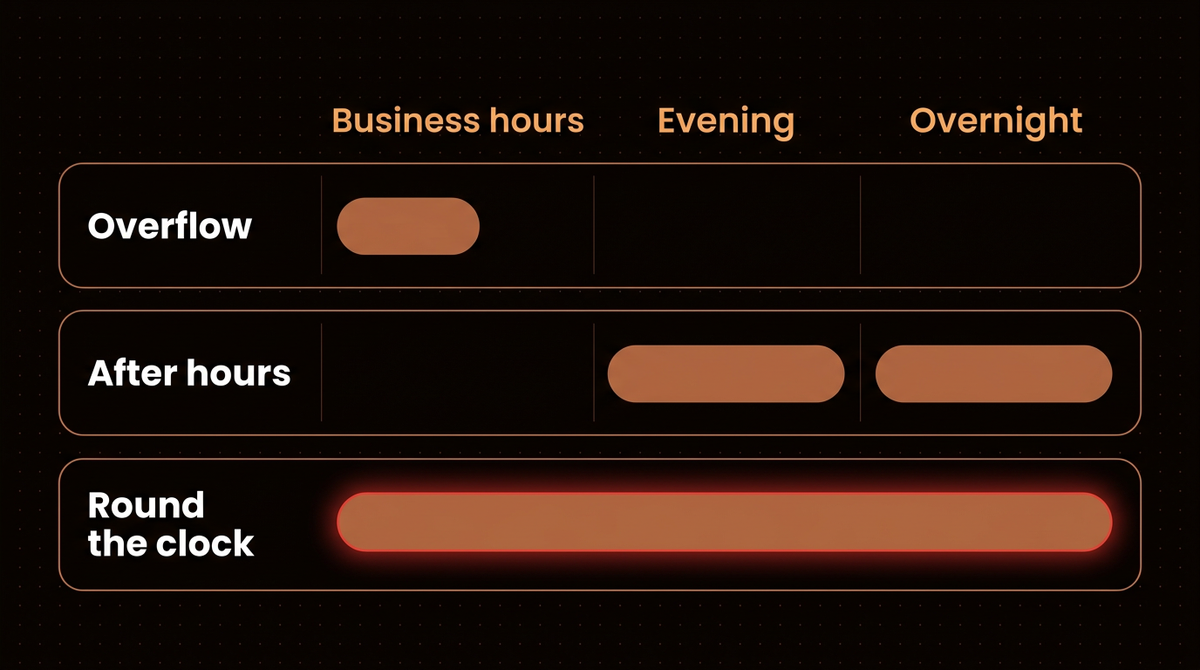
| Pattern | Who answers first | Fits when | Watch for |
|---|---|---|---|
| Overflow | Your staff, then the service on no answer or a busy line | You have a front desk and calls bunch up | Two voices answering; tell the service who is in each day |
| After hours | The service, from close to open and on weekends | Urgent calls now go to voicemail | Escalation rules; callers who expect a lawyer that night |
| Round the clock | The service, always | You are a solo lawyer, often in court | The highest bill |
My rule of thumb is to start with after hours, which is what most people mean when they search for an after hours answering service for lawyers. It is the lowest volume pattern to test, and the alternative at that hour is a voicemail box. If you want consultations booked as well as messages taken, that is the receptionist job I covered in virtual receptionist for lawyers. This guide stays on the answering side.
Step 2: Read the billing model before the price
Whether you call it a law firm answering service, a lawyer answering service or an answering service for law firms, vendors bill in three ways, and each punishes a different call pattern.
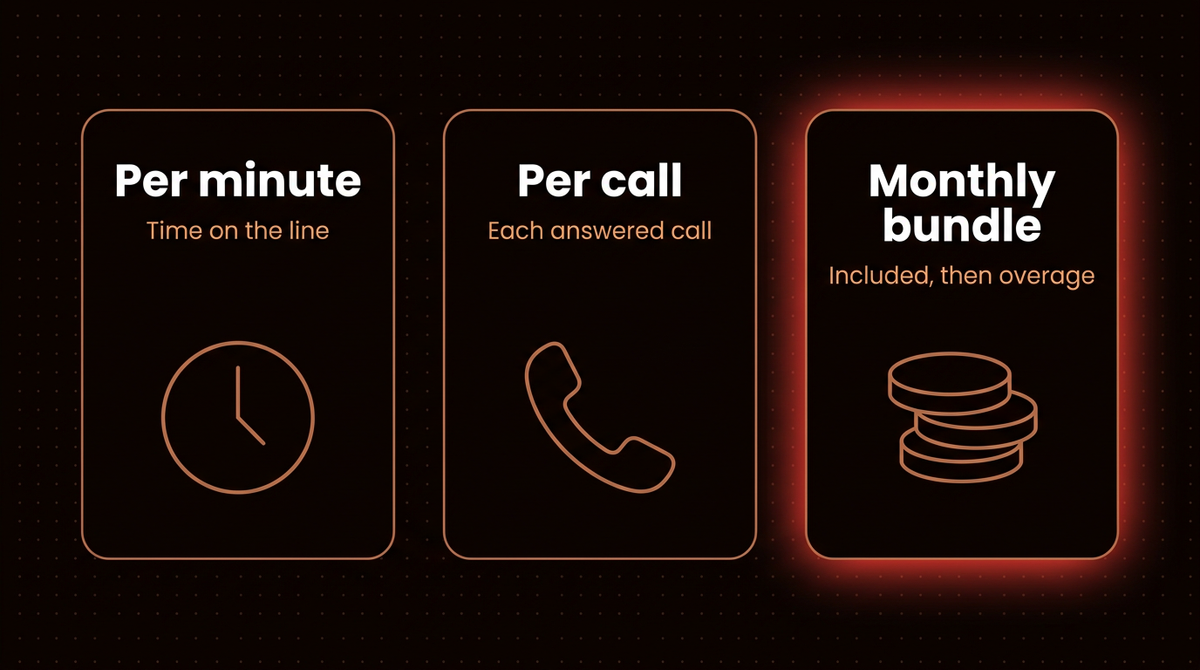
Per minute bills for time on the line. Posh counts the time a receptionist spends on the phone with your callers or on a task for your account. LEX Reception rounds each call up to the next minute and shows no plan prices on its plans page. Long intake calls cost more here.
Per call bills each answered call whatever its length. Smith.ai says a call at 2 am costs the same as one at 2 pm. The catch is a fair use limit: its add ons mention a Reasonable Use Policy and cap some extras, such as one minute of additional questions on third party intake, so ask what counts as a long call.
A monthly bundle with overage sells a block of calls or minutes and bills extras at a stated rate, on top of either unit above. A few skip overage: NextPhone sells unlimited AI calls at a flat price. Some vendors publish no overage rate, so a busy month is a number you cannot compute.
| Service | Billed by | Published plans | Overage and extras |
|---|---|---|---|
| Smith.ai receptionists (human) | Per call | $300 for 30 calls, $810 for 90, $2,100 for 300 | $11.50, $10.50 or $8.50 a call over; conflict checks $0.50 a call; recording $0.25 a call |
| Smith.ai AI Receptionist | Per call | Free for 25 calls; paid $150 for 75, $270 for 150, $500 for 300 | $3.00 a call over the free plan; $2.50, $2.30 or $2.17 over a paid plan |
| Ruby (human) | Per minute | $250 for 50 minutes, $395 for 100, $720 for 200, $1,725 for 500 | No overage rate on the page |
| Posh (human) | Per minute | $65 plus $2.30 a minute, or $130 for 50 minutes up to $1,900 for 1,000 | $2.20 down to $1.90 a minute over |
| Answering Legal (human, law firms only) | Per minute | $360 for 100 minutes, $676 for 200, $936 for 300 | No overage rate on the page; 400 free trial minutes |
| Dialzara (AI) | Per minute of talk time | $29 for 60 minutes, $99 for 220, $199 for 500, $349 for 1,000 | $0.48, $0.45, $0.40 or $0.35 a minute over |
| NextPhone (AI) | Flat monthly | $199, $299 or $599, unlimited calls | No overage fees |
Source: each vendor's own pricing page, linked in the first column, read on October 23, 2026. US dollars a month. Answering Legal and LEX Reception are built for law firms; check the legal features of the others before you buy.
Step 3: Work out the cost per handled call
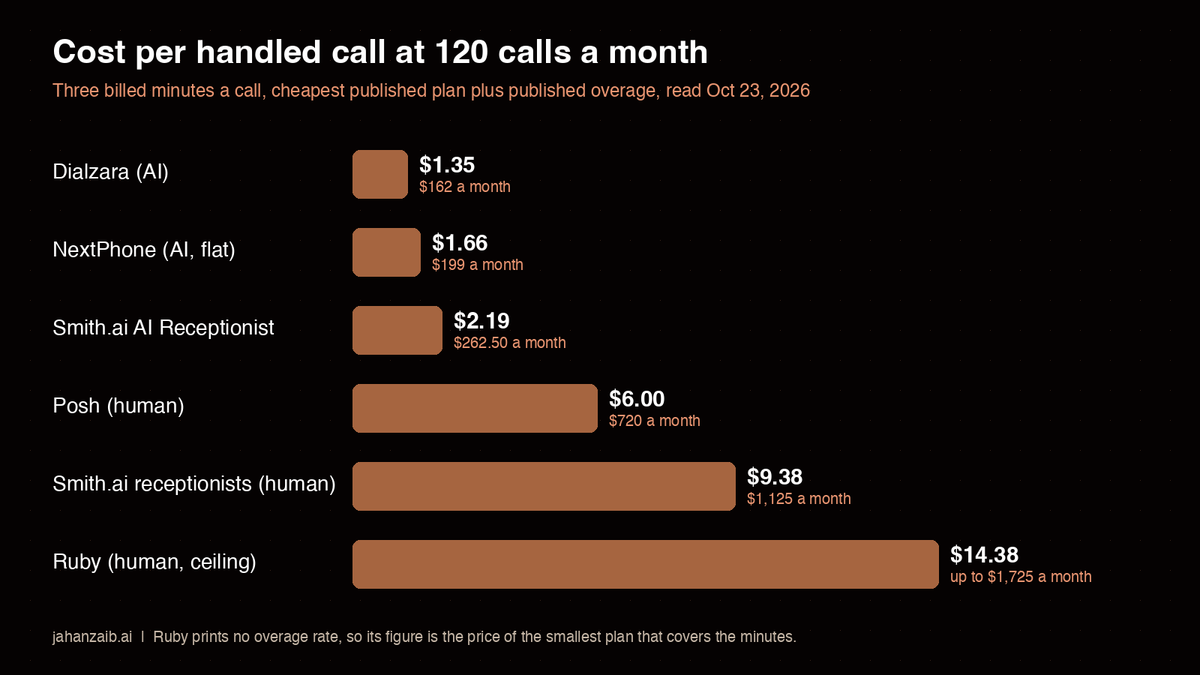
A price table cannot answer "what will I pay", because the units differ. So I ran the published plans through code for three scenarios: a small firm covering evenings at 40 calls a month, overflow plus after hours at 120, and a whole front desk at 300. Each call is billed at three minutes, a "handled" call is one where a message or intake was captured, and I took the cheapest published plan plus published overage. Any cell is checkable by hand: plan price plus extra units times the overage rate.
| Service | 40 calls a month | 120 calls a month | 300 calls a month |
|---|---|---|---|
| Smith.ai receptionists | $415 ($10.38 a call) | $1,125 ($9.38 a call) | $2,100 ($7.00 a call) |
| Smith.ai AI Receptionist | $45 on the free plan ($1.13 a call) | $262.50 ($2.19 a call) | $500 ($1.67 a call) |
| Ruby | Up to $720 ($18.00 a call) | Up to $1,725 ($14.38 a call) | No published plan covers 900 minutes |
| Posh | $258 ($6.45 a call) | $720 ($6.00 a call) | $1,755 ($5.85 a call) |
| Answering Legal | Up to $676 ($16.90 a call) | No published plan covers 360 minutes | No published plan covers 900 minutes |
| Dialzara | $57.80 ($1.45 a call) | $162 ($1.35 a call) | $349 ($1.16 a call) |
| NextPhone | $199 ($4.98 a call) | $199 ($1.66 a call) | $199 ($0.66 a call) |
How to read it: "Up to" is a ceiling, because a smaller plan might fit but the vendor prints no overage rate. "No published plan covers" means the largest published plan is too small and no overage is published. Answering Legal's ROI calculator assumes four minute calls; at that length 120 calls need 480 minutes, still beyond its 300 minute plan. At 120 calls, Smith.ai's receptionists with conflict checks and recording added come to $1,215.
Per minute vendors swing hardest when calls run long, as intake calls do. Here are the same 120 calls at two, three and six minutes.
| Service | 2 minute calls | 3 minute calls | 6 minute calls |
|---|---|---|---|
| Posh | $504 | $720 | $1,404 |
| Smith.ai receptionists | $1,125 | $1,125 | $1,125 |
| NextPhone | $199 | $199 | $199 |
Posh's bill nearly triples between two and six minute calls, while the per call and flat plans do not move. Two cautions apply. An AI call that transfers to a person can cost you twice, and a cheap AI minute is not a human who can hear that a caller is frightened. For that choice, read AI answering service versus human answering service, and for the staffing alternative, what a virtual receptionist costs.
Step 4: Decide what a legal answering service may ask before conflicts clear
Taking a message and running intake are different jobs. Taking a message means recording who called, how to reach them, whom they want and how urgent it is. Intake means asking structured questions about the matter itself. The first carries less exposure. The second can put information in your firm's hands before a lawyer decides whether to take the case.
Start with Model Rule 1.18. A person who consults a lawyer about possibly becoming a client is a prospective client, and the lawyer may not use or reveal what that person said. A lawyer who receives information that could be significantly harmful to the caller cannot take an adverse client in the same or a related matter, and the disqualification can spread to the whole firm. The way out in paragraph (d) needs either informed written consent from both sides, or reasonable measures to avoid more disqualifying information than was reasonably necessary, plus timely screening, no share of the fee and written notice. The rule text does not settle whether a caller who has only spoken to your service has consulted a lawyer, so ask your state bar, and write the script as if the information will count.
Existing clients matter too. Someone ringing your after hours line about their own case tells the operator things that relate to the representation, and Rule 1.6(c) asks you to make reasonable efforts to prevent inadvertent or unauthorized disclosure of, or access to, that information. I read that as putting access controls and transcript handling on your checklist.
Note: This is practical guidance on the operational side, not legal advice. Rules on prospective clients, recording, unauthorized practice and outsourcing differ by state, and I read the ABA Model Rules, not your state's version. Check your state bar before you finalize a script.
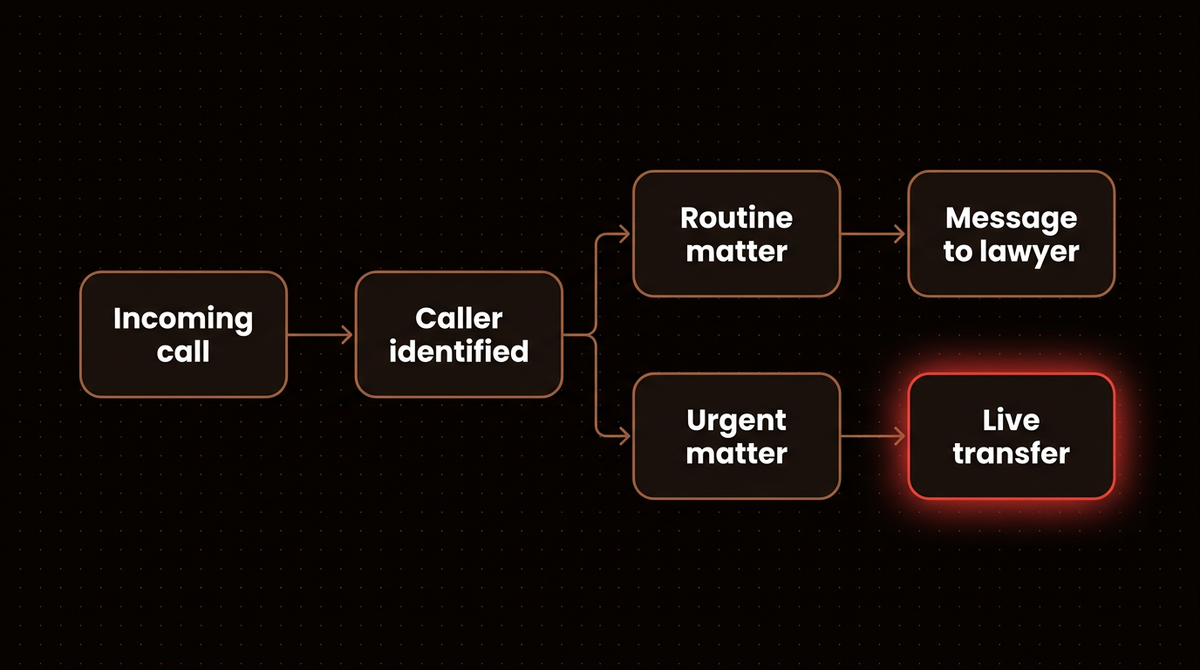
Here is the script card I would hand a service. Five things to capture:
- Name and callback number. Read the number back.
- Existing client or new caller. It changes the routing.
- Who they want to reach. A lawyer, a department or the firm.
- One phrase on the matter. The category in the caller's words, such as "a car accident" or "a landlord dispute", and no story.
- Urgency. Any hearing, deadline, arrest or safety issue triggers escalation.
Names of the other side belong on the card only if your conflicts process needs them before the callback, and then names only. Even these fields are information, so treat the card as the minimum, not a safe harbor. Smith.ai prices a conflict check at $0.50 a call and says its receptionists check leads against your CRM, the only priced conflict check line in the table above. That also means sharing conflict data with a vendor, which is question 6 below.
And three things the service must never promise:
- That the firm will take the matter, or that a lawyer will call back by a time you did not set.
- Any view on the merits, a deadline or what the caller should do legally. A lawyer shall not assist another in practicing law in violation of the profession's regulation. Whether an operator saying "you have a strong case" crosses that line is a state question, so keep it off the script.
- That the call is privileged or that a client relationship exists.
Step 5: Send a vendor questionnaire
The comment to Rule 5.3 says how much checking you owe an outside nonlawyer depends on experience and reputation, the nature of the work, the terms protecting client information, and the legal setting. Turn that into questions and get the answers in writing.
- Recording. Are calls recorded, who can play them, and can I switch recording off for some scripts? Federal law allows recording when the recorder is a party or one party has consented, absent a criminal or tortious purpose (18 U.S.C. 2511), but some states want everyone's consent. California does for confidential conversations, per the Reporters Committee. A recorded announcement at the start is one way to get it.
- Retention. How long are audio, transcripts and messages kept, and can you delete them?
- Subcontracting. Does any other call center, contractor or AI model provider touch my calls, and where?
- Access. Who can read a transcript, is access logged, and can an agent see my whole client list?
- Escalation. What happens on an arrest, a protective order, a looming deadline or a safety threat? Who is rung, how often, and what if nobody answers?
- Conflict data. If you check conflicts, where do the names live, what leaves my system, and is any of it used to train a model?
- Script control. Can I edit and version the script, and read what was asked on each call?
- Business associate agreements. If I provide legal services to a health care client and receive protected health information, will you sign as a subcontractor? 45 CFR 160.103 names legal services and subcontractors in its business associate definition. Ask only if health data is involved.
- Surcharges. Is there an extra price for nights, weekends or holidays? Ruby says its plans carry no extra fee for coverage during certain periods. Ask the others.
- Exit. What happens to my number, recordings and data when I cancel?
Step 6: Write down how you supervise the service
In plain words, Model Rule 5.3 treats the service as your nonlawyer assistant. Partners and managers must make reasonable efforts to have measures in place giving reasonable assurance that the assistant's conduct fits the lawyer's obligations, and a lawyer who directly supervises the assistant must make reasonable efforts to ensure it does. The comment to Rule 5.3 extends that to nonlawyers outside the firm and says to give them directions appropriate to the circumstances. Signing the vendor's terms does not hand the duty over.
A supervision file takes an afternoon: the dated script and escalation protocol, the vendor's questionnaire answers, who reviews calls, and a log of mishandled calls with what you changed. Review a monthly sample of transcripts; ten is my suggestion, not a rule.
Step 7: Trial it with four test calls
Posh's trial runs seven days or 250 minutes, Answering Legal offers 400 free minutes. Use any trial on awkward calls, not friendly ones.
- An existing client who starts describing their case. Does the operator stop and route it?
- A caller who asks "do I have a case?" The operator should decline and promise nothing.
- An arrest at 11 pm. Time the escalation.
- A routine message from a new caller, checked against your card.
Then read the transcripts, not just the summaries.
When an answering service is the wrong tool
A service that takes messages is a poor fit when you want screened, booked consultations at volume. That is the territory of the AI receptionist for law firms and the receptionist services in my earlier guide. I have shipped 126 production AI systems, voice agents among them. The law firm page and the voice agent page for law firms set out what I build. If you would rather talk through your own call pattern first, tell me what your phones look like.
Frequently asked questions
What is a legal answering service?
It is a service that answers a law firm's calls using a script the firm controls, with people, AI or both. It takes messages, captures limited details, transfers urgent calls and passes the result to the firm. It does not give legal advice or accept clients.
How much does a legal answering service cost?
On published plans, 120 calls a month at three billed minutes each runs from $162 for an AI service to $1,125 for human answering billed per call, and up to $1,725 on per minute plans that print no overage rate. The billing unit matters more than the headline price.
Can an answering service do legal intake?
It can capture a short controlled set of details: name, number, who the caller wants, one phrase on the matter and urgency. Fuller intake can put disqualifying information in the firm's hands before a lawyer screens conflicts under Rule 1.18, so let the lawyer ask the detailed questions.
Can a service record calls to my firm?
Federal law allows recording when one party consents, but some states require everyone's consent, and California does for confidential conversations. A recorded announcement at the start is one way to get it. Check your state's statute.
Published
October 23, 2026
Category
Industry Guides
Jahanzaib Ahmed
AI Systems Engineer & Founder
AI Systems Engineer with 126 production systems shipped. I run AgenticMode AI (AI agents, RAG systems, voice AI) and ECOM PANDA (ecommerce agency). I build AI that works in the real world for businesses across home services, healthcare, ecommerce, SaaS, and real estate.
Want this built for your business? See AI Agent Development, or browse the free tools and guides.
Related articles
Virtual Receptionist for Law Firms: Rule 1.18, Real Prices and an Intake Script
What a virtual receptionist for law firms creates on the first call, what the main services cost in 2026 on their own pricing pages, and the intake script that avoids a conflict.
GuideIndustry GuidesVirtual Receptionist
How to Set Up an AI Receptionist for a Law Firm: What It Must Never Do and 14 Test Calls
What an AI receptionist for a law firm may never do, how to disclose and record calls, the escalation rules for urgent matters, 14 test calls to run before go live, and six priced plans.
How toVoice AIAI Receptionist
How to Choose a Virtual Receptionist Service: A Small Business Buyer Guide to the Fine Print
A practical buyer guide to picking an answering service, with published 2026 rate cards, the call length that flips per minute against per call pricing, and the contract terms worth reading twice.
How toIndustry GuidesVirtual Receptionist