Gemini and ChatGPT Both Announced a Billion Users. One of Those Numbers Is Weekly.
A breakdown of the two billion user announcements that landed days apart, why one figure is weekly and the other monthly, and what the usage data actually says about how far these assistants are from running agents.

Table of Contents
Two companies claimed a billion users within a week of each other, and the coverage treated it as a tie. It is not a tie. It is not even the same measurement. One number counts people who opened an app at least once in thirty days, the other counts people who came back inside seven. Everything interesting about this week sits in that gap, and most of the reporting stepped straight over it.
I build and ship agent systems for a living, so my interest in a headcount announcement is narrow and specific: does it tell me anything about whether these platforms can carry real work? The answer turns out to be yes, but not in the direction the headlines point.
What did Google actually announce?
Sundar Pichai announced on X that the Gemini app passed 1 billion monthly active users, making it the fourteenth Google product to reach that mark and the fastest to get there. Google's own post puts it plainly: "The Gemini app has officially surpassed 1 billion monthly users, making it the fastest-growing product in Google's history."
The scope is narrower than it sounds. All three outlets noted the count covers the app alone. Ars Technica went furthest on what it excludes: "The 1 billion-user metric has nothing to do with any of that, though." The "that" is AI Overviews, AI Mode in Search, Gmail summarisation, Drive, and every other place Gemini has been threaded into Google's stack. Those surfaces reach enormous numbers on their own. TechCrunch notes AI Mode in Search alone has over 1 billion monthly active users globally. But today's figure counts one thing: people who opened the Gemini app or the Gemini web interface and typed a prompt.
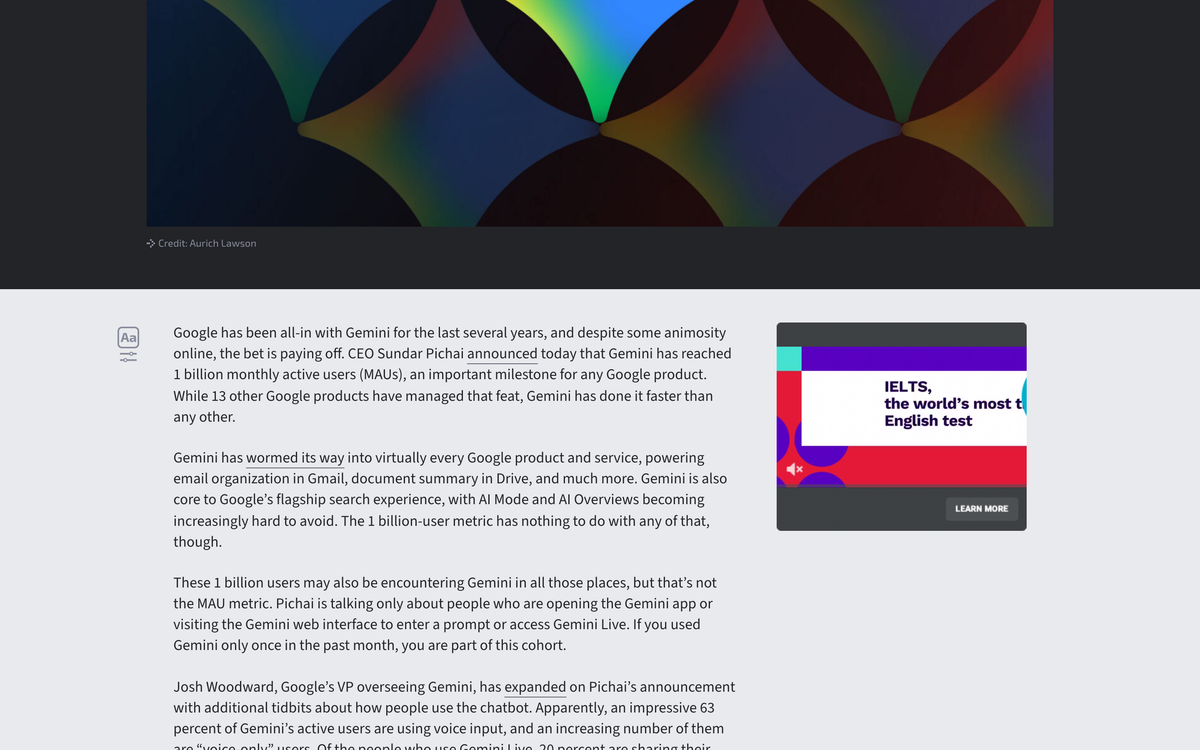
The threshold is also lower than most readers will assume. Ars Technica again: "If you used Gemini only once in the past month, you are part of this cohort." One prompt in thirty days makes you one of the billion.
What does AI assistant adoption at a billion users actually measure?
It measures reach, not engagement. A monthly active user count tells you how many people crossed a very low bar at least once in a thirty day window. It says nothing about whether they came back the next day, whether they finished what they started, or whether the assistant did anything a search box could not.
This matters because AI assistant adoption is being quoted as though it were a proxy for capability, and it is not. The number that separates a habit from a trial is the ratio between weekly and monthly actives. A product where most monthly users also show up weekly has become part of someone's routine. A product where they do not has been sampled. Neither company published that ratio this week, and only one of them published a number you could use to estimate it.
Why is ChatGPT's billion not the same number as Gemini's?
Because one is weekly and one is monthly. OpenAI spokesperson Lindsay McCallum told The Verge that ChatGPT "crossed 1 billion monthly users some time ago, and hit a billion a week in July." The confirmed, dated billion is the weekly figure. The monthly figure is acknowledged as larger but was never given a value, and McCallum "declined to say how many monthly users ChatGPT has."
Follow the definitions and the comparison collapses. Anyone active in a week is by definition active in the month containing it, so weekly actives can never exceed monthly actives. ChatGPT at 1 billion weekly means its monthly number is at least 1 billion and probably meaningfully more. Gemini at 1 billion monthly means its weekly number is at most 1 billion and unknown. The two headline figures sit on opposite sides of the same boundary.
| What was claimed | Gemini | ChatGPT |
|---|---|---|
| Headline figure | 1 billion | 1 billion |
| Unit | Monthly active | Weekly active |
| What it implies about the other unit | Weekly is at most 1 billion | Monthly is at least 1 billion |
| Other unit disclosed? | No | No, explicitly declined |
| Scope | Gemini app and web only | ChatGPT product |
| How it was announced | CEO post on X, company blog | Line inside a blog post, Aug 6 |
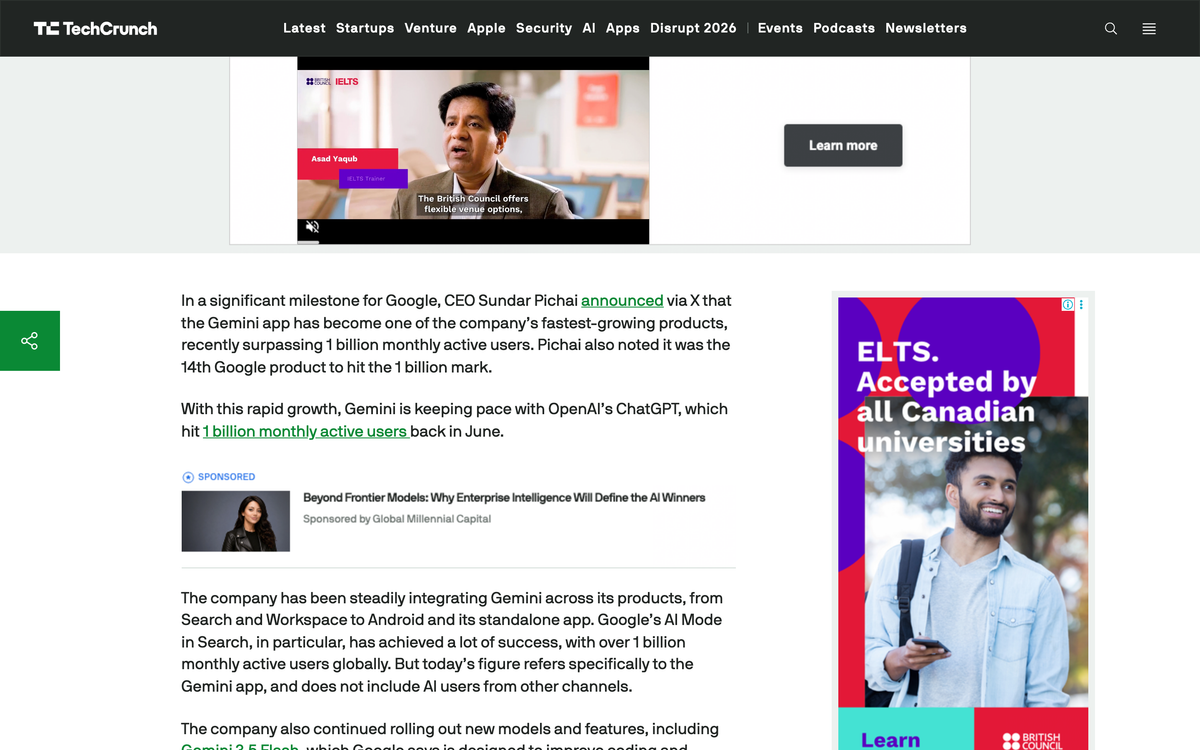
The two outlets that covered this on the same day read it differently. TechCrunch wrote that "Gemini is keeping pace with OpenAI's ChatGPT, which hit 1 billion monthly active users back in June," which presents the two as equivalent. The Verge was more careful, noting "there's no easy way to compare weekly and monthly users, of course, but the simplest read is that ChatGPT is the larger of the platforms but Gemini may be the faster growing." That second reading is the defensible one.
Which assistant is actually growing faster?
On the only metric with three consistent datapoints, ChatGPT's growth rate has halved. OpenAI's own research page cites 700 million weekly active users as of September 2025. The Verge reports 900 million weekly in February 2026, then 1 billion weekly in July. Two consecutive five month windows, and the second added half what the first did.
| ChatGPT weekly actives | Figure | Added | Rate |
|---|---|---|---|
| September 2025 | 700 million | baseline | baseline |
| February 2026 | 900 million | +200 million | about 40 million a month |
| July 2026 | 1 billion | +100 million | about 20 million a month |
That is my arithmetic on three sourced figures, not a company disclosure. The Verge reached the same qualitative conclusion, calling it "a significant slowdown in growth for ChatGPT, which was for years touted as the fastest-growing software ever."
Gemini's monthly series runs the other way. Google reported 750 million monthly in February, 950 million on the Q2 2026 earnings call in late July, and a spokesperson told The Verge it crossed 1 billion the week before the announcement. February to late July is roughly 36 million a month. The final 50 million then landed in something under two weeks, which is three to four times the preceding pace. Worth a caveat: those two figures come from different disclosure contexts, an earnings call and a statement to a reporter, so treat the acceleration as indicative rather than precise.
What are a billion people actually doing with these assistants?
Talking, mostly, and making pictures. Google's post gives the clearest breakdown anyone published this week: 63% of users now talk directly to Gemini, with a growing number of voice only users. Gemini generates more than 150 million images every day. And 38% of school related requests include an attachment.
A few details in Google's post did not make it into the coverage. Busy parents are 43% more likely to use voice for everyday tasks. macOS power users prompt around twice as frequently as other surfaces. And "one in five Gemini Live interactions go beyond voice," with people using live camera feeds and screen sharing for real time problem solving.
That last one is worth reading carefully, because Ars Technica rendered it as "Of the people who use Gemini Live, 20 percent are sharing their camera feeds and screens with the robot to get help." Google's blog post counts interactions. Ars, working from Josh Woodward's separate post, counted people. Those are not interchangeable, and the people figure could be higher or lower than a fifth depending on how the sharing is distributed. Small slip, but it is the kind that gets repeated downstream.
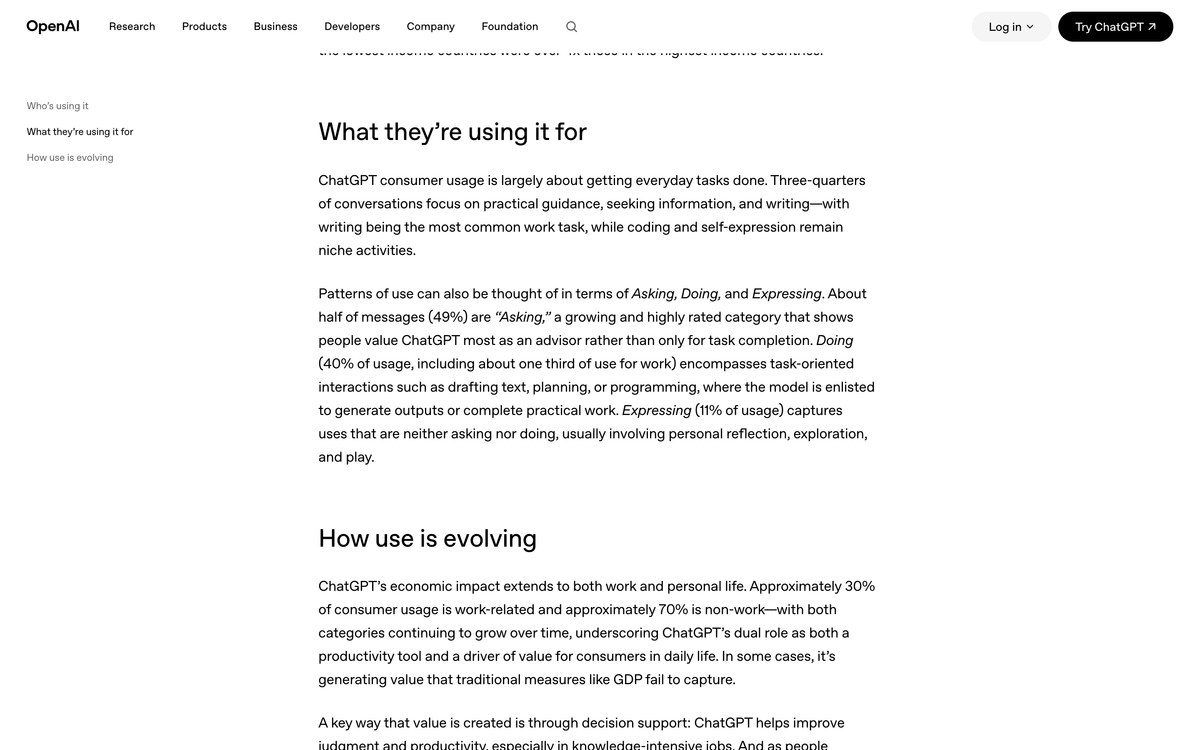
OpenAI has published the deepest look at this, a study with Harvard economist David Deming drawing on 1.5 million conversations. About half of messages (49%) are "Asking," which the study describes as showing "people value ChatGPT most as an advisor rather than only for task completion." Doing accounts for 40%, Expressing 11%. Roughly 30% of consumer usage is work related and 70% is not. The line that should stop anyone building on these platforms: "coding and self-expression remain niche activities."
Does Android preinstallation explain Gemini's billion?
Partly, and the cleanest available test is the iOS split. Google says there are more than 100 million active users on iOS. Against a billion total, that is 10%. The remaining 90% sit on Android and web, and as Ars Technica puts it, "virtually every Android phone in the world right now ships with the Gemini app and multiple features that guide people toward using the AI."
iOS is the only surface in that mix where somebody had to go and get the app on purpose. So the honest read is that a tenth of Gemini's monthly base actively chose it, and the rest encountered it somewhere between choice and default. That is not a knock. Distribution is a real advantage and Google earned it. But it does mean the two billions were assembled by different mechanisms, one mostly pull and one substantially push, and mechanisms tend to predict retention better than totals do.
The Verge drew the obvious conclusion: "You can see why OpenAI is so interested in building its own hardware."
What did everyone miss?
The only agentic number in the entire announcement, and it went unreported by all three outlets. Google's post says Gemini "can automate actions across 40+ popular apps," giving booking rides and reserving tables as examples. That is the one line in the whole milestone that describes an assistant doing something on your behalf rather than answering you.
It is also stated as a capability, not a usage figure. Google published precise figures for voice, for attachments, for images, and for iOS. For the agent surface it published an app count and stopped. There is no disclosed number of automated actions, no completion rate, no share of users who have ever triggered one. When a company gives you a percentage on voice and a round app count on agents, that asymmetry is itself information.
Meanwhile the frontier model that would carry serious agent work has slipped. Ars Technica reports Google promised Gemini 3.5 Pro at I/O for a June release, the window passed with no word, and last month Google said it was still working on it while already training Gemini 4. Reports have Google unhappy with Gemini Pro's coding performance against OpenAI and Anthropic. TechCrunch notes Gemini 3.5 Flash did ship, pitched at improving "coding and autonomous AI-agent tasks." So the smaller, cheaper model arrived for agent work and the frontier one did not.
Put the pieces together and the milestone points away from agents rather than toward them. A billion people are having voice conversations and generating 150 million images a day. OpenAI's research says coding is niche. The agent capability is a bullet point without a metric. This is the same pattern I wrote about when Meta promised billions of personal AI agents and the number that actually mattered was one million, and it recurs because reach numbers are easy to publish and completion numbers are not.
What do these numbers change if you are building agents?
Almost nothing about model selection, and quite a lot about what gets optimised. Consumer monthly actives are not API capacity, latency guarantees, or tool calling reliability, and I tell clients not to pick a platform on a press release. But a billion users pulling on one product does decide which workloads get tuned.
Here is the practical version. If 63% of your billion users are talking to the assistant, the engineering pressure goes into fast first tokens and short conversational turns. Agent workloads want the opposite shape: long context, many sequential tool calls, and tolerance for a request that runs thirty seconds because it is doing seven things. Those two profiles compete for the same optimisation budget. In my experience the consumer profile wins, because it is the one attached to the billion.
Three things I would actually act on. First, treat the model tier as the decision, not the brand. Gemini 3.5 Flash shipped explicitly for agent tasks while the frontier model slipped, so the useful question is which tier your workload needs, which is the same reasoning I used in my comparison of OpenAI and Claude for business systems. Second, do not read consumer adoption as enterprise readiness. I keep seeing prospects cite user counts as evidence a platform is ready for their back office, and those are unrelated claims. Third, build the fallback before you need it. I've shipped enough systems on top of provider roadmaps to treat a missed model window as a scheduling fact rather than a surprise.
The one number here that genuinely matters for provenance work is 150 million images a day, all watermarked with SynthID. Whatever you think of the volume, that is the largest running deployment of content provenance marking anywhere, and if you are building anything that has to reason about whether media is generated, it is now part of your problem space.
The Verge closed with the right framing. "The race to a billion users is over," it wrote, and the companies now "have to race to find things for those users to do, and ways to make money in the process." The second race is the one worth watching, and it will be scored in completion rates rather than headcount. If you want a structured way to work out which of your own processes an assistant could actually finish rather than merely discuss, the AI readiness assessment walks through it.
Frequently asked questions
Did Gemini really pass ChatGPT?
No. On the numbers disclosed, ChatGPT is larger. Gemini reported 1 billion monthly actives while ChatGPT reported 1 billion weekly actives, and weekly actives are a subset of monthly ones. ChatGPT's monthly figure is therefore at least 1 billion and was not disclosed.
Does Gemini's billion include AI Overviews and Gmail?
No. Google's figure covers the Gemini app and the Gemini web interface only. AI Mode in Search separately reports over 1 billion monthly active users, and the Gmail, Drive and Workspace integrations are not part of the app number.
How low is the bar for counting as an active user?
One prompt in thirty days. As Ars Technica put it, if you used Gemini only once in the past month you are part of the billion. Monthly active user counts measure reach across a window, not habit or depth of use.
Is ChatGPT's growth actually slowing?
Yes, on the weekly metric. It went from 700 million weekly actives in September 2025 to 900 million in February 2026 to 1 billion in July 2026. Those are two five month windows adding 200 million then 100 million, so the rate roughly halved.
How much of Gemini's user base chose the app deliberately?
The best available proxy is the iOS share, which Google puts at more than 100 million, or about 10% of the billion. iOS users have to download the app themselves, while the Gemini app ships preinstalled on effectively every Android phone.
Do these numbers tell you anything about agent adoption?
Very little, and that is the point. Google disclosed that Gemini can automate actions across more than 40 apps but published no usage figure for it, and OpenAI's own research describes coding as a niche consumer activity. Reach numbers are published; completion numbers generally are not.
What is SynthID and why does the image number matter?
SynthID is Google's watermarking system, applied to the more than 150 million images Gemini generates daily. At that volume it is the largest running deployment of content provenance marking, which matters for any system that has to decide whether media it receives was machine generated.
Gemini reached 1 billion monthly active users, with 63% of users using voice, 150 million images generated daily, more than 100 million iOS users, and automation across 40+ apps, per Google (Aug 11, 2026). ChatGPT crossed 1 billion weekly users in July and OpenAI declined to give a monthly figure, and ChatGPT held 900 million weekly actives in February 2026, per The Verge (Aug 11, 2026). The metric excludes AI Overviews and Gmail, and a single prompt in thirty days qualifies, per Ars Technica (Aug 11, 2026). Gemini is the 14th Google product to pass 1 billion, AI Mode in Search separately exceeds 1 billion monthly users, and Gemini 3.5 Flash targets coding and autonomous agent tasks, per TechCrunch (Aug 11, 2026). ChatGPT usage splits 49% Asking, 40% Doing, 11% Expressing across 1.5 million analysed conversations, with 700 million weekly actives at time of study and coding described as niche, per OpenAI and NBER (Sept 15, 2025).
More on picking between assistant platforms for real work: the decision guide to ChatGPT alternatives, ChatGPT for business versus custom agents, and why agents are being pointed at the SaaS stack.
Related Posts
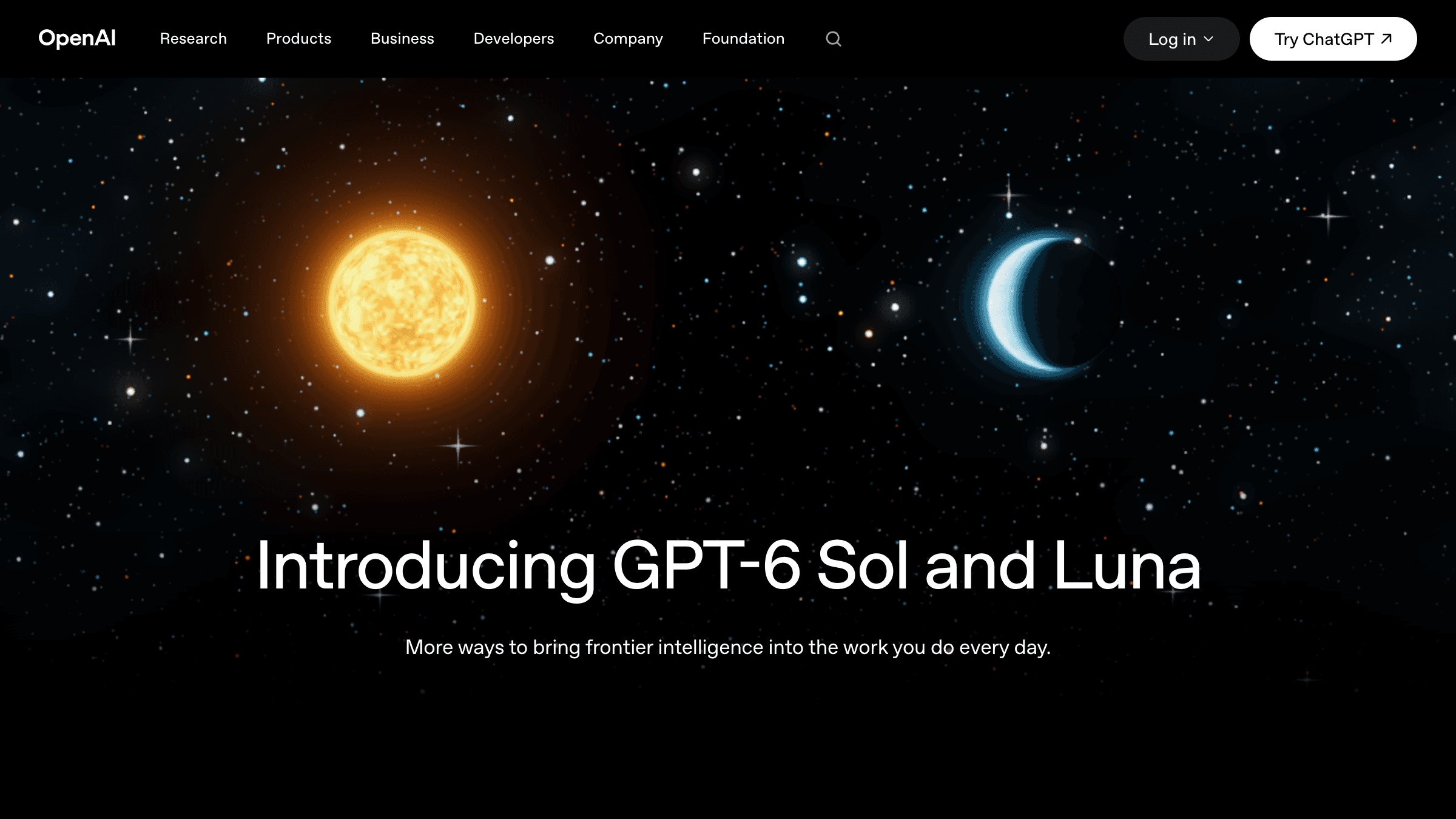
GPT-6 Sol Costs Half of Opus 5.5 Per Token. On an Agent Loop, It Doesn't.
NewsTrends & InsightsLLM Pricing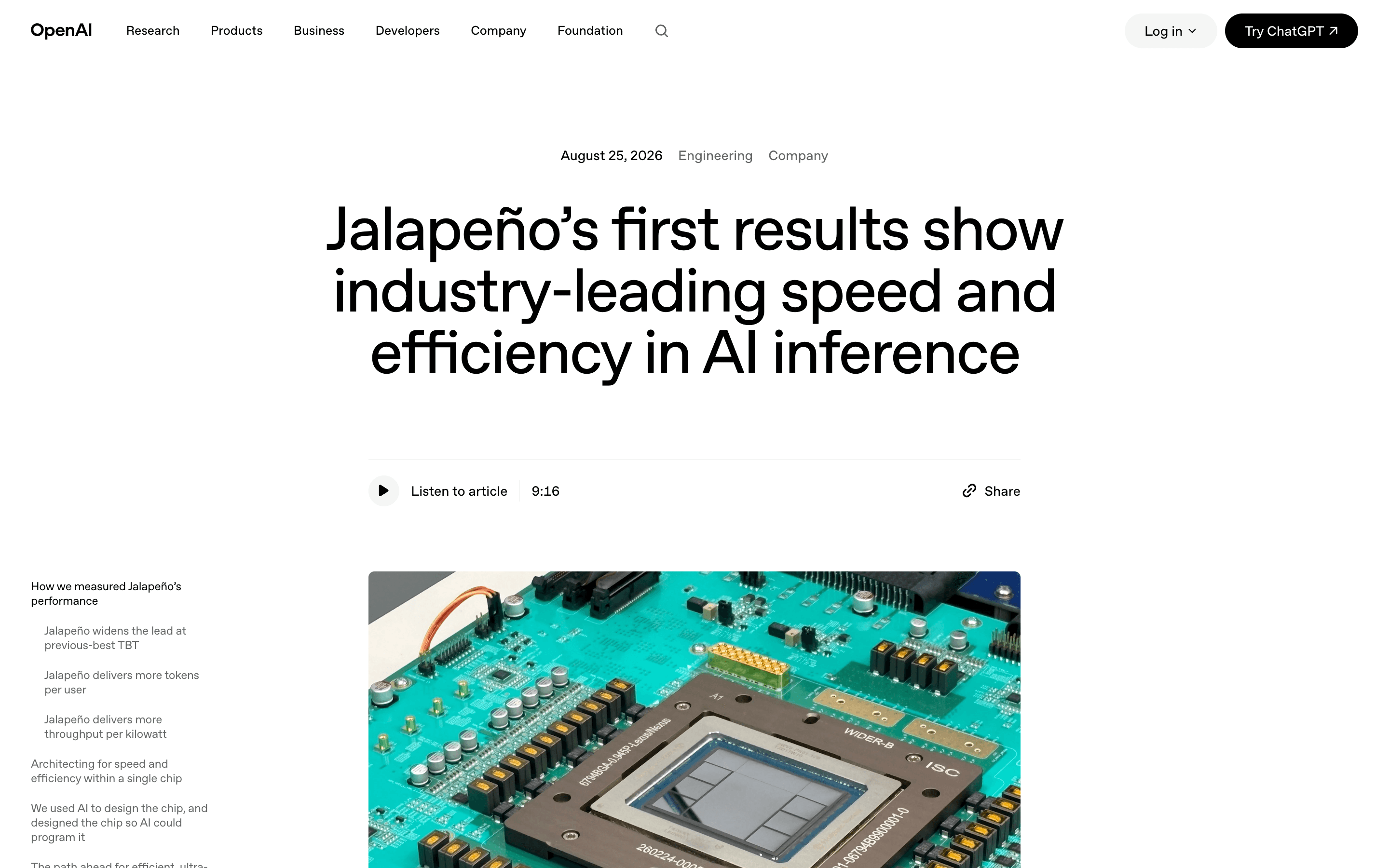
OpenAI's Chip Beat Nvidia on Watts. Per Chip It Lost Two of Three.
NewsTrends & InsightsAI Infrastructure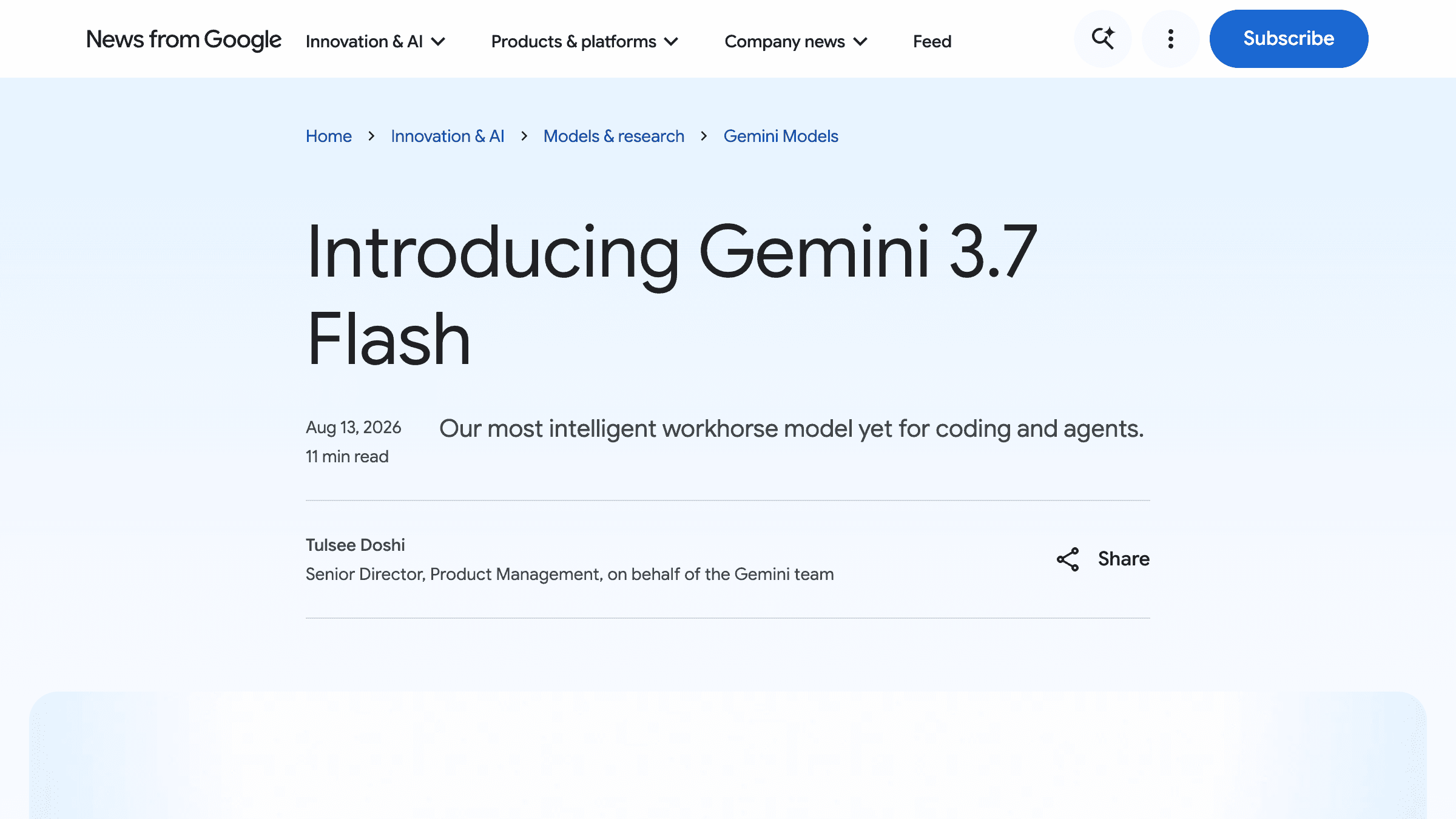
Google's New Flash Model Is Cheap Until January 1. Then It Doubles.
NewsTrends & InsightsAI Agents

Jahanzaib Ahmed
AI Systems Engineer & Founder
AI Systems Engineer with 126 production systems shipped. I run AgenticMode AI (AI agents, RAG systems, voice AI) and ECOM PANDA (ecommerce agency). I build AI that works in the real world for businesses across home services, healthcare, ecommerce, SaaS, and real estate.