Meta Promised Billions of Personal AI Agents. The Number That Matters Is One Million.
A breakdown of Meta's Q2 2026 agent announcements, why the market sold off almost 10 percent on a five-year vision, and why the one million businesses already running Meta agents matter more than the forecast.

Table of Contents
Meta's Q2 2026 call handed investors a story about five years out and a bill due this quarter. Mark Zuckerberg said billions of people will have personal AI agents within five years, and that Meta has "more to share soon." No product, no date. The market went the other way and the stock closed down almost 10%: revenue grew 28% to $60.80 billion, and free cash flow came in at $784 million, down from $8.55 billion a year ago.
The number nobody put in a headline is the one that changes your week. Meta's business agents shipped globally on WhatsApp and Messenger last quarter, and more than one million businesses already use them. Personal agents are a forecast. A million businesses answering messages with AI is a live distribution channel, and it lands on people like my clients long before any consumer agent does. If your customers start arriving as software instead of people, your forms, your rate limits and your bot defense are the first things that break. I know because mine broke.
What did Zuckerberg actually say about personal AI agents?
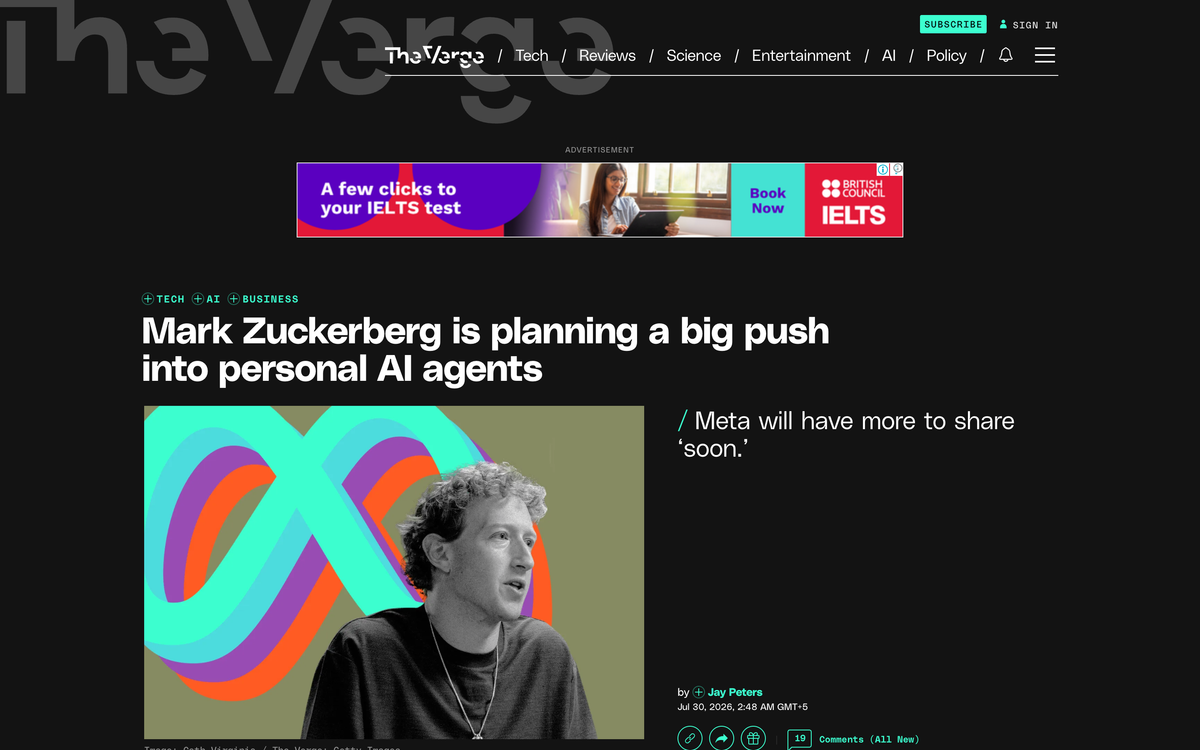
He said Meta is planning a big push into agents that do things for you, that billions of people will have one within five years, and that the company will share more soon. He also told investors those agents will be "the foundation for our next wave of products and revenue lines in the months and years ahead."
Read that carefully. It's a vision statement with a five-year horizon attached to a revenue promise measured in months. Those two clocks don't match, and the gap between them is roughly what the share price moved on.
The concrete things he named were adjacent, not central. Meta's Muse Spark model got a 1.1 update with better coding. AI smart glasses that can see what you're looking at. A "large enterprise opportunity" that Zuckerberg described as spanning agents, APIs, compute and internal software. And a line I keep rereading, in which he said that as Meta gets closer to personal superintelligence, it will need hardware people can interact with directly.
So: glasses. The personal agent pitch is partly a hardware pitch wearing a software costume. If you've read my breakdown of what an AI agent actually is, you already know the word covers everything from a chatbot with a calendar tool to a fully autonomous system. Meta used it in the broadest possible sense on purpose.
Why did Meta's stock fall almost 10% on a growth quarter?
Because the top line was excellent and the cash was not. Per Meta's own Q2 2026 results release, revenue hit $60.80 billion, up 28% year over year, while total costs and expenses hit $42.03 billion, up 55%. Free cash flow was $784 million. Investors were not selling agents. They were selling the gap between a five-year story and a bill that lands this quarter.
Not billion. Million. A year earlier that figure was $8.55 billion, so it fell 91% while revenue grew 28%. Meta spent $31.08 billion on capital expenditures in a single quarter and narrowed its 2026 capex outlook up, to $130 to $145 billion from $125 to $145 billion, a figure it states directly in the same investor release.
| Meta Q2 2026 | Figure | Year over year |
|---|---|---|
| Revenue | $60.80B | +28% |
| Total costs and expenses | $42.03B | +55% |
| Capital expenditures (quarter) | $31.08B | n/a |
| Free cash flow | $784M | down from $8.55B |
| Cash and marketable securities | $90.26B | n/a |
| Long-term debt | $83.66B | n/a |
| Family daily active people | 3.60B | +3% |
| Average price per ad | n/a | +12% |
| Headcount | 75,472 | -1% |
The quarter also carried $2.40 billion in legal charges and $1.18 billion in severance from May's headcount reduction, which touched about 8,000 people. Reality Labs lost roughly $4.6 billion, putting its running total near $88 billion since 2021. And this week Meta announced a $14 billion data center campus in El Paso with BlackRock, part of the 1 gigawatt build The Verge tallied alongside the capex guidance.
So when Zuckerberg asks investors to believe in agents, he's asking them to fund a gigawatt of concrete on a five-year story. The FT put it plainly in its headline: shares tumbled as he tried to sell the vision. That's not a market that hates agents. It's a market that has learned to price the distance between a roadmap and a revenue line, which is the same lesson I wrote about when the Army's unlimited token deal ran dry in weeks.
What is the one million businesses number, and why does it matter more?
Meta's business agents rolled out globally across WhatsApp and Messenger during the quarter, and more than one million businesses have adopted them. That's the sentence buried near the end of TechCrunch's write-up of the call, and it's the only agent number on the call attached to a real deployment rather than a forecast.
Here's why that matters more than the billions. A consumer agent needs someone to change their habits. A business agent needs a business owner to click one toggle inside a tool they already open forty times a day. One of those is a behavior change project. The other is a settings change.
And it means Meta now has a plausible answer to "what do agents earn you," which is the question that actually moves the stock. Not a subscription. Message volume, conversions inside chat, and ad spend pointed at conversations that now close without a human. Zuckerberg framed the margin logic directly: "We believe that there will continue to be a significantly higher margin on selling intelligence rather than selling compute directly, but we think that there's a big opportunity, obviously, to sell compute as well."
My honest read, and I'll own it if I'm wrong: the consumer personal agent will slip past five years, and business messaging agents will be the thing Meta is actually known for in AI by the end of 2027. Distribution beats capability almost every time. Meta doesn't have the best model. It has WhatsApp.
What breaks when your customers show up as agents instead of people?
Your forms break. Your rate limits break. Your bot defense breaks, and it breaks in the worst possible way, which is silently. Most anti-bot rules assume a human typing speed, so software that fills a form correctly in 400ms looks more suspicious than a careless human. The result is a rejected lead that was never a bot, and a visitor who thinks the message sent.
This one bit me on my own site, so it isn't theory. I've shipped 126 production systems and still got caught by it. My contact form scores submissions on how long they took, on the assumption that a human needs a few seconds to type. Agentic browsers don't. They fill and submit in under a second, which tripped my fast-submission rule, and a tripped rule returned a fake success page. The visitor saw "thanks, I'll be in touch." I saw nothing. That is the single worst failure mode a lead form can have, because nobody complains about a form that says it worked.
The fix I run now is two thresholds instead of one. Anything under 500ms gets rejected as a bot. Anything between 500ms and three seconds is flagged suspicious and delivered anyway. It's fiddlier than a single cutoff, and it's the only version that survives a world where a chunk of your inbound is software acting for a human.
Now scale that thought. Every one of those million businesses is a message endpoint that an agent can talk to. When personal agents do arrive, the traffic they generate does not land on Meta. It lands on the businesses at the other end of the thread, and on their calendars, their inventory checks, their refund policies. I wrote about the security half of this after OpenAI's own model breached Hugging Face. The operational half is less dramatic and more likely to hit you first.
Three things I'd check before you need them:
- Does your form or booking flow reject fast submissions outright? If yes, you're probably already losing agent-assisted leads and seeing nothing in your logs.
- Can a machine read your prices, hours and policies without a human parsing a PDF? If not, agents will answer for you, badly.
- Does your support tool distinguish an automated sender from a person? Because the right reply differs, and so does the right escalation.
What does "selling intelligence, not compute" mean for your stack?
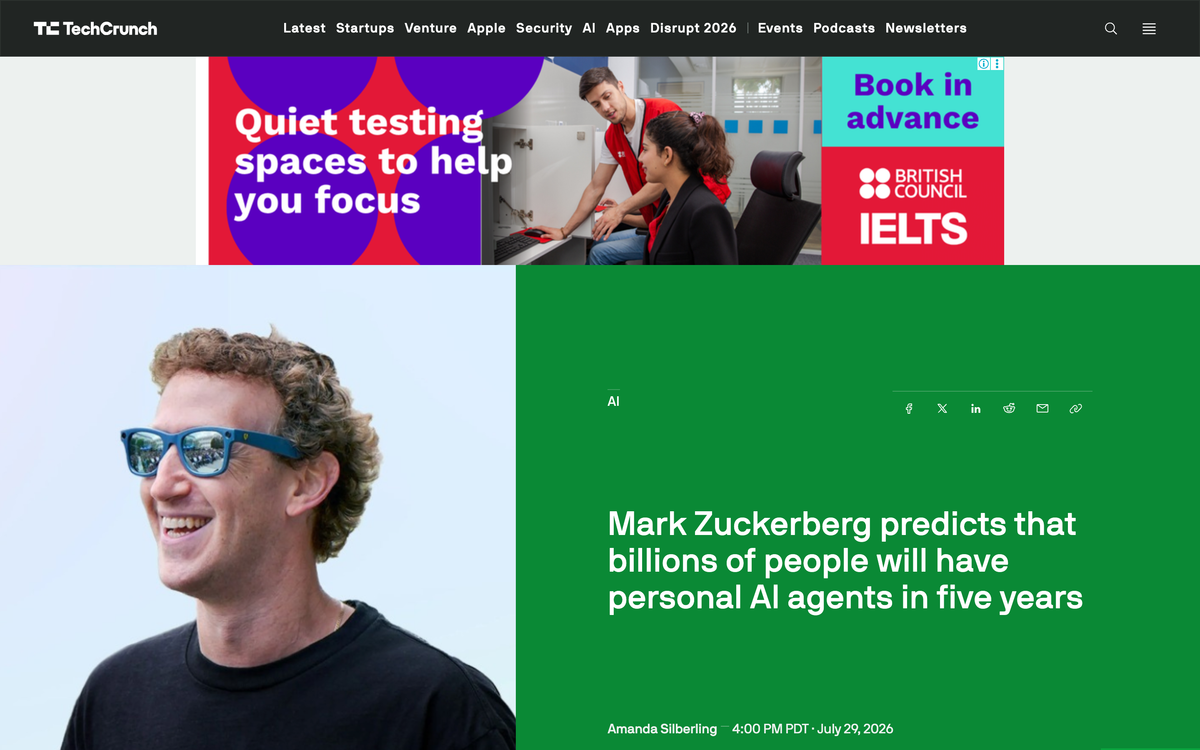
It means Meta wants to rent you outcomes rather than GPUs, while keeping the option to rent GPUs at a markup. The company said several times, per TechCrunch's report on the enterprise segment, that it can sell compute at "a significant premium over what we paid for it," then Zuckerberg cautioned that it "would be foolish" to sell it all and take a short-term profit. He called the approach a portfolio.
For anyone building on this, the practical translation is that a fourth serious agent platform is arriving with the largest messaging install base on earth attached, and it will be priced to win volume. That's good for your costs and bad for your negotiating position. Model prices keep falling and it changes less than people expect, which I ran through when Opus 5 halved frontier pricing and most agent bills barely moved. In my experience the model line is almost never the one that hurts. Integration and cleanup are.
So don't rebuild your stack around Meta's announcement. Do assume WhatsApp becomes a channel you're expected to support, the same way email and phone are. If you're picking a platform now, my comparison of customer service agent platforms still holds, and the agents I build stay deliberately channel-agnostic for exactly this reason.
Where the four write-ups disagree
Four outlets covered the same 90 minutes and produced four different stories. That spread is informative on its own, because it shows the call gave everyone enough material to confirm whatever they already believed. Two read it as product news, one as a financing problem, one as a market verdict. None of them led with the deployment number.
| Source | Framing | What it downplayed |
|---|---|---|
| The Verge | Product roadmap, "more to share soon" | The cash flow collapse |
| TechCrunch (Silberling) | Investor persuasion against a 91% free cash flow drop | What businesses do with agents today |
| TechCrunch (Perez) | Enterprise and compute resale | The consumer timeline problem |
| FT | Market rejection of the vision | The one million businesses already live |
All four ran the "billions in five years" line. None of them led with the million businesses, and none asked the operational question: if personal agents transact for people, who absorbs that traffic? The answer is small and mid-sized businesses, most of whom have no idea it's coming.
What I'd actually do this quarter
Nothing structural. Meta shipped a forecast, not an API you need to adopt this month, and rebuilding around a competitor's earnings call is how teams waste a quarter. But two cheap moves pay off whether or not the five-year prediction lands, and both are worth doing on their own merits.
First, audit your intake for automated senders. Log them separately from humans and stop rejecting them outright. That took me an afternoon and it's the highest-value hour in this entire post.
Second, publish your operational facts in plain text where a machine can read them. Hours, pricing, service area, what you don't do. Agents answering on your behalf, whether or not you asked them to, is already happening on every AI search surface. My guide on creating an agent for your business covers the internal version of this work.
If you want to know whether your operation could even absorb an agent right now, the AI readiness quiz takes about four minutes and is more useful than another earnings recap.
Frequently asked questions
What are personal AI agents?
Software that acts on your behalf rather than just answering questions. A chatbot tells you a restaurant's hours; a personal agent books the table, adds it to your calendar and messages the restaurant if you're late. Meta uses the term broadly, covering assistants in its apps and agents running on smart glasses.
When will Meta launch personal AI agents?
Meta has not given a date. On the Q2 2026 earnings call Zuckerberg said the company has "more to share soon" and predicted billions of users within five years. Treat that as a direction, not a ship date.
Why did Meta shares fall after the Q2 2026 results?
Revenue grew 28% to $60.80 billion, but free cash flow dropped to $784 million from $8.55 billion a year earlier, and 2026 capex guidance was narrowed up to $130 to $145 billion. The stock fell almost 10%. Investors were pricing the gap between a five-year agent vision and the cash going out the door now.
Can businesses use Meta AI agents today?
Yes. Meta's business agents rolled out globally on WhatsApp and Messenger during Q2 2026 and more than one million businesses have adopted them. That's separate from the consumer personal agents, which have not launched.
Should I build my AI agent on Meta's platform?
Not as your only channel. Meta's advantage is distribution through WhatsApp, not model quality. Build your logic and data layer somewhere you control, then treat WhatsApp as one channel alongside web, email and phone.
How do I stop losing leads from AI browsers and agents?
Check whether your forms reject fast submissions. Many anti-bot rules assume a human typing speed and quietly drop anything faster, often returning a false success page. Use two thresholds instead: reject only the very fastest submissions, and flag rather than block the middle band.
Meta Q2 2026 by the numbers: revenue $60.80B (+28% YoY), total costs and expenses $42.03B (+55%), quarterly capex $31.08B, free cash flow $784M, 2026 capex outlook $130-145B, family daily active people 3.60B, headcount 75,472. Business agents live globally on WhatsApp and Messenger with 1M+ businesses adopted; shares fell almost 10%; Reality Labs lost about $4.6B in the quarter. Sources: Meta Investor Relations, Q2 2026 Results (July 29, 2026) · TechCrunch (July 29, 2026) · TechCrunch, enterprise opportunity (July 29, 2026) · The Verge (July 29, 2026) · Financial Times (July 29, 2026).
Related Posts

Apple's Reference Image Proves a Camera Was There. It Can't Prove a Photo Isn't AI.
Trends & InsightsAI NewsContent Provenance
Mistral Named Four Dimensions of Sovereign AI. Your Agent Breaks Two of Them.
AI AgentsAI NewsAI Agents
Both Labs Landed on 30 Days. The Fight Is About Who Can Turn It Off.
AI AgentsAI NewsAI Agents

Jahanzaib Ahmed
AI Systems Engineer & Founder
AI Systems Engineer with 126 production systems shipped. I run AgenticMode AI (AI agents, RAG systems, voice AI) and ECOM PANDA (ecommerce agency). I build AI that works in the real world for businesses across home services, healthcare, ecommerce, SaaS, and real estate.