What Are the Real AI Use Cases in Financial Services? (A Guide for Independent Advisors and Firms)
Every other article about AI in financial services targets JP Morgan and Goldman Sachs. This one is for the independent advisor, accountant, and insurance agency trying to figure out what actually applies to their size of business.

Explore with AI
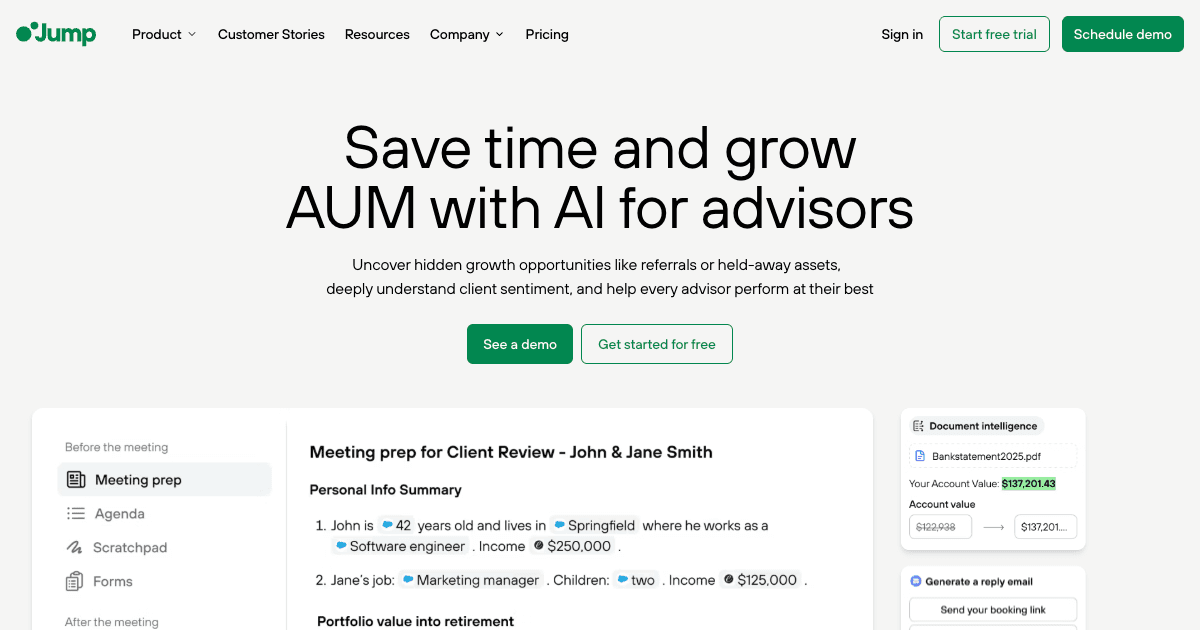
Table of Contents
An advisor I worked with was losing about eleven hours a week to work that had nothing to do with advising: typing up meeting notes, sending onboarding packets by hand, writing follow up emails from scratch. That is the shape of the opportunity for an independent firm, and it is unglamorous on purpose. The practical use cases are meeting notes, document processing, client onboarding, and follow up automation.
Adoption has moved quickly. In NVIDIA's 2026 State of AI in Financial Services report, a survey of more than 800 industry professionals, 65% said their company is actively using AI, against 45% in the previous year's report, and 64% said AI has raised annual revenue by more than 5%. Tools like Jump AI and Zocks are built specifically for advisors and connect to CRMs such as Redtail and Wealthbox, so the connection is a setup task rather than a build, although keeping it connected takes some care (more on that below). What none of it replaces is your judgment or your client relationships. It clears the eleven hours so more of the week goes to the advice.
A financial advisor I worked with last year was spending about 11 hours a week on tasks that had nothing to do with advising. Meeting notes typed up after calls. Client onboarding packets sent manually. Follow up emails written from scratch each time. Compliance logs updated by hand. He had built a solid book of business but felt like he was running a data entry operation, not a financial services firm.
He asked me about AI use cases in financial services and whether any of them actually applied to a one person practice. Not JP Morgan. Not Goldman Sachs. Him.
That question comes up constantly. Most of what gets written about AI in financial services is written for large institutions with IT departments and six figure software budgets. If you run an independent advisory firm, an accounting practice, or an insurance agency, you could be forgiven for thinking none of it applies to you.
It does. But the use cases look different at your scale.
What AI in financial services actually means at your scale
When NVIDIA published its 2026 financial services AI survey, the headline numbers were staggering. 65% of firms actively using AI. 64% reporting revenue increases above 5%. The McKinsey figure that gets quoted next to them, $200 billion in value from generative AI, is narrower than it sounds: McKinsey's December 2023 estimate is $200 billion to $340 billion a year for banking alone, not the whole industry and not independent advisors.

Those numbers describe the industry as a whole, not a two advisor practice. Gartner's finance data points the other way on results. In a June 2025 survey of 183 CFOs, which Gartner published on June 8, 2026, 84% of finance organizations had implemented or were planning to implement AI, yet only 7% reported a high or very high impact. Lots of activity, not much result.
The firms seeing real ROI are not the ones buying the most expensive platform. They are the ones identifying two or three high friction tasks and automating those specifically. A 50 person accounting firm replacing 15 hours of manual reconciliation per week. A two advisor practice automating post meeting summaries and follow up emails. An insurance agency using AI to handle inbound inquiry triage at midnight.
That is where the actual opportunity is for independent financial services firms in 2026.
This post stays with advisors, wealth managers and the operations of the firms around them. If you work in banking, lending or insurance and want the generative AI angle (fraud monitoring, client chatbots, reporting), my companion post on generative AI use cases in financial services covers that side.
The 7 most practical AI use cases for independent financial firms
I have helped implement AI workflows for advisory practices and financial services businesses across the Americas. These are the use cases that deliver measurable time savings fastest.
1. Meeting notes and client summaries
This is the single highest ROI use case for financial advisors right now. Tools like Zocks and Jump AI capture your Zoom, Teams or in person meetings, transcribe them, extract action items, and generate structured meeting notes that sync to your CRM. Advisors I work with report saving 45 to 90 minutes per client meeting when you factor in note taking, summary drafting, and follow up email writing. For a public reference point, Morgan Stanley's June 26, 2024 release on its own Debrief notetaker quotes one advisor saving about half an hour per meeting. That is a testimonial, not a measured study. Debrief works with client consent, drafts an email the advisor edits and sends at their discretion, and saves a note into Salesforce, which is a sound template for any firm.
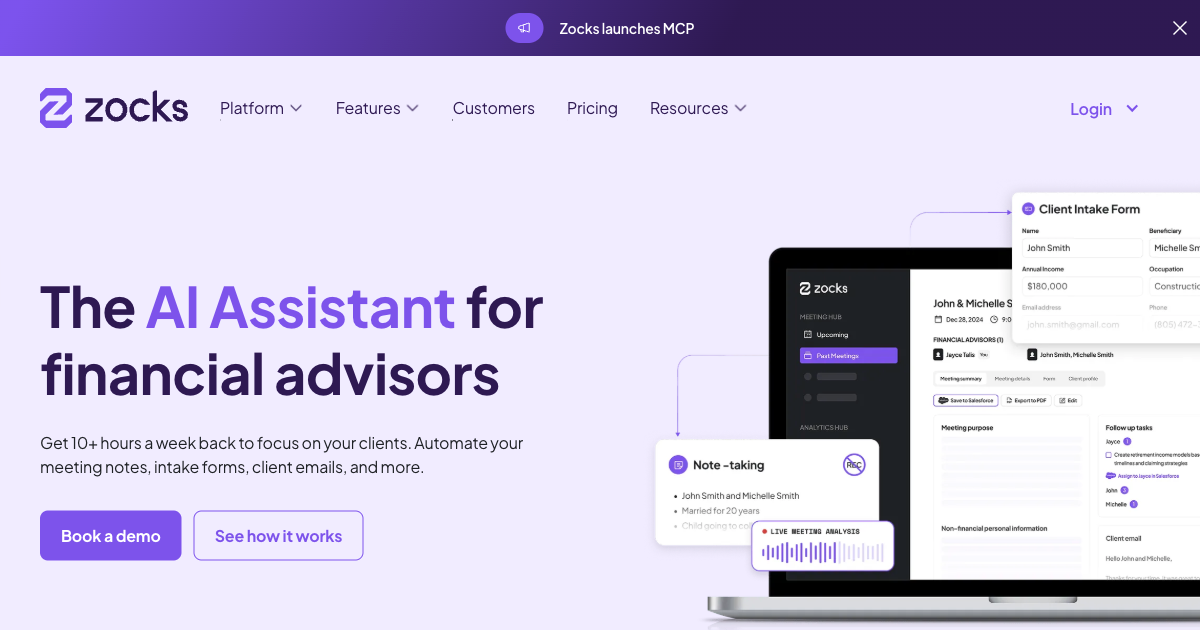
Zocks lists Wealthbox, Redtail and Salesforce on its integrations page. On its security page it says it received SOC 2 Type 2 certification in November 2023, that client data is never used to train large language models, and that client conversations are never recorded. Jump AI does similar work with CRM integration and post meeting email drafting; its security page says it maintains SOC 2 Type II compliance assessed by an independent auditor over a continuous 12 month period and that meeting recordings, transcripts and summaries are never used for training. Those are vendor statements checked on October 17, 2026, so ask for the audit report itself. Whichever tool you pick, set it so you read and approve each draft before anything goes to a client.
Zocks and Jump side by side (checked October 17, 2026)
This table only holds what each vendor says on its own pages. I did not test either tool for this post, and I found no independent accuracy comparison of the two.
| Item | Zocks | Jump |
|---|---|---|
| Recording | States that client conversations are never recorded | Offers a no recording option or optional compliant recording and transcription (jumpapp.com/compliance) |
| Security statement | SOC 2 Type 2, certified November 2023, in its words | SOC 2 Type II, 12 month audit period, in its words |
| CRM integrations | Redtail, Wealthbox and Salesforce on its integrations page, plus 40+ two way integrations overall | Redtail (embedded), Wealthbox and Salesforce on its integrations page, plus 30 to 40+ integrations overall (its pages differ) |
| Archiving and supervision | Supports archiving of transcripts and summaries, naming Smarsh and Global Relay | Archives selected outputs to Global Relay, Smarsh or Proofpoint, with audit trails; recording is optional (jumpapp.com/compliance) |
| Listed price | Essentials $67 and Professional $117 per user per month, both billed annually | Meet plan $100 per advisor per month, Onboard add on $50 per advisor per month |
On Jump's price: its pricing page also offers a monthly or annual billing toggle that saves up to 20% annually, and I did not confirm which term the $100 shows. Get a current quote before you budget.
2. Client onboarding and intake automation
New client onboarding in financial services involves collecting documents, running KYC checks, gathering financial data, and getting signatures on agreements. Most of this can be partially or fully automated.
AI powered intake workflows can send a welcome sequence, collect required documents via a secure portal, run basic data extraction from those documents, and flag missing items without anyone on your team lifting a finger. What used to take two or three days of back and forth emails can happen in a few hours.
What an onboarding agent does, step by step
An onboarding agent is best treated as a checklist runner with a person at every exit. A typical flow: send the welcome message, collect documents through a secure portal, extract the fields and map them to your CRM, flag anything missing or inconsistent, assemble the forms for your review, and hand a complete file to a person for signature and account opening. Jump's Onboard add on lists AI assisted account opening, automatic form completion, document intake, CRM field mapping and syncing forms to the CRM. Zocks lists form fill and document intelligence on its site. Both are vendor feature lists, not measured results.
Identity verification and the decision to accept a client stay with your existing provider and your compliance process. The agent routes and checks documents; it does not decide whether a client passes. One date to know: FinCEN's final rule of December 31, 2025 moved the effective date of its investment adviser anti money laundering rule from January 1, 2026 to January 1, 2028, and I found no later change as of October 17, 2026. That rule is not yet in force, but your compliance officer should tell you what applies to your firm today.
3. Financial document processing
Accountants and bookkeepers spend a significant portion of their week processing documents. Bank statements. Invoices. Receipts. Tax forms. vendors of AI document processing tools claim reductions in manual processing time of over 70%. I could not tie that figure to an independent study, so treat it as a vendor claim and measure it on your own documents. Tools like Dext, AutoEntry, and the AI layers built into QuickBooks and Xero are practical entry points.
4. Lead follow up and appointment scheduling
Financial services firms lose a significant percentage of leads to slow or inconsistent follow up. AI can handle the first response, qualify the lead, and book the discovery call without human intervention. When someone fills out your contact form at 10 PM on a Sunday, an AI agent can respond within seconds, gather basic information, and present your calendar for booking. I cover how that works in practice in my guide to AI lead follow up for small business. For a regulated firm, keep the first reply factual (who you are, what happens next, a booking link) and leave anything that sounds like advice to a licensed person.
5. Compliance monitoring and documentation
FINRA, SEC, state insurance regulators, and IRS audit requirements all create documentation burdens that consume significant staff time. AI is being applied here with careful guardrails: automated flagging of communications requiring disclosure review, structured logging of client interactions, and AI assisted review of marketing materials. For an example of the same idea inside a large firm, Morgan Stanley Wealth Management announced in March 2023 that it was building an OpenAI based tool that lets advisors ask questions of the firm's own research and content, with answers drawn only from that content and linked back to the source documents. The regulatory side is covered below.
The key principle: augment human review, do not replace it.
6. Client communication and reporting
Monthly reports, market update emails, and educational content are time consuming to produce consistently. AI drafts these based on your actual data, tone guidelines, and client profile. The advisor reviews and sends. What used to take two hours per report can take 20 minutes.
7. Cash flow forecasting and scenario modeling
For accounting firms with business clients, AI assisted cash flow forecasting is becoming a meaningful service differentiator. Tools like Jirav, Fathom, and Spotlight Reporting have AI layers that pull from accounting software data, identify seasonal patterns, and generate scenario projections at a price point accessible to small practices.
Beyond chatbots and note taking: what else independent wealth managers use AI for
Note taking is the entry point, not the ceiling. The vendors' own feature lists show where the next gains sit for an independent firm. These are vendor descriptions checked on October 17, 2026, not measured results:
- Meeting preparation: agendas, key client details, open action items and a draft client email ready before the call (a Zocks feature).
- Form filling and system updates: completing forms and updating planning tools and the CRM from what was said in meetings and found in documents (Zocks form fill, Jump Onboard).
- Document intelligence: pulling client and financial details out of statements and other documents into the CRM (Zocks).
- Finding opportunities in your own book: held away assets, planning opportunities and life events surfaced from client data (Zocks client queries, Jump Grow).
- Drafting replies to client emails from the client record, for your review (Zocks).
Underneath all five is the pattern FINRA names: in its 2026 Annual Regulatory Oversight Report (December 9, 2025), summarization and information extraction is the top GenAI use case among its member firms. Zocks also now offers an MCP connection so assistants such as Claude or ChatGPT can read your client intelligence. Where a tool does not reach your stack, a custom workflow can carry the data between systems, with the same rule: a person approves anything that leaves the firm.
How this works in practice: a financial advisor scenario
One advisory practice I worked with had one lead advisor, one associate, and one admin. The advisor was seeing about 8 clients per week and spending roughly 15 hours on non advisory tasks.
I set up three things: Zocks for meeting notes, an AI intake workflow for new client onboarding, and an AI follow up agent for inbound inquiries. After 90 days, the advisor reclaimed about 9 hours per week. He took on 3 additional client relationships, adding roughly $18,000 in annual recurring revenue. Total cost of the AI tools: under $400 per month.
The admin ended up with more interesting work: reviewing AI outputs, managing exceptions, and handling higher complexity client requests. Her job got better.
When AI is right for your financial services firm
AI tends to deliver fast ROI for firms with repetitive high volume tasks, documented processes, staff willing to work alongside AI, and a client base with digital touchpoints. If you are processing similar documents, sending similar emails, or logging similar information repeatedly, that is exactly where AI excels.
When AI is NOT the right call
This is the part that does not get written about enough.
Your data is a mess. If your CRM has inconsistent records and your processes live in people's heads, fix that before adding AI. AI magnifies existing chaos.
Your firm is going through major changes. A merger, a system migration, a key hire departure. Stabilize first, then automate.
The use case requires licensed judgment. AI can draft, flag, and schedule. It cannot give investment advice, make suitability determinations, or substitute for a licensed professional's review of a complex tax situation.
Your compliance infrastructure is not ready. Before deploying any client facing AI, review your regulatory obligations. What disclosures are required? What happens when the AI makes a mistake? These are not optional questions in financial services.
What to expect from implementation

Most AI implementations I run for financial services firms follow a similar arc. The first two to four weeks involve setup and team training. This is usually slower than people expect. Weeks four through eight are where ROI starts to appear. By month three, the workflow is habitual and savings are consistent.
Total cost for a meaningful AI stack typically runs $200 to $800 per month for an independent financial services firm. If you recover 5 to 10 hours per week at $80 per hour fully loaded, the math works in the first month.
Which assistants keep the CRM connection stable without constant reconnecting
I could not find a published reconnect rate or uptime figure for any advisor notetaker, so I cannot rank them on stability, and I will not guess. What I can give you is the mechanism and a test. Wealthbox's developer documentation says its OAuth access tokens live for two hours, refresh tokens live for 90 days, and authorization is scoped to an individual user rather than to the firm. A well built integration refreshes tokens in the background, so you should never notice the two hour expiry. The reconnect prompts people complain about tend to come from the connection depending on one person's login, from a password or permission change on that login, or from a refresh token that has gone unused for too long. That last part is my reading of the token rules, not a vendor statement.
The practical test before you commit: connect with the account that will stay in the firm for years, ask the vendor how it refreshes tokens and what happens when the connecting user leaves or changes permissions, and run a two week trial that crosses a password change. Redtail connections work differently, and I could not verify Redtail's current authentication requirements from its own documentation, so ask Redtail and the vendor which flow applies to your account. Jump says it is embedded inside Redtail, which is one fewer thing to connect, but I have no data on how it behaves over months.
What regulators say about AI at an advisory firm (as of October 17, 2026)
None of this is legal advice, and which regulator applies depends on whether you are an SEC registered adviser, a state registered adviser, a broker dealer representative, or in the United Kingdom. FINRA's rules apply to broker dealers and their registered representatives; an independent RIA answers to the SEC or its state. The pattern across regulators is the same: existing rules apply to AI, and you must be able to show supervision and accurate claims.
| Source | What it says | Date |
|---|---|---|
| SEC Division of Examinations, fiscal year 2026 priorities | Examiners will check that representations about AI capabilities are accurate and that firms have policies to monitor and supervise their use of AI, including for back office tasks | November 17, 2025 |
| SEC enforcement, Delphia and Global Predictions | Two advisers settled charges over false and misleading statements about their use of AI, $400,000 in total penalties | March 18, 2024 |
| SEC Regulation S-P amendments | Requires incident response programs and oversight of service providers, including notice to you within 72 hours of a breach at a provider. Compliance dates were December 3, 2025 for larger entities and June 3, 2026 for smaller ones, which includes advisers under $1.5 billion in assets under management | Adopted May 16, 2024 |
| Advisers Act Rule 204-2 | Written communications relating to advice or recommendations must be kept for at least five years, which in my reading covers AI drafted emails once you send them | Rule text as of October 2026 |
| FINRA 2026 Annual Regulatory Oversight Report | Supervision, communications, recordkeeping and fair dealing rules apply to GenAI, and a new section covers AI agents | December 9, 2025 |
| FCA, United Kingdom | No extra AI rules planned; existing frameworks such as the Consumer Duty and the Senior Managers regime apply | Page updated October 2, 2026 |
The SEC had not published fiscal year 2027 priorities when I checked, so the 2026 document is the latest.
Best practices for deploying AI agents in a regulated firm
FINRA's report lists the risks of AI agents that matter most here: acting without human validation, acting beyond the user's intended scope, outcomes that are hard to trace, mishandling of sensitive data, and a lack of domain knowledge in general purpose agents. Each one maps to a practice I would apply to any agent in a financial firm:
- Give the agent the narrowest job and the narrowest access it needs, one task and one system at a time, so it cannot act outside its scope.
- Put a person at every exit that touches a client: drafts are reviewed, nothing is sent, filed or posted without approval.
- Log every input, output and action so you can reconstruct what happened, and keep what the record keeping rules require.
- Keep client data inside tools with a security audit you have asked to see, and check the vendor's own policy on training and retention.
- Start with summarization and extraction, where errors are easy to spot, before anything that makes a recommendation.
- Test on your own documents before launch and spot check outputs weekly afterward.
- Do not describe the tool to clients as more than it is; the SEC's enforcement cases above were about overstated AI claims.
For the engineering side of reliable agents, see my guide to building AI agents that work in production.
Public case studies, and what I can and cannot verify
The best documented examples are large firms. Morgan Stanley Wealth Management says it fully rolled out its AI Assistant to advisors in September 2023 and that, as of its June 26, 2024 release, 98% of advisor teams had adopted it; Debrief followed for meeting notes. Across the industry, NVIDIA's survey found 42% of respondents using or assessing agentic AI and 21% saying they had already deployed AI agents. I did not find an independently verified case study of a small advisory firm with measured results, which is why the scenario above is described from my own work and not presented as a benchmark. Treat any vendor customer story, including time saved per advisor per week, as marketing until you see how it was measured.
What AI consulting for a financial firm covers
In practice the work splits into five parts: an audit of where staff time goes, a ranked list of use cases, vendor selection with the security and archiving questions above, building whatever the off the shelf tools do not cover, and the supervision and logging setup that lets your compliance officer sign off. My post on AI automation consultant deliverables lists what you should receive at each stage. The AI readiness assessment below is the first stage.
Frequently asked questions about AI use cases in financial services
What are the most common AI use cases in financial services for small firms?
Meeting note automation, document processing, client onboarding, and follow up scheduling are the highest ROI starting points for independent advisors, accountants, and insurance agencies.
How are financial advisors actually using AI day to day?
The most common daily use is AI note taking during client calls. Advisors let the AI transcribe and summarize, review the output, and use it to draft their follow up email. Savings vary by firm. Morgan Stanley's release on its Debrief tool quotes one advisor saving about half an hour per meeting, which is a testimonial and not a measured average.
Can a small financial firm afford AI tools?
Yes. Jump lists its Meet plan at $100 per advisor per month, and Zocks lists Essentials at $67 and Professional at $117 per user per month billed annually (both checked October 17, 2026). Other vendors vary by plan and billing term, so get current numbers before you budget. The ROI for a one person advisory practice usually pays back within the first 30 days based on time recovered alone.
Is client financial data safe with AI tools?
It depends on the tool. Look for SOC 2 Type II certification, data residency in the country where your clients live, clear policies on model training with your data, and explicit financial services compliance. Do not use general purpose AI tools that route client data through systems without these controls.
How long does it take to implement AI in a financial services firm?
A focused implementation of one or two use cases typically takes four to six weeks from decision to consistent adoption. Technical setup is usually one to two days. The rest is team training and output calibration.
Does AI replace human financial advisors?
No. Vanguard's August 14, 2026 article is direct: AI does not replace the human financial advisor, and a person still has to review AI generated material before it reaches the client. Relationships, emotional intelligence during major life events, and licensed judgment remain irreplaceable. AI replaces the repetitive administrative burden that pulls advisors away from those interactions.
What is the ROI of AI for financial advisors?
Firms I work with typically see ROI within 30 to 90 days starting with a focused use case. Recovering 8 to 15 hours per week translates directly to additional client capacity. For an advisor billing $250 per hour, 10 recovered hours per week is $2,500 in potential capacity against $400 per month in tools.
What compliance issues should I know before deploying AI in my financial services firm?
For SEC registered advisers, the SEC's examination priorities for fiscal year 2026 say examiners will check that your claims about AI are accurate and that you monitor and supervise your use of it. FINRA says its supervision, communications and recordkeeping rules apply to GenAI for broker dealers. Amended Regulation S-P now requires vendor oversight and incident response, and emails you send that relate to advice or recommendations are likely records under Advisers Act Rule 204-2, so confirm with your compliance officer. State insurance departments and the FCA in the United Kingdom have their own rules. The table in the implementation section has dates and sources. At minimum: document what AI tools you use, what they do, and how you review outputs. Involve your compliance officer before deployment.
Where to go from here
The Gartner finding that only 7% of CFOs report a high or very high impact from AI is a warning about buying tools without a plan. Technology does not save time by itself. The workflow change is where the work actually is.
If you are trying to figure out where AI fits in your firm, the most useful first step is an honest audit of where your team's time is going. How many hours per week go to tasks that are repetitive, rules based, and low on judgment? That number is your total addressable automation opportunity.
I run an AI readiness assessment that helps financial services firms identify which processes are worth automating first. It takes about eight minutes and gives you a clear starting point based on your specific situation.
If you want to talk through what this looks like for your specific firm, book a call. I work with financial advisors, accounting practices, and insurance agencies on exactly this kind of implementation.
For a broader look at how AI agents are being deployed in business operations, read my post on how AI agents are replacing the SaaS stack. And if you are evaluating AI implementation support, the agents overview shows what I build.
Last updated
October 16, 2026
Category
Industry Guides
Jahanzaib Ahmed
AI Systems Engineer & Founder
AI Systems Engineer with 126 production systems shipped. I run AgenticMode AI (AI agents, RAG systems, voice AI) and ECOM PANDA (ecommerce agency). I build AI that works in the real world for businesses across home services, healthcare, ecommerce, SaaS, and real estate.
Want this built for your business? See AI Agent Development, or browse the free tools and guides.
Related articles
How to Use AI to Automate Your Small Business: A Practical 2026 Guide
A step-by-step guide for non-technical small business owners on how to use AI to automate repetitive tasks, save 10+ hours per week, and start for under $100/month.
How toIndustry GuidesBusiness Automation
What Generative AI in Financial Services Actually Does for Firms Like Yours
The generative AI use cases in financial services that are delivering real ROI right now, explained for practitioners and smaller firms.
GuideIndustry GuidesGenerative AI
AI Automation for Business in Australia: What It Really Costs a Small Business Owner
A practical guide to what AI automation actually costs an Australian business, with real AUD ranges, live tool pricing, and an 11 week Brisbane deployment broken down call by call.
GuideIndustry GuidesAI Automation