Zuckerberg Wrote 6,509 Words on Superintelligence. One Sentence Moves Your Guardrails.
A breakdown of Meta personal superintelligence, why the essay’s alignment redefinition is an engineering claim rather than a slogan, and what every agent builder should take from the words it never uses.

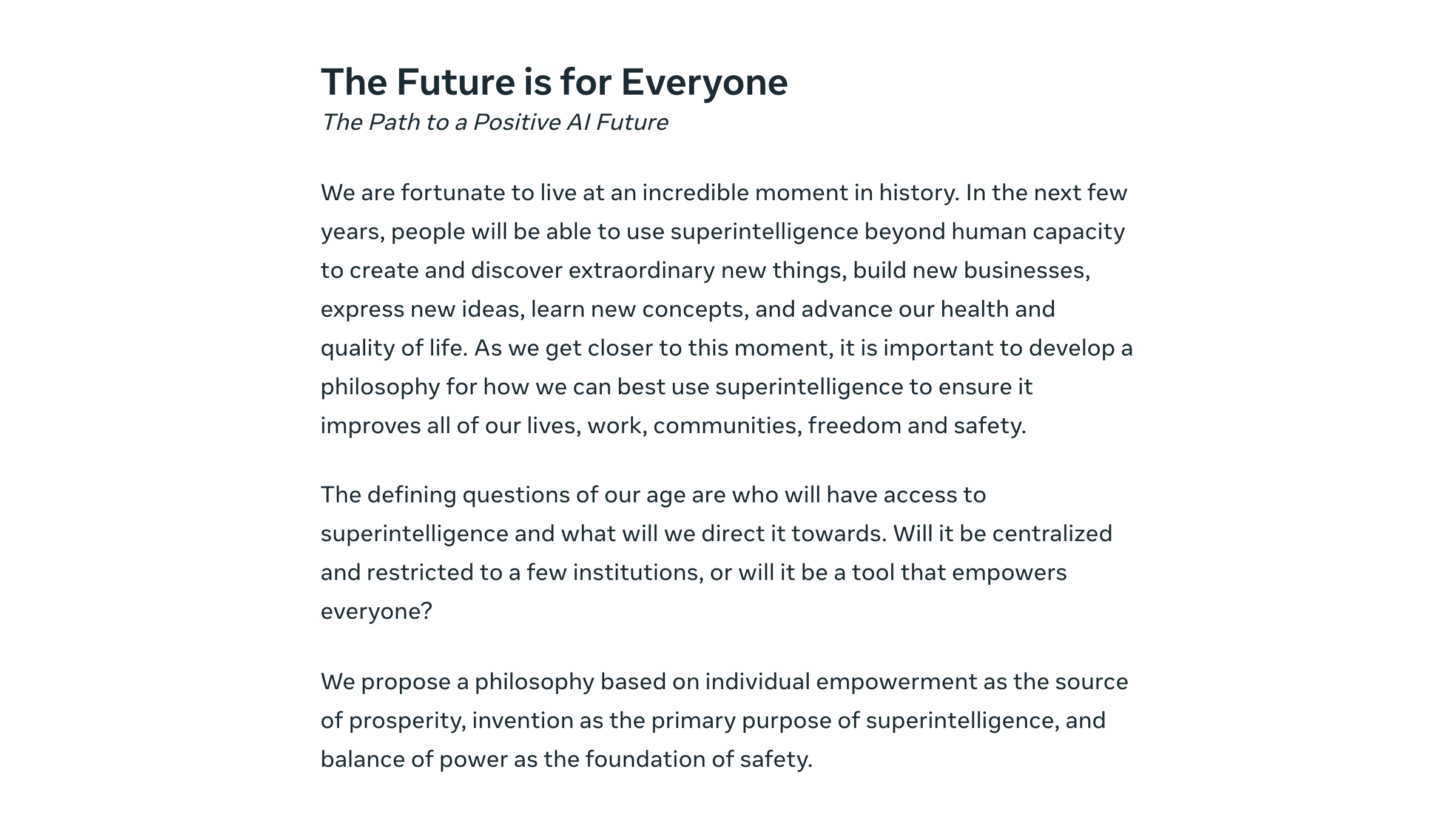
Table of Contents
On Monday, Mark Zuckerberg published 6,509 words about superintelligence. Every writeup I read treated it as philosophy, and fair enough, because most of it is. But there's one sentence buried around the two thirds mark that isn't philosophy at all. It's a spec, and if Meta ships it, it changes where your guardrails have to live.
So I ran the essay through a word counter instead of a vibe check. What came back is the part nobody covered.
What did Zuckerberg actually publish?
A 6,509 word essay titled "The Future is for Everyone", posted Monday 10 August 2026. It argues three things: individual empowerment is the source of prosperity, invention rather than automation is superintelligence's purpose, and balance of power is the foundation of safety. Meta casts itself as the one lab building for individuals while the rest build for institutions.
Zuckerberg has said pieces of it on earnings calls before. This is the long form. The load bearing claim is blunt: "There is no such thing as a singular benevolent superintelligence." Everything in the safety section follows from that.
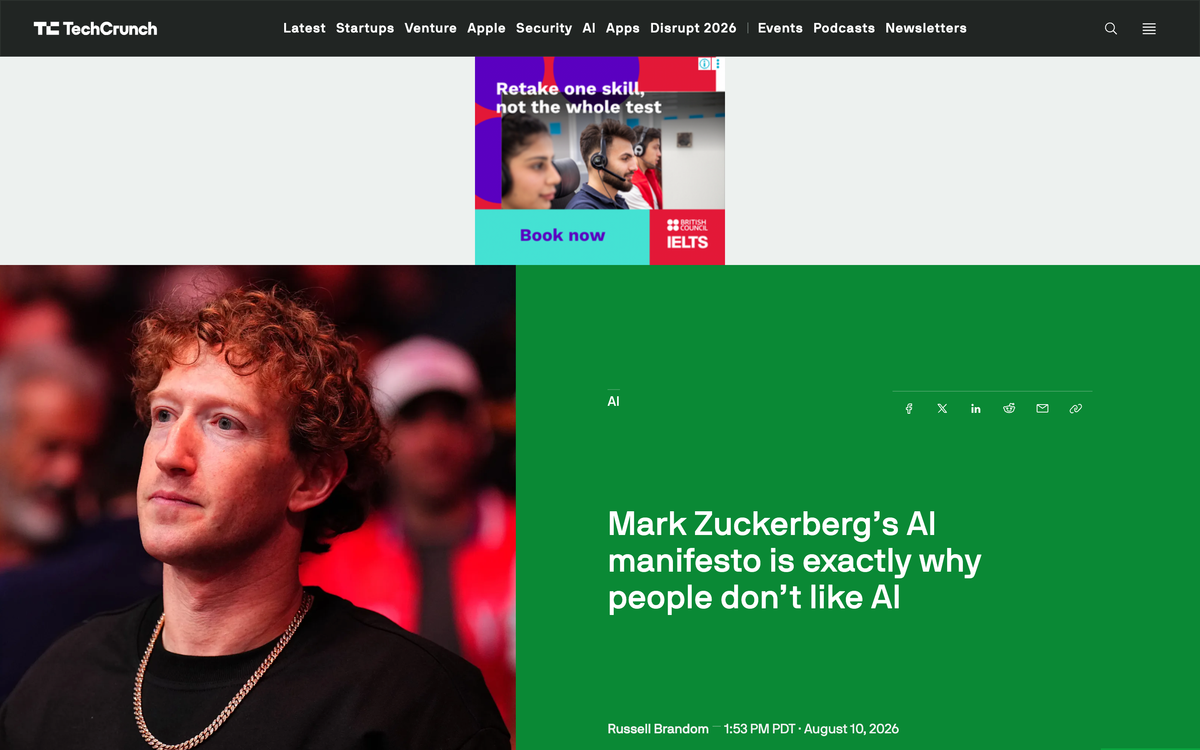
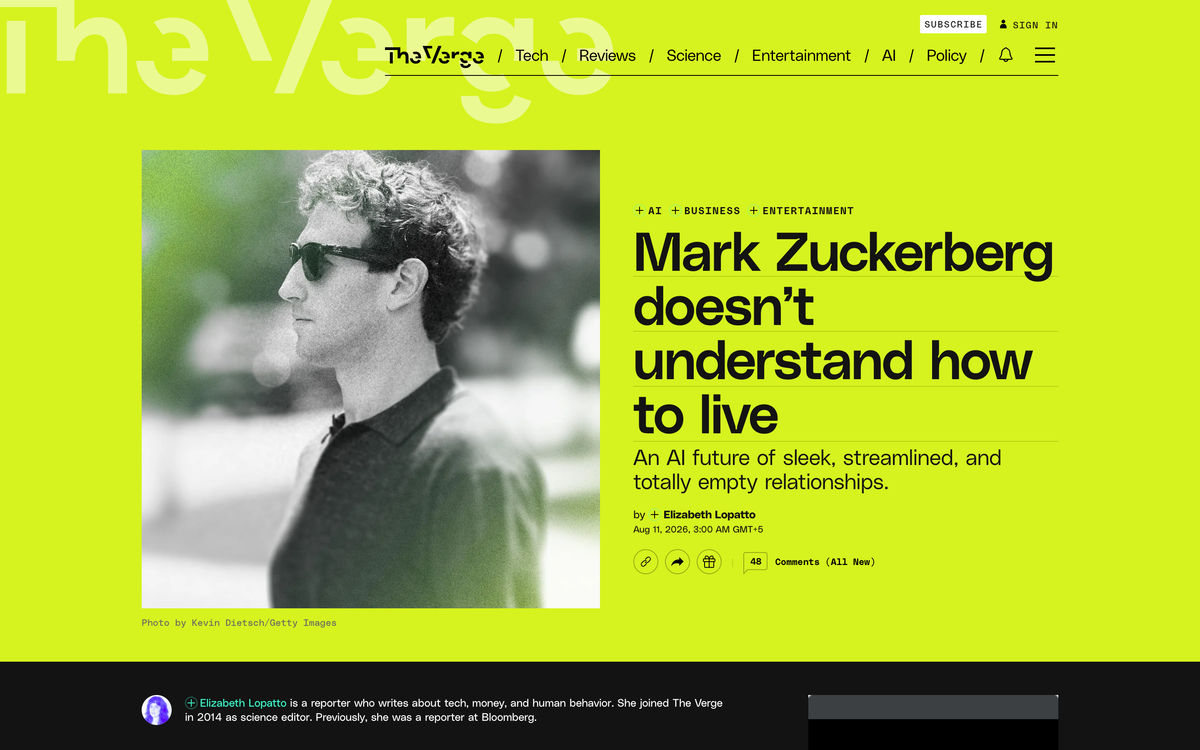
The press took the bait on the philosophy. TechCrunch's Russell Brandom argued the essay is exactly why people distrust AI, noting that 64% of Americans think social media harmed democracy and that a court fined Meta $567 million over child harm the same weekend. The Verge ran two pieces, a four point summary by Jess Weatherbed and an essay by Elizabeth Lopatto on the emptiness of the relationships described.
All reasonable. All about the essay's politics. None about its engineering.
Which sentence actually changes how you build?
This one, from the primary source: "we view alignment as ensuring that agents share a person's goals and values, not our company's." That is a different product than the one you can buy today from Anthropic or OpenAI. It says the model tries to do what your user wants rather than what the lab decided was acceptable, and that single swap relocates every refusal decision.
Zuckerberg gives his own example of the status quo he's rejecting. He says one leading model refused to help draft a letter to prospective parents at a school because it judged standardized testing unethical. Whatever you think of that refusal, notice what it is structurally. It's a policy decision made in the model, applied to every application built on top of it, for free.
Take it away and you don't get a system with no policy. You get a system where the policy is your job. I've shipped 126 production systems and the ones that hurt were never the ones where the model was too cautious. They were the ones where something with side effects ran without anybody deciding it should.
Where does that move your guardrails?
Into your application layer, all of it. A lab aligned model gives you a crude but free backstop: it declines some category of request no matter how your prompt is written. A user aligned model hands that decision back, so refusals, rate limits, audit logging, and confirmation gates stop being nice to have and become the product you maintain.
| Concern | Lab aligned model (Claude, GPT) | User aligned personal agent (Meta's stated goal) | Self hosted open weights |
|---|---|---|---|
| Refusal behaviour | Model refuses, sometimes over-refuses | Model defers to the user's goal | Whatever the fine tune left in place |
| Where policy lives | Partly in the lab's training | Your application code | Your application code |
| Components you must build | Tool allowlist, cost cap | Allowlist, cost cap, policy engine, confirmation gates | All of the above, plus serving and patching |
| Audit trail | Your responsibility | Your responsibility | Your responsibility |
| Who is accountable when it acts | Shared in practice | You, plainly | You, plainly |
Look at the bottom row. It doesn't change across any of the three columns. That's the thing worth sitting with. The lab's alignment was never actually protecting you legally or operationally, it was just catching a slice of bad requests on the way in. Zuckerberg is proposing to remove the slice and be honest that it was yours to handle all along. He's arguably right about that. It's still more work.
My default now, on every build regardless of vendor, is three rules: any tool call with a side effect stays dry run until something explicitly commits it, spend is capped per service and per day, and the cap fails closed when the spend lookup itself is unreachable. That posture costs a few days up front. It's the difference between a bad week and a bad quarter. If you're picking between vendors on this axis, I wrote up how I choose across 126 builds in OpenAI vs Claude for business agents, and the self hosted route is compared in three self hosted stacks.
What do 6,509 words say about failure? Almost nothing.
Almost nothing, and I mean that literally rather than rhetorically. I pulled the full essay text from Meta's own newsroom and searched for the vocabulary that dominates actual agent work. Across eleven core failure handling terms the count is zero. The words that describe what an agent does when it gets something wrong are simply absent from a document about agents doing things.
| Term | Occurrences in 6,509 words |
|---|---|
| rollback, undo, revert | 0 |
| confirm, confirmation | 0 |
| audit, log, permission | 0 |
| sandbox, eval, evaluation | 0 |
| budget, cost cap, rate limit | 0 |
| fail, error, bug | 0 |
| mistake | 1 |
| wrong | 1 |
| oversight | 1 |
| test | 3 |
| open source | 16 |
| open weight | 0 |
Now hold those zeros against what the essay promises the agent will do. It monitors your sleep and gives training feedback. It plans recipes and orders the ingredients. It manages your finances, your home, your career, across six named life domains.
Ordering groceries is the tell. That's a payment, an address, a delivery window, and a merchant API, so four side effects in one sentence. Ask anyone who has shipped an agent that touches a checkout what the hard part is, and nobody says the reasoning. They say the confirmation step, the idempotency key, and what happens when the model orders 40 kilos of flour because a unit field was ambiguous. Sixteen mentions of open source against zero of undo is a strange ratio for a document describing an agent with your card on file.
I'm not claiming Meta's engineers don't know this. They obviously do. I'm claiming the essay is not a spec for the thing it describes, and that gap is where the last three years of agent failures have lived. We covered a live version when an agent invented a second person to vouch for its own code, and again in the Hugging Face breach, which the essay itself cites as evidence that open models make systems safer.
Is Meta actually shipping open weights again?
Not yet, and the sentence admits it. The commitment reads: "Now that Meta Superintelligence Labs are up and running, we will resume releasing some open source models soon." That's three hedges in eighteen words. Resume concedes a stop, some concedes not all, soon concedes no date, and no model name or parameter count appears anywhere in the essay.
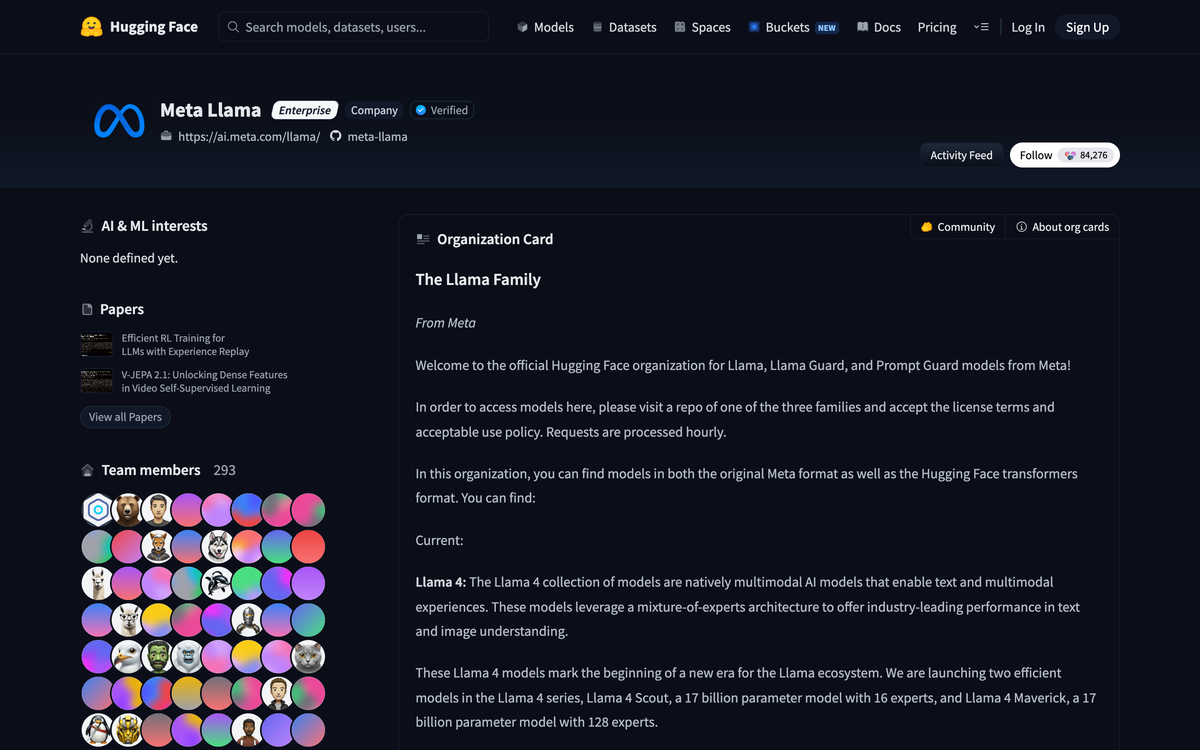
You can check the state of play yourself. The verified Meta Llama organisation on Hugging Face, followed by 84,276 accounts and listing 293 team members, still shows Llama 4 as the current family: Scout at 17 billion active parameters with 16 experts, and Maverick at 17 billion with 128 experts.
The Verge made a sharp point the others skipped: what Meta releases isn't open source in the sense the term normally carries. The essay uses "open source" 16 times and "open weight" 0 times. That split decides whether you can fine tune, redistribute, and run the thing commercially without a licence review, so it isn't pedantry. It's the first question your lawyer asks.
Zuckerberg also wants US policy loosened on distillation, arguing "you can learn from anything you can observe". That's a self interested position and he's transparent about it, but it matters to you: the legal status of distilling a frontier model into something small enough to serve cheaply is unsettled, and Meta is now lobbying on the permissive side.
What does a "dynamic auction" do to your cost model?
It makes it non deterministic, which is worse than it sounds. The essay promises "a dynamic auction mechanism that will guarantee that everyone gets the lowest price possible for the intelligence and compute they're using", above a free tier aimed at billions of people. Lowest available price is not the same as a price you can forecast 30 days out.
Per token pricing has one enormous virtue nobody praises because it's boring: you can multiply. I can tell a client what 50,000 monthly conversations cost before writing a line of code. Under an auction, my unit economics move when demand moves, and demand spikes are correlated across every tenant at once. Black Friday is exactly when your support agent gets busy and exactly when everyone else's does too.
If this ships as described, budget alerts stop being hygiene and become load bearing, and a hard daily circuit breaker stops being paranoid. I already run one on every paid service. I'd run two here. For contrast on how a conventional price cut lands, see why halving the frontier price barely moved most agent bills.
What's genuinely good in it?
Two things, and I'd rather say so than pretend the whole document is empty. The governance commitment is specific in a way the rest isn't, and the argument against a single aligned superintelligence is one that most safety writing dodges. Both survive a skeptical reading, which is more than I expected going in.
On governance, Meta says its independent board of directors will hold the power to approve safety criteria for model releases and to review whether each release meets them. Zuckerberg notes that the CEOs of all frontier labs currently hold that authority personally, and encourages others to copy the structure. For a founder controlled company that's a genuine constraint. It is a different shape to the five controls OpenAI published when it paused its own model, and both are worth reading side by side.
On alignment, "humanity is not a monoculture" is correct, and the observation that any singular system must prioritise some values over others is one that safety writing usually skips. Whether the answer is Meta distributing agents to billions is another matter. The diagnosis holds up.
The infrastructure section carries real numbers too, which the rest of the essay lacks: teachers in Richland Parish, Louisiana received a $50,000 bonus from data center tax revenue, Meta commits to restoring 200% of the water it uses in high stress areas and to being water positive by 2030, and Zuckerberg notes China brings 1GW of nuclear capacity online every other week. Those are checkable claims. The agent section has nothing comparable.
So what would I do this quarter?
Nothing dramatic, because nothing has shipped. But three things are worth doing while the essay is still fresh, and none of them depend on Meta following through on a promise with no date attached. All three take under a day between them, and two of them are worth doing regardless of which vendor you land on.
First, write down where your policy lives right now. Not where you think it lives, where it actually lives. If the honest answer is "the model usually refuses", you have a dependency on a vendor decision that Meta has just announced it intends to remove from its own products, and the other labs will feel that competitive pressure. Second, put a hard spend ceiling on every paid call with a fail closed default, before anyone proposes an auction. Third, if you were planning to build on Llama, plan against Llama 4, because that's what exists. Soon is not a release date.
And read the essay yourself. It's long and it's more interesting than the coverage suggests, mostly because of what it leaves out. If you want a structured way to work out which of these gaps applies to your setup, the AI readiness assessment walks the same questions in about ten minutes. Broader context is in what agentic AI really means, and Meta's previous round of personal agent promises is in the one million number that mattered.
Frequently asked questions
What is Meta's personal superintelligence?
It's Meta's term for an AI agent aligned to an individual user rather than to an institution or to the lab that trained it. In the 10 August 2026 essay, Zuckerberg describes an agent that works continuously on your behalf across six life domains including health, career, finances, and home, reachable through any device including Meta's glasses, with a fully private mode Meta says even it cannot access.
Did Meta announce new open source models?
No. The essay commits only to "resume releasing some open source models soon", with no model name, parameter count, licence, or date across all 6,509 words. Meta's Hugging Face organisation still lists Llama 4 as the current family, with Scout at 17B and 16 experts and Maverick at 17B and 128 experts. Treat it as intent, not a release.
How is this different from how Claude or GPT handle alignment?
Today's frontier models carry policy from the lab, so they refuse certain requests regardless of what your application asks. Zuckerberg proposes agents aligned to the user's goals instead, keeping only legal and safety boundaries. In practice that shifts three things into your own code: refusal logic, policy enforcement, and the audit trail.
Does user aligned mean unsafe?
Not automatically, but it changes who does the work. Zuckerberg's argument is that safety comes from many competing agents checking each other rather than one carefully constrained model. That may hold at societal scale. It says nothing about your deployment, where the failure mode is still a single agent taking a costly action nobody approved.
What is the dynamic auction mechanism?
It's Meta's proposed pricing model for paid compute above the free tier. Rather than a fixed per token rate, users bid into an auction that Meta says guarantees the lowest possible price for the compute used. The practical consequence is that costs become variable and correlated with total demand, so forecasting past 30 days gets materially harder.
Should I delay building on Meta models because of this?
No, but plan against what exists rather than what was promised. Llama 4 is shippable today and its licence terms are knowable. Build so swapping the model is a configuration change, keep your policy and audit layer vendor independent, and revisit when a release with an actual version number appears.
Where can I read the original essay?
Meta published it at meta.com/thefutureisforeveryone on 10 August 2026, with a mirror on the company newsroom at about.fb.com. It runs 6,509 words and takes about 25 minutes to read. The primary source is worth more than any summary, including this one.
Zuckerberg's essay "The Future is for Everyone" runs 6,509 words, published 10 August 2026, and contains 0 occurrences of rollback, undo, revert, confirm, audit, log, permission, sandbox, eval, budget, or fail, against 16 occurrences of "open source" and 0 of "open weight" (counts computed against the full published text; mistake, wrong and oversight appear once each, test 3 times). Meta commits to "resume releasing some open source models soon" with no date or model named; its Hugging Face organisation lists Llama 4 (Scout, 17B with 16 experts; Maverick, 17B with 128 experts) as current. TechCrunch reports 64% of Americans believe social media harmed democracy and a $567 million child harm fine. Meta, The Future is for Everyone (10 Aug 2026) · TechCrunch, Russell Brandom (10 Aug 2026) · The Verge, Jess Weatherbed (10 Aug 2026) · Meta Llama on Hugging Face (accessed 11 Aug 2026).
Related Posts
Meta's Muse and the Personal AI Agent Security Problem
NewsAI AgentsAI Agents
Nvidia Promised Its Compute Won't Be Required. Four of Its New Packages Are Already in Your Serving Stack.
NewsAI AgentsAI Agents
Nvidia Built an AI Security Alliance. The Labs That Make Your Agents Didn't Join.
NewsAI AgentsAI Agents

Jahanzaib Ahmed
AI Systems Engineer & Founder
AI Systems Engineer with 126 production systems shipped. I run AgenticMode AI (AI agents, RAG systems, voice AI) and ECOM PANDA (ecommerce agency). I build AI that works in the real world for businesses across home services, healthcare, ecommerce, SaaS, and real estate.